
Menu
START HERE
Home School refusal in Japan ADHD, autism and school Signs of bullying Where to get helpWAYS TO LEARN
Free schools Education support centers Online schools Homeschooling in Japan International schools Correspondence high schoolsJAPANESE SCHOOLS
How Japanese schools work School rules explained Attendance credit and costs Japanese phrases for school Glossary of school terms Learning Place Finder 日本語サイトへPTA in Japan: Do You Have to Join, What It Involves, and How to Say No Politely
Rainbow Star by Nijiiro is the English section of Nijiiro, an education media site operated by NIJIN Inc. in Japan. NIJIN Inc. also runs NIJIN Academy (an alternative school for children in Japan) and is preparing NIJIN GLOBAL ACADEMY (a planned online international school). Where this page mentions NIJIN GLOBAL ACADEMY, it is presented as one option among many, and we only describe what its official site states. This guide is general information, not legal advice. Every PTA sets its own rules, so check your school’s documents.
The short answer: no, you do not legally have to join the PTA in Japan. The Japanese government has stated in official written answers to the Diet (2023) that a PTA is a voluntary organization and that whether a parent joins or leaves is up to that parent. In practice, many schools still treat membership as the default, and roles are sometimes assigned by lottery. You can join and help in ways that fit your life, or decline in writing, politely and calmly.
- What a Japanese PTA is, where it came from, and how it is organized
- What the government has officially said about voluntary membership
- Typical roles: officers, committees, patrols, Bellmark collection and events
- How the role lottery (kujibiki) works and how much time roles can take
- Word-for-word English scripts and simple Japanese phrases to decline or limit your role
- How Japanese PTAs compare with PTAs and PTOs in the US and UK
What is the PTA in Japan?
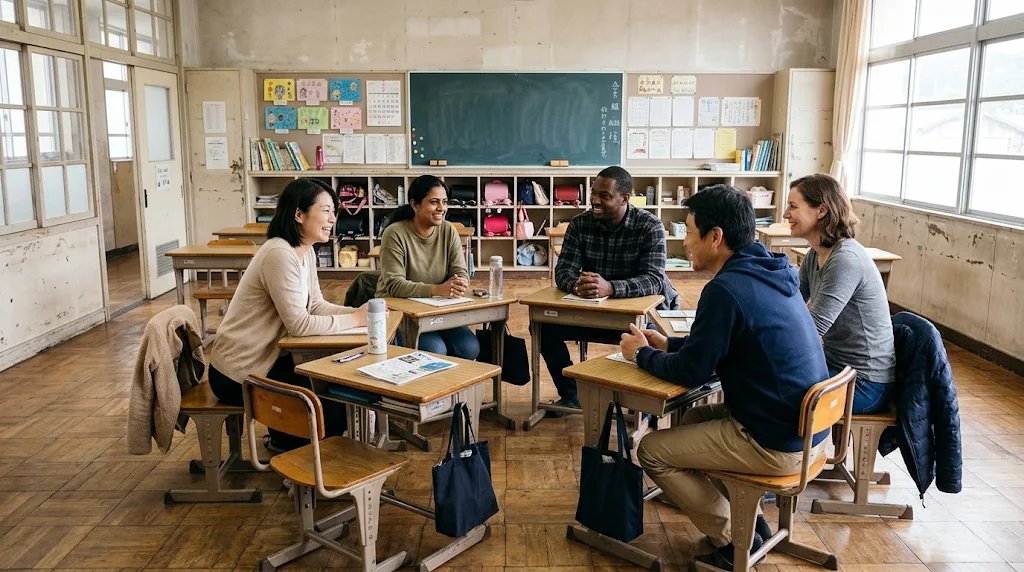
A Japanese PTA (Parent-Teacher Association) is a group made up of parents and the teachers at one school. The government describes it as a voluntary organization consisting of the parents or guardians of children enrolled at the school and that school’s teaching staff. Almost every public elementary and junior high school has one, and it runs events, safety activities and communication between families and the school.
The PTA is not the school, and it is not the city’s board of education. It is a separate group that works closely with the school, often using school rooms and school letters to reach families. That close link is the main reason many parents assume it is part of school enrollment.
The idea came to Japan after the Second World War. According to the Japan PTA National Council’s own history page, the report of the first US Education Mission, published in April 1946, called for supporting “parent and teacher associations,” and in March 1947 the Ministry of Education sent prefectural governors a guide to forming “parent and teacher associations.” PTAs then spread across the country.
Each school’s PTA is independent and has its own rules (often called kiyaku, or bylaws). Many school PTAs also belong to a city-level council, which belongs to a prefecture-level council. At the top is the Japan PTA National Council (Nihon PTA Zenkoku Kyōgikai), a public interest incorporated association founded in 1952. Its website says it is made up of 54 councils, one for each prefecture and designated city. Whether a local PTA joins these upper councils is a decision for that PTA.
| Level | What it is | What it means for you |
|---|---|---|
| Your school’s PTA | Parents and teachers at one school, with its own bylaws, budget and officers | This is the group that asks you to join, collects fees and assigns roles |
| City or ward PTA council | A network of school PTAs in one municipality | Officers may attend city meetings; part of your fee may go here |
| Prefecture or designated-city council | A network of city councils | Usually invisible to ordinary members |
| Japan PTA National Council | National federation of 54 prefecture and designated-city councils | Runs national events; does not set your school’s rules |
If you are new to how Japanese schools work in general, our overview of the Japanese school system explains grades, the school year and who does what.
Do you have to join the PTA in Japan?
No. Membership is voluntary. In a written answer to the House of Representatives dated 30 June 2023, the Cabinet stated that a PTA is a voluntary organization of parents and school staff, and that a parent joining or leaving is that parent’s free choice. There is no law that makes PTA membership a condition of your child attending a public school.
Two official Cabinet answers from 2023 are worth knowing about, because they are primary sources you can point to if anyone tells you membership is compulsory:
- House of Councillors, 24 February 2023: In answer to a question about PTA membership and parents’ personal information, the Cabinet described the PTA as a voluntary organization made up of parents and staff, and said each PTA decides for itself how it is run. It also said that, depending on the case, parents could consult the school’s board of education about school administration matters.
- House of Representatives, 30 June 2023: In answer to a question about joining and leaving the PTA, the Cabinet said that joining and leaving is the parent’s free choice (in Japanese, hogosha no nyūtaikai wa tōgai hogosha no jiyū).
So why does it feel compulsory? In many schools, the joining form is handed out with enrollment papers, fees are collected automatically, and every family is expected to take a role at least once. The Diet member who asked the June 2023 question described exactly this: an unwritten rule that every parent joins and takes a committee or officer role once while their child is at the school. Some local boards of education, such as Saitama Prefecture’s, have asked principals to make the voluntary nature of membership clear to families.
Being voluntary also means the opposite is true: you are free to join. Many international parents find the PTA a useful way to meet other families, learn how the school works and practice Japanese. The point is that it should be your choice.
What does the PTA actually do? Typical roles and activities
PTA work usually falls into a few areas: officer roles that run the organization, committees that handle specific tasks, class representatives, school-route safety, and help with events. Most activities happen at the school, on weekdays, and in Japanese. What exists at your school depends entirely on that PTA, so treat the list below as typical, not universal.
| Role or activity | Japanese term (romaji) | What it usually involves | Typical load |
|---|---|---|---|
| Officers | yakuin (president: kaichō, vice president: fuku-kaichō, secretary: shoki, treasurer: kaikei) | Running meetings, budget, contact with the principal, city council meetings | Highest; regular meetings across the whole year |
| Class representative | gakkyū iin or kurasu iin | Passing messages to parents in one class, helping at class events | Moderate; several tasks per term |
| Committees | iinkai (for example: kōhō for newsletters, seikatsu shidō or anzen for safety, bunka for culture events) | Producing the PTA newsletter, organizing talks, safety checks | Moderate; meetings and a few events |
| School-route patrols | tōgekō mimamori, patorōru | Standing at crossings in the morning or walking a route after school | Light to moderate; a few assigned days |
| Bellmark collection | berumāku | Collecting and sorting small marks cut from product packaging, which are exchanged for school equipment | Light but fiddly; sorting sessions |
| Event help | undōkai (sports day), bazā (bazaar), matsuri | Setting up tents, traffic guidance, stalls, cleaning | Light; one-off shifts |
| Nominating committee | senkō iinkai or senkō iin | Finding the next year’s officers, sometimes by phone calls to parents | Moderate; concentrated in winter |
Some PTAs also run swimming pool supervision in summer, school cleanups, parent education lectures and graduation celebrations. In recent years, many PTAs have moved paperwork online, cut committees or switched to a volunteer sign-up system where people choose single tasks instead of year-long roles. Ask what your school’s PTA does now; it may be lighter than stories from a few years ago.
The PTA is separate from rules the school itself sets, such as uniforms, school bags or cleaning duty for children. For those, see our guide to Japanese school rules.
How much time does the PTA take?
It depends on the role. Being an ordinary member with no role may take almost no time beyond reading letters and paying the fee. A single volunteer shift or a few patrol mornings takes a few hours a year. Committee roles involve regular meetings, and officer roles can mean frequent weekday commitments throughout the year. Ask for the actual schedule before you accept any role.
No official national figure exists for PTA hours, and loads vary hugely between schools, so be wary of anyone quoting a single number. A practical way to estimate is to ask the person handing you the form three questions: How many meetings are there per year? Are they on weekdays or weekends, and at what time? Can tasks be done online or at home?
Use this rough guide to compare roles at your school:
Read PTA letters, pay the annual fee, attend events if you wish.
A sports-day shift, a few morning patrols, a Bellmark sorting session.
Several meetings a term, message relay, helping organize one or two events.
Regular weekday meetings all year, budget and planning, meetings with the principal and the city PTA council.
If you work full time, have a baby or toddler, care for a family member, or cannot yet read Japanese school letters easily, say so early. Many PTAs accept these as reasons to take a lighter task, although the rules differ from school to school.
The lottery (kujibiki) and the “once per child” custom
At many schools, roles that nobody volunteers for are decided by drawing lots, called kujibiki, at a class meeting in spring. Some PTAs also follow a custom that each family takes a role once during their child’s time at the school. These are customs set by each PTA, not laws, and members can ask for exemptions or for the system to change.
Here is how it often works. At the first class parents’ meeting of the school year, usually in April, the class teacher leaves and a PTA member asks for volunteers for each role. If nobody steps forward, everyone present (and sometimes absent parents too) draws lots. Some PTAs use a points system, where families who have already done a role are exempted.
For international parents, the lottery can be stressful because it happens quickly and in Japanese. Three things help:
- Read the form before the meeting. Many PTAs send a survey asking about your availability. This is your best chance to explain your situation in writing.
- Volunteer early for a light role you can manage. If you know you will be expected to take something, choosing a small role first often avoids being drawn for a heavy one.
- Ask about exemptions before the draw. You can say calmly that you cannot accept a role because of language, work or care responsibilities, and ask whether there is a lighter alternative.
If you are a member and the lottery result does not work for you, you can still explain your situation to the PTA officers. If you are not a member, you should not be included in a members’ lottery at all.
PTA fees: how much and how they are collected
Each PTA sets its own annual or monthly fee, and amounts vary between schools. Fees typically pay for events, newsletters, school-route safety items, graduation gifts and contributions to city PTA councils. In some schools the fee is collected together with school lunch or material costs, so it is worth checking each item on any payment notice you receive.
Because the PTA is a separate organization from the school, its fee is also separate from school costs such as lunches, field trips and materials. If you decide not to join, ask the school how the PTA fee will be handled in your case, especially if it is normally deducted from the same bank account as school charges. For a broader picture of school costs, see our guide to attendance and costs.
Useful questions to ask about money:
- How much is the PTA fee, and is it per family or per child?
- What is it used for? Can I see the budget?
- Is it collected separately from school lunch and other school costs?
- If my child receives something paid for by the PTA (for example, a graduation gift), can I pay for that item separately if I am not a member?
How to say no to the PTA politely: scripts in English and Japanese
Decline in writing, briefly and kindly, without long explanations. Address a short note to the PTA president, and consider sending a copy to the principal so the school knows too. Say that you will not join (or that you cannot take a role this year), thank them, and, if you wish, offer a small way to help. Keep a copy of what you send.
You do not need to justify your decision. Still, a friendly tone helps relationships at school, which matter for your child. Choose the option that matches what you want:
Not joining (English): “Dear PTA President, Thank you for the information about the PTA. After thinking about our family’s situation, we have decided not to join this year. We appreciate everything the PTA does for the children, and we will continue to cooperate with the school. Kind regards, [your name], parent of [child’s name], Grade [X], Class [X].”
Joining, but no role this year: “We are happy to be members, but because of work and our limited Japanese, we are not able to take on a committee or officer role this year. We would be glad to help with a one-off task, such as a sports-day shift.”
Asking for a lighter role before the lottery: “Before the role selection, I would like to let you know that I can only take a role with occasional, short tasks. Could you tell me which roles might suit this?”
Leaving the PTA: “Thank you for this year. Our family has decided to leave the PTA from [month]. Please let me know if there is any paperwork I need to complete.”
If you want to use a few words of Japanese, at a meeting or at the top of your note, these short phrases are polite and widely understood:
| Situation | Romaji | Japanese | Meaning |
|---|---|---|---|
| Not joining | PTA ni wa nyūkai shinai koto ni shimashita. | PTAには入会しないことにしました。 | We have decided not to join the PTA. |
| Softening | Mōshiwake arimasen ga… | 申し訳ありませんが… | I am very sorry, but… |
| No role this year | Kotoshi wa yakuin o o-hiki-uke dekimasen. | 今年は役員をお引き受けできません。 | I cannot take on an officer role this year. |
| Language | Nihongo ga mada jūbun dewa arimasen. | 日本語がまだ十分ではありません。 | My Japanese is not yet good enough. |
| Work | Heijitsu wa shigoto de sanka ga muzukashii desu. | 平日は仕事で参加が難しいです。 | Work makes it hard for me to take part on weekdays. |
| Offering help | Dekiru koto ga areba o-tetsudai shimasu. | できることがあれば、お手伝いします。 | I will help with anything I can. |
| Thanks | Itsumo arigatō gozaimasu. | いつもありがとうございます。 | Thank you for all you do. |
Our glossary explains more Japanese school terms you are likely to see on PTA letters. If a staff member or parent pushes back in person, a calm repeat works well: “Thank you. I understand. Our decision is the same.”
What happens if you don’t join the PTA?
Your child keeps the same right to attend school, take part in lessons and use school facilities, because public school education is not provided by the PTA. What may change is access to things the PTA itself pays for or organizes, such as small gifts or PTA-run events. Check with the school and PTA how these are handled, and ask that your child is never singled out.
In practice, outcomes vary. Some PTAs offer non-members the option to pay for specific items, such as graduation commemorative gifts, so that every child receives the same thing. Others simply include all children. If you are worried, ask the principal directly: “How will the school make sure my child is treated the same as other children?”
A few points to keep in mind:
- School-run activities are not PTA activities. Lessons, school trips, school lunch and sports day itself are run by the school. The PTA may help, but your child takes part either way.
- School-route groups can be different. In some areas, walking groups to school are organized by the neighborhood, the school or the PTA. Ask who runs your area’s group and how your child can join it safely.
- Social relationships matter. Some parents worry about being seen as unhelpful. A friendly note, a smile at events and an offer of occasional help usually go a long way.
- If something feels unfair, get advice. The February 2023 Cabinet answer noted that parents can consult the board of education that runs the school, depending on the situation.
Tips for non-Japanese-speaking parents
Language is the biggest barrier for most international parents. Use translation apps for PTA letters, ask the school whether a parent who speaks your language or English can help, and tell the PTA early about your language level. If you do join, choose roles with clear, practical tasks, such as patrols or event shifts, rather than roles built on meetings and writing.
- Photograph and translate. Phone camera translation is good enough to understand most PTA forms. Watch for deadlines and the words for “join” (nyūkai), “leave” (taikai), “officer” (yakuin) and “committee” (iinkai).
- Ask the class teacher which papers matter. Teachers usually know which PTA forms need a reply and by when.
- Find one friendly parent. A single parent who can tell you “this one is important” saves a lot of stress.
- Offer skills, not hours. Some PTAs welcome help with English events, design, photos or simple spreadsheets that can be done from home.
- Ask about interpreters. Some cities provide interpreters or multilingual support for school meetings. Ask the school or your city’s international association.
- Keep everything in writing. A short written note avoids misunderstandings much more reliably than a quick conversation in a second language.
Remember that you are not the first international family at the school. Many Japanese parents also find the PTA confusing at first, and many PTAs are actively trying to become simpler and more flexible.

Japanese PTA vs PTA and PTO in the US and UK
The biggest difference is how people join. In the US and UK, parent groups are usually opt-in: you sign up if you want to, and most activity is fundraising and volunteering by choice. In Japan, membership is legally voluntary too, but many schools treat it as the default and expect every family to take a role at some point.
The US National PTA was the model that influenced postwar Japan. Today, according to its website, National PTA is made up of 54 state congresses and more than 20,000 local units, is a registered 501(c)(3) nonprofit, and says membership is open to anyone who wants to support its mission. Many US schools instead have a PTO (Parent-Teacher Organization), which is an independent group not affiliated with National PTA. In the UK, many schools have a PTA focused on fundraising, and Parentkind is a registered charity that supports PTAs with advice and resources.
| Japan (public school PTA) | US PTA | US PTO | UK PTA | |
|---|---|---|---|---|
| How you join | Voluntary by law, but often treated as automatic | Opt-in; open to anyone who supports the mission | Opt-in; set by each school’s group | Usually open to all parents and staff; activity is by choice |
| Network | Optional city, prefecture and national councils | Part of state and National PTA | Independent; no national body | Independent groups; may use Parentkind support |
| Main focus | Events, safety patrols, newsletters, school support | Advocacy, family engagement, fundraising | School-level fundraising and events | Fundraising and community events |
| Roles | Officers and committees, often assigned by lottery | Elected officers; volunteers choose tasks | Elected officers; volunteers choose tasks | Committee volunteers; others help as they can |
| Meetings | Often weekday daytime, in Japanese | Varies; often evenings | Varies | Varies; often evenings |
| Expectation | Strong social expectation at many schools | Welcome, not expected | Welcome, not expected | Welcome, not expected |
If you are comparing local schools with international schools, PTA culture is one of the many differences. Our guide to international schools in Japan covers others, such as language, curriculum and cost.
A simple decision guide: join, join lightly, or decline
Start with what your family can genuinely manage this year. If you have time and want to connect, joining is a great way in. If time or language is tight, join without a heavy role, or decline politely in writing. Whichever you choose, tell the PTA early, keep a copy, and stay friendly with the school and other parents.
| Your situation | Option that often fits | First step |
|---|---|---|
| Want to meet families and practice Japanese | Join and choose a role with clear tasks | Volunteer early for a patrol or event role |
| Busy with work or young children, but want to support | Join without a year-long role | Write on the survey that you can only do one-off tasks |
| Japanese is very limited | Join lightly or decline for now | Ask whether there is an English-friendly or home-based task |
| Cannot commit at all this year | Decline politely | Send a short written note to the PTA president, with a copy for the principal |
| Already a member, but it is too much | Ask to change roles or leave | Write to the officers explaining your situation |
Your choice is not permanent. Many parents decline in their first year, then join later when they know the school better, or the other way around.
Frequently asked questions
These are the questions international parents most often ask about PTAs in Japan. In short: membership is voluntary, roles and fees are set by each PTA, your child keeps their place at school whatever you decide, and a short, polite written note is the clearest way to decline or limit what you take on.
Is the PTA mandatory in Japan?
No. The Cabinet stated in a written answer to the House of Representatives on 30 June 2023 that the PTA is a voluntary organization and that joining or leaving is the parent’s free choice. Some schools still treat membership as automatic, so check the forms you receive.
Can I join the PTA but refuse a role?
You can ask. Each PTA sets its own rules about roles, and many accept reasons such as work, care duties or limited Japanese. Explain your situation in writing before the role selection, and offer a smaller task if you can.
What is kujibiki in the PTA?
Kujibiki means drawing lots. Some PTAs use it to decide who takes roles that nobody volunteers for, usually at a class meeting in spring. It is a custom of each PTA, not a legal requirement.
Will my child be treated differently if I don’t join?
Your child keeps the right to attend school and join school activities. Items or events paid for by the PTA may be handled differently, so ask the school and PTA how they will make sure your child is not singled out.
How do I leave the PTA in the middle of the year?
Write a short note to the PTA president saying you are leaving and from when, and ask whether any paperwork is needed. The June 2023 Cabinet answer said leaving, like joining, is the parent’s free choice. Fee refunds depend on each PTA’s rules.
Is the PTA part of the school?
No. It is a separate, voluntary organization of parents and teachers that works with the school. Its fees, rules and officers are its own, even though it often communicates through school letters and uses school rooms.
Do international schools in Japan have a PTA?
Many international schools have a parent association, but their systems are set by each school and often work more like opt-in groups in the US or UK. Ask the school directly how its parent group works.
- House of Representatives of Japan, Cabinet written answer to Question No. 137 (211th Diet), “Question on joining and leaving the PTA,” 30 June 2023 (Japanese): shugiin.go.jp (checked 22 November 2026)
- House of Representatives of Japan, Question No. 137 (211th Diet), submitted 16 June 2023 (Japanese): shugiin.go.jp (checked 22 November 2026)
- House of Councillors of Japan, Cabinet written answer to Question No. 16 (211th Diet), on PTA membership and parents’ personal information, 24 February 2023 (Japanese): sangiin.go.jp (checked 22 November 2026)
- Japan PTA National Council, official website and organization overview (Japanese): nippon-pta.or.jp (checked 22 November 2026)
- Japan PTA National Council, “History” (Japanese): nippon-pta.or.jp (checked 22 November 2026)
- National PTA (US), “About National PTA”: pta.org (checked 22 November 2026)
- Parentkind (UK), official website: parentkind.org.uk (checked 22 November 2026)
- NIJIN GLOBAL ACADEMY, official site: nijinglobal.academy (checked 22 November 2026)
Published: 22 November 2026 / Last updated: 22 November 2026