Japanese Schools in Italy: Rome and Milan Full-Time Schools, Weekend Classes & How to Choose (2026)
Moving to Italy and searching for “Japanese school in Italy”? The country has two full-time Japanese schools, in Rome and Milan, as well as weekend supplementary schools and Japanese-language learning programs in several cities. The right choice depends on where you will live, how far your child can travel, how many days of Japanese-language learning you want, and what kind of school life your family is looking for.
Nijiiro is operated by NIJIN Inc. TOMODACHI JAPAN, introduced in this article, is also a NIJIN Inc. service. The schools and services below are included where their official information can be checked; the order is not a ranking.
1. Italy has two full-time Japanese schools—in Rome and Milan
For families looking for a full-time school that follows a curriculum comparable to Japan’s elementary and lower-secondary education, the first schools to check are Rome Japanese School and Milan Japanese School. Both appear on Japan’s Ministry of Education, Culture, Sports, Science and Technology (MEXT) list of recognized overseas educational facilities. They operate in separate metropolitan areas, so the key first question is whether daily travel from your home is realistic.
Italy does not have one Japanese school serving the entire country: the full-time options are based in Rome and Milan. If your family will live in Florence, Turin, Bologna, Venice or another city, do not assume that either school is within a practical daily commute. A local supplementary school, an Italian or international school combined with Japanese study, or an online program may be more workable.
- If you want Japanese elementary- or lower-secondary-level schooling every weekday, start by checking the Rome and Milan schools.
- A weekend supplementary school generally complements a child’s weekday school; it is not the same as a full-time school.
- If distance, schedule or transport is a barrier, compare local Japanese-language learning and online options as well.
This guide covers the two full-time schools and the weekend schools or learning programs listed by Japanese diplomatic offices for Rome, Florence, Milan and Turin. These institutions differ in schedule, age range and purpose. Where a current fee or admissions detail is not publicly available, it is marked as something to confirm directly rather than estimated.
2. What is the difference between a Japanese school and a supplementary school?
The words “Japanese school” can refer to different kinds of education. In MEXT’s usage, a Japanese school is a full-time overseas facility providing education equivalent to Japanese elementary and lower-secondary schools. A supplementary school is usually established by Japanese families living abroad so children can maintain Japanese-language and other learning. Many meet once a week, often on a weekend. The Embassy of Japan in Italy lists these as separate types of institution.
Before comparing names, check which days the child attends, how many hours lessons run and what the program actually teaches. A Saturday school may focus on Japanese language, literacy and culture while a child attends an Italian or international school during the week. Some programs are designed for young children or conversation practice, and do not cover the same curriculum as a full-time school.
| Type | Typical schedule | Main learning purpose | What to check |
|---|---|---|---|
| Full-time Japanese school | Weekdays | Curriculum comparable to Japanese elementary and lower-secondary education | Commute, grade placement, eligibility, tuition and school bus |
| Supplementary school | Often one weekend day per week | Japanese language, literacy, selected subjects and culture | Compatibility with weekday school, homework, admissions and parent duties |
| Japanese-language class or program | Set by the provider | Conversation, literacy, preschool activities or other language learning | Curriculum, age range, records and whether it offers formal grade progression |
| Italian or international school | Weekdays | Education in Italian or the school’s instructional language | Enrollment rules, language support and how to continue Japanese separately |
A full-time school provides a Japanese-language school day: regular lessons, classmates, class activities and school events. A supplementary school can make room for Japanese while the child attends another school, but it usually means extra travel on the weekend and learning at home between classes. Neither model is automatically right for every family. Consider your child’s preferred language with friends, your family’s plans for Italy, and whether maintaining Japanese literacy or having a broader Japanese-language peer group is the main goal.
3. Where Japanese-language learning is available in Italy
MEXT’s recognized list includes two full-time Japanese schools in Italy: Rome and Milan. The Embassy of Japan in Italy also lists Rome Japanese Supplementary School and Florence Japanese Supplementary School. The Consulate-General of Japan in Milan lists Milan Supplementary School, Milan Global Learning Academy (GLA) and Turin Supplementary School. The mix of options therefore depends on the region where you plan to live.
The map below separates full-time schools from weekend programs so the two are not mistaken for equivalent institutions. It is a starting point based on public information from diplomatic offices and schools. Operating status, class availability and admissions can change, so contact the provider before making plans.
Rome supplementary school
Milan supplementary school and GLA
Turin supplementary school
| Area | Institution | Type and publicly listed levels | Schedule shown in public information |
|---|---|---|---|
| Rome | Rome Japanese School | Full-time; elementary and lower-secondary sections | Weekdays; Embassy lists 8:30 a.m.–3:00 p.m. |
| Milan | Milan Japanese School | Full-time; elementary and lower-secondary sections | Weekdays; confirm timetable and transport with the school |
| Rome | Rome Japanese Supplementary School | Weekend supplementary school | Embassy lists Saturdays, 2:30–5:30 p.m. |
| Florence | Florence Japanese Supplementary School | Weekend supplementary school | Confirm current days, age range and classes with the operator |
| Milan | Milan Supplementary School | Published classes from age four through high-school level | Saturdays, 3:00–6:00 p.m. |
| Milan / Turin | Milan GLA / Turin Supplementary School | Diplomatic-office listings show preschool and elementary classes at GLA; preschool, elementary and lower-secondary classes in Turin | Confirm current operation and format with each provider |
The levels shown here describe the classes listed by an institution; they do not mean that it is a MEXT-recognized full-time school. Milan Supplementary School, for example, offers classes for different ages but is a weekend program, distinct from Milan Japanese School. The distinction matters for school enrollment, weekday schedules and how families plan their child’s education.
Sources: MEXT: Recognized Overseas Educational Facilities; Embassy of Japan in Italy: Japanese Schools and Supplementary Schools; Consulate-General of Japan in Milan: Supplementary Schools. The linked pages are primarily in Japanese.
4. Rome Japanese School: weekday classes and a school bus
Rome Japanese School is a MEXT-recognized full-time school with elementary and lower-secondary sections. It follows a curriculum comparable to Japanese schools while operating in Italy. The Embassy’s education information lists classes Monday through Friday from 8:30 a.m. to 3:00 p.m. and indicates that a school bus is available. The route, stops, available seats, operating days and cost should be confirmed with the school for the relevant school year.
For Rome, the practical question is not simply whether there is a bus, but whether a usable stop and departure time fit your neighborhood. The school’s 2026 information includes updated transfer forms and events and gives the address as Via di Monte Cucco, 127, 00148 Roma. Older web pages may still contain wording that the location is not disclosed, so rely on the school’s current official information before arranging a visit or choosing an address.
The current school page directs families interested in the bus to contact a parent-association representative. This is not a public route map from which any family can select a stop. Once you have a likely home address, ask the school which stops may be available, the pickup time, any eligibility conditions and the expected travel time. It is sensible to check this before finalizing housing.
- Is there a place in the child’s grade, and when can a transfer take place?
- Which bus stops might be available from our area? What are the pickup time, service days and fee?
- If we drive, what are the drop-off, access and parking rules?
- What are the current tuition, enrollment, facilities or security charges for 2026, and when are they due?
The school also publishes information about trial attendance and progression for the 2026 school year. A trial visit is not the same as an admission offer or a transfer place. Tell the school whether you want a visit, trial attendance or a formal transfer, and ask which documents or interview are required. Cross-check contact details on the current school site and the Embassy page rather than relying on an old phone number copied elsewhere.
5. Milan Japanese School: the full-time option in northern Italy
Milan Japanese School is listed as a full-time Japanese school by the Consulate-General of Japan in Milan and appears on MEXT’s recognized-facility list. Its published sections include elementary and lower-secondary levels. The listed contacts are +39 02 415 0291 and info@mngitalia.net. The current public consular page does not provide detailed information about the campus address, service area, bus routes, bus fees or grade capacity, so ask the school directly.
Living in Milan does not by itself establish that the daily commute will work; confirm the campus location and transport from your actual address. The consular district covers eight northern Italian regions, including Lombardy, but living within the district is different from having a practical daily route to the school. Ask whether a school bus operates, whether it serves your neighborhood and whether a parent must provide transportation.
In February 2026, the Consulate-General published a report of the Commissioner of the Japan Sports Agency visiting Milan Japanese School, observing classes and meeting students. This confirms a recent school activity, but it does not provide current enrollment numbers, vacancies or tuition. Contact the school office when your expected arrival or transfer date and grade are known.
Families based in Milan should also distinguish the full-time school from Milan Supplementary School, which meets on Saturdays and is intended to complement a child’s weekday education. Its admission information includes a Japanese-language assessment and considers whether the child can participate in group lessons. Discuss as a family whether your child needs Japanese-language schooling every weekday or would benefit from learning Japanese alongside an Italian or international school.
Sources: MEXT recognized-facility list; Consulate-General of Japan in Milan: Full-time Japanese School; Consulate-General report on a 2026 school visit.
6. Weekend Japanese schools in Rome and Florence
The Embassy lists Rome Japanese Supplementary School as meeting each Saturday from 2:30 to 5:30 p.m. The contact information shown for Saturday afternoon is +39 351 524 5712 and rmhoshu@tiscali.it. The school’s website has information about learning and events. It is not a Monday-to-Friday school; families should consider it as Japanese learning alongside the child’s weekday school and home study.
A Saturday supplementary school does not replace a full week of school lessons; it adds a regular opportunity to learn and use Japanese. Before applying, ask about age and grade eligibility, language goals, homework, absences or make-up lessons and any interview. The Embassy lists the Rome timetable, but current availability in each class should be checked with the operator.
The Embassy also introduces Florence Japanese Supplementary School as a Saturday school. Its listed contact is info@firenzehoshuko.org, and the school site describes activities such as learning through play in Japanese. In 2026, the Rome full-time school, the Rome supplementary school, Florence supplementary school and local or international schools took part in a multilingual card-making project based on Rome.
The Embassy page does not establish the Florence school’s current timetable, grades, fees or enrollment dates. When you write, include your child’s age and grade, languages spoken at home, current school, likely neighborhood and preferred day, and ask whether classes are running and where they meet. An older event listing alone is not proof that a class is accepting students for the current year.

7. Milan Supplementary School, GLA and Turin Supplementary School
In northern Italy, the Consulate-General lists Milan Supplementary School, Milan Global Learning Academy (GLA) and Turin Supplementary School. Milan Supplementary School says it serves children attending local or international schools in Milan and nearby areas who want to maintain Japanese. It meets on Saturdays from 3:00 to 6:00 p.m. Its 2026 enrollment information includes a Japanese class for four-year-olds, a preschool class for five-year-olds, elementary, lower-secondary and high-school classes, and a heritage-language class.
Milan Supplementary School considers a child’s Japanese communication skills and the family’s ability to support learning, not age alone. Its published admissions guidance says children need sufficient Japanese comprehension to take part in group lessons, and it also offers a heritage-language class for children who need a different level of support. A standard supplementary class may not suit every child who is still developing Japanese, so contact the school before applying.
| Program | What public information confirms | Contact / next step |
|---|---|---|
| Milan Supplementary School | Classes from age four through high-school level; Saturdays, 3–6 p.m.; 2026 fee schedule published. | milanohoshuko10@gmail.com and the school website |
| Milan Global Learning Academy | Consulate lists preschool and elementary classes. Detailed timetable and fees were not available on the public listing. | milano.gla2020@gmail.com; confirm current classes directly. |
| Turin Supplementary School | Consulate lists preschool, elementary and lower-secondary classes. Confirm schedule and format. | hoshukotorino@gmail.com |
Milan Supplementary School’s 2026 information lists a €200 admission fee. Ten months of tuition are listed as €700 for the five-year-old preschool class, €600 for elementary and lower-secondary classes, and €650 for high-school classes. Materials are listed at €75, accident insurance at €18 and annual dues at €30. For the Japanese class for four-year-olds, the listed fee is €70 per month, plus €45 for materials, €18 for insurance, €30 in annual dues and a €200 admission fee. Confirm the current invoice and payment terms, as fees may be updated.
The Consulate page lists GLA and Turin Supplementary School with class levels and contact details, but the current public information does not establish their full schedules, Japanese-language entry level or fees. Ask each provider before adding it to a shortlist. Being listed by a diplomatic office does not mean that an organization is a MEXT-recognized full-time school.
8. Your real commuting area depends on your address and transport
Two towns that look close on a map may have very different travel times during school drop-off and pickup. Rome and Milan Japanese Schools are mainly candidates for families living within their respective urban areas. A Saturday class in Florence or Turin has a different travel frequency and burden from attending a full-time school every weekday. Check the route at the actual start and finish times instead of making a decision from distance alone.
Ask about stops, arrival times and drop-off rules before signing a housing contract, so you can judge whether the daily routine is sustainable. Rome Japanese School says a bus is available, but interested parents are directed to contact a representative. A public route map and stop list were not available in the information reviewed. Do not assume you can use a bus just because your neighborhood is nearby or in the same district.
The Rome and Milan full-time schools are not designed for daily intercity commuting. Even where high-speed rail is available, traveling from another city for the school day is generally not a realistic routine. If you live in Florence, Turin or another city but want a full-time Japanese school, compare a potential move with local weekend options, a local weekday school plus Japanese learning, and online programs.
Milan Supplementary School says that it uses the Japanese School’s campus on Saturday afternoons. Ask about the current classroom location, public transport and any parent volunteer duties. Weigh a move for school against the burden of weekend travel, the adults’ work schedules and the child’s opportunity to rest.
“Near” is more than kilometers. Include waiting time, the walk between transit and the campus, traffic, whether the family has a car, and weather. Writing out a weekday routine and a Saturday routine makes it easier to see what a school choice would mean in everyday life.
9. Compare tuition, admissions and additional costs
Comparing only tuition can understate the cost of overseas schooling. Ask separately about enrollment fees, facilities or security charges, materials, insurance, school bus, lunch, trips and payment currency. Schools may charge annually or by term, and policies can differ for midyear transfers, withdrawal or a temporary leave.
Always check the school year shown beside a fee: a figure published online may be from an older year. The Rome Japanese School page includes a tuition table for 2024; that should not be presented as its current 2026 rate. A 2026 school notice says fees for the 2027 school year will be announced at the parent meeting in April 2027. Ask the school for the current year’s amount.
An older Rome page may list annual tuition, enrollment and facilities charges for elementary and lower-secondary sections, but those amounts are not necessarily today’s bill. The Consulate’s public Milan Japanese School page lists contacts and school sections but does not give a detailed current tuition schedule. For both schools, request an estimate that includes transportation and one-time expenses.
| Cost area | Questions to ask |
|---|---|
| Tuition | Which school year? Annual or term payment? Currency and expected changes? |
| One-time costs | Enrollment, registration, facilities, uniform and required supplies? |
| Regular extras | Bus, lunch, books, insurance, activities and field trips? |
| Transfers and withdrawal | Is tuition prorated? What happens if the family moves or returns to Japan? |
| Weekend schools | Annual dues, materials, insurance, volunteer duties and absence policy? |
Milan Supplementary School publishes 2026 fees, so families can compare those figures while keeping the year visible. For Rome or Turin supplementary schools and GLA, some current fee details were not publicly listed in the sources reviewed. “Not listed” does not mean “free”: ask for the complete expected cost before enrolling.
10. Combining an Italian or international school with Japanese learning
A full-time Japanese school is not the only way to study in Italy. Some families choose an Italian-language local school or an international school and add a weekend supplementary class, Japanese books and writing at home, or an online Japanese program. The workable combination depends on local enrollment rules, the child’s age and language skills, school entry dates and the adults’ schedules.
The key is to connect the language your child uses at school with a realistic, regular place to use Japanese. If a weekend class focuses on Japanese language and literacy, find out how much homework or reading is expected between sessions. If a class centers on preschool activities or conversation, it may give children more time to play and speak in Japanese, while families may need to support reading and writing at home.
Two schools can add up to a demanding week: a weekday school, activities and homework, followed by a Saturday commute. Consider whether your child will have time to rest, how long each journey takes, and whether the Japanese-language class feels enjoyable to them. If the routine becomes tiring, ask whether the program can be adjusted or whether another format would be a better fit.
Confirm school enrollment and compulsory-education requirements with the relevant local education authority. Enrolling in a Japanese school or an online program does not automatically complete Italian enrollment procedures. Once you know your address, ask the local school office or authority about required documentation and timing, and coordinate with the Embassy, Consulate or school as needed.
Look beyond the number of classes and consider who your child will speak Japanese with. Friends at a weekend school, peers they meet online, or a teacher outside the family can give them a reason to keep using the language. Agree on a family goal for Japanese and build a sustainable routine around it.
11. Compare Japanese schools and supplementary programs in Italy
Once you have a few options, compare them on the same basis: full-time or weekend, practical travel from your address, grade and language eligibility, and costs. Keep published fees separate from items that need a quote; this makes the comparison useful when schools reply.
Prioritize options that are reachable, suitable for your child’s grade and sustainable for your family’s budget and schedule. A school can look appealing on paper but prove difficult if daily transportation is not feasible. A weekend class may match your child’s learning goals, but be hard to maintain if there is no time for travel and home study.
| Option | Schedule and area | May suit families who… | Confirm before applying |
|---|---|---|---|
| Rome Japanese School | Every weekday; Rome area | Want Japanese-language schooling comparable to Japanese elementary or lower-secondary education | Grade placement, bus stops and fee, current tuition |
| Milan Japanese School | Every weekday; Milan area | Want a full-time Japanese school in northern Italy | Route from home, capacity, tuition and eligibility |
| Rome / Florence supplementary schools | Weekend; respective local areas | Want Japanese lessons alongside another weekday school | Current classes, ages, materials, fees and absence policy |
| Milan Supplementary School | Every Saturday; Milan area | Want to continue Japanese language and culture alongside local or international school | Japanese-language assessment, campus, fees and parent activities |
| GLA / Turin Supplementary School | Confirm with provider | Are looking for a local Japanese-learning program for younger or school-age children | Current operation, format, age range, fees and records |
This comparison is a starting point, not a guarantee of current admission. The grades a school lists and the grades accepting students this term may differ. When you contact a school, include your child’s date of birth, current grade, previous school, expected start date and likely address. These details help the school respond about openings and required documents.
12. When local Japanese schools do not fit: TOMODACHI JAPAN
Your family may live far from Rome and Milan, not want a full-time Japanese school during the week, be unable to drive to a Saturday program, or have few Japanese-speaking peers nearby. In these situations, it can be useful to consider online learning alongside a local or international school. One option designed for children growing up outside Japan is TOMODACHI JAPAN.
TOMODACHI JAPAN may be worth considering when your child needs Japanese-speaking peers and teachers without adding a physical commute. Its official information describes small classes of up to eight students, homeroom teachers, about 100 live class sessions a month, a metaverse after-school space and project activities. Children can join from home, so the format can be considered by families across Italy who cannot easily travel to a Japanese-language school.
It is important to understand the program’s role. TOMODACHI JAPAN is not a MEXT-recognized Japanese school and is not an overseas school offering the same full-time curriculum as the Rome or Milan schools. It is an online Japanese-language school. Families can assess whether it might complement a local school, an international school or a supplementary school, or help a child have more opportunities to speak Japanese with peers.
The official information currently plans a pilot opening in December 2026. Its admissions page also describes preparation before opening and says the program will move forward as enough students gather for classes. Treat the date and format as plans, not guarantees. Check the latest official information for the opening date, age range, time slots and actual class schedule before making a decision.
13. TOMODACHI JAPAN’s learning approach: small classes, dialogue and projects
The program’s stated approach is not limited to watching recorded lessons. Its learning information describes children speaking live with peers: sharing how they feel at a morning meeting, joining interactive lessons, spending time together in an after-school metaverse space, creating projects around their interests and taking part in weekend events.
The idea is to use Japanese to share ideas and make things with friends, not only to study it as a school subject. Official information describes classes of up to eight students with a homeroom teacher, grouping according to Japanese-language level and several time slots designed with time zones in mind. For a child who has few opportunities to speak Japanese outside the home, a recurring peer group may provide a welcoming reason to participate.
This approach does not recreate the everyday school experience of an in-person Japanese school: shared classrooms, sports days, face-to-face class activities or hands-on lessons. Families who need local classmates, physical education, music or science activities may prefer a campus-based school. The program’s stated distinction is ongoing online interaction and opportunities to use Japanese with peers.
The official site also says that teachers with current experience in Japan will serve as homeroom teachers and describes a roughly 2% teacher selection rate. When choosing a program, ask about the teacher assigned to your child, class placement, support if they need help and what happens if they miss a session. The program is still preparing to open, so planned class times, weekly frequency and other details should be checked against the latest schedule.
References: TOMODACHI JAPAN: How it works; TOMODACHI JAPAN English site.
14. Full-time school, supplementary school or TOMODACHI JAPAN?
There is no single best choice for every family. A full-time Japanese school centers the weekday around a curriculum comparable to Japanese elementary and lower-secondary education. A supplementary school adds Japanese learning while the child attends another school. TOMODACHI JAPAN is designed to create online opportunities to use Japanese with peers and teachers. Each serves a different purpose.
A practical advantage of TOMODACHI JAPAN is that children can join from different locations and have a recurring online group for Japanese conversation. If a full-time Japanese school is nearby and your family wants a Japanese school curriculum and in-person school life, that option may be closer to your goal. If you want regional friendships and cultural activities on weekends, a local supplementary school may be a better match.
| Comparison | Full-time Japanese school | Supplementary school | TOMODACHI JAPAN (as described in current plans) |
|---|---|---|---|
| Where learning happens | Campus in Rome or Milan | Local weekend venue | Online from home; time-zone-aware schedule planned |
| Frequency | Every weekday | Often once a week; varies by school | Official site describes about 100 live sessions per month to choose from |
| Japanese-speaking peers | Children attending the same regional school | Children and teachers from the local area | Peers in Japan and other locations, with a homeroom teacher |
| Main learning | Curriculum comparable to Japanese elementary and lower-secondary school | Japanese language, literacy and culture | Dialogue, literacy and projects using Japanese |
| Status | MEXT-recognized overseas educational facility | Weekend supplementary education; not a full-time school | Online Japanese-language school; not a Japanese-school accreditation |
| May suit a family that… | Wants school life in Japanese every weekday | Wants to add Japanese while keeping a local weekday school | Needs peer interaction in Japanese without a physical commute |
Choose two or three priorities from this list: maintaining Japanese literacy, a school life similar to Japan, learning Italian or English, reducing travel, or making friends in Japanese. It may be more realistic to combine options—for example, a local school with a weekend program, or a local school with online Japanese—rather than expect one institution to meet every need.
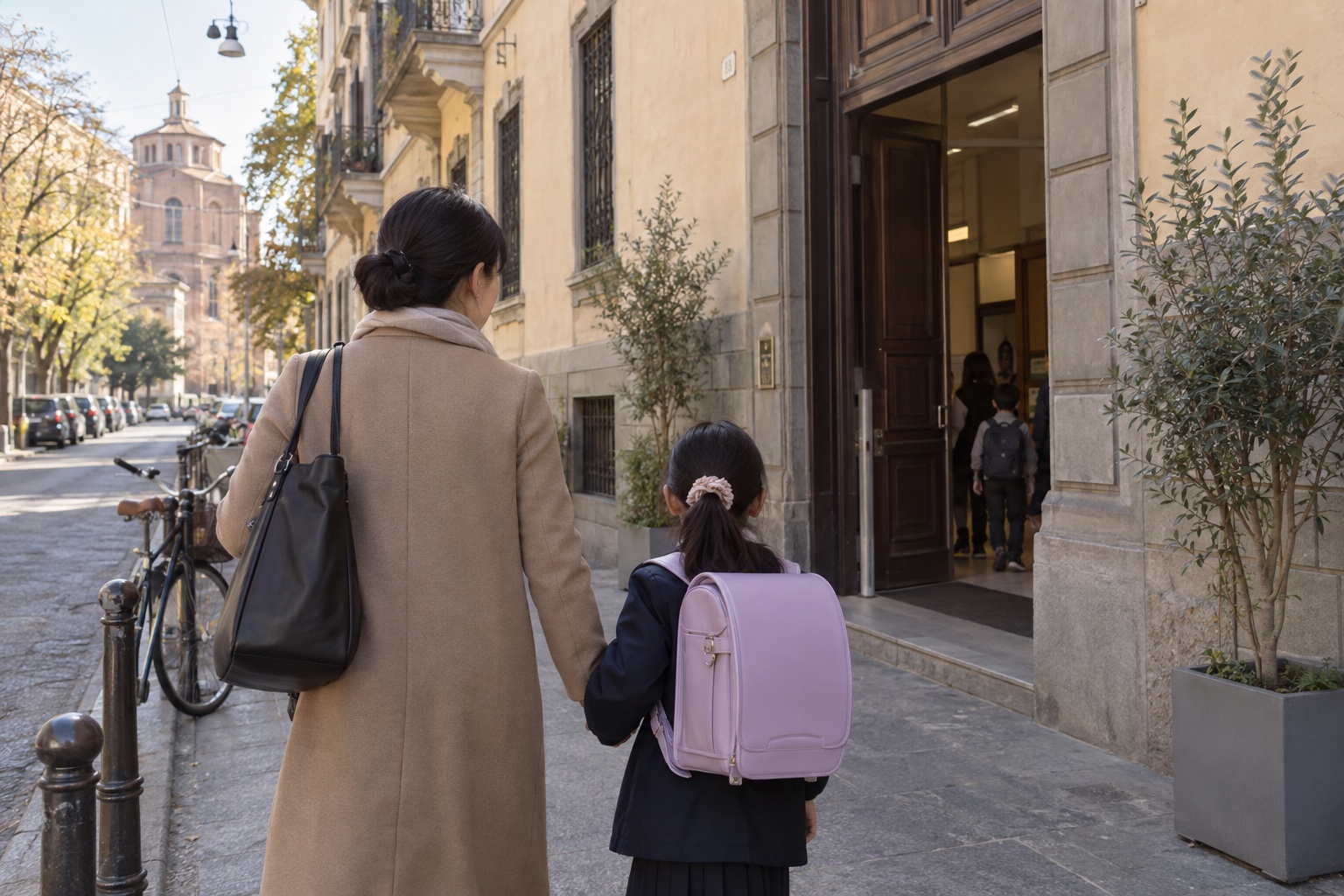
15. Checklist before contacting a school
A short family profile can make admission questions and fee estimates more specific. If your address is not settled, ask about school access as well as the distance from a workplace. Full-time schools, supplementary schools and online programs may each have different application documents and ways of assessing Japanese.
Gathering the same information for each school makes it easier to compare eligibility and costs fairly. Save replies by school year and note the date and person who answered, so current responses do not get mixed up with older web information.
- Expected city, neighborhood and home address, or likely addresses
- Child’s date of birth, current grade and desired start or transfer date
- Japanese speaking, reading and writing experience; languages used at home
- Current school, arrival date in Italy and any expected return or move
- Desired attendance days, whether another school will be attended and who can provide transport
- Annual budget including tuition, admission, travel and materials
- Any learning support or accommodations to discuss before enrollment
Ask the Rome and Milan schools about grade availability, documents, transfer dates, bus service, tuition and school events. Ask weekend schools about current classes, language placement, homework, make-up lessons, breaks and parent participation. For an online program, ask when it will start, which local times are available, class size, teacher communication, tuition and any assistance or scholarship conditions.
If a fee is not listed publicly, treat it as “not stated in the available official information” and request an estimate. When recording a prior-year fee, include its year so no one mistakes it for today’s price.
16. Frequently asked questions about Japanese schools in Italy
How many full-time Japanese schools are there in Italy?
MEXT’s recognized overseas education list includes two: Rome Japanese School and Milan Japanese School. They offer full-time schooling with elementary and lower-secondary sections. Confirm current sections and admissions with each school.
Can my child attend if we live outside Rome or Milan?
It depends on the address, transport, school-bus coverage and admissions conditions. Rome Japanese School lists a bus, but current stops and routes must be confirmed. Ask Milan Japanese School about its campus, transport and current grade openings. Do not plan on daily travel between cities without first confirming a workable routine.
Should we choose a full-time Japanese school or a supplementary school?
A full-time school may suit a child who should attend a Japanese-language curriculum on weekdays. A supplementary school may suit a child attending an Italian or international school who wants regular Japanese lessons on weekends. Compare schedule, curriculum, Japanese-language level, travel, home learning and family workload.
How much does a Japanese school in Italy cost?
Fees vary by school and school year. Rome Japanese School’s publicly available fee table is for 2024, so it should not be treated as the current 2026 amount. The Consulate page for Milan Japanese School does not show a detailed current tuition schedule. Ask each school for tuition, admission, bus, materials and other costs. Milan Supplementary School publishes a 2026 fee schedule.
Can TOMODACHI JAPAN replace a Japanese school?
No. It is not a full-time Japanese school or a MEXT-recognized overseas educational facility. Current information describes an online Japanese-language program in preparation, with plans for peer interaction and Japanese learning. Consider it only for the role that fits your family, and confirm its start date, format and fees.
Where should we verify school information?
Check MEXT for recognized full-time facilities, the Embassy of Japan in Italy for Rome and Florence weekend schools, and the Consulate-General of Japan in Milan for institutions in Milan and Turin. Then contact each school directly about admissions, schedule and costs.
A reliable order is to check MEXT’s list for full-time schools, use diplomatic-office pages to find weekend schools, and confirm details with each provider. A list of names alone cannot settle your choice. Compare the city and commute, language used during the week, Japanese class frequency, eligibility and total cost against your family’s needs. If neither full-time school fits your living area, local programs or online Japanese learning may still help create a regular place to use the language.
Primary sources consulted
- MEXT: Recognized Overseas Educational Facilities
- Embassy of Japan in Italy: Japanese schools and supplementary schools
- Consulate-General of Japan in Milan: Full-time Japanese school
- Consulate-General of Japan in Milan: Supplementary schools
- Rome Japanese School; Rome Japanese Supplementary School; Florence Japanese Supplementary School
- Milan Supplementary School; Milan Global Learning Academy
- TOMODACHI JAPAN: English site; How it works; Get the free school guide
This article was checked against the official pages available on October 15, 2026. Admissions, tuition, class times, addresses and transportation may change. Confirm current details with the school or provider before applying.