
If you are raising a child in Berlin, you have probably asked yourself some version of these questions. Is there a place that helps my child keep up Japanese? I always thought a Japanese supplementary school meant Saturdays, so is it true that Berlin’s schools meet on weekday afternoons? Or, if you are a German- or English-speaking parent, where can a child with Japanese roots, or simply a curious child, actually study Japanese? This article answers those questions using only what the schools’ own websites and Japan’s Ministry of Education (MEXT) say, as of October 29, 2026. It lines up four options on the same criteria: two Japanese supplementary schools (hoshuko), one full-time Japanese school, and one online Japanese school.
Nijiiro is an information site provided by NIJIN Inc. Tomodachi Japan, featured in this article, is a business of NIJIN Inc. We compare all schools on the same criteria and do not rank them.
That means Tomodachi Japan gets the same headings, the same facts and the same length as the other three, and nothing more. Wherever an official page does not state a schedule, a fee or an age range, we say “check with the school” instead of guessing. Unless noted otherwise, every fact below was checked on October 29, 2026.
- Within the scope we could verify, the Berlin options with an official, confirmable presence are two hoshuko (Berlin Japanese Supplementary School and Chuo Gakuen Berlin Supplementary School), one full-time Japanese school (Japanese International School Berlin), and one online school (Tomodachi Japan).
- Berlin Japanese Supplementary School runs on Wednesday, Thursday and Friday afternoons, and each pupil attends once a week according to the official timetable. This is a weekday, after-school model, not a Saturday one.
- The full-time Japanese International School Berlin lists tuition of €720 per month (plus €720 enrollment and €720 administrative fees at entry), which makes it a different kind of school from a hoshuko in both role and cost.
- Tomodachi Japan was not yet open on October 29, 2026. A pilot opening in December 2026 is planned once enough students sign up, but the date is not guaranteed. The pre-opening dedicated-support trial plan is ¥16,500 per month (tax included) with a ¥0 entrance fee.
- Berlin has been on winter time since October 25, 2026, which puts it 8 hours behind Japan. After clocks go forward on March 28, 2027, the gap shrinks to 7 hours. That gap decides which online time slots are realistic.
Four ways to keep up Japanese in Berlin: how we chose and what the order means
First, how we chose. We used three tests. One: the school’s own website confirms that it exists and gives contact details. Two: at least two of the following are readable on official pages: location, class days and times, and fees. Three: children can attend regularly now, or an opening is announced on the official site. Anything that failed these tests was left out rather than added to make up a number. Individual tutors, classes that appear only on booking sites, and adult courses are covered briefly later, together with the reason each was not included.
The order is not a ranking and not a popularity order. We grouped the options by how they fit alongside a child’s current local school (a German state school or an international school): first, after-school hoshuko (two schools); second, a full-time school that replaces the local school; third, online learning from home. The two hoshuko are listed with the one whose official site states a founding year (1973) first, which says nothing about quality. Tomodachi Japan is a business of NIJIN Inc., so it is handled on the same items and at the same length as the other three.
The table below is the big picture. Each school’s details follow in its own section.
| Option | Type | Location (as the school states it) | Days and times | Fees (summary, official) |
|---|---|---|---|---|
| Berlin Japanese Supplementary School | After-school hoshuko | At Halensee-Grundschule (Joachim-Friedrich-Str. 35/36, 10711 Berlin) | Wednesday, Thursday and Friday afternoons; each pupil once a week (timetable by grade) | €50 entrance fee; €73 per month for primary school and above (first child); more |
| Chuo Gakuen Berlin Supplementary School | After-school hoshuko | Address not published (for safety). The kindergarten “Higashi” classes are in Moabit, near U9 Turmstr. | Official phone hours mark Wednesday and Friday as school days; class-by-class timetable is in PDFs (not read for this article) | €50 entrance fee; €76 per month for primary and lower secondary (first child); more |
| Japanese International School Berlin | Full-time Japanese school | Lankwitz, southern Berlin (street address: check with the school) | Full-time; hours: check with the school | €720 per month tuition; €720 enrollment and €720 administrative fee at entry |
| Tomodachi Japan (online; a business of NIJIN Inc.) | Online from home | Online (home) | Not yet open. Schedule is adjusted to the family’s time zone; exact times not published | Trial plan ¥16,500 per month (tax included), ¥0 entrance fee. Regular tuition is sent with the free school guide |
What the table shows is that these four are not really competitors. They occupy different slots. A hoshuko is meant to run alongside local school, a Japanese school replaces it, and online learning is a no-commute add-on. Which one fits depends on your child’s age, current Japanese, whether you may move to Japan, and how much driving or travelling your household can absorb. The first thing to settle is why you want to keep up Japanese: preparing for a return to school in Japan, being able to talk with grandparents, or making Japanese friends. The answer changes which row of the table matters most.
MEXT draws the line between school types like this. A Japanese school (nihonjin gakko) is a full-day school providing education equivalent to Japanese elementary, junior high and senior high schools. A supplementary school (hoshuko) is a facility where Japanese children attending local or international schools take Japanese-language classes on Saturdays or after school. As of April 15, 2026, MEXT counts 91 Japanese schools (about 15,000 students) and 246 supplementary schools (about 20,600 students) worldwide. Japanese International School Berlin appears under Germany in MEXT’s list of accredited schools.
Want your child to keep up Japanese from home?
Tomodachi Japan, a business of NIJIN Inc., was not yet open as of October 29, 2026. A free consultation with a teacher and a free brochure request are available. Please check the official page for time slots and pricing.
See the official admissions pageBerlin Japanese Supplementary School: a hoshuko on Wednesday, Thursday and Friday afternoons
The first is the Berlin Japanese Supplementary School (ベルリン日本語補習授業校), legally “Japanische Ergänzungsschule in Berlin e.V.” According to its website, it was founded in 1973 by volunteers from the Japanese community of what was then West Berlin and marked its 50th anniversary in 2023. The school says it is supported by the Japanese government, Japanese companies in Berlin and parents. It teaches “Japanese language” and “arithmetic and mathematics.” Classes are held at Halensee-Grundschule (Joachim-Friedrich-Str. 35/36, 10711 Berlin), which means a local primary school’s classrooms are used after the regular school day.
The home page says it is recruiting new members from age 0 through high school and that more than 200 students are enrolled. The same page adds that some classes are already close to capacity, so it pays to ask early. It does not say which grades are filling up, so check with the office.
| Item | Berlin Japanese Supplementary School (items confirmed on official pages) |
|---|---|
| Location | c/o Halensee-Grundschule, Joachim-Friedrich-Str. 35/36, 10711 Berlin |
| Ages | From age 0 through high school (kindergarten, primary, lower secondary, upper secondary) |
| Days and times | Open Wednesday, Thursday and Friday; each pupil attends once a week. Primary years 2 to 6: Wednesday or Thursday 16:00 to 18:45. Year 1: Thursday 16:00 to 18:45 or Friday 15:30 to 18:15. Lower and upper secondary: Friday 16:15 to 18:50 |
| Fees | €50 entrance fee (one time); €73 per month (age-5 class, primary through upper secondary, first child); €90 per year administrative fee. Kindergarten fees vary by age |
| Curriculum | Primary and lower secondary: Japanese and mathematics following MEXT Courses of Study. Kindergarten: songs, picture books, crafts and play. Upper secondary: Japanese language |
| Admission requirements | Classes follow Japanese grade and age bands. No Japanese-ability requirement is stated on the official pages. Parents become full members of the association |
| Trial lesson | One trial per child. Email the child’s full name (with furigana) and date of birth |
| Official URL | https://www.berlin-hoshuko.de/ |
| Sources and check date | Overview, timetable, tuition, admission and education pages of the official site. Checked October 29, 2026 |
What stands out is that Berlin’s hoshuko meets on weekday afternoons. Many families picture a Saturday school, but according to the official timetable this one opens on Wednesday, Thursday and Friday, and each child attends once a week on their class day. The school year runs April to March, as in Japan, and holidays follow the Berlin state school calendar. German schools run five days a week, so this model frees up the weekend for family life but puts travel and lessons into a weekday evening. Whether that is a burden or a relief depends on your household.
The stated educational aim is for children to “study Japanese willingly, show consideration and responsibility, and enjoy interacting with others in a multilingual, multicultural setting.” Primary and lower secondary have one class per grade. Upper secondary has a mixed-level “Class A” for students with varied Japanese backgrounds, while “Class B,” aimed at entering Japanese universities, has been suspended since the second semester of 2021, according to the school.
Berlin’s hoshuko means weekday afternoons, once a week. The rhythm of family life is different from a Saturday schoolBerlin Japanese Supplementary School: timetable, fees and how to enroll
The official timetable separates kindergarten from primary and above. Kindergarten meets on Wednesday and Thursday in age-based classes. From primary school up, each grade has set days. The school notes that class days, times and subject hours can change with each year’s enrollment and class structure, so confirm the actual day with the office.
| Group | Day | Time | What is taught (official wording) |
|---|---|---|---|
| Kindergarten Yochi-yochi (ages 0 to 1) | Wed / Thu | 15:45 to 16:45 | Parent-and-child childcare group |
| Kindergarten Koguma (age 2) | Wed / Thu | 15:45 to 16:45 | Childcare, getting used to Japanese |
| Kindergarten Koala (age 3) and Panda (age 4) | Wed / Thu | 17:00 to 18:30 | Vocabulary, interest in letters, play |
| Kindergarten Lion (age 5) | Wed / Thu | 15:45 to 18:30 | Hiragana study, preparation for primary school |
| Primary year 1 | Thu or Fri | Thu 16:00 to 18:45 / Fri 15:30 to 18:15 | Japanese 2 hours, maths 1 hour |
| Primary years 2 to 6 | Wed or Thu | 16:00 to 18:45 | Japanese 2 hours, maths 1 hour |
| Lower secondary years 1 to 3 | Fri | 16:15 to 18:50 | Japanese 2 hours, maths 1 hour |
| Upper secondary | Fri | 16:15 to 18:50 | Japanese 3 hours |
From the timetable you can work out the load. For primary years 2 to 6, one session ties up 16:00 to 18:45, or 2 hours 45 minutes including breaks, split into 2 hours of Japanese and 1 hour of maths. For a child who spends the day in a German or international school, that is another block of schooling after the regular day. Lower and upper secondary meet on Friday evenings and finish at 18:50.
Costs have three parts: an entrance fee, a monthly membership fee and an annual administrative fee. The one-time entrance fee is €50 for full members (kindergarten Koguma and up) and €25 for associate members (kindergarten Yochi-yochi). Monthly and annual amounts are below.
| Group | Monthly fee (EUR) | Administrative fee (per year, EUR) |
|---|---|---|
| Kindergarten Yochi-yochi (ages 0 to 1) | 25 | 60 |
| Kindergarten Koguma (age 2) | 35 | 60 |
| Kindergarten Koala (age 3) and Panda (age 4) | 46 | 75 |
| Lion (age 5), primary, lower and upper secondary: first child | 73 | 90 |
| Same: second child | 68 | 90 |
| Same: third child | 53 | 90 |
| Same: fourth child and later | 48 | 90 |
Payment is by SEPA direct debit, per household. Membership fees are collected three months at a time in advance, at the start of April, July, October and January. The administrative fee is collected each May (or right after joining, if a child starts mid-year). The school states that the administrative fee is an annual charge regardless of when a child takes leave or withdraws, with no reductions or refunds. Households receiving social welfare benefits and similar can ask for a 50% reduction in membership fees.
The official enrollment steps are as follows.
Email info@berlin-hoshuko.de with the child’s full name (with furigana) and date of birth. Each child may attend one trial. Replies can be slow during holidays and school events.
A membership application, an enrollment application and a SEPA direct debit mandate. You can also pick them up at the office on the day of the trial.
Email them to the office or hand them in. Everything must be in before official enrollment.
Families under the jurisdiction of the Japanese Embassy in Germany can apply through the embassy’s consular section for free textbook distribution. The school also advises buying the standard overseas textbooks for the grade in advance.
Leave lasts at least 3 months (summer holidays excluded) and at most 12 months, and must be requested by the end of the month three months before it starts. Withdrawal follows the same three-month notice.
The “three months’ notice, by month-end” rule for leave and withdrawal is easy to miss. If your family may relocate or return to Japan, read it before you join. The school says the board may make exceptions for reasons such as illness or relocation.
Chuo Gakuen Berlin Supplementary School: a member-run hoshuko
The second is the Chuo Gakuen Berlin Supplementary School (共益法人ベルリン中央学園補習授業校). Its website describes a school that gives Japanese-language supplementary lessons based on MEXT’s kindergarten curriculum guidelines and the elementary and lower-secondary Courses of Study. It was founded by parents and teachers in Berlin who wanted to build Japanese ability that fits each child’s growth, and it is run cooperatively by its member families. The FAQ says families are strongly encouraged to help with school events and that, because the school is run by its members, parents are its operators.
On location, the official access page says the address and map are currently withheld for safety reasons and asks visitors to phone or email. For that reason we do not print a street address here. The home page does tell us that the kindergarten “Higashi” (east) classes were announced to move from August to a building in Moabit, near the U9 Turmstr. station, and that kindergarten days and times differ between the main school and the Higashi classes. The school rents classrooms in a German state school, so, according to its FAQ, its holidays follow the German state school calendar.
| Item | Chuo Gakuen Berlin Supplementary School (items confirmed on official pages) |
|---|---|
| Location | Street address not published (for safety). Kindergarten Higashi classes: Moabit, near U9 Turmstr. Phone 030 8639 4196 or email for details |
| Ages | Kindergarten (0 to 5), primary (6 to 12), lower secondary (13 to 15), upper secondary (16 to 18). The junior/senior high international division is listed as “not currently established” |
| Days and times | In the official phone-hours table, the days marked as main-school class days are Wednesday (13:00 to 18:00) and Friday (13:00 to 20:00). Class-by-class timetables are in PDFs we could not read, so check with the school. Higashi classes start at 16:00 (Tsukushi, Tanpopo, Hiyoko) or 15:30 (Usagi, Zou, Kirin) |
| Fees | €50 entrance fee (per household); monthly €76 for primary and lower secondary (first child), €78 for upper secondary; kindergarten €30 to €68 |
| Curriculum | Japanese language (listening, speaking, reading, writing), integrated studies, a kanji-test class (required from year 1), a returnee class with individual instruction, and career guidance |
| Admission requirements | Only classes with vacancies. Some Japanese ability is needed from the Usagi class and from primary school up. Help with homework at home is assumed. Parents are asked to contribute to running the school |
| Trial lesson | Possible for classes with vacancies (not for full classes). Email the class, preferred date, and the child’s name, date of birth and gender |
| Official URL | https://www.chuo-gakuen.de/ |
| Sources and check date | Home, admission, class introduction, schedule, access and FAQ pages of the official site. Checked October 29, 2026 |
In the classroom, Japanese language is the core, alongside “integrated studies” on themes such as geography and Japanese history. From year 1, a kanji-test class is required, with two exam sittings a year, according to the school. For children who plan to return to Japan, a “returnee class” offers individual instruction in chosen subjects, and the school describes career guidance, entrance-exam preparation and mock interviews for those heading back. For lower and upper secondary, the school says it plans to teach Japanese and short-essay writing.
This school gives more concrete guidance on Japanese ability than most. Some Japanese is needed from the Usagi class (age 3) and from primary school up. The example for Usagi is “can understand instructions in Japanese.” For Kirin (age 5), children are expected to read the 46 hiragana to some degree. For year 2, the example is “can read and write sentences and read the kanji from year 1 to some extent.” The FAQ is candid that a child with no Japanese will probably struggle to follow lessons from primary school upward.
Chuo Gakuen: classes, fees and how admission works
Fees are a household entrance fee plus a monthly fee per class. The entrance fee is €50 for both regular members and “Friends of the School” members. Monthly fees depend on lesson length in kindergarten and on the division from primary school up.
| Class | Lesson length (official) | First child (monthly, EUR) | Second child | Third/fourth child |
|---|---|---|---|---|
| Tsukushi (age 0) | 60 min | 30 | 28 | 26 |
| Tanpopo (age 1) | 60 min | 30 | 28 | 26 |
| Hiyoko (age 2) | 60 min | 40 | 38 | 36 |
| Usagi (age 3) | 90 min | 50 | 48 | 46 |
| Zou (age 4) | 90 min | 53 | 51 | 49 |
| Kirin (age 5) | 105 min | 68 | 66 | 64 |
| Primary and lower secondary | Japanese 105 min + integrated studies 60 min | 76 | 73 | 70 (58 from the fourth child) |
| Upper secondary | Japanese 105 min + integrated studies 60 min | 78 | 75 | 72 (60 from the fourth child) |
The FAQ also says that from primary school up you buy kanji workbooks, and that some events have participation fees. Enrolled children of compulsory-school age receive textbooks from Japan. There is also an optional supporting membership at €300 or more per year.
Unlike the other schools, the first hurdle is whether there is a place. According to the admission page, you first check the “class vacancy overview” PDF, then phone or email, and only classes with vacancies can offer a trial. There is no waiting list, and the school does not contact families individually when a place opens. For full classes, new recruitment happens twice a year, after the first semester ends (mid-June to mid-July) and at the end of the second semester (mid-December), announced on the home page.
Recruitment for the second semester of 2026 (September entry) closed at noon on August 17. However, a note dated September 3 on the home page says the target classes (all kindergarten main-school classes except Zou, all Higashi classes except Zou Higashi, and primary years 2 to 5) are accepting entries on a rolling basis by email. If applications exceed capacity, places are drawn by lottery. This changes from day to day, so check the home page and the vacancy PDF before you apply.
For the 2026 summer intake, the path from trial to enrollment was described this way: you receive the membership documents on the trial day, tell the office by the day after the trial whether you want to join, and submit the application on the next class day to become a member. Leave can last up to one year, but seats are not held during leave, so a child in a full class may not be able to return.
At Chuo Gakuen, ask first whether there is a place. After joining, expect parents to take part in running the schoolJapanese International School Berlin: a full-time school is a different category
The third is not a hoshuko but a full-time Japanese school: the Japanese International School Berlin (Japanische Internationale Schule zu Berlin e.V.). According to the principal’s message, it was founded to provide primary and secondary education under Japanese law to children of Japanese and other nationalities. The school describes itself as a full-time school in the Lankwitz district of southern Berlin, covering year 1 of primary through year 9 of lower secondary. It also appears under Germany in MEXT’s list of accredited schools.
The features the school highlights are small classes and teaching tailored to each child. Its international elements include lessons on Berlin and German history and geography, exchanges with local schools, visits to the Berlin Philharmonic and State Opera, and English conversation and German taught by native speakers. It says it is open to students of any nationality. Its financial-support page says the school left its previous building in 2023 when that building became privately owned, so no current street address appears on the official pages we read. Please confirm the address before visiting.
| Item | Japanese International School Berlin (items confirmed on official pages) |
|---|---|
| Location | Lankwitz, southern Berlin. No street address on the pages we read (the school moved in 2023). Phone +49 30 8036830 |
| Ages | Primary year 1 through lower secondary year 3 (grades 1 to 9) |
| Days and times | Full-time school. Specific days and hours are not stated on the pages we read (annual event calendars are published as PDFs). Check with the school |
| Fees | Tuition €720 per month; enrollment fee €720 and administrative fee €720 at enrollment (each per person). Donations are separate. No effective year is stated |
| Curriculum | Primary and lower secondary education under Japanese law, plus Berlin and German history and geography, English conversation, German, and exchanges with local schools |
| Admission requirements | Submit an enrollment and referral form and correspond with the office. Open to any nationality. No Japanese-ability or age conditions are stated on the pages we read |
| Trial lesson | Trial enrollment is available, booked one week at a time, up to four weeks per year. €172.5 per week (€180 per week from the April 2026 school year). Submit the application at least two weeks before the school year starts |
| Official URL | https://jap-schule-berlin.de/ |
| Sources and check date | About, principal’s message, tuition, trial enrollment, registration inquiries and financial-support pages; MEXT list of accredited schools. Checked October 29, 2026 |
The big difference from a hoshuko is that your child does not attend a local school; this becomes their school for the day. You get full-time education following Japanese Courses of Study, but at €720 a month the official fee is roughly ten times a hoshuko’s monthly fee (€73 to €76). The school says it depends mainly on tuition from a small student body. Think of it as the option for families who want daily life close to a school in Japan, not as a supplement to a German school. For most readers, it is less a rival to the hoshuko than a way to check whether a Japan-style school day exists in Berlin at all.
The four options on the same criteria: days, times, fees, admission and trials
Here is everything so far on one page. Tomodachi Japan is covered in detail in a later section. This table is for seeing what fits your household, not which school is better.
| Criterion | Berlin Japanese Supplementary School | Chuo Gakuen Berlin | Japanese International School Berlin | Tomodachi Japan |
|---|---|---|---|---|
| How it works | Alongside local school (after school) | Alongside local school (after school) | Replaces local school (full-time) | Alongside local school (from home) |
| Ages | 0 to high school | Kindergarten to upper secondary (0 to 18) | Primary 1 to lower secondary 3 | Official FAQ: from about age 5 to the third year of high school, mainly primary and lower secondary |
| Days and times | Wed/Thu/Fri afternoons, once a week | Wed and Fri are main-school days (timetable in PDFs) | Full-time (hours: check with the school) | Not yet open. Time zone-adjusted slots (exact times not published) |
| Monthly guide | €73 (primary and up, first child) | €76 (primary and lower secondary, first child) | €720 | Trial plan ¥16,500 (tax included). Regular fee not published |
| Up-front costs | €50 entrance + €90 per year | €50 entrance | €720 enrollment + €720 administrative | ¥0 entrance fee (if you start on the trial plan) |
| Curriculum | Japanese and maths (Courses of Study) | Japanese, integrated studies, kanji test, returnee class | Japanese primary and lower secondary education | Conversation-centred project learning; Japanese language arts to grade level |
| Admission | No ability requirement stated | Ability guide stated; vacancies required | Application forms, contact with the office | Reading hiragana not required; placed by conversation level |
| Trial | One per child | Only classes with vacancies | One-week blocks, paid | Free trial and consultation (choose a teacher) |
One factor does not appear in the table: a class may be full. Both Berlin hoshuko say on their official pages that some classes are near capacity or have a class limit. If you are thinking of enrolling, checking vacancies is the realistic first step. The flow chart below is not an official process; it is our way of organizing the decision.
Yes: go to Q2. No (you want a day close to a school in Japan): check the Japanese International School Berlin materials
Yes: go to Q3. Difficult: consider online learning from home (for example, Tomodachi Japan)
Yes: check vacancies and timetables at both hoshuko. Conversation and friendship come first: online learning can be combined with a hoshuko
You do not have to follow this chart. In practice, the days you can travel, your child’s local school finishing time and your child’s energy tend to decide. Tomodachi Japan’s official FAQ explicitly says it can be combined with a weekend Japanese school (hoshuko).
Getting there in Berlin: Halensee in the west, Moabit in the north, Lankwitz in the south
Berlin is a large city, and the venues are spread across it. The official pages say almost nothing about nearest stations or travel times, so this section does not state journey times or line numbers as fact. It gives the district each school names and the steps to check yourself.
| Option | District (from official pages) | Rail clue | What to check |
|---|---|---|---|
| Berlin Japanese Supplementary School | Inside Halensee-Grundschule (postcode 10711) | Halensee S-Bahn station at Kurfürstendamm 129a-b, also postcode 10711, served by S41, S42 and S46 on the Ring. The walking time from the school is not stated officially | The trip from your child’s school to a 16:00 (or 15:30) start; check walking and transfers in a map app |
| Chuo Gakuen Berlin | Main-school address withheld. Kindergarten Higashi classes: Moabit (near U9 Turmstr.) | For Higashi, U9 Turmstr. is the landmark. The main school’s nearest station: check with the school | Whether your class is main school or Higashi. Phone for the address |
| Japanese International School Berlin | Lankwitz, southern Berlin | Nearest station not stated on the pages we read | Your daily commute. Confirm the address (the school moved in 2023) |
| Tomodachi Japan | Home (online) | No travel | Home internet, and a quiet place to join |
The Ring, served by S41 and S42, circles the city centre. S-Bahn Berlin’s official station page gives Halensee’s location as Kurfürstendamm 129a-b, lists S41, S42 and S46, and puts it in fare zone A. However, how many minutes the school is from the station is not stated officially, so check the walk on a map. For Chuo Gakuen’s Higashi classes, the school itself points to U9 Turmstr. in Moabit. The Japanese International School Berlin, in Lankwitz, means a daily commute, so its route is the one to research most carefully.
What matters is not the minutes on one leg but how the whole day fits together. Suppose a child’s local school ends in the mid-afternoon, the hoshuko starts at 16:00 and ends at 18:45. Travel and dinner turn the whole evening into one block. Berlin winters are dark early, and on days when you would get home after 19:30 many families will want an adult to do the pickup. Try writing it out on paper using the steps below.
It varies by school, year and weekday. Work backwards from the hoshuko start time.
Set the day and time and check both directions. Ask the school for the venue address first.
Include grandparents, neighbours, and siblings’ waiting time.
Check that the evening does not hurt the next school day.
See how tired your child is and when you get home before deciding whether it is sustainable.
Time zones, weekdays and daylight saving: Berlin timetables and the gap with Japan
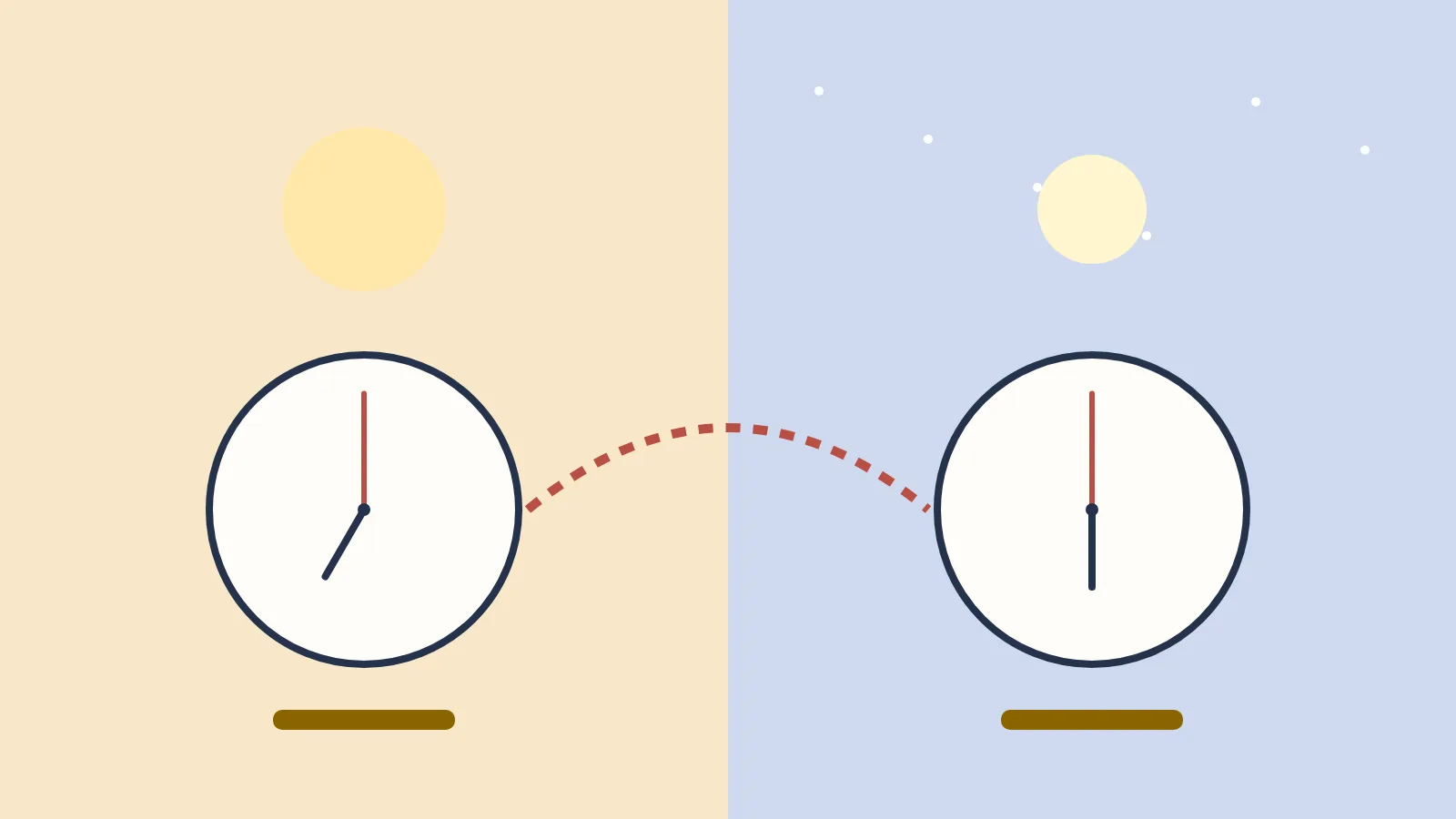
Berlin’s clocks moved from summer time to winter time (Central European Time, UTC+1) on October 25, 2026. They go back to summer time (UTC+2) on March 28, 2027. Compared with Japan (UTC+9), Berlin is 8 hours behind in winter and 7 hours behind in summer. We took the dates of the changeover from German press reports, a secondary source.
Hoshuko lessons run on Berlin local time, so the start time does not shift when the clocks change. The time difference matters for anything tied to Japan time, such as video calls with grandparents or online lessons held at the same time as children in Japan. The table below converts Berlin times to Japan time. These are our own calculations.
| Berlin time | Japan time (winter, 8-hour gap) | Japan time (summer, 7-hour gap) | Typical use |
|---|---|---|---|
| Weekday 07:00 | 15:00 | 14:00 | Morning before school. After school in Japan |
| Weekday 08:00 | 16:00 | 15:00 | Just before leaving for school. Only if your mornings have slack |
| Weekday 16:00 | 0:00 next day | 23:00 | Start of the hoshuko. Does not overlap with live Japan-side lessons |
| Weekday 18:45 | 2:45 next day | 1:45 next day | End of primary-school hoshuko lessons |
| Weekday 19:00 | 3:00 next day | 2:00 next day | After dinner. Far from Japan’s waking hours |
| Saturday 09:00 | 17:00 | 16:00 | Weekend morning. Late afternoon in Japan |
| Saturday 12:00 | 20:00 | 19:00 | Weekend midday. Early evening in Japan |
The table shows that a Berlin weekday afternoon, the hoshuko hours, is already the middle of the night in Japan. If you want to talk live with children in Japan, realistic Berlin slots are weekday early mornings or the daytime on weekends. That also means a hoshuko in the afternoon and an online class in the early morning or at weekends rarely collide, which makes them easy to combine.
Check school holidays too. Berlin Japanese Supplementary School says it follows the Berlin state school calendar, and Chuo Gakuen says it follows the German state school calendar. According to secondary sources that cite the Berlin education department (Kalenderpedia), the autumn break in 2026 is October 19 to 31, the winter break is December 23 to January 2, 2027, the mid-winter break is February 1 to 6, 2027, the Easter break is March 22 to April 2, and the summer break is July 1 to August 14, 2027. Each school’s own annual calendar has the exact dates.
The time difference only bites when you tie lessons to Japan time. Berlin hoshuko stay on local time, winter and summer
Tomodachi Japan: an online Japanese school you join from home (not yet open)
The fourth is the online Japanese school Tomodachi Japan, a business of NIJIN Inc. Its website describes a Japanese school for children growing up abroad, with classes of 8 students who study together every day, including children in Japan. As of October 29, 2026, it had not opened. The official admissions page says the school has “not yet opened,” that the pilot opening listed for December 2026 depends on enough people signing up, and that it will not promise a date it cannot keep.
On timing, the official site says that the daily timetable is adjusted to each country’s time zone and that multiple time slots are offered so families from Asia and Oceania through Europe and the Americas can join at a reasonable hour. A meta description on the curriculum page lists three patterns: weekday daytime, weekday evening and weekend. But which slot corresponds to which Berlin hour is not published; the timetable and tuition are sent with the free school guide. The FAQ page also names Asia and Oceania as examples and does not name Europe, so the surest way to find out whether Berlin hours work is to ask in the free consultation.
| Item | Tomodachi Japan (items confirmed on official pages) |
|---|---|
| Location | Online (join from home). Operated by NIJIN Inc. |
| Ages | Official FAQ: from about age 5 (kindergarten) through the third year of high school, mainly primary and lower secondary. The admissions page gives no age (it welcomes registration by junior and senior high students themselves) |
| Days and times | Not yet open. Adjusted to the family’s time zone; weekday daytime, weekday evening and weekend patterns are mentioned. Exact European times are not published (sent with the school guide) |
| Fees | Pre-opening dedicated-support trial plan: ¥16,500 per month (tax included), entrance fee ¥0. Regular tuition is not published. The page says the current amount is not a promise that it will continue |
| Curriculum | Conversation-centred project learning in classes of 8. Japanese language arts taught to grade level. Morning meeting, after-school time on a metaverse campus, weekend events |
| Admission requirements | Reading hiragana is not required. Placement by conversation level. A PC or tablet and an internet connection are needed |
| Trial lesson | Free trial and consultation (choose a teacher and a time; the child does not need to attend). A brochure request is also free |
| Official URL | https://tomodachi-japan.nijin.co.jp/admissions/ |
| Sources and check date | Admissions, pricing, FAQ, learning, curriculum, time-zone and free-trial pages of the official site (Japanese). Checked October 29, 2026 |
Because it has not opened, there is no track record or enrolled-family feedback yet. What you can start before opening is the “dedicated-support trial plan,” in which one teacher is assigned to each child. The pricing page says enrollment on this plan may close depending on demand. The entrance fee is ¥0 for anyone who starts on this plan, and free for first-cohort students who apply by March 31, 2027. Payment is by credit card or bank transfer, and overseas payment methods are being added gradually.
Using online learning on Berlin time: weekday mornings, evenings and weekends
This section explains how a Berlin household might think about Tomodachi Japan, keeping what the official site says apart from our own arithmetic. The official site tells us that time slots are prepared for different time zones, that there are weekday and weekend patterns, that the tuition model is unlimited attendance for a flat fee, and that about 100 sessions a month are on offer to choose from. It does not tell us the Berlin times or how long one session lasts.
If the idea is to talk with children in Japan at the same time, the conversion table above implies that a Berlin weekday morning (07:00 to 08:00) is mid-afternoon after school in Japan and a Saturday morning is Japan’s late afternoon. That is our reasoning from the time difference, not the school’s timetable. It does mean the online slots would not collide with a hoshuko in the afternoon, which is helpful if you plan to combine them. On the other hand, an early-morning class may clash with getting ready for school. Ask in the free consultation exactly which slots exist for Berlin time.
You only need a name and an email address. The official page says the school guide includes the timetable, class sizes, teachers, tuition and opening schedule.
Choose a teacher and a time. Your child does not need to attend. If no time works because of the time difference, the page says you can contact the teacher directly.
The site says it is fine to say it is not a fit. There is no need to rush.
Tuition after opening is separate and not guaranteed. Check the latest details on the official page before starting.
The official site also says who it suits and who it does not, which is useful. It says it fits families who value conversation, friendship and continuity through moves, and that families whose main aim is a certificate such as a JLPT level, who want score-based evaluation, or who want only one-to-one tutoring may be better served elsewhere. It states that it can be used together with a supplementary school.
As the comparison table shows, Tomodachi Japan is different in character from the other three because it has not opened. Unlike the two hoshuko and the Japanese school, it has no published current enrollment or class timetable. The opening date is not guaranteed either. Whether you can live with that uncertainty, or prefer to wait until tuition after opening is published, is a decision we regard as equally reasonable.
Online’s strength is no commute. But it is not yet open, and the Berlin time slots are still to be confirmed with the schoolChoosing by age and Japanese level: finding the right entry point
Even within Berlin, the right place varies with age and Japanese ability. We use the conditions stated officially as a guide. These are rough guides, not indications of whether a child will be admitted.
Ages 0 to 2. Berlin Japanese Supplementary School’s Yochi-yochi class (ages 0 to 1) is a parent-and-child class on Wednesday and Thursday, 15:45 to 16:45. Chuo Gakuen has Tsukushi (age 0), Tanpopo (age 1) and Hiyoko (age 2). Lessons at both are about 60 minutes. The question is whether a weekly trip is realistic.
Ages 3 to 5 (kindergarten). Both hoshuko have kindergarten divisions. At Berlin Japanese Supplementary School, Koala and Panda meet 17:00 to 18:30 and Lion meets 15:45 to 18:30. Chuo Gakuen lists guides for Usagi and above, such as being able to understand instructions in Japanese, and expects Kirin (age 5) children to read hiragana to some degree. For families who mostly speak German or English, a kindergarten whose stated aim is to get children used to Japanese through play can be a gentle entry.
Primary-school children. This is the age with the most choice. If a return to school in Japan is possible, Chuo Gakuen’s returnee class and both hoshuko’s Japanese and maths lessons following the Courses of Study are candidates. If no return is planned and you want your child to keep speaking and reading Japanese, a weekly hoshuko, online learning from home, or a combination are options. Chuo Gakuen’s FAQ says an older primary pupil with almost no Japanese will probably find lessons hard, so building a conversational base at home or online first is also a realistic path.
Lower and upper secondary. Berlin Japanese Supplementary School has lower and upper secondary classes on Fridays, 16:15 to 18:50. Chuo Gakuen also has them and plans Japanese and short-essay lessons. Tomodachi Japan’s official FAQ includes students up to the third year of high school. Older pupils have more homework and activities at their local school, so ask your child whether once a week is sustainable.
Across the official pages, one assumption is shared: support for Japanese at home is needed. A hoshuko supplements the Japanese a family already uses; it is not a place to start from zero. For children who speak almost no Japanese, a conversation-first online school or a full-time Japanese school may be the better entry point.
Estimating the cost: a first-year guide from the published fees
Adding up the published amounts gives a rough guide. The figures below are simple first-year totals from the official fees as of October 29, 2026. They exclude travel, books and kanji workbooks, event fees, lunch and exchange rates. Monthly fees are counted for 12 months, but how months off are treated should be checked with each school.
| Option | How it is calculated (EUR) | First-year guide |
|---|---|---|
| Berlin Japanese Supplementary School (primary, first child) | Entrance 50 + monthly 73 × 12 (876) + administrative 90 | 1,016 |
| Berlin Japanese Supplementary School (Koala / Panda) | Entrance 50 + monthly 46 × 12 (552) + administrative 75 | 677 |
| Chuo Gakuen (primary / lower secondary, first child) | Entrance 50 + monthly 76 × 12 (912) | 962 |
| Chuo Gakuen (Kirin) | Entrance 50 + monthly 68 × 12 (816) | 866 |
| Japanese International School Berlin | Enrollment 720 + administrative 720 + tuition 720 × 12 (8,640) | 10,080 |
| Tomodachi Japan | Trial plan ¥16,500 per month (tax included), entrance fee ¥0. Tuition after opening is not published | Check with the school (not converted, as rates move) |
The full-time Japanese International School Berlin is at roughly ten times the level of a hoshuko. But that is a difference of role, not like for like: a hoshuko is an addition to local school, and a Japanese school is a replacement. Also, Berlin Japanese Supplementary School collects fees three months at a time (April, July, October, January), so what you pay at joining is three months of fees plus the entrance and administrative fees.
Chuo Gakuen is run with the help of member families. The school gives examples: helping at events, serving on the board or parent council, library duty, class liaison and classroom-safety shifts. The time that takes is as important to check as the money. Berlin Japanese Supplementary School’s sports day was also reported in its June 2026 news as organized by parents.
Tomodachi Japan’s pricing page says plainly that the current amount is not a promise of what will continue. Tuition after opening is given in the free school guide. The price is a single standard price with a regional discount (the “scholarship”) applied automatically according to country of residence, with no application or proof of income. Overseas prices may be higher or lower than Japan’s, so what Berlin pays has to be confirmed by requesting the brochure.
Look at what a fee is for, not just its size: hoshuko = an addition, Japanese school = a replacement, online = an add-on without travelFor local parents: options if your family speaks German or English
What if your family has no Japanese roots, or only one parent is Japanese, and you want your child to learn Japanese? Here is what can be confirmed officially.
Start with the hoshuko. Berlin Japanese Supplementary School states no Japanese-ability requirement on its pages. It says nothing about nationality and describes its aim as nurturing people who can act as a bridge between Japan and Germany. Chuo Gakuen’s admission page sets no nationality or residence criteria, but it gives a guide to Japanese ability and assumes homework support at home. In both cases it is safer to assume that Japanese is already used at home. If it is not, tell the school about your situation in detail before a trial.
The Japanese International School Berlin says in the principal’s message that it is open to students of any nationality. It also has German and English lessons and teaches German history and geography, but it is a full-time school taught in Japanese.
Next, options beyond hoshuko and full-time schools. These are the ones we did not include in the four-way comparison, and why.
| Option | What we could confirm | Why it is not in the comparison |
|---|---|---|
| Polyglot Kids (listed on Kindaling) | Ages 5 to 18, online (Zoom), 45 minutes per lesson, groups of 4 to 10 (runs with at least 3). €35 per lesson, €350 for 10, €650 for 20, €1,500 for 50. Flexible start date | Booking-site listing only; we could not confirm the provider’s own page. No days or times listed |
| Kazue Sensei (listed on Kindaling) | Age 7 and up. Online, Saturday 10:00 to 10:45, €58 per month, starting on the first Saturday of each month, no classes in August or on public holidays, recordings provided | Same: booking-site listing only |
| Nihongo-juku in Germany | Mostly one-to-one online lessons. From primary school year 2 to adults, mostly junior and senior high students. Heritage Japanese, Japanese for primary pupils planning to return | Based only on an individual teacher’s note page; fees and times unknown |
| Japanese at Berlin state schools | A 2013 press report said some Berlin secondary schools offered Japanese (schools not named) | Old information; current schools not confirmed |
| Berlin Japanese-German Center (JDZB) | Listed in Japan Foundation material as an adult Japanese-learning institution | Not a children’s class |
We could not confirm these officially at this time, so they are not part of the comparison. If one interests you, check the latest official information from the provider. For context, the Japan Foundation’s 2021 survey counted 11,687 Japanese learners in Germany: 47 in primary education (0.4%), 1,529 in secondary (13.1%), 5,480 in higher education (46.9%), and 4,631 in other institutions (39.6%). That suggests that places to learn Japanese as a child are limited across Germany.

Sample enquiry emails: what to ask each school
Email is the basic contact method for each school. Berlin Japanese Supplementary School: info@berlin-hoshuko.de. Chuo Gakuen: info@chuo-gakuen.de (the website shows a “●” in place of the “@”, so swap it back). Japanese International School Berlin: info@jap-schule-berlin.de. For Tomodachi Japan, book a free consultation or use the contact form on the official site. In a first message, describe your child’s situation concretely and number the questions; replies tend to be more useful.
Sample (to a hoshuko, in English; the schools’ own communication is mostly in Japanese, so say so if you need English)
Dear Sir or Madam, I am writing about my child, aged X (born month/year), who lives in Berlin. We are considering enrolment at your school. At home we speak X and Japanese. My child’s Japanese is at everyday conversation level, with a little hiragana. Could you please tell me:
1. Current vacancies for the relevant grade, and when a trial or enrolment is possible
2. Which grade my child could join with this level of Japanese
3. The annual calendar (class days, holidays, events) and any costs beyond the fees
4. How much homework there is, and what is expected of parents (including help with running the school)
5. The procedure for leave and withdrawal
Please send the admission information and application forms. Thank you.
For Chuo Gakuen, add: “Is the class main school or Higashi?”, “the day and time for my child’s class in the timetable PDF,” and “the latest vacancy overview.” For the Japanese International School Berlin, confirm “the current address and nearest station,” “school days and hours,” “the next trial enrollment period,” and “the year the fees apply to.” For Tomodachi Japan, ask in the free consultation: “Is there a slot that works in Berlin time?”, “How long is one session?” and “What is the expected tuition after opening?”
Note the date and the name of whoever replies, so you can follow up if the answer differs from the website. Schools update their information, so look at the official page once more before you decide.
Before you apply: a ten-point checklist
- 1. Do the days and times fit your child’s local school finishing time (hoshuko meet on weekday afternoons)?
- 2. Have you checked the venue address, nearest station and door-to-door time in a journey planner or a trial run?
- 3. Have you confirmed the latest entrance fee, monthly fee and administrative fee, and when they are collected (for example, three months in advance)?
- 4. Is there a place? (Chuo Gakuen requires vacancies; Berlin Japanese Supplementary School also says some classes are near capacity.)
- 5. Can you meet the admission conditions (Japanese ability guide, membership, parent involvement in running the school)?
- 6. Do you have the annual calendar (class days, holidays, events)?
- 7. Do you understand how much homework there is and what support at home is expected?
- 8. If you have more than one child, have you checked sibling discounts and whether the days can be aligned?
- 9. Do you know the leave and withdrawal rules (Berlin Japanese Supplementary School: notice by the end of the month, three months ahead)?
- 10. Have you seen how your child reacts at a trial or free consultation?
If four or more of the ten are still unchecked, it is perfectly sound not to rush. The last point, your child’s own feelings, is easily left till last, but it is a fair place to start choosing. First confirm 1 to 5 (venue, fees, vacancies, conditions) by enquiry, then talk through 7 to 10 (household situation and your child’s feelings) as a family. Doing it in two steps cuts down on needless emails.
Any item you cannot tick becomes a question for your enquiry.
Frequently asked questions (FAQ)
These are ten questions parents commonly ask. Answers are limited to what could be confirmed on official pages as of October 29, 2026. Admissions, fees and timetables change easily, so check the official sites before you decide.
Summary: an after-school hoshuko, a full-time school or online: choose the form you can sustain
The four ways to keep up Japanese in Berlin that we could confirm officially are Berlin Japanese Supplementary School, Chuo Gakuen Berlin Supplementary School, Japanese International School Berlin and Tomodachi Japan. The hoshuko are after-school schools on Wednesday, Thursday and Friday and run alongside local school. The full-time Japanese school can replace local school, but costs about ten times a hoshuko. The online school involves no travel and says it offers time slots matched to time zones, but it had not opened and we could not confirm Berlin times.
When you choose, start by putting into words, as a family, why you want to keep up Japanese and with how much effort. Do you want to keep school subjects going for a return to Japan, or is conversation and friendship the heart of it? Can you take on weekday-afternoon travel, and the work of helping to run a member-run school? The answers will tell you which hoshuko fits, or whether online learning from home would be easier to sustain.
Finally, here are the items we marked “check with the school.” They are: current vacancies by class at Berlin Japanese Supplementary School; the days and times in Chuo Gakuen’s timetable PDFs; the address and nearest station of Chuo Gakuen’s main school; the address, school days and fee year of Japanese International School Berlin; Tomodachi Japan’s Berlin time slots and tuition after opening; and each school’s annual calendar. Confirm each one by enquiry before you decide.
Would you like to talk with a teacher, free of charge?
Tomodachi Japan, a business of NIJIN Inc., is an online Japanese school where children around the world and in Japan learn in small classes. It had not opened as of October 29, 2026, so before opening you start on the dedicated-support trial plan. Free consultation and brochure requests are on the official page.
See the free consultation and brochureSources (checked October 29, 2026)
- Berlin Japanese Supplementary School: home page: https://www.berlin-hoshuko.de/
- Berlin Japanese Supplementary School: overview and location: https://www.berlin-hoshuko.de/school-overview/
- Berlin Japanese Supplementary School: annual plan and timetable: https://www.berlin-hoshuko.de/syllabus/
- Berlin Japanese Supplementary School: tuition fees: https://www.berlin-hoshuko.de/tuition-fee/
- Berlin Japanese Supplementary School: enrollment, leave and withdrawal: https://www.berlin-hoshuko.de/admission-withdrawal/
- Berlin Japanese Supplementary School: education system: https://www.berlin-hoshuko.de/education-system/
- Berlin Japanese Supplementary School: kindergarten division: https://www.berlin-hoshuko.de/kinder/
- Berlin Japanese Supplementary School: new member recruitment: https://www.berlin-hoshuko.de/new-membership/
- Chuo Gakuen Berlin Supplementary School: home page: https://www.chuo-gakuen.de/
- Chuo Gakuen Berlin: about the school: https://www.chuo-gakuen.de/aboutus/
- Chuo Gakuen Berlin: class introduction: https://www.chuo-gakuen.de/intro_class/
- Chuo Gakuen Berlin: class schedule: https://www.chuo-gakuen.de/schedule/
- Chuo Gakuen Berlin: admission: https://www.chuo-gakuen.de/admission/
- Chuo Gakuen Berlin: access: https://www.chuo-gakuen.de/access/
- Chuo Gakuen Berlin: FAQ: https://www.chuo-gakuen.de/faq/
- Chuo Gakuen Berlin: junior/senior high international division: https://www.chuo-gakuen.de/intro_class/international/
- Japanese International School Berlin: about our school: https://jap-schule-berlin.de/about-our-school/
- Japanese International School Berlin: message from the principal: https://jap-schule-berlin.de/message-from-the-principal/
- Japanese International School Berlin: tuition fees: https://jap-schule-berlin.de/tuition-fees/
- Japanese International School Berlin: trial enrollment: https://jap-schule-berlin.de/trial-enrollment/
- Japanese International School Berlin: registration inquiries: https://jap-schule-berlin.de/registration-inquiries/
- Japanese International School Berlin: financial support: https://jap-schule-berlin.de/financial-support/
- MEXT: overseas educational facilities (Japanese): https://www.mext.go.jp/a_menu/shotou/clarinet/002/002.htm
- MEXT: list of accredited overseas Japanese schools: https://www.mext.go.jp/a_menu/shotou/clarinet/002/002/001.htm
- Japan Foundation: Japanese-language education in Germany (2023 edition): https://www.jpf.go.jp/j/project/japanese/survey/area/country/2023/germany.pdf
- S-Bahn Berlin: Halensee station: https://sbahn.berlin/en/plan-a-journey/rail-stations/halensee
- Wikipedia: Berlin-Halensee station (secondary source): https://en.wikipedia.org/wiki/Berlin-Halensee_station
- Kalenderpedia: Berlin school holidays 2026/27 (secondary source; cites the Berlin education department): https://www.kalenderpedia.de/ferien/ferien-berlin-schuljahr-2026-2027.html
- leinetal24: 2026 clock change (secondary source): https://www.leinetal24.de/verbraucher/zeitumstellung-2026-warum-dieses-jahr-am-fruehestmoeglichen-termin-gedreht-wird-zr-94534754.html
- Tomodachi Japan: home page (Japanese): https://tomodachi-japan.nijin.co.jp/
- Tomodachi Japan: admissions (Japanese): https://tomodachi-japan.nijin.co.jp/admissions/
- Tomodachi Japan: pricing (Japanese): https://tomodachi-japan.nijin.co.jp/pricing/
- Tomodachi Japan: FAQ (Japanese): https://tomodachi-japan.nijin.co.jp/faq/
- Tomodachi Japan: how learning works (Japanese): https://tomodachi-japan.nijin.co.jp/learning/
- Tomodachi Japan: curriculum and one-week schedule (Japanese): https://tomodachi-japan.nijin.co.jp/learning/curriculum/
- Tomodachi Japan: learn anywhere / time zones (Japanese): https://tomodachi-japan.nijin.co.jp/learning/anywhere/
- Tomodachi Japan: free trial and consultation (Japanese): https://tomodachi-japan.nijin.co.jp/trial/
- nipponip: Japanese schools and hoshuko in Germany (secondary source, Japanese): https://blog.nipponip.de/japanese_school/
- Nihongo-juku in Germany (an individual teacher’s note page, Japanese): https://note.com/nihongo109tamaki/n/n2b15c3128a11
- Kindaling: online Japanese for children (booking-site listing): https://www.kindaling.de/online-kurse-fuer-kinder/japanisch-lernen-online-von-geschulten-muttersprachlern/online
- Kindaling: Saturday online Japanese (booking-site listing): https://www.kindaling.de/sprachkurse/1-online-spielen-mit-japanisch-ab-7-jahre/online
- Tagesspiegel: foreign languages at Berlin schools (20 Aug 2013, outdated): https://www.tagesspiegel.de/berlin/schule/berliner-vielfalt-fremdsprachen-von-klasse-1-bis-13-6348259.html
We could not retrieve Chuo Gakuen’s timetable PDFs (days and times by class) or Berlin Japanese Supplementary School’s annual plan PDFs, and have not confirmed their contents. The Japanese International School Berlin tuition page states no effective year. The clock-change dates and school holidays come from secondary sources, and the time differences with Japan (UTC+1/+2 and +9) are calculations based on standard UTC offsets. Pages on the Tomodachi Japan site are in Japanese; we translated the points we cite.
Nijiiro editorial team (Nijiiro is an information site provided by NIJIN Inc.)