Menu
BASICS
How Japanese schools work Japanese phrases for school Glossary of school termsWAYS TO LEARN
Free schools Education support centers Online schools Homeschooling in Japan International schools Correspondence high schoolsMORE
Neurodivergent children Where to get help Attendance and costs Learning Place Finder 日本語サイトへReturnee Child Struggling at Japanese School: A Parent’s Guide
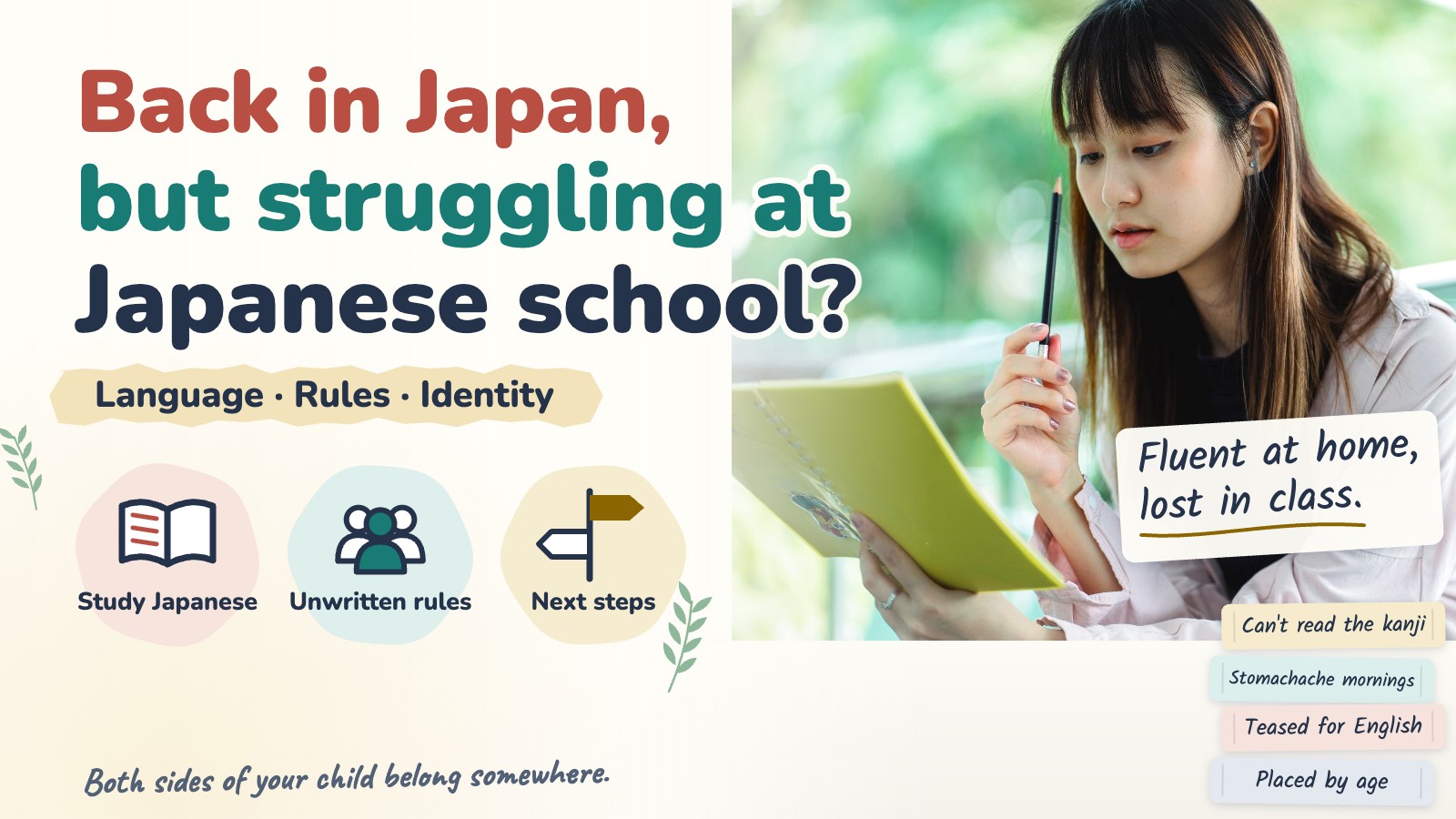
- Why a child who chats easily in Japanese can still be lost in lessons
- The unwritten rules, “standing out” and identity questions that research on returnees describes
- How enrollment and grade placement work when you move to or back to Japan
- The Japanese language support that public schools can provide, and how to ask for it
- Early signs that adjustment is becoming school refusal, and sensible next steps
- How to keep English alive, and how the main school options compare
This article is general information, not medical or legal advice. Rules and practice vary between municipalities, so check details with your local board of education. If your child talks about harming themselves, or you are worried about their safety, contact a doctor or emergency services straight away.
Why “fluent” returnees still struggle in class
Many returnee children, known in Japan as kikokushijo (帰国子女), speak Japanese at home every day. So it can be confusing when a child who chats happily with grandparents comes home from school saying they understood almost nothing. The explanation is that there are two different kinds of language: the Japanese of everyday life, and the Japanese of studying.
Japan’s Ministry of Education (MEXT) makes this distinction itself. Its description of which children qualify for Japanese language instruction includes returnees and children who use another language at home, and it covers two groups: children who cannot yet hold everyday conversations in Japanese, and children who can hold everyday conversations but lack the grade-level “learning language” needed to take part in lessons. A 2008 MEXT expert report made a similar point about children learning Japanese as an additional language: even after they can manage daily conversation, many cannot fully follow lessons, not only in reading and writing but also in listening and speaking.
| Everyday Japanese | Japanese for study |
|---|---|
| Chatting with family and friends | Following a teacher explaining fractions or photosynthesis |
| Familiar topics, lots of context | Abstract ideas, new vocabulary, few visual clues |
| Mostly spoken | Reading textbooks and writing answers in kanji |
| Mistakes are easily forgiven | Tests, homework and grades depend on it |
For a returnee, this gap is easy to miss because they sound fluent. Teachers may assume there is no language issue, and the child may not have the words to explain what is going wrong. Kanji is often the most visible gap: classmates have been learning characters year by year, while a child schooled abroad may have learned far fewer, even with weekend Japanese school.
If your child seems tired, slow with homework, or suddenly “bad at” a subject they were good at abroad, it is worth asking whether study language is part of the picture before assuming it is motivation or ability.
Unwritten rules, standing out and identity
Language is only part of it. Japanese schools have routines that local children absorb from their first year: how to line up, how to speak to older students, cleaning duties, class roles, when to speak in class and when not to. None of this is secret, but much of it is never explained, because everyone else already knows it.
Research suggests the social side can matter as much as the academic side. A study by Yoshida and colleagues, published in the International Journal of Intercultural Relations in 2009, surveyed 512 Japanese returnees who had spent at least two years abroad between the ages of 5 and 18. Those who adjusted easily and those who struggled reported similar challenges, such as stereotyping and language difficulties. The main difference was acceptance: those who struggled more reported feeling less accepted by others, and reported more incidents of discrimination and bullying.
That is a useful message for parents. The problem is often not that your child is “failing to adjust”, but how the people around them respond to a child who is a little different. MEXT’s own policy overview says support for returnees should not only aim at smooth adjustment to school life in Japan, but should also respect what children learned and experienced abroad and help them develop those strengths.
Three pressures that can build up quietly
Each on its own may be manageable. Together, over weeks, they can be exhausting.
01
Study language
Your child understands the chat but not the lesson. Every class takes extra effort, and homework takes far longer than it should.
02
Unwritten rules
Routines and manners everyone else learned years ago. Getting them wrong in front of the class can feel humiliating.
03
Being seen as different
Comments about accent, English, clothes or opinions. Some children start hiding the parts of themselves that came from abroad.
Ask your child which of the three feels heaviest right now. The answer tells you where to start.
Identity questions often sit underneath all of this. A child who was “the Japanese kid” abroad may now be “the foreign kid” in Japan. Some children respond by trying hard to blend in and playing down their English; others hold on tightly to their overseas identity and resist anything Japanese. Neither is a failure. Both are ways of working out who they are, and it helps when home is a place where every part of them is welcome.
Enrollment and grade placement: how it works
If your child is a Japanese national of compulsory school age (roughly 6 to 15), MEXT explains that parents apply to the board of education, or kyoiku iinkai (教育委員会), of the municipality where the family lives. Based on your resident registration, the board then tells you which school your child will attend and from what date.
The general rule is that a returnee child joins the grade that matches their age, not the grade they would have been in based on the overseas school year. MEXT describes some flexibility for children whose Japanese is not yet strong enough:
| Situation | What MEXT describes |
|---|---|
| Standard case | Placement in the grade matching the child’s age |
| Japanese not yet sufficient | Enrollment may be deferred for a set period while the child learns Japanese at a suitable institution |
| Needs time to adapt | The school may place the child in a lower grade temporarily, then move them to the age-appropriate grade during the year |
| Exceptional cases | Formal placement in a lower grade, where Japanese is very limited |
If your child is not a Japanese national, MEXT states that there is no legal obligation for parents to send them to school, but that public elementary and junior high schools accept foreign-national children free of charge in the same way as Japanese children if the family wishes. Again, the local board of education is the place to ask.
High school (from age 15) is not compulsory, and joining a Japanese high school usually involves an entrance or transfer process. As long ago as 1988, MEXT asked high schools to widen transfer opportunities for returnees, for example by holding transfer exams as often as possible during the year and simplifying documents. How far this happens today varies by prefecture and school. This article does not cover entrance exam strategy; the point is simply that high school placement is less automatic than elementary and junior high.
Japanese language support in public schools
Since April 2014, public elementary and junior high schools in Japan have been able to provide Japanese language instruction as a formal “special curriculum”, or tokubetsu no kyoiku katei (特別の教育課程). MEXT’s notice on the change explicitly includes children who have returned from abroad, as well as foreign-national children and children whose main home language is not Japanese.
| Feature | What MEXT’s 2014 notice says |
|---|---|
| Amount | Standard of 10 to 280 class hours a year |
| Where | In principle at the child’s own school; another school is allowed if teachers are hard to find |
| Who teaches | Licensed teachers, including part-time instructors |
| Planning | The school draws up a teaching plan and evaluates learning |
| High school | MEXT’s latest survey notes a high-school version started in FY2023 |
In practice this often means your child is taken out of some regular lessons for small-group or one-to-one Japanese study. MEXT’s most recent survey of public schools, as of 1 May 2025, counted 84,759 students needing Japanese language instruction, of whom 11,446 were Japanese nationals. So your child is far from the only Japanese child in this position.
Support is uneven, though. MEXT is phasing in dedicated staffing for Japanese instruction at one teacher per 18 students by FY2026, but what exists at your particular school depends on the municipality and on how many other children need help. Some areas have visiting instructors or a central school with a language class; others have very little. The only way to find out is to ask, early and specifically.
If you want to raise it with the homeroom teacher in Japanese, you could say: 「学校生活には慣れてきましたが、授業の日本語が難しいようです。日本語指導や学習面での配慮について、ご相談させていただけますか。」 (“My child is getting used to school life, but the Japanese used in lessons seems difficult. Could we talk about Japanese language instruction and support with learning?”)
What “returnee-accepting schools” actually means
Parents often hear about kikokushijo ukeire-ko (帰国子女受入れ校), or “returnee-accepting schools”. It is worth knowing that this is not a single legal category. It is a loose label for schools that have some experience or arrangement for returnees. A few types are worth knowing:
- National university-affiliated schools. Since 1974, some schools attached to national universities have run classes for returnee children, combining educational support with research. MEXT’s list, as of May 2015, covered 45 schools across 21 universities.
- Schools listed by JOES. Japan Overseas Educational Services (JOES), a public interest foundation, runs a search of around 1,400 schools that accept returnees, from kindergartens to universities, including some international schools.
- Ordinary local schools. Most returnee children simply attend their local public school. Some schools have plenty of experience with returnees; others have very little.
Much of the information about “returnee-accepting” private schools focuses on admissions. If your child is already struggling, the more useful questions are about daily life: Is there Japanese language support? Are there other returnees in the class? How are children with overseas backgrounds treated? JOES also offers education consultations for families before and after returning to Japan, online or in person; as of April 2025 it charges ¥10,000 (excluding tax) for up to two sessions a year for families who are not members through an employer, with an extra fee for consultations in English.
Early signs that adjustment is becoming school refusal
Some difficulty in the first months is normal. What matters is whether things are slowly improving or slowly getting worse. In Japan, school refusal is called futoko (不登校), and MEXT counts a student as futoko when they miss 30 or more days in a school year for reasons other than illness or finances. In the 2024 school year, MEXT counted 353,970 futoko students in elementary and junior high schools, the highest number on record. You can read more in our guide to school refusal in Japan.
The American Academy of Pediatrics’ parenting site, HealthyChildren.org, describes typical signs of school avoidance, including headaches, stomachaches, nausea or dizziness that appear mostly on school days and are usually absent at weekends. It advises that if school avoidance lasts more than a week, the family may need professional help.
| Usually part of settling in | Worth acting on now |
|---|---|
| Tired after school in the first weeks | Still exhausted after several months, with no improvement |
| Complaining about homework or kanji | Stomachaches or headaches on school mornings, gone at weekends |
| Missing friends and life abroad | Refusing to speak about school at all, or crying every evening |
| Some awkward moments with classmates | Mentions of being teased, left out, or mocked for accent or English |
| Occasional reluctance on Monday | Refusing to go, arriving late or leaving early several times a week |
For returnees, it is worth listening carefully for anything about being teased for being different. Given the research on acceptance, bullying or exclusion is a real possibility, and it is something the school has a duty to take seriously.
Next steps if your child stops going
If your child has started missing school, it helps to know that Japan’s official approach has changed. In a 2019 notice, MEXT said support for futoko children should not aim only at getting the child back to school, but at helping them take charge of their own path and become independent in society. The notice also recognizes that time away from school can sometimes have a positive meaning, as rest or a time to reflect, while noting real risks such as falling behind.
Three conversations to have in the first few weeks
01
With your child
Ask what is hardest, without pushing for solutions. Language, rules and people are different problems with different answers.
02
With the school
Meet the homeroom teacher. Ask about Japanese language support, the school counselor, and whether other returnees attend.
03
With a doctor
If there are physical symptoms, low mood or poor sleep, see your child’s doctor to rule out other causes and get support.
You do not have to solve everything at once. Getting the right people talking is already progress.
If your child cannot manage school for now, there are options beyond “go back” or “stay home.” Many municipalities run education support centers, and there are private free schools and online options. In some cases, time spent learning outside school can be recognized as attendance by the child’s school principal. We explain how this shusseki atsukai (出席扱い) works, and what support may be available, in our guide to attendance recognition and costs.
| Question to ask the school | Why it matters |
|---|---|
| Can my child receive Japanese language instruction? | Study language may be a hidden cause |
| Can we meet the school counselor? | A neutral adult for your child to talk to |
| How will you respond to teasing about being different? | Acceptance is central for returnees |
| How can my child keep learning during absences? | Prevents gaps from growing |
Keeping English alive
Many returnee parents worry that English will fade quickly once a child is surrounded by Japanese. That worry is reasonable, and it is also where parents can make a real difference. A 2013 study by Ikuko Okamura in Intercultural Education (Japan) looked at returnee high school students and the strengths they felt they had gained abroad, such as foreign language ability and self-expression. It found that for students who returned at around ages 13 to 15, family support was strongly related to how they saw their foreign language ability, and that support from their high school also mattered.
| Approach | What to keep in mind |
|---|---|
| Reading in English at home | Choose books your child actually enjoys, not only “study” books |
| Language maintenance classes | JOES has run such classes since 1974, in several cities and online |
| Staying in touch with friends abroad | Keeps English social, not just academic |
| Online classes in English | Can add structure, but watch the total workload |
JOES says its foreign language maintenance classes, which it describes as the first of their kind in Japan, have around 1,500 students, with classrooms in the Tokyo, Nagoya and Osaka areas plus an online class. They focus on reading and writing in a relaxed atmosphere.
One caution: when a child is already overwhelmed by Japanese school, adding a heavy English program can make things worse. For a struggling child, rest and a sense of safety usually come first. English can wait a few weeks; your child’s wellbeing cannot.
Comparing the main school options
Some families start to wonder whether a Japanese school is the right place at all. Before switching, it is important to know one legal point. For Japanese-national children of compulsory school age, MEXT states that attending an international school that is not a formally recognized Japanese school, or ichijo-ko (一条校), does not fulfill the legal duty of schooling. MEXT also notes that a child who completes the elementary section of such a school cannot, on that basis, enter a Japanese junior high school. This can affect future options, so it is worth asking the board of education before you decide. Our guide to international schools in Japan covers this in more detail.
Stay local, go international, or learn online
| Public school with support | International school | Online intl (NGA) | |
|---|---|---|---|
| Tuition-free | ○ | × high fees | △ unpublished |
| Japanese study support | ○ if available | △ varies | △ bilingual mentors |
| Keeps English strong | △ home effort | ○ | ○ |
| In-person school life | ○ | ○ | × add outside |
| Japanese diploma path | ○ | × most schools | × |
○ = generally yes △ = depends × = generally no / General tendencies, not a judgment on any particular school. As of September 2026.
There is no single right answer. A local public school keeps your child connected to the neighborhood and the Japanese system, and may offer language support. An international school may feel familiar, but fees are high and the legal point above matters for Japanese nationals. An online school keeps English and a small group, but cannot replace in-person school life.

One online option for bilingual children: NIJIN GLOBAL ACADEMY
NIJIN GLOBAL ACADEMY (NGA) is an online international school for ages 6–18, run by NIJIN, the company behind this site. We mention it because some parts of its design relate to returnee children: bilingual mentors, a small group that stays the same, and no English requirement. Its FAQ says families both abroad and in Japan can join. It will not suit every child, and the limitations below matter as much as the features.
| What NGA says it offers | Why it may matter for a returnee |
|---|---|
| Bilingual (English and Japanese) mentors who stay with each small group | An adult who understands both sides of your child’s life |
| Classes of eight, the same small group every day, and a daily morning circle | A steady group, rather than a large class to decode |
| No rankings; describes itself as a place where children “cheer each other on rather than compete” | Less comparison while confidence recovers |
| No entrance exam and no English requirement; children who have struggled with attendance are welcome | No need to “prove” anything after a hard start |
| “Portable” learning that continues if the family moves | Useful for families who may move abroad again |
NGA’s FAQ also says classes run in an environment outsiders can’t freely enter, and that mentors watch over online interactions. Optional Cambridge IGCSE and A-Level courses are available for older students.
NGA opens in September 2027, so it is not an immediate option; free trial classes are planned monthly from September 2026. Tuition has not been published; NGA says it will be well below in-person international schools and shared first with its mailing list. There is no physical campus, so in-person friendships and activities would need to come from elsewhere. NGA is not a Japanese ichijo school and does not issue a Japanese school diploma, and we could not find a statement on its site about attendance recognition at a child’s Japanese school. Its FAQ says enrollment and withdrawal policies (including joining mid-year), mentor hiring criteria and absence policies are still being prepared. Figures such as “1,000+ students” or a 97% attendance-recognition rate belong to its sister school, NIJIN Academy, not to NGA.
NIJIN GLOBAL ACADEMY is an online international school for ages 6–18, with classes of eight and bilingual English–Japanese mentors. It opens in September 2027, and free trial classes are planned from September 2026.
Frequently asked questions
Sources used for this article
- MEXT, “学校教育法施行規則の一部を改正する省令等の施行について(通知)” (Japanese language instruction as a special curriculum; 14 January 2014): mext.go.jp
- MEXT, “日本語指導の対象となる児童生徒” (children eligible for Japanese language instruction): mext.go.jp
- MEXT, “帰国・外国人児童生徒教育等に関する施策概要” (policy overview for returnee and foreign-national children): mext.go.jp
- MEXT, “外国から帰国した学齢児童生徒の就学手続について” (enrollment of school-age children returning from abroad): mext.go.jp
- MEXT, “外国人の子等の就学に関する手続について” (enrollment of foreign-national children): mext.go.jp
- MEXT, “「日本語指導が必要な児童生徒の受入状況等に関する調査」令和7年度調査結果” (as of 1 May 2025; published 2026): mext.go.jp (PDF)
- MEXT, “外国人児童生徒教育の充実方策について(報告)” section 4 (2008): mext.go.jp
- MEXT, “高等学校における帰国子女の編入学の機会の拡大等について” (1988): mext.go.jp
- MEXT, “学齢児童生徒をいわゆるインターナショナルスクールに通わせた場合の就学義務について” (compulsory schooling and international schools): mext.go.jp
- MEXT, “令和6年度 児童生徒の問題行動・不登校等生徒指導上の諸課題に関する調査結果の概要(不登校抜粋版)” (2025): mext.go.jp (PDF)
- MEXT, “不登校児童生徒への支援の在り方について(通知)” (25 October 2019): mext.go.jp
- Yoshida, T., Matsumoto, D., Akashi, S. et al., “Contrasting experiences in Japanese returnee adjustment: Those who adjust easily and those who do not”, International Journal of Intercultural Relations 33(4), 265–276 (2009): ScienceDirect
- Okamura, I., “海外経験によって得られた帰国高校生の特性とその関連要因” 異文化間教育 38, 116–129 (2013): J-STAGE
- Japan Overseas Educational Services (JOES), education consultation, foreign language maintenance classes and returnee-accepting school search (checked September 2026): Consultation / Language classes / School search
- HealthyChildren.org (American Academy of Pediatrics), “School Avoidance: Tips for Concerned Parents”: healthychildren.org
- NIJIN GLOBAL ACADEMY, FAQ, “Why NGA” and Tuition & Admissions pages (checked September 2026): FAQ / Why NGA / Tuition & Admissions
For bilingual families in Japan and abroad, NIJIN GLOBAL ACADEMY offers small online classes with no entrance exam or English requirement. Tuition is yet to be announced, it does not issue a Japanese diploma, and the school opens in September 2027.
Published: 22 September 2026 / Last updated: 22 September 2026