Menu
BASICS
How Japanese schools work Japanese phrases for school Glossary of school termsWAYS TO LEARN
Free schools Education support centers Online schools Homeschooling in Japan International schools Correspondence high schoolsMORE
Neurodivergent children Where to get help Attendance and costs Learning Place Finder 日本語サイトへChild Doesn’t Speak the Language at a New School Abroad? A Guide
- What the so-called “silent period” is, and how children communicate before they speak
- Why conversational language comes long before classroom language (Cummins’ BICS and CALP)
- How age changes placement and what your child will be asked to do
- Three verified examples of newcomer support: Japan, Berlin and Amsterdam
- Signs that immersion is working, and signs that it isn’t
- How to keep your home language strong, and when an international or online school makes more sense
This is general information for parents, not medical, legal or educational advice for your particular child. Rules and support differ by country, region and even by school, and they change. Always confirm the details with the local education office or the school itself before you decide.
The first months: what the “silent period” actually looks like
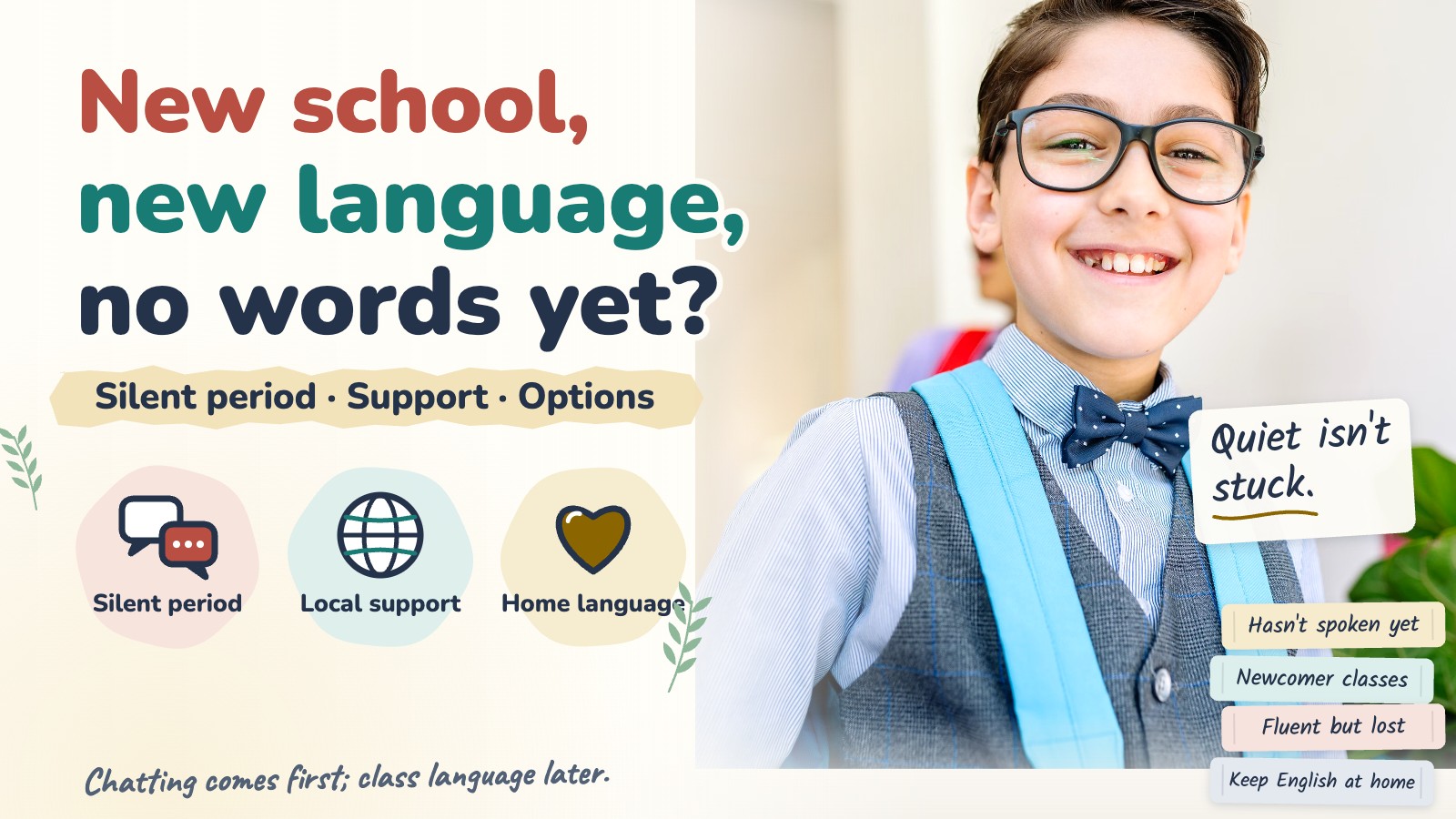
Many parents expect a child to be chattering in the new language within weeks. Some are. Many others spend a stretch of time saying very little at school. Researchers call this the silent period, and it is a widely described phase for children who arrive in a school where they do not yet speak the language.
“Silent” is a slightly misleading word. A 2025 scoping review in the Journal of Child Language by Kan and colleagues looked at 40 studies of young children learning a community language after a different home language. It found that children in this phase were actively communicating in other ways: through gestures and other nonverbal means, through “private speech” (quietly talking to themselves), and through their home language. The review also highlighted the role of teacher support and interaction with classmates in helping children move forward.
Quiet at school does not mean not learning
A research review of 40 studies found children using several strategies before they spoke much of the new language.
01
Nonverbal communication
Pointing, nodding, copying what other children do, joining games that don’t need words. This is real participation, and teachers can build on it.
02
Private speech
Quietly repeating words and phrases to themselves. It can look like mumbling, but it is a way of practising sounds and patterns before trying them out loud.
03
Home language
Using the language they already have, with anyone who shares it or simply to think. It is not a sign of refusing the new language.
We could not find a reliable, agreed figure for how long this phase lasts, and it clearly differs from child to child. Watch the direction of travel rather than the calendar.
At home, your child may come back exhausted simply because listening hard all day in an unfamiliar language is tiring. Quiet evenings and early nights can help more than extra lessons in the first weeks.
Playground language vs classroom language: BICS and CALP
The single most useful idea for parents in this situation comes from the Canadian researcher Jim Cummins. He distinguished between BICS (basic interpersonal communicative skills: everyday conversational language) and CALP (cognitive academic language proficiency: the language needed to understand and express ideas in school subjects). In a 2008 overview, Cummins explained that the distinction was intended to draw attention to the timelines and challenges second-language learners face in catching up with classmates in the academic side of the school language.
| Conversational (BICS) | Academic (CALP) | |
|---|---|---|
| What it sounds like | “Can I play?” “Where’s the toilet?” Jokes, games, lunch talk | “Explain why the result changed.” “Compare the two sources.” |
| Helped by | Gestures, faces, the situation itself | Mostly words alone, often abstract or written |
| Where you notice it | Playground, clubs, the shop | Worksheets, tests, textbooks, homework |
| Why it matters | Your child sounds fluent | Your child can still be lost in lessons |
How long does each take? The best-known research comes from children learning English in English-speaking school systems, so treat the figures below as an indication rather than a promise for Japanese or German.
| Study | What it found |
|---|---|
| Hakuta, Butler and Witt, University of California Linguistic Minority Research Institute (2000), data from four school districts | “Oral proficiency takes 3 to 5 years to develop, and academic English proficiency can take 4 to 7 years.” |
| Collier, TESOL Quarterly (1987), 1,548 students taught in English in all subjects | At least four to eight years may be needed to reach national grade-level norms of native speakers. |
Around the point when a child sounds fluent with friends, it is easy for everyone, parents and teachers alike, to assume the language question is solved. Sounding fluent and being able to learn fractions or history through the language are different milestones, and the research above suggests the second one takes years, not months. Keep asking how your child is doing in lessons, not only socially.
How age changes the picture
There is no single “best age” to join a local school, and we have not included claims about one because the research is more complicated than popular sayings suggest. What we can say is that age changes how a school system places your child and how much academic content is waiting for them. The official pages we checked show the same pattern: the youngest children tend to go straight into ordinary classes, older ones are more likely to get a separate language class first.
| Age | What official pages describe | What it means in practice |
|---|---|---|
| 6–7 | Berlin: children of this age usually go directly into the ordinary school-entry phase, not a welcome class | Classmates are also early readers; lessons are concrete and visual |
| Roughly 8–12 | Berlin: welcome classes from age 8. Amsterdam: newcomer classes for ages 6–12, usually for about a year | A year of focused language before full lessons; academic content is building |
| 12 and over | Amsterdam refers to “international bridging classes” for this age group | Subject content is dense and exams start to matter |
| Any age (Japan) | MEXT’s guidebook: grade is set by age, but a child can be placed temporarily in a lower grade if their Japanese is not yet enough | Ask about this option if it would help; it is decided locally |
Two practical points follow. First, a teenager joining a local secondary school may face years of subject learning in a language they are still acquiring, just as exams approach. That raises the stakes. Second, older children usually already read and write well in their first language, and that is an asset they bring with them.

What support local state schools may offer: three real examples
Many countries have some form of newcomer language support in state schools. It is called different things, is organised differently and is not always available at the school nearest you. Here are three examples we were able to verify on official pages.
| Where | What it is | Key details we verified |
|---|---|---|
| Japan (national, MEXT) | Japanese-language instruction as a “special curriculum” (tokubetsu no kyōiku katei) | In force since 1 April 2014 for elementary and lower secondary levels. Taught outside the child’s regular classroom. Standard of 10 to 280 class periods a year. Led by a licensed teacher, with an individual plan and evaluation. Can be provided at another school where staff are hard to find. |
| Berlin, Germany | Willkommensklassen (welcome classes) | Small learning groups for newly arrived children aged 8 and over without German. Should normally last at most one year. Children join ordinary lessons in some subjects such as art, music and sport from the start where possible. Apply through the coordination office of the district school authority. |
| Amsterdam, Netherlands | Newcomers’ classes (nieuwkomersklassen) | For children aged 6–12 who are new to the Netherlands and don’t speak Dutch. Focus on learning Dutch and getting to know Dutch culture. Around one year, then regular Dutch or bilingual education. No additional cost to attend. |
A few things are worth knowing about Japan in particular. MEXT publishes a school-entry guidebook for foreign families in several languages, including English. It says tuition at public elementary and junior high schools is free, textbooks are provided free, and lessons are normally taught in Japanese. Its wording to foreign families is permissive (“if you would like to enroll your child…”), and it notes that in some areas the designated school may be changed so that a child can receive enough Japanese-language instruction. In other words, the national framework exists, but what your local school can actually provide depends on the municipality.
Do not assume that support exists at your nearest school, and do not assume it doesn’t. The Dutch government’s page on schooling for pupils from Ukraine, for instance, says provision takes different forms depending on local situations. Contact the local education office before you sign a lease if school support is a deciding factor.
Questions to ask the local school before you enrol
You are not being difficult by asking these. If you don’t yet speak the language, ask whether an interpreter can join school meetings, or bring a trusted person.
| Question | Why it matters |
|---|---|
| 1. Is there a separate language class, or pull-out lessons, and how many hours a week? | “Support” can mean a daily class or one short lesson a week |
| 2. Who teaches it, and are they trained in teaching it as a second language? | A subject teacher with a spare hour is not the same as a specialist |
| 3. How long does support usually last, and what happens when it ends? | Many programmes run about a year; academic language takes longer |
| 4. Which grade will my child join, and can that be reviewed? | Placement by age is common, but some systems allow flexibility |
| 5. How will you assess progress, and how will you tell me? | You need information in a form and language you can understand |
| 6. Are there other children at the school who speak our language or English? | A single friend who shares a language can make early weeks easier |
| 7. What happens with tests and homework while my child can’t read them? | Tells you whether the school adapts, or simply expects children to cope |
A realistic plan for the first year
Rather than asking “is it working?” every week, it helps to agree with yourself (and your child’s teacher) what reasonable progress looks like at different points. The stages below are not research milestones; they are a practical way of organising your check-ins.
Settle first, then speak, then learn through the language
Children move at different speeds. Use these as conversation prompts with the school, not as a test.
01
Settling in
Is your child willing to go to school, following routines by watching others, and eating lunch? Early on, belonging matters more than words.
02
Starting to speak
Are there set phrases, a friend or two, games in the new language? Is the teacher seeing participation, even if it is mostly nonverbal?
03
Learning through it
Can your child follow parts of lessons, and is there a plan for the subjects they can’t yet access? This is the long stage.
If your child seems stuck at the first point for a long time, that is the moment to talk to the school, rather than waiting for the end of the year.
Keep homework in proportion. If a worksheet is impossible to read, ask the teacher what matters most and whether it can be adapted. Explaining subject ideas in your home language can help the concepts land while the school vocabulary catches up.
Signs it isn’t working, and when to get an assessment
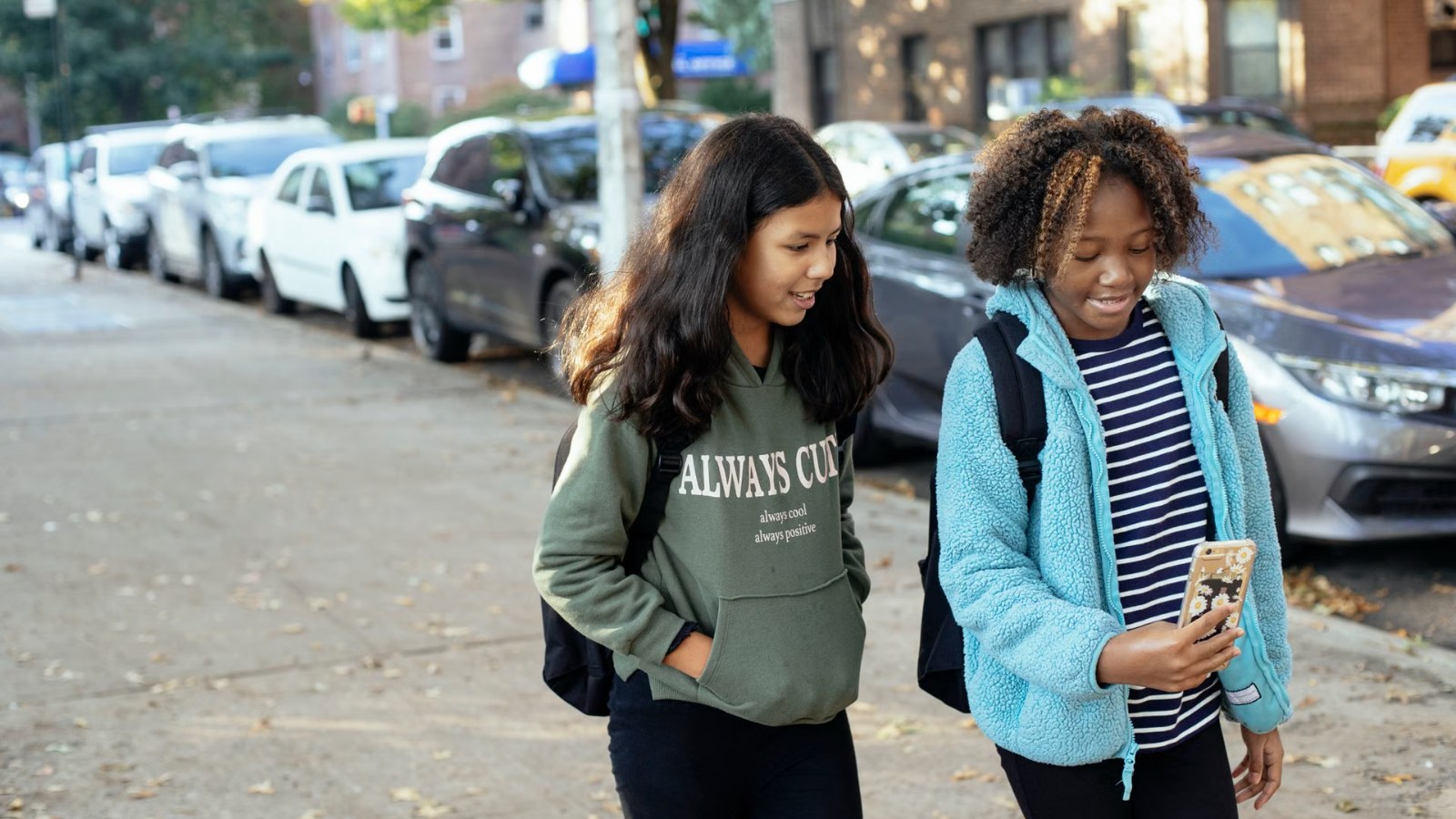
Immersion is hard for almost every child at the start, so some upset is expected. The question is whether things are gradually getting easier. The table below separates ordinary adjustment from signs that deserve a conversation with the school, and possibly a professional.
| Usually part of adjusting | Worth raising with the school |
|---|---|
| Tired and irritable after school for the first weeks | Still exhausted or dreading school after many months, with no improvement |
| Saying little at school, but playing or joining in | Isolated for a long time: no friends, eating alone, not joining in at all |
| Mixing languages in one sentence | Your child’s first language also seems to be slipping badly, not just less used |
| Understanding more than they can say | Not understanding simple classroom routines after a long stretch |
| Occasional reluctance on Monday mornings | Stomach aches, headaches or refusing to go, becoming a pattern |
Sometimes a child’s difficulties are not only about the new language. A leaflet from the speech-language pathology team at Cincinnati Children’s Hospital notes that children growing up bilingual develop language a little differently, but this is not a true disorder; a language disorder is when a child’s skills are significantly poorer than expected in their native or dominant language. The practical point: if you have concerns, ask for an assessment that looks at your child’s first language too, ideally by a professional who can work in that language or with an interpreter. An assessment done only in the new school language, a few months after arrival, is likely to mistake “still learning” for a problem.
Loneliness and constant stress can affect children’s mental health, whatever the cause. If your child’s mood, sleep or eating change noticeably, or they talk about not wanting to be anywhere, contact the school and a doctor promptly rather than waiting to see whether the language improves.
Keeping your home language (and English literacy) strong
When a child is working hard to learn a new school language, parents sometimes wonder whether they should switch to that language at home to help. For most families, the advice from child-development sources points the other way. The Australian government-funded Raising Children Network suggests that if a child becomes less willing to use their heritage language as they get older, parents should keep using it with them, especially at home. Cincinnati Children’s leaflet similarly says it is easiest for children to use one language at home as much as possible, and describes the risk of “subtractive” language acquisition, where a first language stops being used and is replaced by the second.
English-speaking families have an extra consideration: many will move again, perhaps back to an English-speaking system. If your child learns to read and write only in Japanese or Dutch, their written English may fall behind their age even while spoken English stays strong.
Three habits that keep English alive
None of these need to take long. Consistency matters more than volume.
01
Talk properly
Keep rich conversation at home in English: stories, arguments, plans, feelings. This is where vocabulary for ideas, not just everyday things, grows.
02
Read together
Reading aloud and independent reading in English keep literacy growing in step with your child’s age, which the local school cannot do for you.
03
Find English friends
A club, sports team, library group or online contact where English is the normal language helps it feel like a living language, not just “Mum and Dad’s”.
If one parent speaks the local language, children can benefit from hearing both; the aim is simply that English does not quietly disappear.
Local school, international school or online: an honest comparison
Full immersion can be a wonderful experience. It can also be the wrong fit for a particular child, age or family that will move again soon. Here is how the three main routes compare in general.
Immersion, international, or online
| Local state school | International school | Online school | |
|---|---|---|---|
| Daily immersion in local language | ○ | △ some lessons | × |
| Learning in English from day one | × | ○ usually | △ check school |
| Low or no tuition | ○ often free | × high fees | △ varies |
| In-person friends and community | ○ | ○ | × |
| Continues if you move again | × | × | ○ |
○ = generally yes △ = depends × = generally no / General tendencies, not a judgement on any particular school. Tuition for local schools is based on the examples above. As of September 2026.
Some families combine routes, for example a local school plus English literacy at home. An online school does not give your child a local community, so if you choose one, plan for in-person contact through activities.
An online option with bilingual mentors: NIJIN GLOBAL ACADEMY
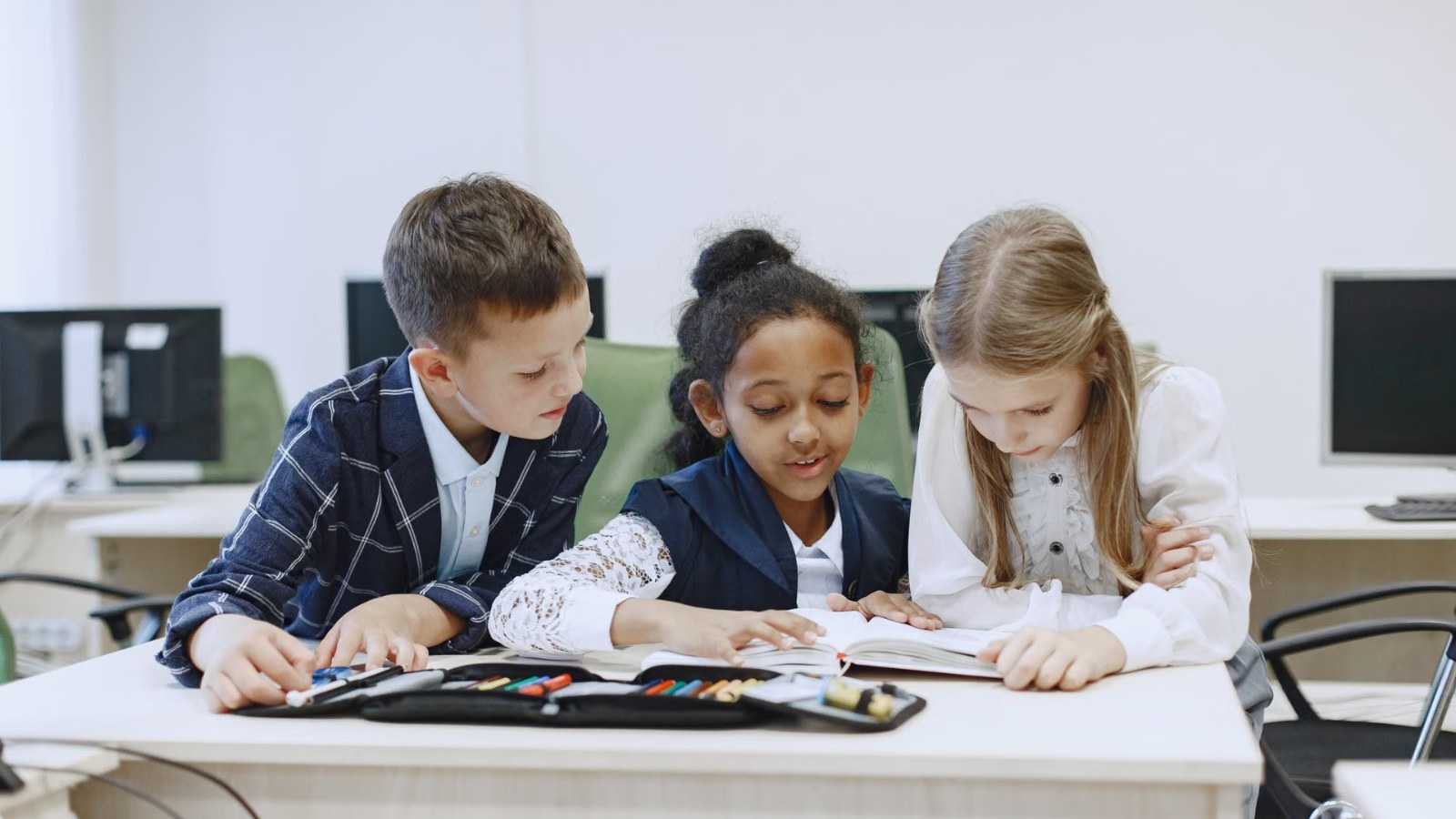
NIJIN GLOBAL ACADEMY (NGA) is an online international school for ages 6–18, run by NIJIN, the company behind this site. We mention it as one alternative for families who are unsure whether full immersion is right, or who expect to move again. Please read the limitations as carefully as the features.
| What NGA says it offers | Why it may matter for this decision |
|---|---|
| Bilingual (English and Japanese) mentors who stay with each small group | Support in English, and in Japanese for families in or connected to Japan |
| No entrance exam and no English requirement | No need to “prove” language level before joining |
| Classes of eight, with the same small group every day and a daily morning circle | A predictable group, rather than a large class where a new child can go unnoticed |
| No rankings; describes itself as a place where children “cheer each other on rather than compete” | Less comparison for a child who is already finding a move hard |
| Timetables for Asia and Oceania time zones; “portable”, so learning continues if the family moves | One school through several relocations in the region |
| Optional Cambridge IGCSE and A-Level | An internationally recognised pathway if you later return to an English-language system |
NGA opens in September 2027. Free trial classes are planned monthly from September 2026. Tuition has not been published yet; NGA says fees will be well below in-person international schools and will be shared first with its mailing list. There is no physical campus, so it cannot give your child daily immersion in the local language or local friendships; you would need to arrange those separately. Its bilingual support is English and Japanese only, so it does not help with German, Dutch, Korean or Thai. NGA does not issue a Japanese high-school diploma, and its FAQ says mentor hiring criteria and absence policies are still being prepared. Figures such as “1,000+ students” or a 97% attendance-recognition rate that appear in NIJIN materials belong to its sister school, NIJIN Academy, not to NGA.
NIJIN GLOBAL ACADEMY is an online international school for ages 6–18 with classes of eight, bilingual English/Japanese mentors and no English requirement. It opens in September 2027, with free trial classes planned from September 2026.
Frequently asked questions
Sources used for this article
- Kan, P. F., Jones, M., Meyers-Denman, C. and Sparks, N., “Emergent bilingual children during the silent period: A scoping review of their communication strategies and classroom environments”, Journal of Child Language 52(3) (2025): PubMed
- Cummins, J., “BICS and CALP: Empirical and Theoretical Status of the Distinction”, Encyclopedia of Language and Education, Springer (2008): Springer
- Hakuta, K., Butler, Y. G. and Witt, D., “How Long Does It Take English Learners to Attain Proficiency?”, University of California Linguistic Minority Research Institute (January 2000): ERIC / eScholarship
- Collier, V. P., “Age and Rate of Acquisition of Second Language for Academic Purposes”, TESOL Quarterly 21(4) (1987): ERIC
- Ministry of Education, Culture, Sports, Science and Technology (MEXT), notice on the “special curriculum” for Japanese-language instruction (14 January 2014): mext.go.jp and overview page: mext.go.jp
- MEXT, Guidebook for Starting School (English edition) and multilingual guidebook page: English PDF / mext.go.jp
- Berliner Familienportal (State of Berlin), “Willkommensklassen in Berlin”: familienportal.berlin.de
- I amsterdam (City of Amsterdam’s official portal), “Newcomers’ classes for primary school children”: iamsterdam.com
- The Hague International Centre, “Newcomer classes”: thehagueinternationalcentre.nl
- Rijksoverheid (Government of the Netherlands), “Welke onderwijsvoorzieningen zijn er voor leerlingen uit Oekraïne?”: rijksoverheid.nl
- Raising Children Network (Australia), “Raising bilingual children: tips” (reviewed 2025): raisingchildren.net.au
- Cincinnati Children’s Hospital Medical Center, Division of Speech-Language Pathology, bilingualism information leaflet (2015): cincinnatichildrens.org (PDF)
- NIJIN GLOBAL ACADEMY, FAQ and “Why NGA” pages (checked September 2026): FAQ / Why NGA / Tuition & Admissions
If your family expects to relocate again, or your child needs to keep learning in English while the local language grows, NIJIN GLOBAL ACADEMY offers live online classes across Asia and Oceania time zones. Tuition is yet to be announced; the school opens in September 2027.
Published: 22 September 2026 / Last updated: 22 September 2026