Menu
BASICS
How Japanese schools work Japanese phrases for school Glossary of school termsWAYS TO LEARN
Free schools Education support centers Online schools Homeschooling in Japan International schools Correspondence high schoolsMORE
Neurodivergent children Where to get help Attendance and costs Learning Place Finder 日本語サイトへDyslexia Assessment for an Expat Child: Getting Support Abroad
- How authoritative bodies define dyslexia — and what it is not
- How to tell a second-language lag apart from a reading difficulty
- Early signs by age, from preschool to secondary school
- What an assessment involves, and who is qualified to do one abroad
- Eight things to check before you book and pay for an assessment
- What support at school looks like, and what exam boards say about access arrangements
This is general information for parents, not medical, educational or legal advice. Rules, professional titles and funding differ in every country, and what one school accepts another may not. Fees and waiting times vary so widely that we have not quoted any. If you are worried about your child’s mood, sleep or wellbeing, speak to your family doctor as well as the school.
What dyslexia is — and what it is not
The NHS describes dyslexia as “a common learning difficulty where your brain works differently to most people” that “mainly affects things like reading, writing, and using numbers”. It adds the sentence that matters most to worried parents: “It does not affect intelligence.”
The International Dyslexia Association’s 2025 definition says something similar in more technical language: dyslexia is “a specific learning disability characterized by difficulties in word reading and/or spelling that involve accuracy, speed, or both.” Those difficulties “vary depending on the orthography” and “occur along a continuum of severity” while persisting despite effective instruction.
The British Dyslexia Association presents the consensus definition reached by a Delphi study of researchers and practitioners: “Dyslexia is a set of processing difficulties that affect the acquisition of reading and spelling.” It adds that “difficulties in reading fluency and spelling are key markers of dyslexia” across languages, and that “the most commonly observed cognitive impairment in dyslexia is a difficulty in phonological processing.”
That definition also notes that dyslexia “frequently co-occurs with one or more other developmental difficulties, including developmental language disorder, dyscalculia, ADHD, and developmental coordination disorder.” If you are also wondering about attention or social communication, our guide on getting an ADHD or autism assessment as an expat family covers that; this article stays with reading and spelling. And it is never too late: the IDA says identification and targeted instruction “are important at any age.”
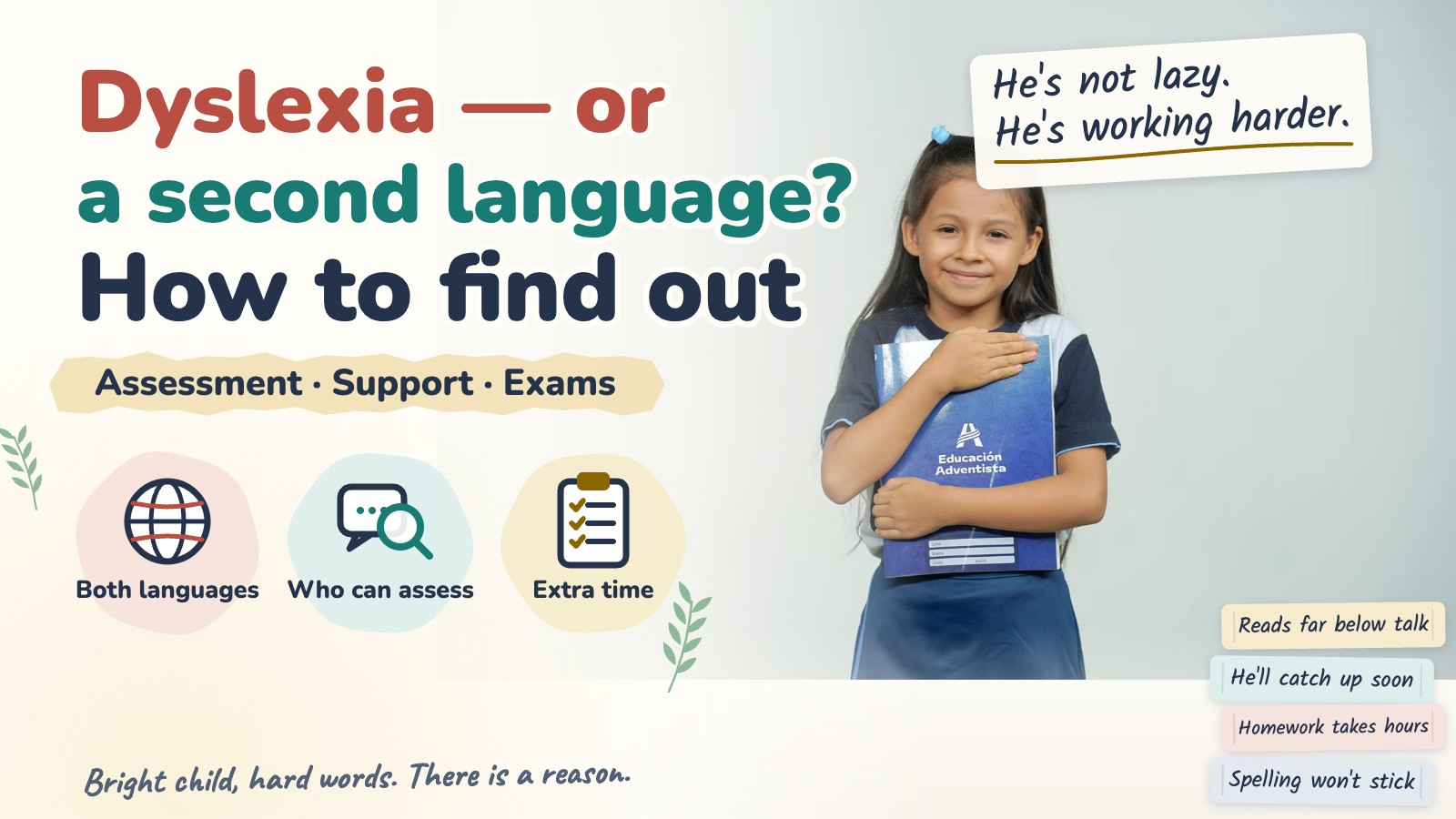
Is it dyslexia, or is it the second language?
This is the question that stalls expat families for years. A child who has moved into an English-medium school, or a local-language school abroad, will read slowly and spell oddly for a while simply because the language is new. When do you stop waiting?
The International Dyslexia Association addresses this in its guidance on English learners: “teasing apart these two factors is important for an accurate identification of dyslexia.” Its steer is that “if a student seems to have literacy skills in their native language but struggles with English, the issue might be related to limited exposure to high-quality instruction in English,” whereas “if a student has difficulty in their native language, that might point toward dyslexia.”
Three questions that tell a language lag from dyslexia
None of these is a diagnosis. They are what a good assessor will ask you for, so have the answers ready.
01
Both languages?
SASC, the UK standard-setting body for specialist assessors, notes that where a specific learning difficulty is suspected, the student has likely had similar problems in their other languages too.
02
How long in English?
The same guidance says that where overall experience of English has been under seven years, “some impact on syntax, vocabulary and comprehension is generally to be expected.” Persistent difficulty after longer exposure is a flag.
03
Compared with whom?
The IDA advises comparing a child with “peers with similar native languages and background experiences,” not with classmates who grew up in the language of instruction.
The answer to all three lives partly outside school — which is why an assessment has to consider every language your child uses.
An assessment in only one of your child’s languages can mislead. SASC warns that most tests “have been developed and standardised on populations that are predominantly English-speaking,” and that background information “has a heightened role” here, because it is what lets an assessor separate a specific learning difficulty from “other linguistic and cultural factors.”
If your child is also silent or withdrawn in class, the picture gets more complicated — see our guides on selective mutism in bilingual children and on starting at a local school in a language your child doesn’t speak.
Early signs, by age
No single sign means dyslexia. What matters is a pattern that persists, and a gap between how your child sounds when they talk and what they produce on paper. The list below comes from the NHS and the British Dyslexia Association.
| Stage | What is often noticed |
|---|---|
| Preschool | NHS: learning to speak later than other children; little interest in language activities such as saying the alphabet |
| Primary — reading | BDA: slow reading progress; difficulty blending letters; “hesitant and laboured reading, especially when reading aloud”; missing or adding words |
| Primary — writing | BDA: “poor standard of written work compared with oral ability”; confusing b/d and p/g; spelling the same word differently in one piece; “phonetic and bizarre spelling” |
| Primary — other | BDA: trouble telling the time; confusion with yesterday/today/tomorrow; difficulty with tables and sequences; left/right confusion |
| Across ages | NHS: messy written work with many spelling mistakes; difficulty planning schoolwork. BDA: slow processing, difficulty following instructions, forgetting words |
The BDA also lists things easily read as character flaws: “work avoidance tactics,” appearing “dreamy,” being easily distracted, being “excessively tired due to amount of concentration and effort required.” A child decoding every word works far harder than classmates for the same page. The NHS adds that frustration can lead to “disruptive behavior, or make a child become withdrawn at school and home.” If your child’s behavior changed before their reading was ever discussed, that order of events is worth telling the school.

Why a child abroad can be missed for years
The most common outcome for an expat child with reading difficulties is not a wrong diagnosis. It is no diagnosis at all, for years, because there is always a reasonable-sounding explanation available. The IDA describes exactly this pattern: English learners with dyslexia were “less likely to be identified” early, and schools may fail to identify them by “attributing any English reading and writing difficulties to their status as English learners” — yet “by third grade, the proportion of non-native, English-speaking students identified with dyslexia was higher than expected.” Identified late, and then in a rush.
| What you may hear | What to ask instead |
|---|---|
| “He’s still acquiring English.” | How is he doing against peers who arrived at the same time, with similar language backgrounds? |
| “She’s just not applying herself.” | Is her written work far below what she can say out loud? |
| “Let’s give it another year.” | What exactly will be different next year, and what do we measure in March? |
| “We don’t assess before Year 3.” | What targeted reading support starts now, while we wait? |
| “He’s fine, he’s happy.” | How long does homework take at our end of the day? |
Mobility is the second reason children slip through: a concern raised in spring rarely reaches the new school in a new country in September, because the file that travels is the transcript, not the worry. If you are moving, put your concerns in writing and ask for them to go into the records that transfer — the same principle we describe in our guide to changing international schools mid-year.
What a dyslexia assessment actually involves
First, a screener is not a diagnosis. The British Dyslexia Association says “screening tests and checklists can be a great help in order to ensure support is put in place quickly, but they can’t provide a diagnosis”; dyslexia “can only be formally diagnosed through a Diagnostic Assessment carried out by a certified assessor.” The BDA assesses children from age 7 onwards, to comply with SASC guidelines.
Second, who does it. The NHS is explicit: “An educational psychologist or a specialist teacher will usually do a dyslexia assessment, not a doctor.” It adds that “a GP cannot diagnose dyslexia,” though a doctor can check hearing and vision. It suggests starting with the school’s special educational needs coordinator, and notes that “most people have to pay for an assessment.”
Three things a good assessor gathers
The tests are only one third of it. For a multilingual child, the first card carries the most weight.
01
Background and history
SASC guidance asks which languages were used at home and in schooling, at what age each became dominant, and whether the child reads and writes in their first language. The IDA adds family history and years of good instruction.
02
Reading and spelling
The Delphi definition names reading fluency and spelling as key markers. The IDA suggests gathering work samples: “written spelling assessment, written expression, and oral reading with error analysis.”
03
Underlying processing
Phonological processing is the most commonly observed cognitive difficulty in dyslexia, with working memory, processing speed and orthographic skills also shaping how it shows up.
A report with test scores but no language history is of limited use to a multilingual family.
A report also has a shelf life. SASC advises reassessment after more than one year for a primary-aged child and more than two years for a secondary student. Exam boards set their own windows: Cambridge International tells exams officers that for learning difficulties such as dyslexia, evidence “must be dated within four years” of the exam series, because “their symptoms may change.” If you are assessing a 13-year-old with IGCSEs in mind, check that timing before you book.
Who can assess your child abroad, and what to check first
Outside your home country, professional titles do not map neatly. “Educational psychologist,” “school psychologist” and “dyslexia assessor” can mean very different qualifications in Singapore, Dubai, Jakarta or Sydney. The question is not what the person is called, but whose rules their report has to satisfy.
Two reference points help. SASC recognizes two groups as qualified to carry out diagnostic assessments: specialist teacher assessors holding a current Assessment Practising Certificate (APC) issued by the BDA, the Dyslexia Guild or Patoss, and psychologists registered with the Health and Care Professions Council (HCPC). The BDA tells parents to look for an active AMBDA with recent CPD or a current APC, and to check it “by asking to see copies of each document.” Cambridge International requires evidence “signed by an authorised, qualified person such as a doctor, medical professional, or educational psychologist,” stating “details of their relevant qualifications.”
| Check before you book | Why it matters |
|---|---|
| What is their qualification, and who issued it? | The BDA advises asking to see copies of certificates |
| Will our exam board accept the report? | Cambridge requires a qualified assessor who states their qualifications |
| Will our school accept an outside report? | Some act only on their own assessments. Ask the learning support lead |
| In which language is the assessment done? | The IDA notes screening should align with the language of instruction |
| How are my child’s other languages handled? | SASC cautions that most tests are standardized on English-speaking populations |
| Does it give recommendations, not just scores? | You need classroom actions the school can implement |
| How recent must it be for exams? | Cambridge: within four years. SASC: reassess after one year (primary), two (secondary) |
| Will it be recognized if we move? | No one can promise this. Ask whether the credential travels |
Fees, waiting lists and whether anything is subsidized differ enormously by country and provider, and in most places families pay. We have deliberately not quoted figures, because any number we gave would be wrong somewhere. Ask two or three local providers before you commit.

Support at school, and exam access arrangements
Teaching that actually changes reading
The IDA describes Structured Literacy as “the most effective approach for students who experience unusual difficulty learning to read and spell printed words.” It covers phoneme awareness, sound-symbol correspondences, syllable types, morphology, syntax and semantics — taught explicitly and systematically. In the IDA’s words, “the teacher explains each concept directly and clearly, providing guided practice,” follows “a planned scope and sequence of skills,” and “uses student response patterns to adjust pacing, presentation, and amount of practice.”
That last phrase is worth quoting when a school offers “extra reading” with no named method.
| Ask the school for | What a clear answer sounds like |
|---|---|
| A named structured literacy approach | The program name and who is trained in it |
| Frequency and group size | “Four times a week, 30 minutes, groups of three” |
| Classroom adjustments | Less copying from the board, printed notes, extra time in class tests, spelling not penalized outside spelling work |
| Assistive technology on everyday work | Text-to-speech, speech-to-text, spellcheckers, screen and font settings, touch-typing. Dyslexia Scotland notes “a lot of this technology is free or low cost” |
| A review date | A fixed date to look at progress data together |
Exams: start earlier than you think
Exam boards allow adjustments, but on their terms. The International Baccalaureate frames its approach as removing or reducing “barriers so that every student can fully participate in IB programmes.” Cambridge International’s guidance to exams officers contains the rule parents discover too late: arrangements must reflect the candidate’s normal way of working — candidates “should be using these arrangements for their classwork and homework, as well as class tests and mock exams.”
| Cambridge International says | What it means for you |
|---|---|
| Evidence must show the barrier and “their corresponding need for the access arrangements” | A label alone is not enough |
| Scores in the below-average range: standardized 84 or below, percentile 15 or below, scaled 6 or below | Ask your assessor to report scores in a form the board recognizes |
| Evidence “must be dated within four years” of the exam series | An assessment done at age 8 will not support exams at 16 |
| Arrangements may include reader, word processor, scribe, 25%–100% extra time, supervised rest breaks | Each must be justified by matching evidence |
| Arrangements should be the normal way of working | Put the laptop or reading pen in place years before the exam |
Applications are made by the school as an exam center, not by you. Ask in writing who is responsible, and by which internal deadline.
What you can do at home
You are not your child’s therapist, and home should not become a second school day. The aim is to keep reading something that happens with you, and to protect your child’s sense of being capable.
| Instead of… | Try… |
|---|---|
| Making your child read aloud to prove progress | Taking turns, so the story keeps moving |
| Correcting every spelling in every piece | Agreeing the one thing you work on this week |
| Homework that runs past bedtime | A time limit agreed with the teacher, and signing off what was done |
| Treating audiobooks as cheating | Using them so ideas and vocabulary grow while decoding catches up |
| Dropping the home language to “focus on English” | Keeping it — the IDA treats first-language literacy as diagnostic information |
Keep a short, dated record: how long homework took, which words came back wrong three weeks running, what your child said about reading group. When you finally sit down with an assessor, that record is evidence no test can reproduce. And protect one place where your child is unquestionably good at something — sport, music, cooking, a language they speak beautifully even if they cannot spell it.
Finally, tell your child what is going on, in words that match their age. Children who are not told why reading is hard reach a conclusion on their own, and it is rarely a kind one.

Stay, specialist provision, or online school?
Most children with dyslexia stay in mainstream school and do well there with the right teaching. Some move to a school with specialist literacy provision. A few families abroad, especially those who move often or live where provision is thin, look at online schooling. Here is how the three compare.
Stay, go specialist, or learn online
| Stay and press for support | Specialist provision | Online school | |
|---|---|---|---|
| Daily structured literacy | △ depends | ○ | △ ask first |
| Trained dyslexia specialists | △ varies | ○ | × not advertised |
| Keeps friends and routine | ○ | × new setting | △ outside school |
| Works if you move again | × | × | ○ |
| Small group, less reading aloud | × large classes | ○ | ○ |
○ = generally yes △ = depends × = generally no / General tendencies, not a judgment on any particular school. As of September 2026.
Note the second row. An online school is not a substitute for specialist literacy teaching unless it says in writing that it provides it. For many families the honest arrangement is online school plus a separate specialist tutor for reading — plan and budget for both.
An online option to consider: NIJIN GLOBAL ACADEMY
NIJIN GLOBAL ACADEMY (NGA) is an online international school for ages 6–18, run by NIJIN, the company behind this site. We mention it because small-group learning suits some children who have spent years dreading being asked to read aloud to a class of twenty-five. Please read the limitations as carefully as the features.
| What NGA says it offers | Why it can matter for a struggling reader |
|---|---|
| Classes of eight, the same group daily, with a morning circle | Fewer listeners when your child reads |
| Bilingual (English and Japanese) mentors who stay with each group | A named adult who knows how your child works |
| No rankings; children “cheer each other on rather than compete” | Less of the public comparison that makes slow reading feel like failure |
| No entrance exam and no English requirement | No literacy test at the door |
| Asia and Oceania timetables; described as “portable” | Support does not reset every relocation |
| Optional Cambridge IGCSE and A-Level | A recognized exam route, if access arrangements can be organized (ask) |
NGA does not advertise specialist dyslexia provision. We found no statement on its site about structured literacy teaching, specialist assessors, or how it would support a child with a diagnosed specific learning difficulty — do not assume it is there; ask directly. NGA opens in September 2027, and free trial classes are planned monthly from September 2026. Tuition has not been published yet; NGA describes it as far more affordable than a typical international school and says exact fees will be shared first with its email community. Its FAQ says mentor hiring criteria and absence policies are still being prepared, and enrollment and withdrawal policies, including mid-year joining, are in preparation. There is no physical campus, and NGA does not issue a Japanese high-school diploma. Figures such as “1,000+ students” or a 97% attendance-recognition rate belong to its sister school, NIJIN Academy, not to NGA.
NIJIN GLOBAL ACADEMY is an online international school for ages 6–18 across Asia and Oceania, with classes of eight and bilingual mentors. It opens in September 2027, and free trial classes are planned monthly from September 2026. If literacy support is your priority, ask what it can provide first.
Frequently asked questions
Sources used for this article
- NHS, “Dyslexia” (checked September 2026): nhs.uk
- NHS, “Dyslexia — Diagnosis” (checked September 2026): nhs.uk
- International Dyslexia Association, “Definition of Dyslexia” (2025 revision, adopted 22 October 2025): dyslexiaida.org
- International Dyslexia Association, “English Learners and Dyslexia”: dyslexiaida.org
- International Dyslexia Association, “Structured Literacy: Effective Instruction for Students with Dyslexia and Related Reading Difficulties”: dyslexiaida.org
- British Dyslexia Association, “What is dyslexia?” (including the Delphi consensus definition): bdadyslexia.org.uk
- British Dyslexia Association, “Signs of dyslexia (Primary school age)”: bdadyslexia.org.uk
- British Dyslexia Association, “How is dyslexia diagnosed?”: bdadyslexia.org.uk
- British Dyslexia Association, “What should I be looking for in an assessor when seeking a dyslexia diagnosis?”: bdadyslexia.org.uk
- British Dyslexia Association, “Diagnostic Assessments” (assessment from age 7, per SASC guidelines): bdadyslexia.org.uk
- SASC (SpLD Assessment Standards Committee), “Frequently Asked Questions”: sasc.org.uk
- SASC, Guidance on the assessment of individuals for whom English is an additional language (November 2019): sasc.org.uk (PDF)
- Cambridge Assessment International Education, Evidence for access arrangement applications (guide for Cambridge Associate exams officers): cambridgeinternational.org (PDF)
- International Baccalaureate, “Inclusive education in the IB”: ibo.org
- Dyslexia Scotland, “Dyslexia and assistive technology”: dyslexiascotland.org.uk
- NIJIN GLOBAL ACADEMY, FAQ and school pages (checked September 2026): nijinglobal.academy

NIJIN GLOBAL ACADEMY runs live online classes of eight with bilingual mentors and no rankings, for families across Asia and Oceania. It opens in September 2027, tuition is not yet announced, and free trial classes are planned monthly from September 2026. It does not advertise specialist dyslexia provision, so ask about literacy support.
Published: 23 September 2026 / Last updated: 23 September 2026