Menu
BASICS
How Japanese schools work Japanese phrases for school Glossary of school termsWAYS TO LEARN
Free schools Education support centers Online schools Homeschooling in Japan International schools Correspondence high schoolsMORE
Neurodivergent children Where to get help Attendance and costs Learning Place Finder 日本語サイトへGifted Child Bored at School? A Guide for International School Parents
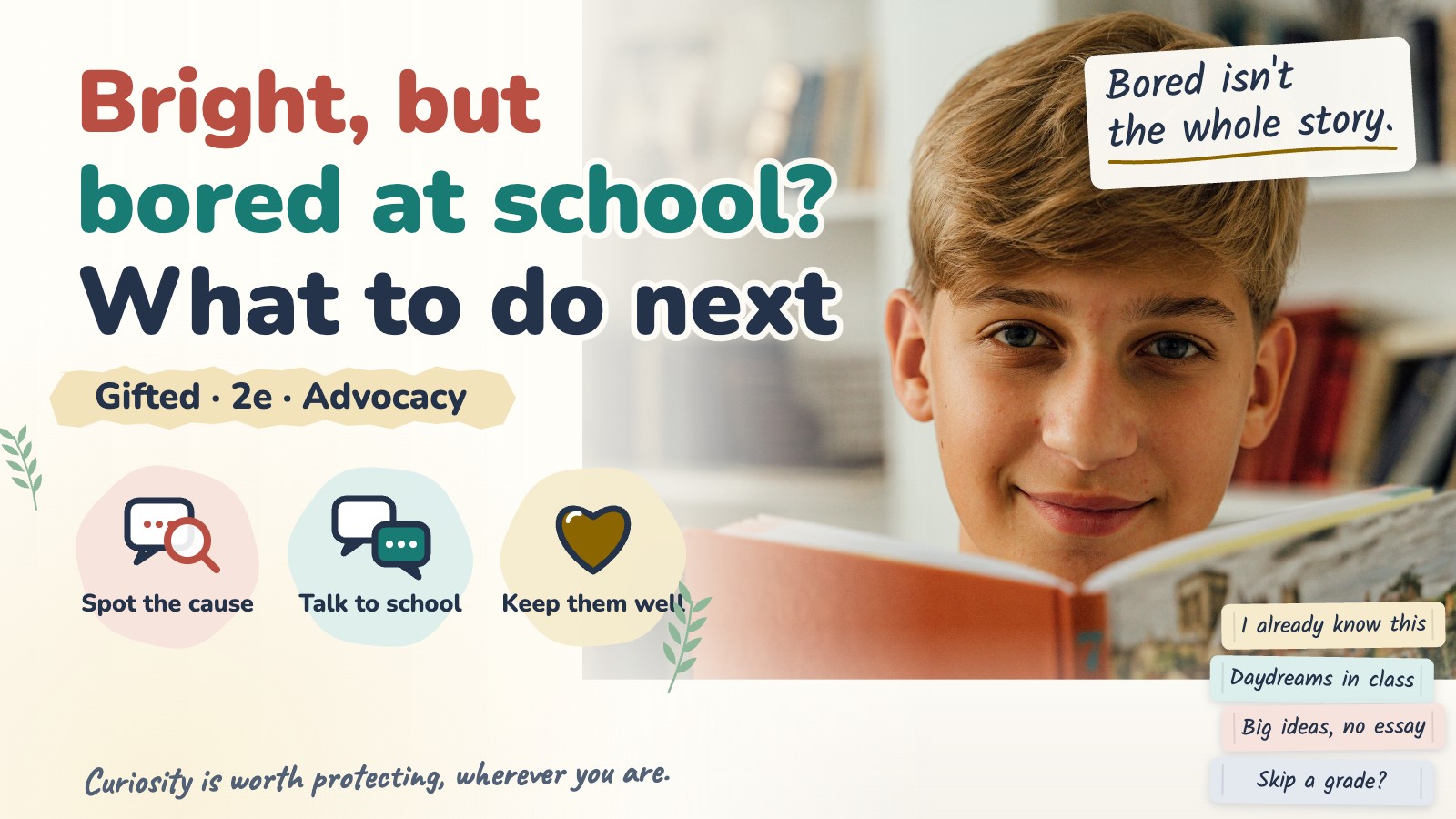
- Why “bored” can mean many things, and how to tell under-challenge from other causes
- What “gifted” and “twice-exceptional (2e)” mean, and why definitions differ from country to country
- The main ways schools respond: differentiation, enrichment and acceleration
- What large research reviews say about acceleration, in plain language
- How to prepare for a productive meeting with the school, and when an assessment helps
- How to protect your child’s wellbeing and love of learning at home
This article is general information for parents, not medical, psychological or legal advice. If your child seems very low, anxious or withdrawn for weeks, or you are worried about their safety, contact a doctor or local health services rather than waiting to see whether things improve.
What “bored at school” can really mean
“Bored” is a small word children use for many feelings. It can mean “I learned this two years ago,” “I don’t understand this,” “I’m lonely,” or “I can’t follow the lessons in this language yet.” The first job is to find out what sits behind it.
For bright children, under-challenge is a real and common reason. The Raising Children Network, an Australian government-funded parenting website, notes that when gifted children don’t have enough opportunities to learn, they may not engage with activities or other children, or may distract themselves or classmates instead of doing the classwork. The Davidson Academy at the University of Nevada, Reno, lists inattentiveness, disruptiveness, underachievement, self-isolation and frustration as common signs of boredom in gifted students.
But almost every item on that list could have another cause: inattention can come from ADHD, anxiety or poor sleep, and underachievement from a learning difficulty the child is hiding. It helps to gather some information before going to the school with a conclusion.
A simple starting point, suggested in different words by the Davidson Academy, is to ask your child for specifics. “What exactly was boring today?” “Did you already know it, or was it hard to follow?” “What would have made it interesting?” An answer like “I already knew all my spelling words” points somewhere quite different from “I don’t get what the teacher wants.”
What “gifted” means, and why definitions differ by country
There is no single international definition of giftedness, and this matters for expat families because each school, and each country, may use a different one. The US-based National Association for Gifted Children (NAGC) describes students with gifts and talents as those who “perform—or have the capability to perform—at higher levels compared to others of the same age, experience, and environment in one or more domains.” NAGC also stresses that gifted children do not all look or act alike, and that they need changes to their educational experience to reach their potential.
Other systems use different language. New South Wales in Australia uses a framework adapted from the researcher Françoys Gagné and speaks of “high potential and gifted” students across four domains: intellectual, creative, social-emotional and physical. In Singapore, the Ministry of Education announced in August 2024 that from the 2024 Primary 1 cohort it would discontinue its Gifted Education Programme in its current form and extend school-based programs so that around 10% of each cohort could benefit, up from around 7%.
| Where | Term used | Key idea |
|---|---|---|
| NAGC (US organization) | Gifts and talents | Performs, or could perform, at higher levels than peers of the same age, experience and environment |
| New South Wales, Australia | High potential and gifted | Potential that exceeds same-age peers in one or more of four domains |
| Singapore (MOE schools) | Higher-ability learners | School-based programs for around 10% of each cohort (from the 2024 P1 cohort) |
| Your international school | Varies | Ask whether it has a written definition or policy at all |
So a label from one country may not carry over to another, and many international schools set their own policies. The most useful question is often not “Is my child gifted?” but “What does this school do for a child who is ready for more?”
Twice-exceptional (2e): when strengths and difficulties hide each other
Some children are both gifted and have a disability or learning difference. The NAGC glossary defines twice-exceptional as “a student who is both gifted and disabled,” and notes the term also applies to students with ADHD or autism alongside giftedness. The Raising Children Network gives examples such as intellectually gifted children with autism, ADHD, hearing loss or specific learning disorders. A 2014 paper by Sally Reis, Susan Baum and Edith Burke in Gifted Child Quarterly proposed a more detailed operational definition, reflecting how complex this group can be to identify.
The key idea for parents is masking. NAGC’s white paper on twice-exceptionality explains that a gifted student with a learning disability often goes unnoticed because their performance looks satisfactory, and that in other cases the disability prevents the child from fully showing their abilities. The Davidson Institute also describes masking as something that can complicate identification.
How a 2e child can slip through the net
These are common patterns described in the gifted-education literature, not diagnoses. A child can move between them over time.
01
Gifts hide difficulty
Strong reasoning lets the child compensate, so grades look “fine.” The difficulty, such as slow writing or reading, only shows when work gets harder.
02
Difficulty hides gifts
Attention, reading or social challenges dominate what teachers see. The child’s ability shows in conversation or hobbies but rarely in schoolwork.
03
Each hides the other
Strengths and difficulties cancel out, so the child looks “average.” They may feel frustrated or bored without anyone knowing why.
If your child’s spoken ideas and written work seem far apart, that gap is worth mentioning to the school and to any professional you see.
The Davidson Institute lists behavioral problems from stress, boredom or lack of motivation among possible characteristics of 2e children, alongside strong curiosity and intense focus on interests. If you are already wondering about ADHD or autism, our guide to getting an ADHD or autism assessment for an expat child covers that process in more detail.
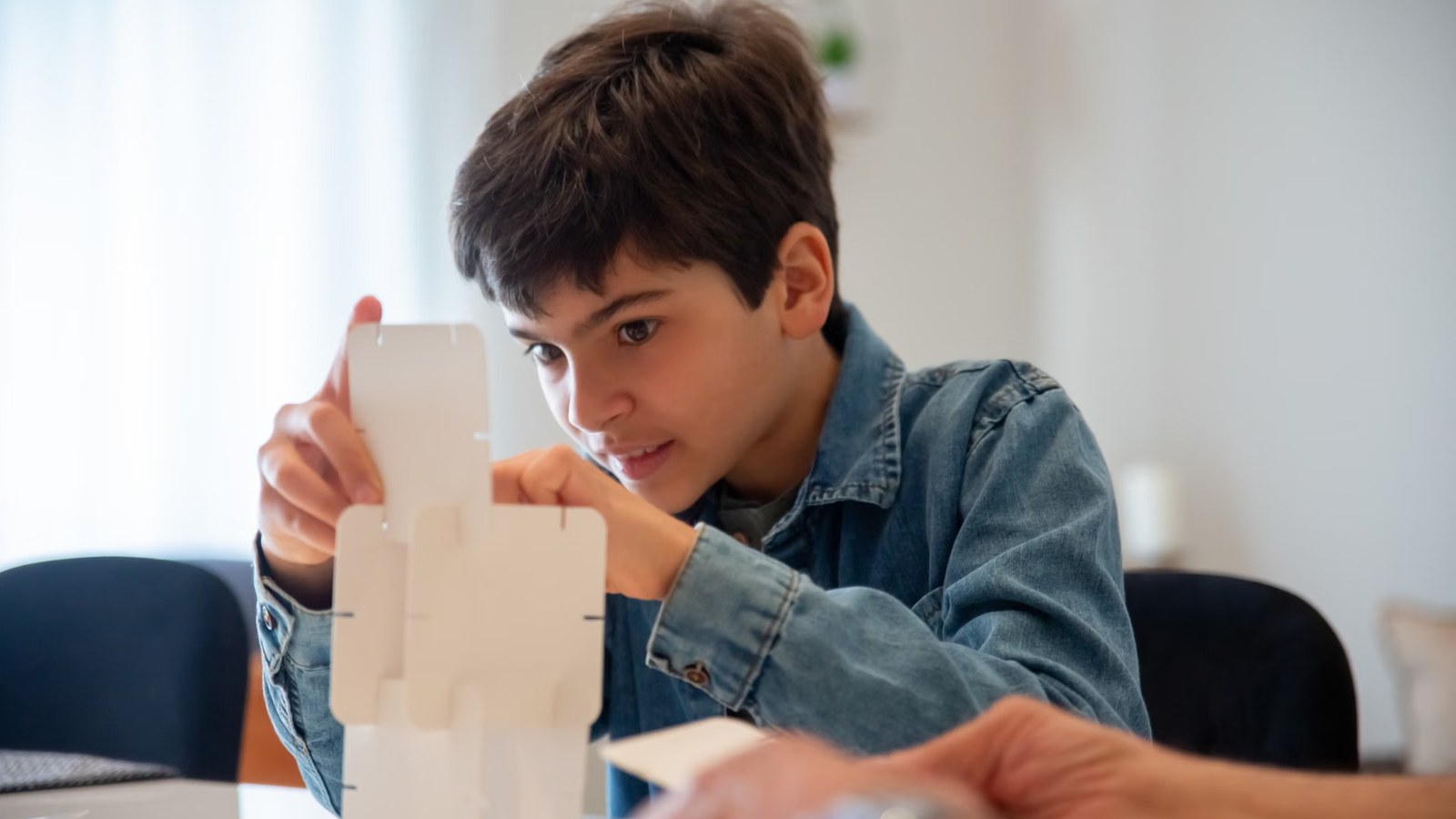
Boredom or something else? Sorting out the causes
A reassuring finding: a 2016 systematic review in Exceptional Children by Rosanna Francis, David Hawes and Maree Abbott looked at 18 studies and reported that gifted children showed better socio-emotional adjustment and fewer behavioral difficulties than typically developing peers, while noting limitations such as samples drawn from gifted programs. So if your bright child is acting out, it is worth asking “why?” rather than assuming it simply comes with being gifted.
The table below is not a diagnostic tool. It is a way of organizing what you notice so that you and the school can look in the right direction.
| What you notice | Points toward under-challenge | Could also suggest |
|---|---|---|
| Daydreams in class | Already knows the material; engaged in challenging tasks | Attention difficulties, poor sleep, anxiety |
| Rushes work, careless errors | Finds tasks too easy to bother checking | Attention difficulties; a hidden learning difficulty |
| Avoids writing tasks | Finds them repetitive | Handwriting, spelling or processing difficulty (possible 2e) |
| Disrupts or argues | Stops when given harder work | Frustration, friendship problems, stress at home |
| Withdraws from classmates | Prefers older children or adults | Loneliness, bullying, low mood |
Two quick tests help. First, what happens when the work gets harder? If your child perks up with a genuinely challenging task, under-challenge is likely part of the picture. If they avoid it or melt down, look more closely at skills, confidence or anxiety. Second, is it every subject, or one? Boredom in math only may simply mean math is a strength; difficulty everywhere deserves a broader look.
The US Centers for Disease Control and Prevention (CDC) lists daydreaming a lot, careless mistakes and fidgeting among possible signs of ADHD, and notes there is no single test. These overlap with signs of boredom, which is why a professional who can consider both is more useful than guessing at home.
What schools can offer, and what the research says
Schools use a few main approaches for children who are ready for more. The terms can sound like jargon in meetings, so here they are in plain language, using NAGC’s glossary definitions as a guide.
| Approach | What it means | What it can look like |
|---|---|---|
| Differentiation | Changing content, pace or product to fit a student | Harder questions, different tasks, open-ended projects |
| Curriculum compacting | Skipping work already mastered, replacing it with new work | A pre-test, then extension work instead of repetition |
| Enrichment | Activities that add to or go beyond the curriculum | Clubs, competitions, pull-out groups, independent projects |
| Subject acceleration | Moving ahead in one or more subjects | Joining an older class for math only |
| Whole-grade acceleration | Skipping a year group | Moving up a grade, usually after a careful review |
Of these, acceleration has the strongest research base, though it is also the option schools most often hesitate over. A Nation Empowered (2015), published by the Belin-Blank Center at the University of Iowa, reviewed research on acceleration and describes it as one of the most effective interventions for gifted students. In May 2025, NAGC published a position statement calling acceleration a “powerful, research-supported educational intervention” and reporting that accelerated students performed as well as, or slightly better than, non-accelerated students in social and emotional areas.
What large reviews say about acceleration
These findings describe averages across many studies. They cannot say whether acceleration is right for your child.
01
Academic gains
A 2016 review of about 100 years of research found accelerated students outperformed same-age peers who were not accelerated, with a large average effect.
02
Keeping pace
The same review found accelerated students did about as well as the older students they joined, suggesting they could hold their own.
03
Social worries
NAGC reports that accelerated students did as well as, or slightly better than, others in the psychosocial area, contrary to a common fear.
NAGC recommends a team decision, tools such as the Iowa Acceleration Scale for grade-skipping, and planning the transition carefully.
The 2016 study referred to above is a pair of “second-order” meta-analyses by Saiying Steenbergen-Hu, Matthew Makel and Paula Olszewski-Kubilius in the Review of Educational Research. It reported an average effect size of g = 0.70 for accelerated students compared with same-age peers, and no significant difference compared with the older peers they joined. It also found benefits for some forms of ability grouping, such as cross-grade subject grouping.
For expat families, subject acceleration is often the most practical first step: a child moves ahead in one strong area without leaving their friends, and it is easier to undo if it doesn’t work.
How to talk to the school
Teachers in international schools often manage classes with children at very different stages. A calm, specific approach usually gets further than “my child is gifted and bored.” NAGC recommends that schools have written acceleration policies and use a team approach, so it is reasonable to ask what exists at yours.
Three steps toward a useful meeting
The aim is a shared picture and one or two concrete changes, not a verdict on your child or the teacher.
01
Bring examples
Collect a few pieces of work, books your child reads, or things they build or write at home. Note what they say is boring, in their own words.
02
Ask, then listen
Ask what the teacher sees first. They may notice things you don’t, such as focus in some lessons, friendships or a skill gap.
03
Agree a small trial
Ask for one change, such as a pre-test in math with extension work, and a date to review it. Small trials are easier to say yes to.
Follow up by email with a short summary of what was agreed. It keeps everyone clear, including you.
| Question to ask | Why it matters |
|---|---|
| What do you see in class when the work is harder? | Helps separate under-challenge from skill gaps |
| Does the school have a policy for advanced learners or acceleration? | Tells you what is formally possible |
| Could my child be pre-tested and skip work they already know? | A low-cost first step many schools can try |
| Is there a learning support or counseling team we should involve? | Important if you suspect 2e or anxiety |
| When shall we review how it is going? | Stops the conversation from drifting |
Involve your child in a way that suits their age. Older children can prepare a few specific points themselves; younger ones mainly need to know you are on their side.
If your child attends a Japanese public school rather than an international school, formal gifted programs are not a standard part of the system. Support there is organized differently, for example through tsukyu (通級), part-time resource rooms for children with learning or developmental needs. Our guide to special needs support in Japanese schools explains the options.

Assessment: when it helps, and what to expect
You do not need a formal assessment to ask a school for harder work. Good observation and a few work samples are often enough to start. But an assessment can help when the picture is confusing, when you suspect twice-exceptionality, or when the school needs evidence before considering acceleration.
The Raising Children Network explains that an educational psychologist can carry out an IQ test and write a report on a child’s advanced abilities, that such tests are generally best for children over six, and that formal tests can be expensive. NAGC recommends above-level testing, meaning tests designed for older students, to give objective information when acceleration is being considered.
| Type of assessment | Who usually does it | What it can tell you |
|---|---|---|
| Cognitive (IQ) assessment | Educational or clinical psychologist | Reasoning, memory, processing speed; uneven profiles |
| Educational achievement testing | Psychologist or school learning support | Current skill level in reading, writing, math |
| Above-level testing | Talent search programs or schools | How far ahead a child is in a subject |
| ADHD, autism or learning disorder assessment | Pediatrician, psychiatrist or psychologist | Whether a difficulty is also present (2e) |
Abroad, ask before you book: Is the assessor experienced with gifted or 2e children? Can the test be done in your child’s strongest language? Will the school accept the report? Fees and waiting times vary widely by country, and we could not find a reliable comparison to share.
Protecting wellbeing and the love of learning
A bright child who spends years waiting for others to catch up can learn that effort is unnecessary or that mistakes are shameful. Much of what protects them happens at home.
Perfectionism. The Raising Children Network notes that gifted children often set very high standards and get frustrated when they can’t meet them, which can lead to meltdowns. It suggests helping them see that mistakes are part of learning.
Uneven development. NAGC uses the term asynchrony for the different rates of intellectual, emotional and physical development often seen in gifted children. A nine-year-old may argue like a teenager and still need comfort like a nine-year-old.
Friends. Raising Children notes that gifted children may feel they don’t quite fit in with same-age peers. Interest-based clubs, online communities with good supervision, or mixed-age activities can help a child find people who share their passions.
If boredom is turning into low mood, school avoidance, or physical complaints on school days, treat it as a wellbeing concern first and speak to the school counselor and your child’s doctor.

When the setting itself is part of the problem
Most schools can make useful adjustments once they understand a child. Sometimes, though, the fit is the problem: no flexibility on pace, a strong culture of rankings, or large classes where a quiet 2e child is easy to miss. Here is a general comparison. None of these options is a gifted program in itself.
Adjust, move, or try a small online group
| Stay and adjust | Move to another school | Small online group | |
|---|---|---|---|
| Keeps current friends | ○ | × starts again | × starts again |
| Formal acceleration policy | △ depends | △ depends | × not stated |
| Small, stable class | △ depends | △ depends | ○ |
| Less ranking and comparison | △ | △ | ○ |
| Labs, sport, in-person clubs | ○ | ○ | × add outside |
○ = generally yes △ = depends × = generally no / General tendencies, not a judgment on any particular school. As of September 2026.
For many families, staying and adjusting is the best first step, especially if the school is willing to try subject acceleration or compacting. Moving makes most sense when you have tried that and the school cannot or will not respond. If you are weighing a very different kind of setting, our learning place finder quiz can help you think through what matters most for your child.
One option built around a small, non-competitive group: NIJIN GLOBAL ACADEMY
NIJIN GLOBAL ACADEMY (NGA) is an online international school for ages 6–18, run by NIJIN, the company behind this site. We mention it because some bright children who struggle at school find large, competitive classes hard, and NGA is designed around a small, stable group without rankings. To be clear, NGA does not describe itself as a gifted program, and it will not suit every child. The limitations below matter as much as the features.
| What NGA says it offers | Why it may matter for a bored or 2e child |
|---|---|
| Classes of eight, the same small group every day, and a daily morning circle | A setting where one child’s needs are less likely to go unnoticed |
| Bilingual (English and Japanese) mentors who stay with each small group | An adult who knows your child well enough to see the pattern |
| No rankings; a place where children “cheer each other on rather than compete” | Less comparison for a child prone to perfectionism |
| No entrance exam and no English requirement; children who have struggled with attendance are welcome | No need to “prove” ability after a difficult spell |
| Timetables for Asia and Oceania time zones; learning continues if the family moves | Continuity for families who relocate |
NGA’s FAQ also says classes run in an environment outsiders can’t freely enter, and that mentors watch over online interactions. Optional Cambridge IGCSE and A-Level courses are available for older students. Families both abroad and in Japan can join.
NGA opens in September 2027, so it is not an immediate option; free trial classes are planned monthly from September 2026. Tuition has not been published; NGA says it will be well below in-person international schools and will share it first with its mailing list. There is no physical campus, so labs, sport and in-person friendships would need to come from outside activities. NGA does not advertise acceleration, grade-skipping or a dedicated gifted or 2e program, so ask directly about pace and learning support. Its FAQ says mentor hiring criteria, absence policies and enrollment policies (including joining mid-year) are still being prepared. NGA is not a Japanese “ichijo” school and does not issue a Japanese school diploma, and we could not find a statement on its site about shusseki atsukai (出席扱い, attendance recognition) at a child’s Japanese school. Figures such as “1,000+ students” or a 97% attendance-recognition rate belong to its sister school, NIJIN Academy, not to NGA.
NIJIN GLOBAL ACADEMY is an online international school for ages 6–18 with classes of eight, no rankings and bilingual mentors. It opens in September 2027, and free trial classes are planned from September 2026, so you can see whether it suits your child.
Frequently asked questions
Sources used for this article
- National Association for Gifted Children (NAGC), “What is Giftedness?” (checked September 2026): nagc.org
- NAGC, “Glossary of Terms” (checked September 2026): nagc.org
- NAGC, “White Paper: Twice-Exceptionality” (approved March 2009): nagc.org (PDF)
- NAGC, “Acceleration” position statement (May 2025): nagc.org (PDF)
- Reis, S. M., Baum, S. M. & Burke, E., “An Operational Definition of Twice-Exceptional Learners: Implications and Applications”, Gifted Child Quarterly 58(3) (2014): SAGE Journals
- Steenbergen-Hu, S., Makel, M. C. & Olszewski-Kubilius, P., “What One Hundred Years of Research Says About the Effects of Ability Grouping and Acceleration on K–12 Students’ Academic Achievement”, Review of Educational Research 86(4) (2016): SAGE Journals
- Francis, R., Hawes, D. J. & Abbott, M., “Intellectual Giftedness and Psychopathology in Children and Adolescents: A Systematic Literature Review”, Exceptional Children (2016): ERIC
- Belin-Blank Center, University of Iowa, A Nation Empowered: Evidence Trumps the Excuses Holding Back America’s Brightest Students (2015): accelerationinstitute.org
- Davidson Institute, “Twice Exceptional: Definition, Characteristics & Identification” (May 2021): davidsongifted.org
- Davidson Academy, University of Nevada, Reno, “How to Help a Gifted Child Bored at School” (April 2024): davidsonacademy.unr.edu
- NSW Department of Education, “HPGE policy information” (checked September 2026): education.nsw.gov.au
- Ministry of Education, Singapore, “Strengthening Support for Higher-Ability Learners” (19 August 2024): moe.gov.sg
- Raising Children Network, “Gifted and talented children & teenagers” (August 2024): raisingchildren.net.au
- Raising Children Network, “Gifted children and talented children: identifying advanced abilities” (August 2024): raisingchildren.net.au
- Raising Children Network, “Gifted children and talented children: behaviour, emotions and social development” (August 2024): raisingchildren.net.au
- U.S. Centers for Disease Control and Prevention, “Signs and Symptoms of ADHD” (July 2026): cdc.gov
- NIJIN GLOBAL ACADEMY, FAQ and “Why NGA” pages (checked September 2026): FAQ / Why NGA / Tuition & Admissions

NIJIN GLOBAL ACADEMY offers the same small online group every day, with no entrance exam and timetables for Asia and Oceania. It is not a gifted program, tuition is yet to be announced, and the school opens in September 2027.
Published: 22 September 2026 / Last updated: 22 September 2026