Menu
BASICS
How Japanese schools work Japanese phrases for school Glossary of school termsWAYS TO LEARN
Free schools Education support centers Online schools Homeschooling in Japan International schools Correspondence high schoolsMORE
Neurodivergent children Where to get help Attendance and costs Learning Place Finder 日本語サイトへChild Refusing School Abroad? A Guide for Expat Families
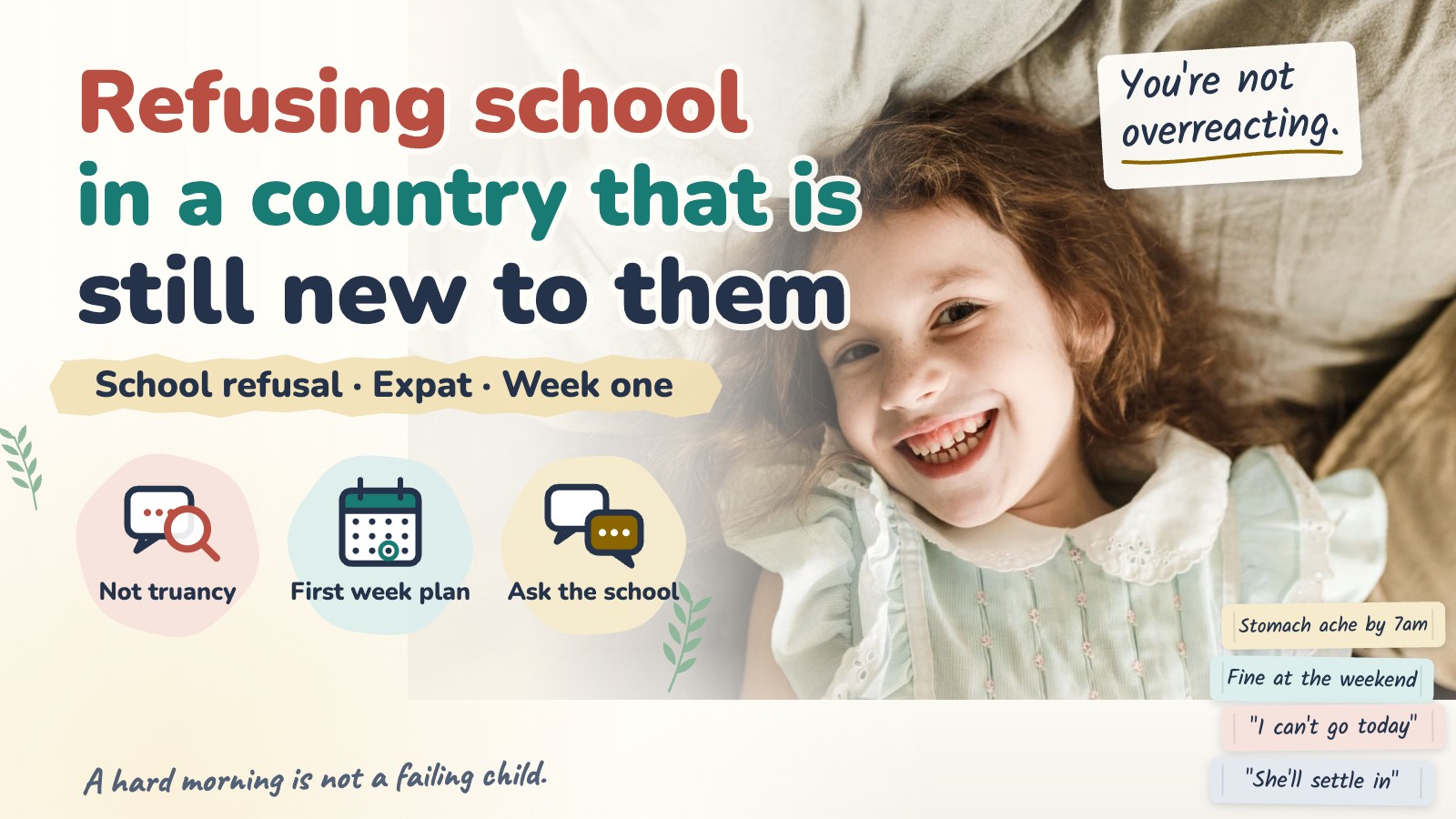
- How school refusal differs from truancy, and why the distinction changes what you do
- What researchers and pediatric bodies actually say about how common it is
- Why a move abroad, a new curriculum and a small expat social world can trigger it
- What to do in the first week, and the point at which professionals say to seek help
- Medical causes worth ruling out before anyone calls it anxiety
- What to ask an international school for, in writing, when no attendance law applies
This is general information for parents, not medical or legal advice. Rules differ by country and by school, and international schools are private institutions with their own policies. If your child talks about not wanting to be alive, is not eating or drinking, or you are seriously worried about their safety, contact your doctor or local emergency services now rather than working through the steps below.
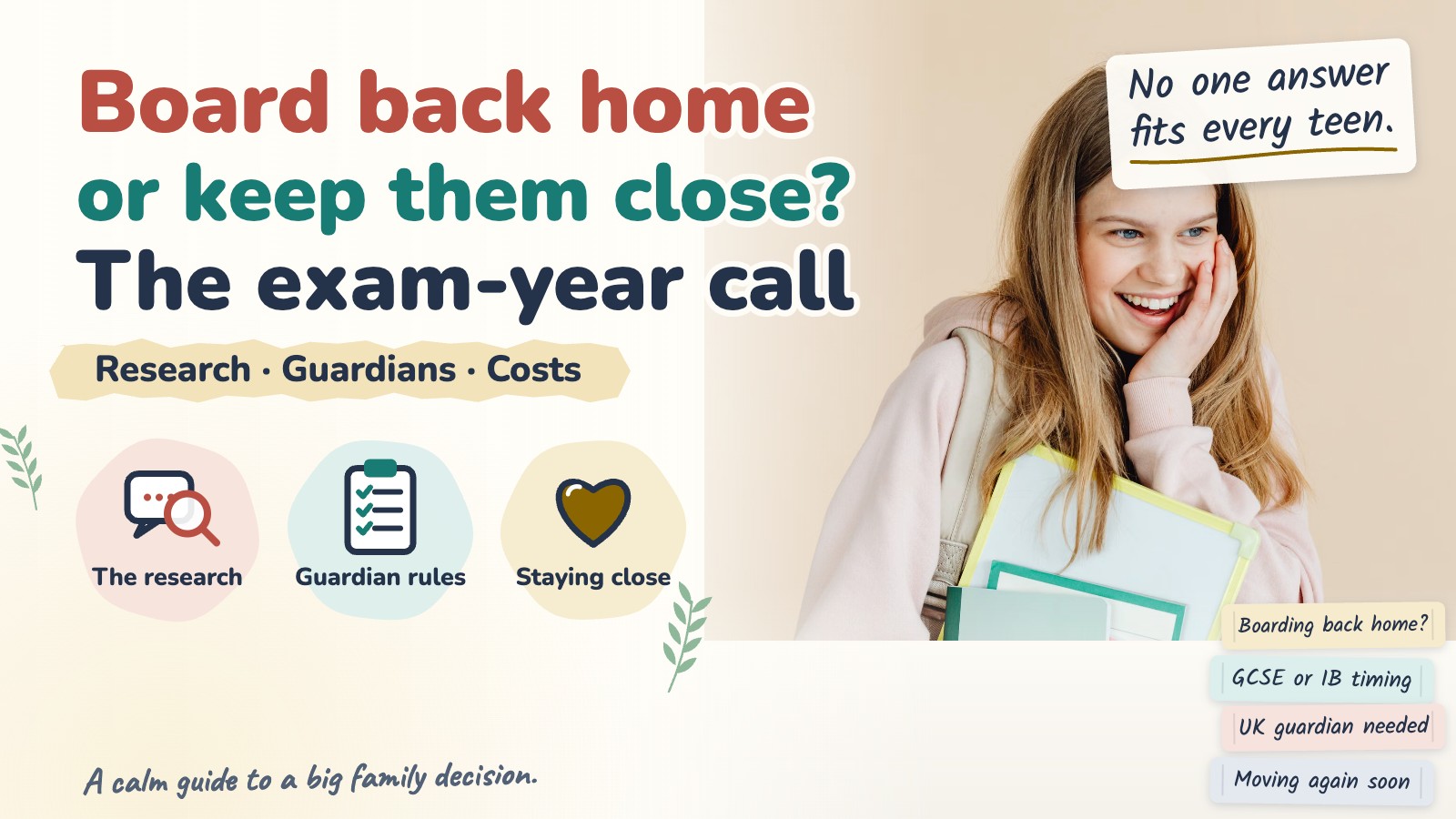
School refusal, school avoidance, truancy: what the words mean
The words matter, because schools respond to them differently. The American Academy of Pediatrics, writing on HealthyChildren.org, uses school avoidance (also called “school refusal or school phobia”) to describe a child who “regularly resists going to school,” typically with headaches, stomach aches, hyperventilation, nausea or dizziness — symptoms that happen most often on school days and are usually absent on weekends.
A 2021 review in Frontiers in Education sets out the standard clinical picture using Berg’s criteria: reluctance or refusal that leads to prolonged absence, the child staying at home with the parents’ knowledge, emotional distress at the prospect of school, no serious antisocial behavior, and parents actively trying to get the child to attend. Truancy is close to the opposite: the absence is hidden from parents, the child is not anxious about school, and there are often wider conduct problems.
| Question | School refusal | Truancy |
|---|---|---|
| Do you know where they are? | Yes, at home | Often not; absence is hidden |
| Is there emotional distress? | Yes, often intense | Usually not about school itself |
| Do they want to keep up with work? | Often yes, from home | Usually not interested |
| Are you trying to get them in? | Yes, every morning | Parents may not know |
| Physical symptoms on school days? | Common; gone at weekends | Uncommon |
If you are looking at the left-hand column, telling the school your child is “being difficult” gets you the wrong response. Saying this is distress-related non-attendance and you need a plan tends to get you the counselor.
How common is it, and what the numbers don’t cover
Estimates vary because definitions vary. The Frontiers in Education review reports school refusal in roughly 1–2% of the general population and 5–15% of clinically referred young people, and notes it is distributed about equally between boys and girls. A review in American Family Physician puts it at 1–5% of school-aged children, again with no meaningful difference between boys and girls, and identifies peak ages around 5–6 and 10–11. The American Academy of Child & Adolescent Psychiatry describes two common windows, ages 5–7 and 11–14, which line up with starting school and moving to middle school.
Broader non-attendance has risen sharply in some countries. Anna Freud, citing data from the Children’s Commissioner for England, notes that 22.3% of pupils in England were persistently absent in the 2022/23 academic year, against 10.9% in 2018/19. Persistent absence is a much wider category than school refusal — it includes illness and holidays — so this is not a school-refusal rate. It does tell you that school attendance has become a mainstream problem, not a rare one.
We could not find published figures for school refusal specifically among children at international schools, or among expat children as a group. Nobody appears to collect it. Treat any number you are given on that subject, including by a school, as an estimate rather than a measurement.
Why a move abroad can tip a child into refusing school
School refusal rarely has one clean cause. What a move abroad does is stack several ordinary stressors in the same term, at an age when one of them alone would have been enough.
Three pressures that arrive together
None of these causes school refusal by itself. Arriving in the same month is what makes them hard to absorb.
01
Language load
Following lessons in a second language costs constant effort. UNESCO’s estimate, cited by its IIEP Learning Portal, is that close to 40% of children worldwide do not have access to education in a language they understand, and that test scores fall when home and school languages differ.
02
A new curriculum
Moving between IB, Cambridge, American and national systems means gaps and repetitions. A child can be a year ahead in math and a year behind in written English in the same week, and feel stupid in both.
03
A small social world
A systematic review of third culture kids found longer time at the same school supported wellbeing and resilience, while recently relocated students scored lower on resilience, and adolescents aged 12–14 were more vulnerable than younger children.
Add a parent working long hours, a grandparent eight time zones away, and no old friend to call after a bad day, and the morning gets very heavy.
Some triggers are specific and findable. HealthyChildren lists fear of failure and perfectionism, peer problems including teasing, anxiety about school toilets, conflict with a teacher, cyberbullying, and physical threats or bullying. AACAP adds that new refusal in an older child or teenager is more often linked to peer or social problems than to separation anxiety. If bullying is part of it, see bullying at an international school; if your child is sitting in lessons they cannot follow, start with the language gap, and third culture kids and school anxiety covers repeated moves.
The first week: what the guidance actually says
This is the part parents get wrong in both directions — either forcing a child through the gate in tears, or letting a week become a month. The published guidance sits between the two, and it is fairly consistent.
HealthyChildren’s advice is to acknowledge that you understand your child’s concerns, but insist on their immediate return to school, involving teachers, the principal and the school nurse, with a gradual re-entry if anxiety is severe and a letter of support from your pediatrician. Its threshold for outside help is specific: if school avoidance lasts more than one week, you and your child may need professional assistance.
The reason for urgency is not toughness. England’s Department for Education puts the mechanism plainly: being away from school “might exacerbate” the underlying issue, and “a prolonged period of absence may heighten anxious feelings about attending in future.” That guidance has no force at an international school abroad, but the observation holds: the longer the gap, the bigger the return feels.
At the same time, YoungMinds is clear about the limit: do not “shout, tell them off or physically force them into school,” because it can make things worse in the long run. The NHS says the same about anxiety generally — do not force a child into a stressful situation without first talking about what is making them anxious.
Attend, find out, then plan
A rough shape for the first week, drawn from the pediatric and school guidance cited in this article.
01
Days 1–2
Aim for attendance, even partial. Book a same-week appointment with your doctor about the physical symptoms. Email the homeroom teacher and the counselor the same day; do not wait for a scheduled meeting.
02
Days 3–5
Find out what is being avoided: a subject, a person, lunch, the bus, the toilets. Ask the school what they see. Keep a short daily note of what happened and what helped.
03
Day 7 onward
If they have missed most of a week, ask for a written plan and, per HealthyChildren, expect that you and your child may need professional assistance. Agree a review date rather than an open-ended arrangement.
General guidance only, not a treatment plan. A child in crisis needs medical help, not a schedule.

Medical causes worth ruling out
Before anyone settles on anxiety, the physical symptoms deserve a proper look. The American Family Physician review of school refusal lists the somatic complaints that typically present — dizziness, headaches, palpitations, chest pain, abdominal pain, nausea, vomiting, diarrhea, and back or joint pain — and says medical evaluation is needed to rule out organic illness. HealthyChildren describes the classic pattern in which doctors examine the child and find no medical cause, with symptoms clustering on school mornings and easing at weekends.
Both can be true at once: a child can have a real migraine problem and be frightened of a class. Calling pain “just nerves” before anyone has looked at it is a good way to lose their trust.
| Worth mentioning to the doctor | Why |
|---|---|
| Symptoms only on school days | The single most useful clue; take your dated notes |
| Headaches, dizziness, palpitations | Listed in the clinical literature; needs examining, not assuming |
| Abdominal pain, nausea, vomiting | Same: rule out before labeling |
| Sleep and eating changes | NHS lists both as signs of anxiety in children |
| New symptoms after the move | Vaccinations, climate, diet and a new water supply all change |
Ask your doctor to put their view in writing. HealthyChildren suggests a pediatrician’s letter supporting a graded return, and a school will act faster on a letter than on a parent’s account. If you suspect ADHD or autism underneath this, our guide to assessment as an expat family covers how that usually works.
Working with an international school when no attendance law applies
Here is the part that catches expat parents out. In a state system, attendance is backed by law and by a local authority with duties toward your child. At most international schools abroad, neither applies to you.
Compulsory education laws are usually written around the national system and around citizens. Singapore’s Ministry of Education, for example, states that “all Singapore Citizens born after 1 January 1996 and living in Singapore must attend a national primary school unless an exemption is granted.” By its own terms, that duty is about citizens and national schools. Other countries frame it differently, and some do regulate private and international schools closely. We cannot tell you what applies where you live, and you should not assume. Ask the school directly: “Is this school covered by local compulsory schooling rules, and what are you required to report if my child stops attending?”
What you usually do have is a contract and, often, an accreditation framework. The Council of International Schools publishes standards its accredited schools are evaluated against, and several are directly relevant here:
| CIS standard | What it covers |
|---|---|
| E2 — Learning support | Support for admitted students with learning differences or specific needs |
| E3 — Language support | Programs to help learners access the curriculum |
| E4 — Counseling | Access to advice and counsel on academic and personal matters |
| E5 — Health and wellbeing | Appropriate health care and healthy-living practices |
| F1 — School climate | Fairness, trust and mutual respect supporting wellbeing |
Accreditation is voluntary and not every good school holds it. But if your school is CIS-accredited, it has already had to answer for its counseling and learning support at an inspection. If another body accredits it, ask which, and check what that body requires.
What to ask for, and what a written plan looks like
Go in with requests, not just a problem. These are the ones most often available, drawn from the school-facing guidance cited above.
| What to ask for | What it means in practice |
|---|---|
| A named point of contact | One person who coordinates, usually the counselor or head of year |
| A safe place and an exit card | YoungMinds lists both: a quiet room, and permission to leave a lesson when overwhelmed |
| A phased return with targets | Small achievable steps, agreed in advance, not “see how she feels” |
| A reduced or flexible timetable | Time-limited only, with review dates and a proposed end date |
| A buddy or staff mentor | Someone to meet at the gate so the first ten minutes are covered |
| Reduced work pressure, briefly | YoungMinds: on hard days, wellbeing comes before output |
On reduced timetables, borrow the discipline the English guidance applies to state schools, even though it does not bind your school: exceptional circumstances only, in the child’s interests, agreed with parents, part of a wider reintegration plan, with review dates and a proposed end date — never to manage behavior. A reduced timetable with no end date is not a plan; it is a slow exit.
Dear [name],
[Child] has missed [number] days in the last [two weeks] and is distressed each morning, with [stomach aches / headaches] that ease at weekends. We have a doctor’s appointment on [date]. We would like to agree a short written plan: a named contact at school, a safe place and exit card, and a phased return with steps and review dates. Could we meet this week, and could you tell me who in school will coordinate this?
Thank you, [your name]

What helps at home: mornings, sleep, and the accommodation trap
Make the morning predictable and boring. YoungMinds suggests a visual schedule covering waking, dressing, breakfast and leaving time, with bags packed the night before; the NHS emphasizes regular daily routines. Fewer decisions at 7am means fewer places for an argument to start.
Protect sleep. The American Academy of Sleep Medicine’s recommendations, published by the CDC, are 9–12 hours per 24 hours for children aged 6–12 and 8–10 hours for teenagers aged 13–18. The AAP advises keeping screens out of bedrooms and switching them off at least an hour before bed. Sleep debt does not cause school refusal, but it makes every morning harder, and a child who has been at home for a week will drift later without anyone noticing.
Watch what a day at home is worth. HealthyChildren is blunt: a day at home should not be rewarded with screen time privileges, special snacks or visitors. The point is not punishment. If home on a school day is warm, quiet and full of a tablet while school is loud and difficult, the gap between them grows every week, and so does the step back.
What not to do
| Avoid | Try instead |
|---|---|
| Shouting or physically forcing them in | YoungMinds warns against it; agree one small step for today |
| “There’s nothing wrong with you” | “Your stomach really hurts. We’re seeing the doctor Thursday.” |
| Open-ended time off to “reset” | A dated plan with a review, agreed with the school |
| Negotiating at 7:40am | Decide the night before; keep the morning short |
| Long reassurance conversations daily | One short check-in at a fixed time, plus the plan |
| Waiting for the school to call you | Email first, in writing, with dates |
One more thing families abroad forget: keep a few familiar adults reachable. Grandparents and old friends on video calls are no substitute for a counselor, but they help.
Stay, change school, or learn online? An honest comparison
Most children come back with a plan, time and support. Some do not, and at some point the question becomes whether this school is the right place. That is a real question, not a failure — and one expat families often have to answer on someone else’s timetable, because of visas, term dates or a posting ending.
Before changing schools, be specific about what you are changing. If your child is avoiding one teacher, subject or group, a new school solves it. If the problem is the volume of academic English, or the size and noise of the campus, the school down the road may reproduce it exactly. Our guide to changing international schools mid-year covers the practical side.
Stay with a plan, change school, or learn online
| Stay with a plan | Change school | Online school | |
|---|---|---|---|
| Keeps current friends | ○ | × fresh start | △ outside school |
| Removes the trigger | △ depends | ○ if it was local | ○ |
| Daily in-person contact | ○ | ○ | × |
| Survives the next move | × | × | ○ |
| Speed of change | △ weeks | △ waitlists | △ intake dates |
○ = generally yes △ = depends × = generally no / General tendencies, not a judgment on any particular school. As of September 2026.
Be careful with the appeal of online school mid-term. It removes the commute, the corridors and the lunch hall, which is sometimes exactly what a frightened child needs. It also removes daily in-person company, which most children need. Some families use it as a bridge for a year; others stay.

An online option built around small classes: NIJIN GLOBAL ACADEMY
NIJIN GLOBAL ACADEMY (NGA) is an online international school for ages 6–18, run by NIJIN, the company behind this site. Parts of its design speak to the problems above, but it is not open yet, and the limitations deserve as much attention as the features.
| What NGA says it offers | Why it might matter here |
|---|---|
| Classes of eight, the same small group every day, with a daily morning circle | A predictable start to the day with a small number of faces to manage |
| Bilingual English and Japanese mentors who stay with each group | A named adult who knows your child, rather than a rota |
| No entrance exam, no English requirement; children who found school hard are welcome | No pressure to prove readiness after a difficult year |
| No rankings; describes itself as a place where children “cheer each other on rather than compete” | Less of the comparison that feeds fear of failure |
| Classes in an environment outsiders cannot freely enter; mentors watch over online interactions | A closed setting rather than an open platform |
| Timetables for Asia and Oceania time zones; portable if the family moves; optional Cambridge IGCSE and A-Level | Learning does not restart with the next posting |
NGA opens in September 2027, so it is not an answer to a crisis this term. Tuition has not been published yet; NGA describes it as far more affordable than a typical international school and says exact fees will be shared first with its email community. Its FAQ says mentor hiring criteria and absence policies are still being prepared, and we could not find a published policy on supporting a child returning from a period of non-attendance. There is no physical campus and no daily in-person contact. NGA is not a Japanese “ichijo” school and does not issue a Japanese high-school diploma; we could not find a statement on its site about whether enrollment counts toward attendance at a child’s school elsewhere. Figures such as “1,000+ students” or a 97% attendance-recognition rate belong to its sister school, NIJIN Academy, not to NGA.
NIJIN GLOBAL ACADEMY is an online international school for ages 6–18 with classes of eight and bilingual mentors, timetabled for Asia and Oceania. It opens in September 2027, and free trial classes are planned monthly from September 2026.
Frequently asked questions
Sources used for this article
- American Academy of Pediatrics, HealthyChildren.org, “School Avoidance”: healthychildren.org
- American Academy of Child & Adolescent Psychiatry, Facts for Families, “School Refusal” (No. 7): aacap.org
- Fremont, W. P., “School Refusal in Children and Adolescents,” American Family Physician (15 October 2003): aafp.org
- Havik, T. & Ingul, J. M., “How to Understand School Refusal,” Frontiers in Education (2021): frontiersin.org
- YoungMinds, “School Anxiety and Refusal: Parent Guide to Support”: youngminds.org.uk
- NHS, “Anxiety in children”: nhs.uk
- NHS Fife CAMHS, “School anxiety and avoidance”: nhsfife.org
- Anna Freud, “School Attendance and Mental Wellbeing” (citing Children’s Commissioner for England data): annafreud.org
- UK Department for Education, Working together to improve school attendance (August 2024): gov.uk (PDF)
- Council of International Schools, International Accreditation: Standards and Indicators (8th edition), standards E2–E5 and F1: PDF / cois.org
- Ministry of Education, Singapore, “Compulsory education” and “Exemption from compulsory education”: moe.gov.sg
- UNESCO IIEP Learning Portal, “Language of instruction” (citing UNESCO 2016): iiep.unesco.org
- Tan, G. et al., “Adjustment in third culture kids: A systematic review of literature,” Frontiers in Psychology (2022): frontiersin.org
- CDC Healthy Schools, “Sleep in Middle and High School Students” (citing AASM consensus, J Clin Sleep Med 2016): archive.cdc.gov
- American Academy of Pediatrics, HealthyChildren.org, “Healthy Sleep Habits: How Many Hours Does Your Child Need?”: healthychildren.org
- NIJIN GLOBAL ACADEMY, FAQ and “Why NGA” pages (checked September 2026): FAQ / Why NGA / Tuition & Admissions

NIJIN GLOBAL ACADEMY teaches ages 6–18 online in classes of eight, with bilingual mentors, no rankings and no entrance exam, for families across Asia and Oceania. Tuition has not been announced yet; the school opens in September 2027 and free trial classes are planned monthly from September 2026.
Published: 23 September 2026 / Last updated: 23 September 2026