Menu
BASICS
How Japanese schools work Japanese phrases for school Glossary of school termsWAYS TO LEARN
Free schools Education support centers Online schools Homeschooling in Japan International schools Correspondence high schoolsMORE
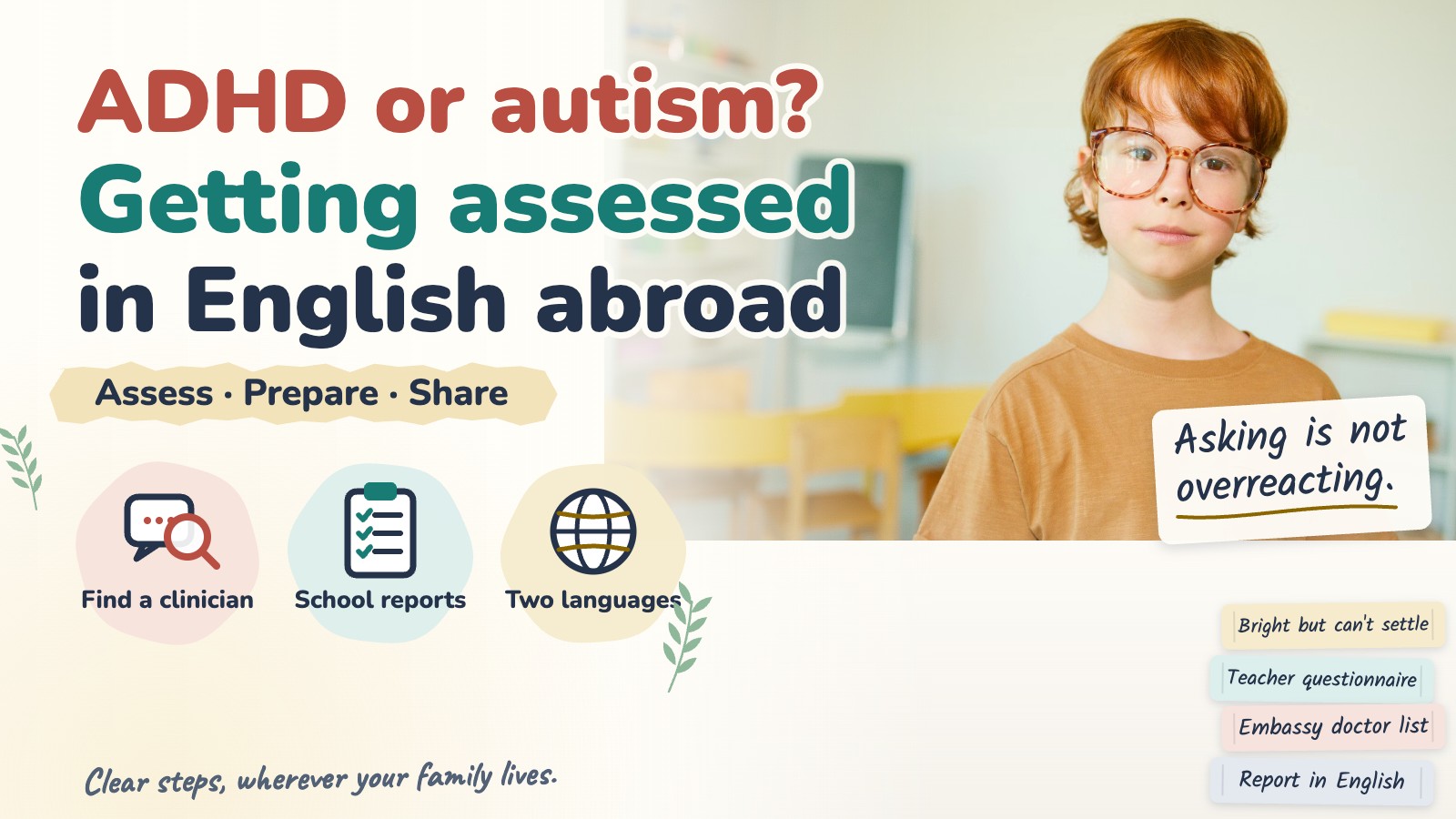
Neurodivergent children Where to get help Attendance and costs Learning Place Finder 日本語サイトへADHD or Autism Assessment Abroad: A Guide for Expat Parents
- What authoritative guidelines (NICE, the American Academy of Pediatrics, CDC, NHS) say a good assessment includes
- Which professionals can diagnose ADHD or autism, and why this varies from country to country
- Practical ways to find an English-speaking clinician when you live abroad
- What to gather before the first appointment, including school reports and teacher input
- Why a second language matters in an assessment, and what to ask about it
- How to read the report and decide what to share with your child’s school
This article is general information for parents, not medical advice. It does not replace an assessment by a qualified professional, and rules and services differ by country. If you are worried about your child’s safety or mental health right now, contact a doctor or local emergency services straight away.
When is it worth asking for an assessment?
Every child is distractible, restless or socially awkward at times, and a move abroad can make any child look unsettled for a while. So how do you know when to ask for more than reassurance? Guidelines give some useful clues. The American Academy of Pediatrics (AAP) 2019 guideline says clinicians should start an ADHD evaluation for any child or adolescent aged 4 up to their 18th birthday who presents with academic or behavioural problems together with symptoms of inattention, hyperactivity or impulsivity.
For parents, the practical question is usually whether the difficulty shows up in more than one place, lasts beyond the settling-in period, and gets in the way of learning, friendships or family life. You do not need to be sure. You only need enough concern to ask a professional to look properly.
| Worth noting down | Why it helps |
|---|---|
| Where it happens (home, class, clubs, playdates) | Both ADHD and autism assessments look at more than one setting |
| When you first noticed it | Clinicians ask about early development, not just the present |
| Whether it began before or after the move | Helps separate adjustment stress from longer-standing patterns |
| What it stops your child doing | Guidelines focus on impact, not just the behaviour itself |
| What helps, and what makes it worse | Useful for the report’s recommendations later |
What a thorough assessment actually includes
The single most useful thing to know is that neither ADHD nor autism is diagnosed with one test. The US Centers for Disease Control and Prevention (CDC) says there is no single test to diagnose ADHD, and that there is no medical test, such as a blood test, to diagnose autism. Both are diagnosed by clinicians who gather information from several sources and use their judgement. Knowing what the guidelines expect lets you judge whether a clinic abroad is offering a full assessment or a quick screen.
ADHD
NICE guideline NG87 (UK) says a diagnosis should be made only by a specialist psychiatrist, paediatrician or other appropriately qualified healthcare professional with training and expertise in ADHD. It should be based on a full clinical and psychosocial assessment, including discussion of behaviour and symptoms in different settings, a full developmental and psychiatric history, observer reports and an assessment of the child’s mental state. NICE is explicit that a diagnosis should not be made solely on the basis of rating scale or observational data, and that symptoms should cause at least moderate impairment and be present in two or more important settings.
The AAP guideline says the clinician should confirm that DSM-5 criteria are met, with information obtained primarily from parents or guardians, teachers, other school staff and mental health clinicians involved in the child’s care. It also says the evaluation should at least screen for other conditions, including anxiety, depression, learning and language disorders, autism, tics and sleep apnoea. The CDC adds that the process can include a medical examination with hearing and vision tests.
Autism
NICE guideline CG128 (autism in under-19s) lists what a diagnostic assessment should include: detailed questions about the parents’ concerns, a developmental history, assessment of social and communication skills, a medical history, a physical examination, consideration of other possible explanations, assessment of coexisting conditions, and a profile of the child’s strengths, skills, impairments and needs. It says not to rely on any autism-specific diagnostic tool alone. The NHS describes the same picture from a parent’s view: one or more appointments with a team, questions about development such as when your child started talking, tasks to see how your child communicates and thinks, watching how they play and interact with you, and reading reports from school.
Information from more than one place
Whichever condition is being considered, guidelines expect the clinician to combine these three sources.
01
Your history
A detailed interview with you about pregnancy, early development, health and family life. Baby books, old reports and videos can help fill gaps.
02
School’s view
Teacher questionnaires, reports and sometimes a school visit. ADHD guidance requires difficulties in more than one setting, so school input is essential.
03
Seeing your child
Direct observation, conversation and structured tasks, plus a physical check. Hearing and vision are often checked so other causes are not missed.
If a clinic offers a diagnosis after a single questionnaire, ask how it gathers the other two.
| Element | ADHD (NICE NG87, AAP) | Autism (NICE CG128) |
|---|---|---|
| Parent interview and history | Full developmental and psychiatric history | Parents’ concerns and developmental history |
| School input | Teachers and school staff are key informants | Reports from school; sometimes a school visit (NHS) |
| Seeing the child | Observer reports and mental state assessment | Assessment of social and communication skills |
| Physical checks | Medical exam, hearing and vision (CDC) | Medical history and physical examination |
| Other conditions | Screen for anxiety, learning, autism, sleep | Consider ADHD, language, hearing and others |
| Questionnaires | Useful, but not enough on their own | No single tool enough on its own |
One point matters especially for families: ADHD and autism can occur together. The World Health Organization notes that autistic people often have co-occurring conditions including ADHD, anxiety and depression, and both NICE CG128 and the AAP guideline ask clinicians to consider the other condition. If you suspect both, say so at the start.
Who can diagnose, and why it varies by country
This is where living abroad gets confusing. Job titles, training and legal rights to diagnose differ between countries, and even between the guidelines themselves. Here is what the sources we checked say.
| Source | Who it says diagnoses |
|---|---|
| NICE NG87 (ADHD, UK) | Specialist psychiatrist, paediatrician or other appropriately qualified professional with ADHD expertise |
| NHS (ADHD, UK) | One or more specialists, such as a paediatrician or child and adolescent psychiatrist |
| AAP (ADHD, US) | The paediatrician or other primary care clinician |
| CDC (ADHD, US) | A psychologist or psychiatrist, or a primary care provider such as a paediatrician |
| NICE CG128 (autism, UK) | A team including a paediatrician and/or child psychiatrist, a speech and language therapist, and a psychologist |
| CDC (autism, US) | Trained specialists such as developmental paediatricians, child psychologists, speech-language pathologists and occupational therapists |
In practice, the professionals you are most likely to meet are developmental paediatricians, child and adolescent psychiatrists and clinical psychologists. Educational psychologists often assess learning, attention and cognitive skills and can be very helpful for school planning; whether they can give a formal medical diagnosis depends on the country and their registration, so ask directly. Speech and language therapists and occupational therapists usually contribute to autism assessments as part of a team.
If you expect to move again or return home, ask whether a diagnosis made in your current country will be accepted by schools, doctors or exam boards elsewhere. A report that names the diagnostic criteria used (such as DSM-5 or ICD-11), the professionals involved and the information gathered is generally easier for others to understand. We could not find a single rule on recognition across countries; it varies.

How to find an English-speaking clinician abroad
There is no global directory of English-speaking child assessors, so most families combine several routes. We do not name private clinics here; availability and quality change, and we cannot vouch for any individual provider.
| Route | What to know |
|---|---|
| Your embassy’s list of doctors | The UK Foreign, Commonwealth & Development Office publishes country lists of English-speaking doctors and medical facilities, and says none are recommended by the FCDO. The US State Department says lists of local doctors and hospitals are on US embassy and consulate websites. Other embassies may do the same. |
| International or university hospitals | Many large cities have hospitals with international patient departments and child development or child psychiatry services. Ask whether assessments can be done fully in English. |
| Your health insurer’s network | International insurers usually keep a list of approved providers. Check this first if you want the cost covered. |
| Your child’s school | School counsellors and learning support staff often know which local services other families have used. Treat this as a starting point, not an endorsement. |
| Assessment in your home country | Some families assess during a home visit. Ask about follow-up, since ongoing care usually needs someone local. |
Online assessments by clinicians in another country are sometimes offered. If you consider one, ask how they will observe your child, gather school information and handle a physical examination, which both NICE CG128 and the CDC’s ADHD guidance include. Also ask whether they are allowed to practise across borders and who will provide follow-up care where you live.
Three questions for every clinic
01
Who assesses?
Ask the professions and qualifications of the people involved, and whether they specialise in children. For autism, ask whether it is a team assessment.
02
What’s included?
Ask how many appointments there are, whether school input is gathered, and whether other conditions are checked. Compare the answer with the table above.
03
What you receive
Ask for a written report, in English, with a feedback meeting. Ask what happens next: support, therapy, follow-up and review.
Writing the answers side by side makes it much easier to compare clinics that describe their services very differently.
What to prepare before the first appointment
Because assessments rely so much on history and school input, preparation saves time and money, and it matters even more when your child’s early records are in another country or language.
| Bring or send | Tips |
|---|---|
| School reports from every school | Include schools in other countries; translate key comments if needed |
| Teacher questionnaires | The clinic usually supplies them; ask teachers early, as they take time |
| Development and health records | Milestones, hearing and vision checks, past specialist letters |
| Your own notes | Dated examples from home, including what helps |
| Language history | Which languages your child has used, where, and since what age |
| Your questions | Write them down; appointments go quickly |
The NHS notes that there may be forms to fill in before the appointment or as part of an ADHD assessment. Ask the clinic what it needs, in which language, and how teachers should return their forms. If your child has changed schools often, a short timeline of moves is useful: clinicians will want to know what was happening when difficulties appeared.
It is worth telling your child, in simple words, what will happen. Something like “We’re going to meet someone who helps work out how your brain learns best, so school can be easier” is usually more reassuring than silence.

Assessing a child who lives in two or more languages
Many expat children speak one language at home and learn in another at school. That can blur the picture. A child who seems not to follow instructions may be struggling with attention, or may simply be missing some of the English.
The guidelines are clear that language should neither explain everything away nor be ignored. NICE CG128 asks professionals to ask about the child’s use and understanding of their first language, and warns not to assume that language delay is explained just because English is not the family’s first language. The American Speech-Language-Hearing Association (ASHA) says that being multilingual is not a communication disorder, that language samples should be collected in all the languages a child uses, and that standardised test scores are not valid for a child who is not reflected in the test’s normative sample. ASHA also describes working with an interpreter where necessary.
| Ask the clinic | Why |
|---|---|
| Which language will you assess in? | A child may show different skills in each language |
| Can you assess or observe in our home language? | Helps separate language learning from other difficulties |
| Do you use interpreters, and are they trained? | Family members as interpreters can change what is said |
| Were your tests designed for children like mine? | Scores from tests normed on monolingual children may mislead |
| How will you allow for cultural differences? | Eye contact, play and politeness norms vary by culture |
You may find that the best clinician for your child is not the one who speaks English, but the one who speaks your home language or has experience with multilingual children. It is reasonable to ask for a report in English even if the assessment itself used another language.
Costs, insurance and waiting times
We have not included prices, because they vary widely by country, provider and what is included, and any figure we gave would quickly be out of date or wrong for your city. What you can do is ask the same questions of every provider so you can compare like with like. The US State Department advises travellers to make sure they understand what their health insurance covers outside their home country; the same applies to families living abroad.
| Question | Why it matters |
|---|---|
| Is the quoted price for the whole assessment? | Some quotes cover only the first consultation |
| Are school observation and the report extra? | These are often itemised separately |
| Does my policy cover developmental or mental health assessment? | Cover varies, and some policies exclude it |
| Do I need a referral or pre-approval? | Missing this step can mean a claim is refused |
| How long is the wait? | If it is long, ask what support is possible meanwhile |
If the wait is long, you do not have to put everything on hold. You can share your concerns with the school now and ask what adjustments are possible while you wait.
After the assessment: the report and your child’s school
NICE CG128 says findings should be discussed with parents in person and without delay, with the reasons for the conclusions explained even if autism is not diagnosed, and that parents should be given a written report. It also says the child’s profile can be shared with professionals in education, with consent, so that it can contribute to planning. Whatever the outcome, ask for the report in writing and for time to ask questions.
Sharing is your decision. Some families share the full report; others share a summary or a letter focused on what helps. A diagnosis is not required for a school to make reasonable adjustments, but a clear report often makes the conversation easier.
| Option | When it can suit | Watch out for |
|---|---|---|
| Full report | The school has a learning support team you trust | Contains personal family and medical history |
| Summary letter from the clinician | You want the school to focus on needs and strategies | Ask the clinician to include practical recommendations |
| Your own one-page profile | Quick start for new teachers each year | Keep it consistent with the report |
When you meet the school, bring two or three specific requests drawn from the report, such as seating, breaks, instructions given in writing, or extra time. Ask who will be your contact, how teachers will be told, and when you will review how it is going. Ask too how the information will be stored and who will see it, especially if the school’s data rules differ from what you are used to.
NICE CG128 suggests considering a second opinion when there is continued uncertainty or disagreement about the diagnosis, including disagreement with parents. It is reasonable to ask questions, request clarification in writing, or seek another assessment.
Where your child learns next: an honest comparison
An assessment may confirm that your child’s current school can work well with some changes. Or it may show that the setting itself is part of the problem: very large classes, lots of transitions, or little adult time. Here is how common options compare in general. None is right for every child.
Stay, move, or learn online
| Current school | Smaller local school | Online school | |
|---|---|---|---|
| Keeps friends and routine | ○ | × fresh start | △ new group |
| Small group, more adult time | △ varies | ○ | ○ |
| On-site specialist support | △ varies | △ varies | × |
| Continues if you move | × | × | ○ |
| In-person friends and activity | ○ | ○ | × |
○ = generally yes △ = depends × = generally no / General tendencies, not a judgement on any particular school. As of September 2026.
Online learning brings its own challenges for some children with attention difficulties, such as screen time and self-organisation, so it is worth discussing with the clinician who assessed your child. Whatever you choose, the assessment report is most useful when the adults around your child actually read it and act on it.

A small-class online option: NIJIN GLOBAL ACADEMY
NIJIN GLOBAL ACADEMY (NGA) is an online international school for ages 6–18, run by NIJIN, the company behind this site. We mention it as one option for families who feel a smaller, steadier group might suit their child. It is not a clinical service and does not replace an assessment or specialist support.
| What NGA says it offers | Why some families may find it relevant |
|---|---|
| Classes of eight, the same small group every day, and a daily morning circle | Predictable routine and fewer children in each lesson |
| Bilingual (English and Japanese) mentors who stay with each small group | An adult who gets to know your child over time |
| No rankings; children “cheer each other on rather than compete” | Less pressure from constant comparison |
| No entrance exam or English requirement; children who have struggled with attendance are welcome | No need to prove readiness first |
| Asia and Oceania time zones; continues if the family moves | One steady school through relocations |
NGA opens in September 2027, with free trial classes planned monthly from September 2026. Tuition has not been published yet; NGA says it will be well below in-person international schools and will be shared first with its mailing list. We could not find a published learning-support or special educational needs policy on NGA’s website, and it does not describe offering assessments or therapy. Its FAQ says mentor hiring criteria and absence policies are still being prepared. There is no physical campus, and NGA does not issue a Japanese high-school diploma. Figures such as “1,000+ students” or a 97% attendance-recognition rate belong to its sister school, NIJIN Academy, not NGA.
NIJIN GLOBAL ACADEMY is an online international school for ages 6–18 with classes of eight and bilingual mentors, timed for Asia and Oceania. It opens in September 2027, with free trial classes planned from September 2026, so you can see whether it suits your child.
Frequently asked questions
Sources used for this article
- National Institute for Health and Care Excellence (NICE), “Attention deficit hyperactivity disorder: diagnosis and management” (NG87), recommendations 1.3.1–1.3.3 (NCBI Bookshelf copy, updated September 2019): ncbi.nlm.nih.gov
- NICE, “Autism spectrum disorder in under 19s: recognition, referral and diagnosis” (CG128), recommendations 1.1.3, 1.2.5–1.2.6, 1.5.1–1.5.11, 1.6.2, 1.8.1–1.8.7 (checked September 2026): nice.org.uk
- Wolraich ML, Hagan JF Jr, et al., American Academy of Pediatrics, “Clinical Practice Guideline for the Diagnosis, Evaluation, and Treatment of Attention-Deficit/Hyperactivity Disorder in Children and Adolescents”, Pediatrics 144(4):e20192528 (October 2019): PubMed Central
- U.S. Centers for Disease Control and Prevention, “Diagnosing ADHD” (updated 7 July 2026): cdc.gov
- U.S. Centers for Disease Control and Prevention, “Screening for Autism Spectrum Disorder” (updated 15 April 2025): cdc.gov
- NHS, “Diagnosis: Attention deficit hyperactivity disorder (ADHD)” (reviewed 19 March 2025): nhs.uk
- NHS, “Getting diagnosed: Autism” (reviewed 6 May 2026): nhs.uk
- World Health Organization, “Autism” fact sheet (17 September 2025): who.int
- American Speech-Language-Hearing Association, “Multilingual Service Delivery in Audiology and Speech-Language Pathology” (Practice Portal): asha.org
- UK Foreign, Commonwealth & Development Office, “Professional services if you are abroad” (updated 24 July 2024): gov.uk
- U.S. Department of State, “Medicine and Health” (checked September 2026): travel.state.gov
- NIJIN GLOBAL ACADEMY, FAQ and Tuition & Admissions pages (checked September 2026): FAQ / Tuition & Admissions
If you are exploring settings where your child can be known by name, NIJIN GLOBAL ACADEMY offers live online classes of eight with bilingual mentors and no rankings. Tuition is yet to be announced, and the school opens in September 2027.
Published: 22 September 2026 / Last updated: 22 September 2026