Menu
BASICS
How Japanese schools work Japanese phrases for school Glossary of school termsWAYS TO LEARN
Free schools Education support centers Online schools Homeschooling in Japan International schools Correspondence high schoolsMORE
Neurodivergent children Where to get help Attendance and costs Learning Place Finder 日本語サイトへCyberbullying and Group Chats: What Parents of Expat Teens Can Do
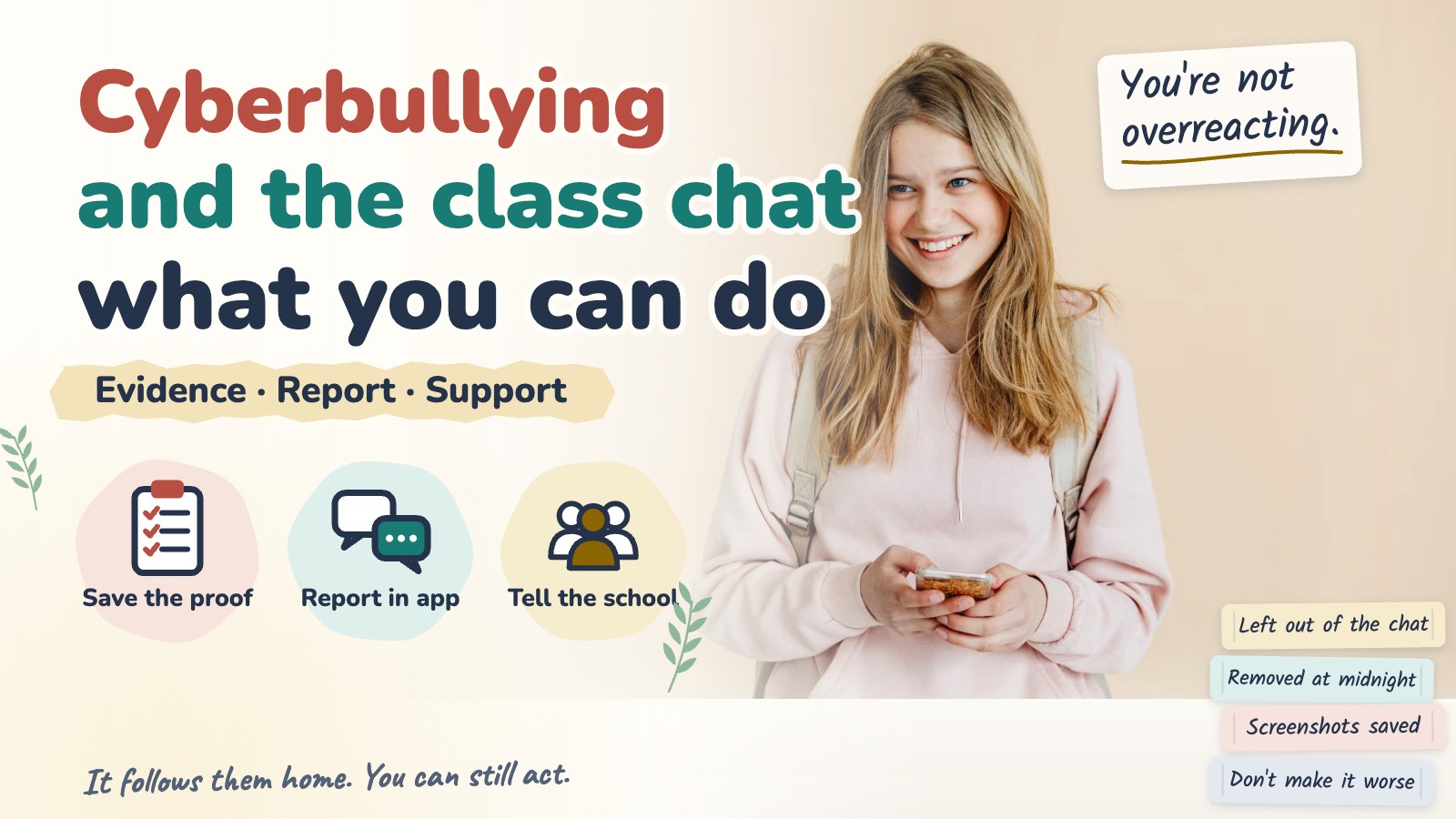
- What official bodies count as cyberbullying, including being deliberately left out
- Real prevalence figures from WHO/Europe, Pew Research Center and Singapore’s Ministry of Education
- Why you save screenshots before blocking, and how to report to a platform
- What a school can and cannot do about behavior that happens at 11pm on WhatsApp
- When to involve the police or a body such as Australia’s eSafety Commissioner
- How to support a teenager who begs you not to “make it worse”, and the signs that need professional help
This is general information for parents, not legal or medical advice. Laws, reporting bodies and school obligations differ by country. If your child is in immediate danger, or you are worried about their safety or mental health, contact local emergency services, your doctor or a crisis helpline now rather than working through the steps below.
What counts as cyberbullying, and how common it is
The word matters, because schools and platforms act on categories rather than on how upset a parent sounds. The US government’s StopBullying.gov defines cyberbullying as “bullying that takes place over digital devices”, including “sending, posting, or sharing negative, harmful, false, or mean content about someone else”. Australia’s eSafety Commissioner, a national regulator with its own complaints scheme, uses a plainer test: it is “when someone uses the internet to be mean to a child or young person so they feel bad or upset”. UNICEF adds that it is “repeated behavior, aimed at scaring, angering or shaming those who are targeted”.
Being left out is not a lesser category. StopBullying.gov’s definition of bullying requires an imbalance of power (“physical strength, access to embarrassing information, or popularity”) and repetition, and lists social bullying as including “leaving someone out on purpose”. A child removed from the class chat, or left in it while a second chat runs without them, fits that description.
| Source | Finding |
|---|---|
| WHO/Europe, HBSC study (March 2024) | 15% of adolescents had experienced cyberbullying — about 1 in 6. Girls 16%, boys 15%, up from 13% and 12% in 2018. |
| WHO/Europe (same study) | About 12%, or 1 in 8, said they had cyberbullied others. From 279,000+ young people aged 11, 13 and 15 in 44 countries and regions. |
| Pew Research Center, US (Dec 2022) | 46% of teens aged 13–17 had experienced at least one of six cyberbullying behaviors; 32% name-calling, 22% false rumors. |
| Pew Research Center (same survey) | Girls aged 15–17 were most affected: 54% reported some form, against 44% of boys the same age. |
| Singapore Ministry of Education (Oct 2024) | An average of 2 bullying incidents per 1,000 primary and 6 per 1,000 secondary students a year; technology-related incidents under 1 per 1,000 secondary students. |
Note the gap between the anonymous surveys and Singapore’s figures, which count cases reported to schools rather than experiences. Note too that none of these surveys measures “left out of the group chat” as a category. We could not find a national statistic for group-chat exclusion, so expect to make that case yourself.
What makes online bullying harder to escape
Parents who were bullied at school themselves often underestimate this: in-person bullying stopped at the school gate. StopBullying.gov names three features that change the picture, and they are why “just log off” is useless advice to a teenager.
Three things that make it different
These are StopBullying.gov’s own categories, and they explain why a child can seem fine at school and fall apart at night.
01
It is persistent
Devices “offer an ability to immediately and continuously communicate 24 hours a day, so it can be difficult for children experiencing cyberbullying to find relief.” Home stops being safe.
02
It is permanent
“Most information communicated electronically is permanent and public, if not reported and removed.” A screenshot of your child can outlive the group that made it.
03
It is hard to notice
“Because teachers and parents may not overhear or see cyberbullying taking place, it is harder to recognize.” Nothing happens in front of an adult, so nothing gets logged.
One advantage is on your side. UNICEF notes that cyberbullying “leaves a digital footprint – a record that can prove useful and provide evidence to help stop the abuse.”
The audience is larger, too. UK Department for Education guidance calls cyberbullying “a different form of bullying” that “can happen at all times of the day, with a potentially bigger audience”. A remark in a corridor reaches three people; in a year-group chat it reaches ninety, and can be forwarded.
When the class chat is also the social life
In an expat setting the group chat does more work than at home. Year groups are small, families live scattered across a city, and almost nobody can walk to a friend’s house. The chat is where weekend plans are made and running jokes live. A child who leaves it is not just off an app — they are outside the only room where their year group exists after 3pm.
Small year group, one chat, constant turnover
None of these cause bullying. They make exclusion cheaper to do and harder to undo.
01
Nowhere else to go
With one class per year there is no parallel friendship group to move to. In a large national school a child can change table; in a year group of twenty-two they cannot.
02
Platforms by country
Families use whatever the host country uses: WhatsApp, LINE, KakaoTalk, Discord, Instagram. Parents often do not use the same app, so never see the room their child lives in.
03
People arrive and leave
Every term resets the hierarchy. A child who is new, or whose family is leaving, can be treated as temporary — and a chat admin can remove them with two taps.
If your child has recently moved, our guide on helping a child make friends after moving abroad covers the friendship side.
Two consequences follow. Taking the phone away punishes your child for being targeted: eSafety warns that “removing your child’s phone or computer could be really unhelpful”, and the American Academy of Pediatrics is blunter — “Don’t threaten to take away your child’s device or cut their time online. They may see this as punishment and be less willing to tell you about bullying situations.” And “just leave the chat” means leaving their social life, which is why teenagers resist it.
What to do first: keep the evidence, then block and report
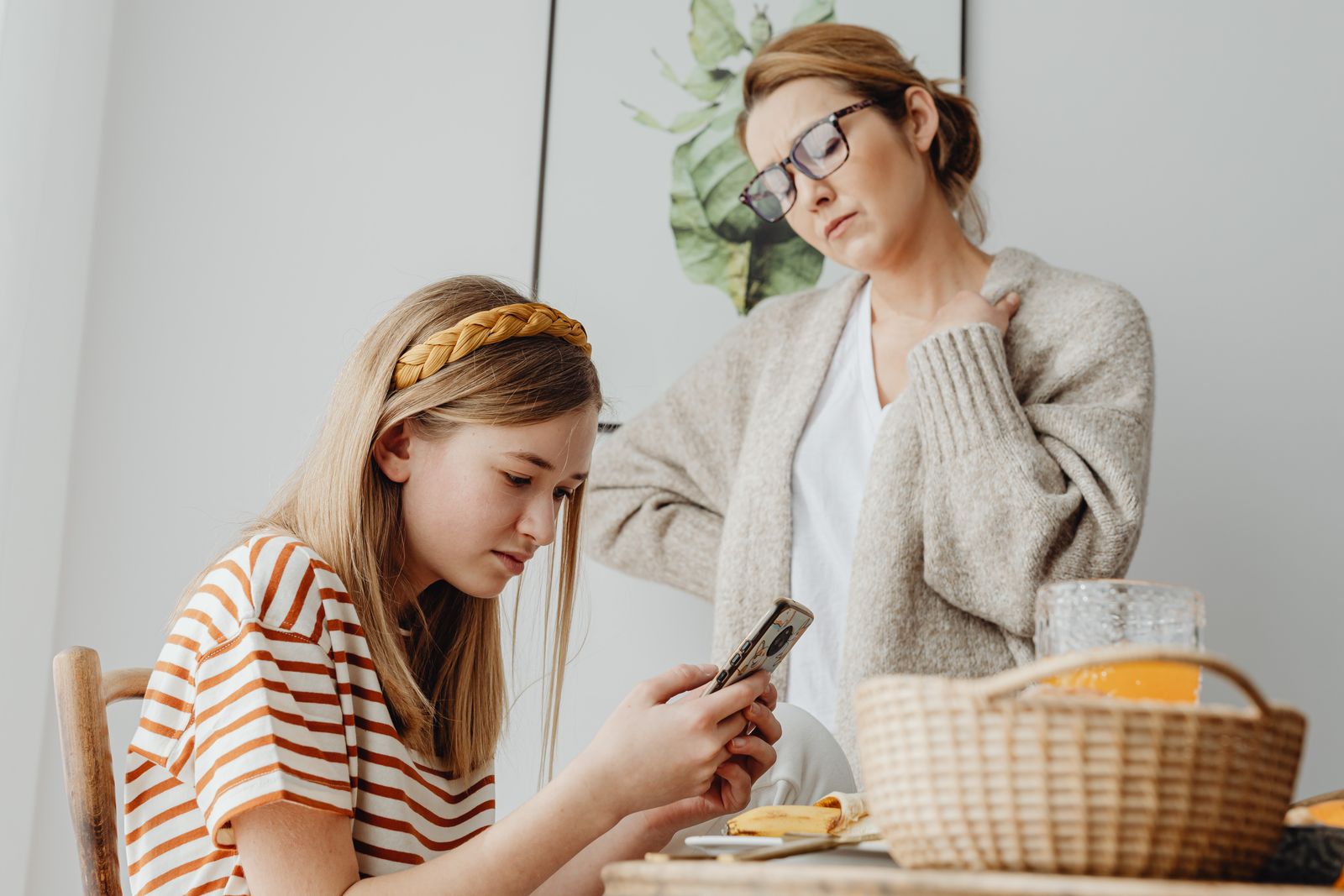
The order matters, and most parents get it wrong by blocking first. Once an account is blocked or a chat is left, you may lose the messages that prove what happened. eSafety tells parents it is “a good idea to collect evidence before you report to social media services” — “screenshots and URLs”. StopBullying.gov says to “Keep a record of what is happening and where. Take screenshots of harmful posts or content if possible”, because “bullying is a repeated behavior, so records help to document it”. UNICEF and the AAP say the same.
| Step | What to do | Why |
|---|---|---|
| 1. Listen | Let them finish. Thank them for telling you. Do not promise to do nothing. | The AAP notes one person listening helps a bullied child cope better. |
| 2. Capture | Screenshots showing the message, the sender and the date. Save the link too. | Platforms and schools need the content, not a summary. |
| 3. Log | One row per incident: date, what was sent, by whom, who else saw, the effect. | Repetition is part of most official definitions; one screenshot rarely shows it. |
| 4. Report in the app | Use the platform’s reporting tool on each item. | StopBullying.gov: contact platforms “to report offensive content and have it removed”. |
| 5. Then block or mute | Agree it with your child, and decide together about leaving. | Blocking after capture protects them without destroying the record. |
Include enough of the screen to show who sent what and when, and keep copies somewhere your child cannot delete them in a bad moment. Do not create a fake account to watch the chat, and do not post screenshots publicly.
Asking the school to act, and what it can and cannot do
This is where expat parents get stuck: it happened at 11pm, off campus, on an app the school does not run. Being international does not settle whether a school must act.
The UK Department for Education’s guidance, which many British-curriculum schools abroad follow, is the clearest statement we found. Staff may discipline pupils for misbehavior outside the premises under the Education and Inspections Act 2006, “but only if it would be reasonable for the school to regulate pupils’ behavior in those circumstances”, and the sanction itself can only be imposed on school premises. Under the Education Act 2011, authorized staff can examine and delete data on a seized device “where there is good reason to do so”, but must not delete material that may relate to a criminal offense.
Elsewhere the picture is similar. Singapore’s Ministry of Education says that for online incidents “schools guide students to report these to the online service provider”, and that in severe cases schools “work closely with parents and the authorities”. Hong Kong’s Education Bureau asks schools for a “whole school approach” with reporting channels and handling procedures, and the government has said “the Internet is not an unreal world that is beyond the law”. Ask your own school which of these applies to it.
| What a school usually can do | What it usually cannot do |
|---|---|
| Investigate and record it against its bullying policy | Force a platform to delete a post or chat |
| Discipline off-site behavior where policy and local law allow | Apply a sanction outside school time or off the premises |
| Change seating, supervision or grouping at school | Control who is in a private chat run by students or parents |
| Offer pastoral support, counseling or a named adult | Diagnose or treat mental health conditions |
Dear [name],
I am reporting cyberbullying affecting [child’s name] in [Year/Grade X]. Between [date] and [date], [he/she/they] received the following in the class group chat on [app]: [2–3 short, dated examples]. I have screenshots and can share them securely.
Under your anti-bullying policy, could you confirm: (1) who is handling this and when I will hear back; (2) what support [child’s name] will get meanwhile; (3) how the school treats online behavior outside school hours.
Thank you, [your name]
Ask in writing, ask for a named person, and ask what happens next. If the response stalls, our guide to bullying at an international school sets out how to escalate and who inspects these schools.

When it becomes a matter for the police or a national body
Most cyberbullying is handled between the family, the platform and the school. Some is not. StopBullying.gov is straightforward: “If a child has received physical threats, or if a potential crime or illegal behavior is occurring, report it to the police.” UK guidance adds that some harassing or threatening communications could be a criminal offense, and that schools should seek police assistance where staff believe one may have occurred.
Whether a national reporting body exists depends on where you live. Australia has a statutory scheme; many countries do not.
| Route | Where | What it does |
|---|---|---|
| eSafety Commissioner | Australia | Takes complaints about cyberbullying of under-18s. For the services eSafety works with, report to the service first and wait 48 hours; if that does not help, eSafety can ask them to remove the content. |
| The platform | Everywhere | In-app reporting, item by item. In most countries the only route that can actually remove content. |
| Local police | Everywhere | For threats of violence, stalking, blackmail or sexual images of a child. Hong Kong notes offenses such as criminal intimidation can apply online. |
| School or education authority | Varies | Singapore’s MOE and Hong Kong’s EDB both expect schools to have reporting channels and handling procedures. |
If anyone has shared, requested or threatened to share a sexual image of your child, report it to the police and the platform straight away. In Pew Research Center’s 2022 survey, 17% of US teens had been sent explicit images they did not ask for, and 7% said images of them had been shared without consent. Do not forward the image yourself, even as proof; ask the police how they want it preserved.
When your teenager says “please don’t make it worse”
This is the most common reason parents do nothing for weeks, and the fear is reasonable: an adult who storms in can raise the social cost. The answer is not to promise silence, but to be specific.
| Instead of… | Try… |
|---|---|
| “I’m calling the school tomorrow.” | “Here’s what I’d say and to whom. What would you change?” |
| “Just come off the app.” | “What would you lose if you left? Could you mute it instead?” |
| “Why didn’t you tell me sooner?” | “I’m glad you told me. Nothing happens without you knowing first.” |
| “Give me your phone.” | “Can we save the screenshots together, in case we need them?” |
Give them control over the details and keep control of the decision. A workable compromise: we report the messages tonight, we save everything, we contact nobody’s parents, and if it happens again this week we email the year head together. eSafety tells parents to “stay calm and open — don’t panic” and to “listen without judging when they open up”. If the difficulty runs wider than one chat, our piece on third culture kids and school anxiety may fit better than this one.
Signs it is affecting their mental health, and where to get help
The American Academy of Pediatrics reports that research links cyberbullying to depression, anxiety and sleep problems, and to avoiding school and trouble concentrating. UNICEF lists shame, withdrawal, negative self-talk and physical symptoms such as “frequent headaches, nausea or stomachaches”, noting that “skipping school is another common effect”.
| Watch for | What it can look like |
|---|---|
| Around the device | Marked changes in phone use; hiding the screen; upset after using it |
| Mood | Becoming more withdrawn, anxious, sad or angry; secretive about online activity |
| Body and sleep | Frequent headaches or stomach aches, faking illness, trouble sleeping or nightmares |
| School and friends | Declining grades, not wanting to go to school, losing friends |
| Urgent | Self-destructive behavior, self-harm, or talking about suicide |
StopBullying.gov states that in the research it cites, “kids who reported cyberbullying were 11.5 times more likely to present suicidal ideation”, while also making clear that “most kids who are bullied do not experience suicidal thoughts or self-harm”. Both halves matter. If your child talks about suicide or self-harm, or you think they are at risk, contact a doctor or mental health professional now, or a crisis line — in the United States, the 988 Suicide and Crisis Lifeline (call or text 988). Your school counselor or family doctor can tell you the local equivalent. If someone is at immediate risk, call your local emergency number.
If your child is the one doing it, or is caught in the middle
About one adolescent in eight in the WHO/Europe study reported cyberbullying others, and many children are both targeted and involved in targeting someone else. In a group chat the line between joining in and failing to object is thin.
StopBullying.gov lists signs that a child may be bullying others: verbal or physical fights, friends who bully, increasing aggression, blaming others, and being “competitive and worry about their reputation or popularity”. It also notes real risks for those children — poorer school results, impulsive behavior, substance use, and depression or self-harm. That is a reason to treat it as something to work on, not a verdict.
| Situation | A useful first move |
|---|---|
| Your child sent the message | Read it together. Ask what they wanted to happen. Agree a repair, usually an apology sent the same way. |
| Your child laughed or reacted | Name it as taking part. Ask what they could do next time. |
| Your child saw it and said nothing | Do not demand public heroics. Agree something smaller: message the child privately, or tell an adult. |
| The school contacts you about your child | Ask for the evidence and what the school wants to happen, before promising any punishment. |

Stay, switch schools, or learn online? An honest comparison
Most families do not need to change school. A smaller number reach a point where the same year group, the same chat and the same corridor are not survivable for another year. If a move is on the table, our guide to changing international schools mid-year covers the practical side.
Stay, switch, or learn online
| Stay and handle it | Change school | Online school | |
|---|---|---|---|
| Breaks contact with the group | × | △ same city | ○ |
| Keeps existing friends | ○ | × | △ outside school |
| Adults present in lessons | △ varies | △ varies | ○ |
| Survives another relocation | × | × | ○ |
| In-person campus life | ○ | ○ | × |
○ = generally yes △ = depends × = generally no / General tendencies, not a judgment on any particular school. As of September 2026.
Be honest about one thing: an online school is not a place where bullying cannot happen. Children still fall out, still form chats you cannot see, and unkind messages are possible anywhere there is a keyboard. What changes is the setting — class size, whether an adult is present in every session, and how fast someone notices. Ask any school those questions.
An online school built around small, supervised classes: NIJIN GLOBAL ACADEMY
NIJIN GLOBAL ACADEMY (NGA) is an online international school for ages 6–18, run by NIJIN, the company behind this site. Parts of its design speak to the problems above. Read the limitations as carefully as the features.
| What NGA says it offers | Why it is relevant here |
|---|---|
| Classes in an environment outsiders can’t freely enter, with mentors watching over online interactions (NGA’s FAQ) | A closed, supervised setting, not an open chat |
| Classes of eight, the same small group daily, and a morning circle | Small enough that an adult notices who is being left out |
| No rankings; it calls itself a place where children “cheer each other on rather than compete” | Less of the status competition that fuels chat hierarchies |
| No entrance exam or English requirement; children who found school hard are welcome | No need to prove readiness after a hard year |
| Timetables for Asia and Oceania time zones; portable if you move; optional Cambridge IGCSE and A-Level | School does not restart at the next posting |
NGA opens in September 2027. Free trial classes are planned monthly from September 2026. Tuition has not been published yet; NGA says fees will be far more affordable than a typical international school and will go first to its mailing list. Its FAQ says mentor hiring criteria, absence policies and enrollment or withdrawal rules, including mid-year joining, are still being prepared. We could not find a published anti-bullying procedure on its site, so ask for one. There is no physical campus, and NGA is not a Japanese “ichijo” school, so it issues no Japanese diploma. Figures such as “1,000+ students” or a 97% attendance-recognition rate belong to its sister school, NIJIN Academy.
An online international school for ages 6–18 across Asia and Oceania, with classes of eight, bilingual mentors and no rankings. It opens in September 2027, and free trial classes are planned monthly from September 2026.
Frequently asked questions
Sources used for this article
- StopBullying.gov (U.S. Department of Health and Human Services), “What Is Cyberbullying” and “Prevent Cyberbullying”: what is it / prevention
- StopBullying.gov, “What Is Bullying”, “Warning Signs for Bullying”, “Effects of Bullying” and “Get Help Now”: definition / signs / effects / get help
- eSafety Commissioner (Australia), “Cyberbullying”, “Report cyberbullying” and advice for parents and carers: overview / report / for parents
- UNICEF, “Cyberbullying: What is it and how to stop it”: unicef.org
- WHO Regional Office for Europe, “One in six school-aged children experiences cyberbullying” (27 March 2024, HBSC 2021/22 data): who.int
- Pew Research Center, “Teens and Cyberbullying 2022” (15 December 2022): pewresearch.org
- UK Department for Education, Preventing and tackling bullying (July 2017): gov.uk (PDF)
- American Academy of Pediatrics, HealthyChildren.org, “Cyberbullying: What Parents Can Do”: healthychildren.org
- Ministry of Education, Singapore, “Managing bullying incidents within and outside of schools” (14 October 2024) and “Our approach to addressing bullying”: reply / approach
- Government of the Hong Kong SAR, “LCQ6: Prevention of school and cyber bullying” (15 September 2021): info.gov.hk
- NIJIN GLOBAL ACADEMY, FAQ and school pages (September 2026): FAQ / Why NGA

NIJIN GLOBAL ACADEMY runs live online classes of eight with bilingual mentors, in a setting its FAQ says outsiders cannot freely enter. Tuition is not yet announced; the school opens in September 2027, and free trial classes are planned monthly from September 2026.
Published: 23 September 2026 / Last updated: 23 September 2026