Menu
BASICS
How Japanese schools work Japanese phrases for school Glossary of school termsWAYS TO LEARN
Free schools Education support centers Online schools Homeschooling in Japan International schools Correspondence high schoolsMORE
Neurodivergent children Where to get help Attendance and costs Learning Place Finder 日本語サイトへSelective Mutism in a Bilingual Child: Silent Period or More?
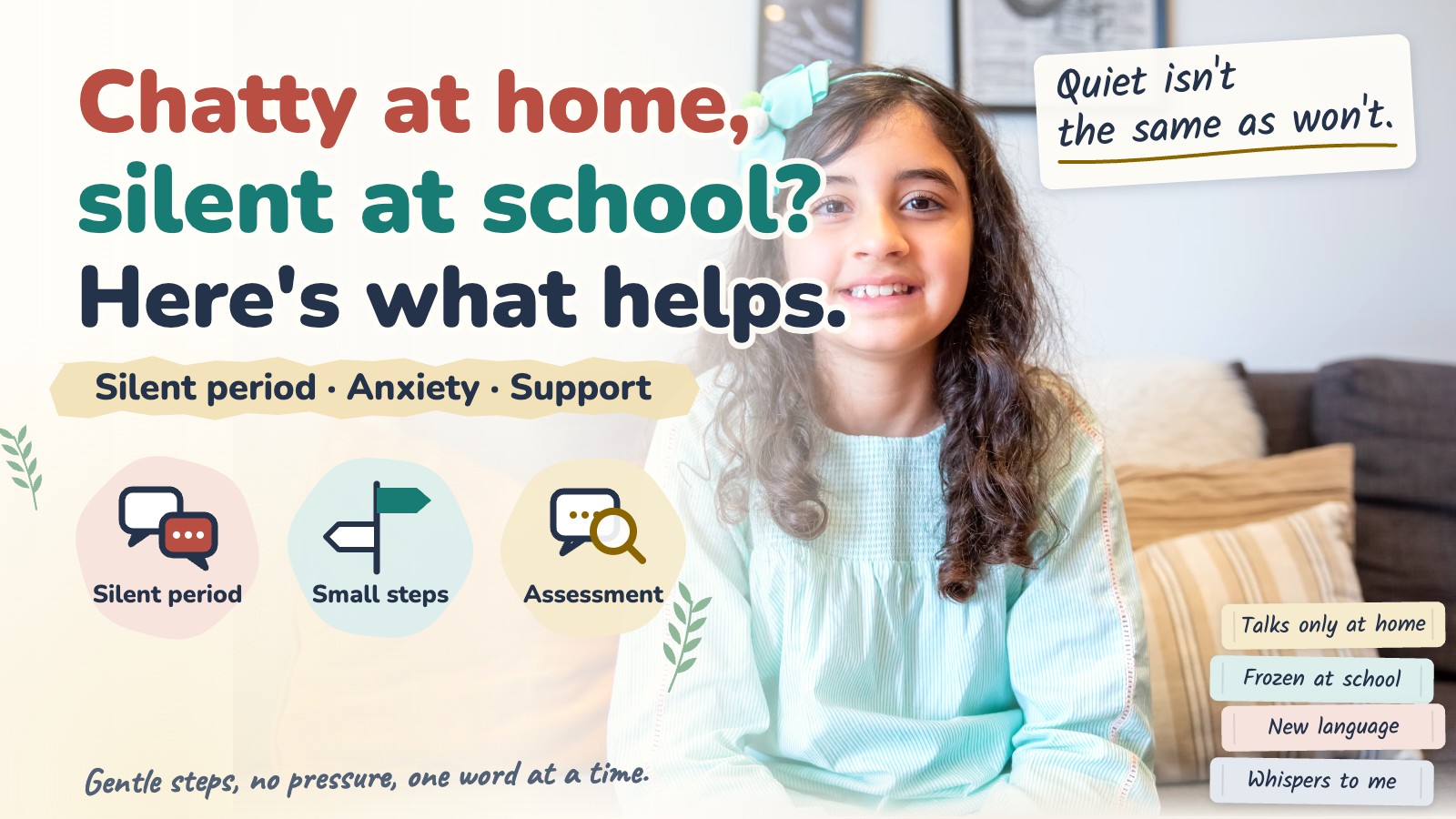
- What selective mutism is, in plain words, based on the diagnostic criteria clinicians use
- How it differs from the silent period many bilingual children go through
- How common it is, and why children who have moved countries are more often affected
- What helps at school: small steps, no pressure, and a consistent plan
- Questions to ask the school, with a short message template in English and Japanese
- How to get an assessment abroad or in Japan, where it is called bamen kanmoku (場面緘黙)
This article is general information for parents, not medical advice, and it cannot diagnose your child. Only a qualified professional can decide whether a child has selective mutism. If your child seems very distressed, stops eating or sleeping well, or you are worried about their safety, contact a doctor straight away.
What selective mutism is
The NHS describes selective mutism as an anxiety disorder where a person is unable to speak in certain social situations, such as with classmates at school, while speaking normally where they feel comfortable. The key word is unable. The Selective Mutism Association stresses that it is “not just shyness”, and the NHS describes a typical sign as a sudden stillness and frozen facial expression when the child is expected to talk to someone outside their comfort zone. It is not a child being rude, stubborn or controlling.
Clinicians use criteria from the American Psychiatric Association’s diagnostic manual (DSM-5). The American Speech-Language-Hearing Association (ASHA) lists them as follows. We have shortened the wording slightly.
| Criterion | What it means in everyday terms |
|---|---|
| 1. Consistent failure to speak in specific situations where speaking is expected (for example, school), despite speaking in others | Chatty at home, silent in class, and this happens again and again, not only on a bad day |
| 2. It gets in the way of school achievement or social communication | It affects learning, making friends or getting help |
| 3. It lasts at least 1 month, not limited to the first month of school | The first weeks at a new school don’t count on their own |
| 4. It is not explained by a lack of knowledge of, or comfort with, the language needed in that situation | The central question for bilingual children (see below) |
| 5. It is not better explained by a communication disorder such as stuttering, or only by autism or a psychotic disorder | A professional needs to rule other explanations in or out |
The NHS adds a practical point for families who have just moved: a diagnosis considers whether the inability to speak to certain people has lasted for at least 1 month, or 2 months in a new setting. It says selective mutism most often starts between the ages of 2 and 4, and ASHA notes that diagnosis often happens when the child starts school, because that is when the silence becomes visible to adults.
The “silent period”: a normal stage of learning a new language
ASHA explains that children learning a new language may go through a brief silent period in which they are quiet and speak little. It is a normal part of second-language learning, not a disorder. We looked at what that phase looks like in detail in our guide for families whose child doesn’t yet speak the language at a new school abroad.
How long does it last? There is no agreed figure. A clinical article by Toppelberg and colleagues in the Journal of the American Academy of Child and Adolescent Psychiatry (2005) says that observations suggest the non-verbal period is typically shorter than 6 months, common in 3- to 8-year-olds, and longer in younger children. Treat that as a rough guide, not a deadline.
Quiet in the new language, but not frozen
These are general features clinicians describe for typical second-language learning. They are not a checklist for diagnosis.
01
Talks in home language
Your child speaks freely in their first language, not only at home but with other children or adults who share it, for example at a weekend club or with a family friend.
02
Joins in anyway
They point, nod, laugh, play and follow routines. They look relaxed even if they say little in the school language.
03
Moves forward
Over weeks and months, a few words appear: a “yes”, a name, a phrase copied from classmates. The direction is towards more talk.
If all three are true, a quiet start at a new school is very likely part of learning the language. If they are not, it is worth looking more closely.
Silent period or selective mutism? The key differences
ASHA puts the difference clearly. Children with typical second-language learning show appropriate social communication in settings and with people who speak their primary language. By contrast, multilingual children with true selective mutism present with mutism in both languages, in several unfamiliar settings, and for significant periods of time. ASHA adds that selective mutism must exist in all of the child’s languages to confirm the diagnosis in these children.
Toppelberg and colleagues suggest selective mutism should be suspected when silence is prolonged, out of proportion to how much of the language the child knows and has been exposed to, present in both languages, and/or accompanied by shy, anxious or inhibited behavior.
| What you notice | More like a silent period | Worth an assessment |
|---|---|---|
| Speaking the home language outside the house | Talks freely with others who share it | Silent even with a teacher or child who speaks the home language |
| Body language at school | Relaxed, smiling, joining games | Stiff, frozen expression, avoids eye contact, looks scared |
| Understanding | Understands more and more of the school language | Understands well but still cannot say anything |
| Change over time | Gradually more words and gestures | No change, or silence spreads to more places |
| Other settings | Talks at birthday parties, shops, clubs in the home language | Also silent with relatives, neighbors or in shops |
A useful check: does your child speak the home language with someone outside the family? If they chat with a visiting family friend but say nothing at school, the language gap is a likely explanation. If they fall silent there too, mention it to a professional.
The two can also overlap: a child can be learning a new language and be anxious about speaking. You don’t have to decide which on your own.

How common is it, and why moving countries matters
The figures below come from the sources we checked. Studies use different methods and age groups, so the numbers are not directly comparable.
| Figure | Source |
|---|---|
| About 1 in 140 young children | NHS (UK) |
| Most prevalence estimates range from 0.2% to 1.6% | ASHA Practice Portal, summarizing several studies |
| 7.6 per 1,000 children in the general population in an Israeli study, and 22 per 1,000 among children from immigrant backgrounds | Toppelberg et al. (2005), citing an Israeli study |
| In a large Canadian survey, 5.5–7.8 per 1,000 among children from immigrant backgrounds versus 0.5–0.7 per 1,000 among non-immigrant children | Toppelberg et al. (2005), citing a Canadian survey |
The NHS says selective mutism is more common in girls and in children who have recently migrated from their country of birth. ASHA also notes that rates can be somewhat higher among immigrant children, language-minority children and children with speech and language delays. When clinicians assess a child, the NHS says they will want to know whether anything is causing distress, such as a disrupted routine or difficulty learning a second language.
Most bilingual children who are quiet at first do not have selective mutism. But a new language, school and country at once are a lot of change for a child who is already anxious.
What helps at school: small steps, no pressure
The advice from the NHS, ASHA and the Child Mind Institute is consistent. The Child Mind Institute says: children with selective mutism “should never be coaxed or pushed to speak.” The aim is to lower pressure and build speaking up in small, planned steps.
Treatment approaches the NHS describes include graded exposure (starting with the least frightening situations), stimulus fading (gradually bringing a new person into a conversation where the child is already comfortable) and shaping (rewarding any step towards speech, such as mouthing or a whisper).
From gestures to words, one small step at a time
A simplified picture of the gradual approach described by the NHS and ASHA. Every plan should be set with a professional.
01
Join in silently
Nodding, pointing, thumbs up, cards or writing are accepted as real participation. ASHA suggests nonverbal jobs in class that build confidence.
02
First sounds
Speaking to a parent at school while a teacher is nearby, then letting that adult come a little closer. This is the idea behind stimulus fading.
03
Widen the circle
A word to one trusted adult, then one classmate, then a small group. Each step is repeated until it feels easy before the next.
Progress is often uneven. A good day followed by a quiet one is not failure; the plan simply stays at that step a little longer.
| Helps | Tends to make it harder |
|---|---|
| Accepting gestures, pointing, writing or cards as participation for now (NHS, ASHA) | Insisting on a spoken answer in front of the class |
| Waiting about five seconds after a question, without repeating it or letting others answer (Child Mind Institute) | Classmates or adults answering for the child every time (ASHA) |
| Asking choice questions (“Red or blue?”) rather than open or yes/no ones (Child Mind Institute) | Bribes, deals or rewards promised only for talking (NHS) |
| Praising privately and specifically; reacting warmly but calmly if the child speaks (NHS) | Big public praise or surprise the first time the child speaks (NHS) |
| Keeping routines predictable and making the same request at the same point in the day (ASHA) | Labeling the child “the one who doesn’t talk” or explaining their silence for them (ASHA) |
ASHA also reminds teachers to reassure others that the child is still understanding, even if they are not talking. In a second-language school, silence is easily mistaken for not following the lesson. Some schools name a trained keyworker, one adult who carries out the plan consistently, which ASHA describes as a common model in schools.
What to ask the school
Schools vary in how much they know about selective mutism, and you may find yourself explaining it. Specific questions, asked calmly and in writing, help.
| Question | Why it matters |
|---|---|
| 1. Does my child speak, whisper or make any sound anywhere at school, even to one child? | Tells you where the plan can start |
| 2. Is there a teacher, assistant or student who speaks our home language? | Helps tell language from anxiety, and can become a first “safe” voice |
| 3. Can my child show learning without speaking for now (writing, pointing, cards)? | Stops silence being graded as “not understanding” |
| 4. Who could be a consistent adult (a keyworker) for small, planned steps? | One trusted person usually works better than many |
| 5. Could I come in before or after class so my child can talk to me in the room? | A common first step in gradual approaches |
| 6. Does the school have a counselor, psychologist or speech therapist, and can they observe? | Their notes will help any outside assessment |
English: Dear [teacher’s name], [child’s name] talks freely at home in [language], but we understand [he/she/they] is not speaking at school. We are looking into whether this is part of learning [school language] or anxiety about speaking. In the meantime, could [child’s name] be allowed to take part without speaking, for example by pointing or writing, without being asked to speak in front of the class? We would be grateful for a short meeting to share what we notice at home.
Japanese (日本語): [先生のお名前]先生 いつもお世話になっております。[子どもの名前]は家では[言語]でよく話しますが、学校ではまだ話せていないと伺いました。言葉の習得の途中なのか、話すことへの不安(場面緘黙の可能性も含めて)なのか、現在相談先を探しているところです。当面は、みんなの前で発言を促すことは控えていただき、うなずきや指さし、筆談での参加を認めていただけると大変助かります。家庭での様子もお伝えしたいので、一度お時間をいただけますでしょうか。よろしくお願いいたします。
Supporting your child at home
Home is usually where your child feels safest, so it is also where confidence gets rebuilt. The NHS advises parents to let the child know you understand they are frightened and that they can move forward at their own pace, to keep up ordinary social activities with small adjustments, and to ask relatives and friends to give the child time to warm up rather than pressing them to speak.
| Instead of saying… | Try… |
|---|---|
| “Why won’t you just say hello?” | “You can wave. Saying hello can come later.” |
| “If you talk to your teacher, you’ll get a treat.” | “I noticed you smiled at your teacher today.” (privately, later) |
| “She’s just shy.” (in front of your child) | “She’s warming up. She’ll join in when she’s ready.” |
| “Everyone else can speak English. Why can’t you?” | “Learning a new language takes time. You’re doing well.” |
| Answering every question for your child | Wait a few seconds, then offer a choice they can point to |
Keep your home language going. None of the sources we checked suggest dropping it to “speed up” the school language.
Small wins outside school count too, such as whispering to a cousin on a video call. The NHS says a child can successfully overcome selective mutism if it is diagnosed at an early age and appropriately managed, and that the older the child is at diagnosis, the longer it tends to take. That is a reason to ask early, not to panic.
Getting an assessment abroad or in Japan
The Selective Mutism Association says only a trained professional familiar with selective mutism or other anxiety disorders should evaluate a child, and that a diagnosis can only be made by a professional qualified to diagnose mental health conditions. An evaluation may also include a speech and language assessment and a hearing test. ASHA emphasizes that for bilingual children, the assessment must be culturally and linguistically appropriate and cover every language the child uses.
| Where you live | Where to start | What to check |
|---|---|---|
| UK | Your GP, or a speech and language therapy clinic directly (NHS) | Waiting times vary by area |
| Other countries abroad | School counselor or psychologist, pediatrician, child psychologist or psychiatrist, speech-language pathologist | Experience with selective mutism and with bilingual children; which languages they can assess in |
| Japan | School counselor (スクールカウンセラー), a pediatrician, or a child psychiatry clinic (jidō seishinka, 児童精神科) | Whether they can assess in your child’s home language, or work with an interpreter |
| Anywhere | Ask whether sessions can be partly online | ASHA notes many strategies can be delivered via telepractice, including coaching parents through practice at home |
We cover the practical side of finding clinicians, reports and costs as a family living overseas in our guide to assessments for expat children. The process is similar for selective mutism, even though the condition is different.
If you live in Japan
In Japan, selective mutism is usually called bamen kanmoku (場面緘黙). The Ministry of Education (MEXT) handbook on educational support for children with disabilities (2021) lists selective mutism (選択性かん黙) under emotional disturbance (情緒障害, jōcho shōgai) and notes that the term bamen kanmoku has become the common one in recent years. It describes children who have no physical problem with speaking but consistently cannot speak in particular social situations. The same handbook mentions the country a child grew up in and their language environment as part of the background to consider.
Depending on how much it affects school life, public schools may offer support through resource-room lessons (tsūkyū, 通級) while the child stays in a regular class, or through a special support class for autism and emotional disturbance. We explain how these work, and how to request them, in our English guide to special needs support in Japanese schools. For a list of places to ask for help, including local consultation services, see where to get help in Japan.
When the school setting itself is part of the problem
Most children with selective mutism are supported where they already are, and moving school is not a treatment. Some families still consider a smaller class or learning online for a period. Here is how the options compare in general.
Stay with a plan, move, or learn online
| Current school with a plan | Smaller in-person school | Online school | |
|---|---|---|---|
| Keeps familiar people | ○ | × fresh start | × new group |
| Small group size | △ varies | ○ | △ varies |
| In-person speaking practice | ○ | ○ | × on screen |
| On-site specialist support | △ varies | △ varies | × arrange outside |
| Continues if you move | × | × | ○ |
○ = generally yes △ = depends × = generally no / General tendencies, not a judgment on any particular school. As of September 2026.
We could not find research showing that online schooling helps or harms selective mutism. Speaking on a video call may be just as hard as in a classroom, so any setting still needs the same gradual, no-pressure plan, ideally guided by a professional.

A small online class with bilingual mentors: NIJIN GLOBAL ACADEMY
NIJIN GLOBAL ACADEMY (NGA) is an online international school for ages 6–18, run by NIJIN, the company behind this site. It is a school, not a clinical service, and we could not find anything on its website about specific support for selective mutism. Please read the limitations as carefully as the features.
| What NGA says it offers | Why it may matter for a quiet child |
|---|---|
| Classes of eight; the same small group every day; a daily morning circle | A small, predictable group and routine |
| Bilingual (English and Japanese) mentors who stay with each small group | Consistent adults, and support in two languages |
| Classes in an environment outsiders can’t freely enter, with mentors watching over online interactions (from NGA’s FAQ) | A closed setting rather than an open platform |
| No entrance exam and no English requirement; children who have struggled with school attendance are welcome | No need to “perform” to get in |
| Timetables for Asia and Oceania time zones; families abroad and in Japan can join | The same class continues if the family moves |
NGA opens in September 2027, so it is not an immediate option; free trial classes are planned monthly from September 2026. Tuition has not been published; NGA says it will be well below in-person international schools and shared first with its mailing list. NGA is not a therapy or assessment service, and selective mutism support would still need to come from a qualified professional. There is no physical campus, so in-person speaking practice would need to happen elsewhere. Its FAQ says mentor hiring criteria, absence policies and enrollment policies (including mid-year joining) are still being prepared. NGA is not a Japanese “ichijo” school and does not issue a Japanese school diploma, and we could not find a statement on its site about attendance recognition (shusseki atsukai, 出席扱い) at a child’s Japanese school. Figures such as “1,000+ students” or a 97% attendance-recognition rate belong to its sister school, NIJIN Academy, not to NGA.
NIJIN GLOBAL ACADEMY is an online international school for ages 6–18 with classes of eight and bilingual mentors who stay with each group. It is not a clinical service. It opens in September 2027, with free trial classes planned from September 2026.
Frequently asked questions
Sources used for this article
- NHS, “Selective mutism” (page last reviewed 17 February 2023): nhs.uk
- American Speech-Language-Hearing Association (ASHA), Practice Portal, “Selective Mutism” (includes DSM-5 criteria, prevalence, multilingual considerations and school strategies): asha.org
- Toppelberg CO, Tabors P, Coggins A, Lum K, Burger C, “Differential Diagnosis of Selective Mutism in Bilingual Children,” Journal of the American Academy of Child and Adolescent Psychiatry 44(6): 592–595 (2005): Harvard Medical School (PDF)
- Selective Mutism Association, “What is SM?”: selectivemutism.org
- Selective Mutism Association, “Evaluating and Diagnosing Selective Mutism”: selectivemutism.org
- Child Mind Institute, “A Teacher’s Guide to Selective Mutism” (Caroline Miller; updated 15 October 2025): childmind.org
- Child Mind Institute, “Selective Mutism: A Quick Guide” (updated 21 November 2025): childmind.org
- Ministry of Education, Culture, Sports, Science and Technology (MEXT), 『障害のある子供の教育支援の手引』 (Handbook on educational support for children with disabilities, 2021), Chapter VIII “情緒障害”: mext.go.jp (PDF, Japanese)
- NIJIN GLOBAL ACADEMY, FAQ and “Why NGA” pages (checked September 2026): FAQ / Why NGA / Tuition & Admissions
If your family is weighing a different setting, NIJIN GLOBAL ACADEMY offers live online classes of eight with no rankings and no English requirement, for families across Asia and Oceania and in Japan. Tuition is yet to be announced; the school opens in September 2027.
Published: 22 September 2026 / Last updated: 22 September 2026