Menu
BASICS
How Japanese schools work Japanese phrases for school Glossary of school termsWAYS TO LEARN
Free schools Education support centers Online schools Homeschooling in Japan International schools Correspondence high schoolsMORE
Neurodivergent children Where to get help Attendance and costs Learning Place Finder 日本語サイトへReverse Culture Shock in Children: Moving Back Home After Expat Life
- Why children can feel like “hidden immigrants” in their own passport country, and where that term comes from
- What research on returning families and students does, and doesn’t, tell us
- How in-year school admissions work in England and in two Australian states, as examples of what to check
- How to handle gaps in curriculum and language, and the social side of starting again
- Signs that your child is struggling more than expected, and when to get help
- A simple before-and-after plan for the year of the move
This article is general information for parents, not medical or legal advice. School admission rules differ by country, state and even local council, and they change. Check the current rules with the official body where you are moving. If your child talks about harming themselves or you are worried about their safety, contact a doctor or emergency services straight away.
Why “home” can feel foreign to your child
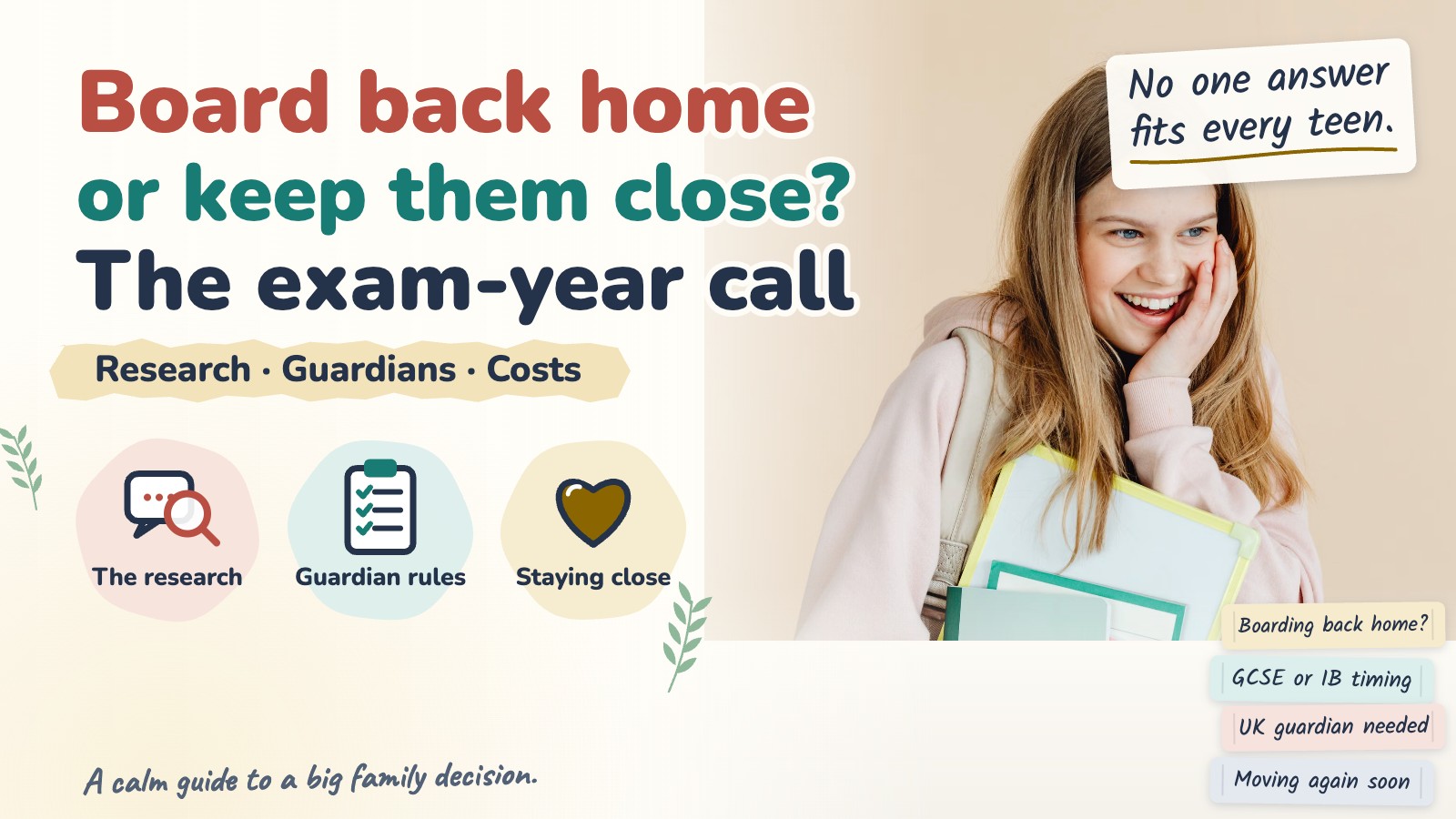
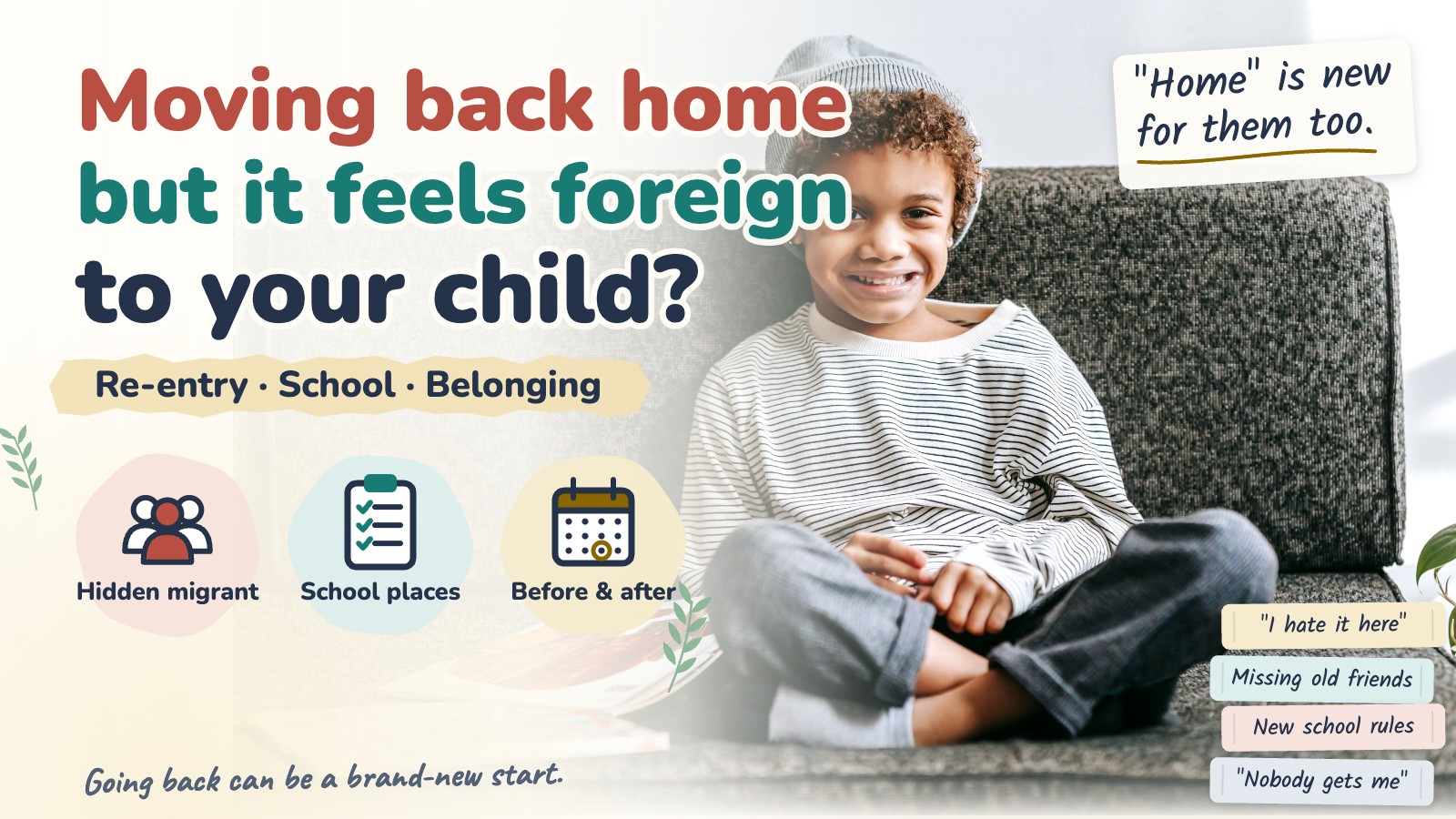
For you, moving back may feel like a return. For a child who left as a toddler, or who has spent most of their school years in Singapore, Dubai or Hong Kong, it is simply another move to a new country, and sometimes a harder one.
Ruth Van Reken, co-author with David Pollock of the well-known book Third Culture Kids: Growing Up Among Worlds, describes this in a chapter published in the academic collection Writing Out of Limbo (Cambridge Scholars Publishing, 2011). She sets out the “PolVan Cultural Identity Model” that she and Pollock developed. It sorts how a child relates to the culture around them into four boxes:
| Box | Looks | Thinks |
|---|---|---|
| Foreigner | Different | Different |
| Hidden immigrant | Alike | Different |
| Adopted | Different | Alike |
| Mirror | Alike | Alike |
A child moving back to their passport country often lands in the hidden immigrant box: they look like their classmates, but they think differently. Van Reken notes that this box can make life “quite complicated.” She also makes a point that matters for schools: educators may assume that hidden immigrant students know the historical or cultural references in the curriculum, and so don’t give them the extra help they would give a child who is clearly new to the country.
Three reasons re-entry can be harder than going abroad
These are general patterns, not a diagnosis. Your child may feel all of them, some, or none.
01
Nobody expects difficulty
Abroad, being new was obvious and people made allowances. At home, teachers, relatives and classmates assume your child already knows how things work.
02
Missing shared references
TV shows, slang, playground games, local history, how to address a teacher. Small gaps can make a child feel “weird” or left out.
03
A double loss
Your child has lost the place they think of as home and their friends there, while being told they should be happy to be “back.”
Naming the gap helps. “You look like everyone here, but you grew up somewhere else, so of course some things feel strange” can be a relief for a child to hear.
What research says about going back
It is worth being honest: there is less research on children returning home than on children moving abroad. A 2022 systematic review of adjustment in third culture kids in Frontiers in Psychology explicitly left out studies on repatriation and returnees, so its findings are about living abroad, not coming back. Much of the research that exists on returning is about university students or young adults, not school-age children.
Returning students. Kevin Gaw’s study in the International Journal of Intercultural Relations (2000) surveyed 66 American college students with overseas experience. Students with high levels of reverse culture shock were more likely to report personal adjustment problems and shyness. Importantly, as reverse culture shock increased, use of student support services went down. These were college students, so the findings may not apply directly to younger children, but it is a good reason not to wait for your child to ask.
Returning families. Daina Grosa and Russell King’s study in the Journal of International Migration and Integration (2023) was based on 40 in-depth interviews with children, parents, teachers, school support staff and return-migration coordinators in Latvia. They found that hopes of a smooth return to a homeland of relatives and friends were often not met. Many children, particularly those in upper primary and secondary school, experienced the move as a “rupture” in their lives. School could be full of unrealistic expectations on all sides, and communication between parents, teachers and support staff was often poor. The authors concluded that preparing children for the return, including language preparation and awareness of differences in teaching and curriculum, matters.
Research can’t tell you how your own child will feel. What it does suggest is that difficulty after a return is common enough to plan for, that older children may find it harder, and that school communication and preparation make a real difference.
How the move can feel at different ages
There is no official timeline for re-entry, and we did not find research that gives one for children. The table below is not a research finding. It is a general guide, drawing on the Latvian study’s observation that older children often found the return harder, to help you think about what your child might be facing.
| Age | What may be hard | What often helps |
|---|---|---|
| 6–8 | Different routines and rules; missing a carer, friend or teacher | Predictable days, familiar objects, time with relatives |
| 9–12 | Friend groups already formed; gaps in local knowledge and games | One regular club; a teacher who knows the background |
| 13–15 | Identity (“where am I from?”); feeling judged as “showing off” about abroad | Privacy, respect for their story, contact with old friends |
| 16–18 | Exam systems and subject choices; limited time to rebuild a social life | Early advice on qualifications; clear plans for the next step |
Teenagers may grieve in ways that look like anger; “this place is boring” can be a sign of loss, not ingratitude. If your child is also anxious at school more generally, our guide to third culture kids and school anxiety goes into more detail.

School places back home: what can be different
Families often assume that as citizens, their child will slot straight into the local school. In many places your child does have a right to a school place, but which school, when, and in which year group depend on local rules. Two official examples show the kind of detail to check.
Example 1: England
The Department for Education’s guidance on applications from overseas says that a local authority should not refuse an application made from overseas on the grounds that the family does not yet live in its area, and that admission authorities cannot require a permanent home address before processing an application. Schools can ask for evidence of an intended move, such as a rental agreement or a letter from an employer. Under the School Admissions Code (2021), a parent can apply for a place at any school at any time, admission authorities must tell parents the outcome in writing within 15 school days, and the child should start as soon as possible.
| Rule in England | Why it matters on return |
|---|---|
| You can apply at any time, to any school | You can apply mid-year, but popular schools may be full |
| Outcome in writing within 15 school days | Build this into your moving dates |
| Can apply before you have a permanent address | Keep proof of your intended address ready |
| Places outside the normal age group can be requested | Decided case by case, in the child’s best interests |
These rules cover England. Scotland, Wales and Northern Ireland have their own systems. The Code also has specific rules for children of UK service personnel and Crown servants returning from overseas, who may be allocated a place in advance.
Example 2: Australia (New South Wales and Victoria)
In Australia, schooling is run by the states. New South Wales’ enrollment procedures say eligible students are entitled to enroll at their local school, based on their residential address within the school’s intake area. Principals may ask for proof of address, using a points-based check of documents such as a lease or utility bills, and applications during the current school year should be assessed within 15 school days. Victoria’s placement policy says eligible students have the right to enroll at their local school, which is generally the one nearest their permanent address, regardless of capacity.
| Question to check | England | NSW / Victoria |
|---|---|---|
| What decides the school? | School’s admission criteria; place if not full | Your home address and local school |
| Need an address first? | Not to apply; evidence of the move helps | Proof of address usually asked |
| Mid-year decision time | Within 15 school days | NSW: assessed within 15 school days |
In the US, Korea, Japan and elsewhere, rules and timings are set by different bodies, and placement often depends on the child’s age and previous schooling. Whatever your destination, ask the education department or school early: which school your address gives you, what documents are needed, how year group is decided, and how long it takes. If you are returning to Japan and looking at options there, our guide to international schools in Japan may help.
Curriculum and language: filling the gaps
Even a child with excellent grades abroad may find gaps at home. National history, handwriting, spelling conventions and exam formats can all differ. Van Reken’s point about hidden immigrants applies here: teachers may not realize what your child has never been taught.
| Possible gap | What you might notice | A gentle response |
|---|---|---|
| Home-language literacy | Fluent speech but weaker reading or writing | Short daily reading; ask about support |
| Local history and civics | Lost in lessons others find easy | Family trips, books, documentaries |
| Math methods | Right answers, “wrong” method | Ask the teacher which method is expected |
| Exam and grading style | Surprise at low marks or new formats | Look at past work together, early |
The key step is telling the school. A short written summary of your child’s education so far (countries, curricula, languages, any assessments) helps a teacher see a hidden immigrant as a new arrival who deserves some adjustment time. Grosa and King’s study found poor communication between parents and schools made things harder, so it is worth being the one who starts that conversation.
It can be tempting to fill every gap with tutoring before the first day. A tired, anxious child learns less. Focus first on the gaps that affect daily confidence, such as reading in the home language, and let the rest catch up over time with the school’s help.
The social side: friends, identity and belonging
For many children, the hardest part of moving back is not lessons but lunchtime. Friend groups at a local school may have been together since kindergarten. Your child may also be used to an international school where new arrivals were normal and everyone was “from somewhere else.” At home, being new can feel much more visible.
Some children hide their overseas life to fit in; others talk about it constantly and are seen as boasting. Both are ways of working out who they are now. You can help by making it safe to talk about both places at home, and by not insisting that they should feel “happy to be back.”
The practical advice is the same as for any move. The Raising Children Network, an Australian government-funded parenting website, suggests asking your child to talk about, draw or list their worries, meeting the new principal or teacher, even setting up a review meeting in the first one to two weeks, and making a contact list of old friends. Our guide on helping your child make friends after a move covers how long friendship takes and what helps.
Signs to watch, and when to get help
Some sadness, irritability and tiredness after a return is expected. The NHS notes that children often find change difficult and may become anxious after a house move or when starting a new school. The question is whether things are slowly improving or spreading into more of your child’s life.
Three signals that it may be more than settling in
None of these is a diagnosis. They are reasons to look more closely and talk to someone.
01
Losing interest
No longer wanting to do things they used to enjoy. The CDC lists this among signs of depression in children, along with feeling sad, hopeless or irritable a lot of the time.
02
School-day symptoms
Headaches or stomachaches on school days that are usually gone at weekends. HealthyChildren.org (from the AAP) describes these as common signs of school avoidance.
03
Changes at home
Sleeping or eating much more or less than usual, or seeming tired and sluggish, or tense and restless. These are also on the CDC’s list.
Remember Gaw’s finding: the young people who struggled most used support services least. Don’t wait to be asked.
| Usually part of re-entry | Worth talking to someone about |
|---|---|
| Misses the old country, especially after calls with friends | Sad, hopeless or irritable most of the time |
| Complains that school is “weird” or “strict” | Physical complaints on school days, or refusing to go |
| Tired and flat in the first weeks | Sleep or appetite changes that don’t settle |
| Nervous but still goes and joins in a little | Stopped enjoying almost everything |
On timing, HealthyChildren.org advises that if school avoidance lasts more than one week, you and your child may need professional help. The NHS suggests seeing a GP if a child’s anxiety is severe, persists and interferes with everyday life, and involving the school. The good news about moving back is that you are now within your own health system: register with a family doctor or pediatrician early, so there is someone to call if you need them. If your child is refusing school in Japan, our guide to school refusal in Japan explains the local support available.
A before-and-after plan for the year of the move
The table below brings together the steps from this article in a simple order. Adjust it to your child’s age and your timeline.
| When | What to do | Why |
|---|---|---|
| 6–12 months before | Check admissions rules, timings and documents where you are moving | Avoid weeks out of school |
| 3–6 months before | Talk about the move; name the “hidden immigrant” feeling; list worries | Fewer surprises, more trust |
| Before leaving | Collect reports, work samples and a short education summary; plan goodbyes | Helps teachers place and support your child |
| First 2 weeks | Meet the teacher; share the summary; set a review meeting | Starts communication early |
| First term | One regular activity; keep old friendships; watch the signs above | Builds belonging without losing the past |
| After 3–6 months | Review with the school; get help if things are getting worse | Stops problems drifting |
Parents can feel reverse culture shock too. It is fine to tell your child that you also find some things strange.
When continuity might help: comparing options
Most children settle into their home school with time and support. For some families, though, the timing is hard: a move in the middle of an exam year, a return that may be temporary, or a child who is already anxious about school. In those cases some parents consider a bridge, a way to keep one part of school life the same through the move. Here is how the main options compare in general.
Local school, international school, or a small online class
| Local school at home | International school at home | Small online class | |
|---|---|---|---|
| Same class through the move | × starts again | × starts again | ○ |
| Builds local friendships | ○ | △ depends | × add outside |
| Home-language schooling | ○ | △ depends | △ depends |
| Low or no fees | ○ public | × | △ unpublished |
| Live classes in your time zone | ○ | ○ | △ check |
○ = generally yes △ = depends × = generally no / General tendencies, not a judgment on any particular school. As of September 2026.
An online class is not a replacement for belonging where you live. Your child still needs local friends, play and activities. What it can offer is a bridge: the same teachers and classmates while everything else changes. Check how any qualification would be recognized at home before choosing.
One option for families moving within Asia and Oceania: NIJIN GLOBAL ACADEMY
NIJIN GLOBAL ACADEMY (NGA) is an online international school for ages 6–18, run by NIJIN, the company behind this site. We mention it because it is designed to be “portable”: NGA says learning continues if the family moves. Its timetables are for Asia and Oceania time zones. That means it may suit a family returning to Australia, New Zealand, Korea or Japan, but it is unlikely to fit a family returning to the UK, Europe or the Americas, where live class times would fall at difficult hours.
| What NGA says it offers | Why it may matter on return |
|---|---|
| “Portable” learning that continues if the family moves | One part of school life stays the same |
| Classes of eight, the same small group every day, a daily morning circle | A steady group while local friendships build |
| Bilingual (English and Japanese) mentors with each small group | An adult who knows your child’s story |
| No rankings; children “cheer each other on rather than compete” | Less comparison during a hard year |
| No entrance exam or English requirement; children who have struggled with attendance are welcome | No need to prove anything after a hard start |
NGA’s FAQ says classes run in an environment outsiders can’t freely enter, with mentors watching over online interactions, and that families abroad and in Japan can join. Optional Cambridge IGCSE and A-Level courses are available for older students.
NGA opens in September 2027, so it is not an immediate option; free trial classes are planned monthly from September 2026. Tuition has not been published; NGA says it will be well below in-person international schools and shared first with its mailing list. There is no physical campus, so local friendships and activities need to come from elsewhere. Timetables are for Asia and Oceania only. NGA is not a Japanese “ichijo” school (一条校) and does not issue a Japanese school diploma, and we could not find a statement on its site about “shusseki atsukai” (出席扱い, attendance recognition) at a child’s Japanese school. Its FAQ says enrollment and withdrawal policies (including mid-year joining), mentor hiring criteria and absence policies are still being prepared. Figures such as “1,000+ students” or 97% attendance recognition belong to its sister school, NIJIN Academy, not to NGA.
NIJIN GLOBAL ACADEMY is an online international school for ages 6–18 with classes of eight and bilingual mentors, and timetables for Asia and Oceania. It opens in September 2027, with free trial classes planned from September 2026.
Frequently asked questions
Sources used for this article
- Van Reken, R. E., “Cross-Cultural Kids: The New Prototype”, in Bell-Villada, G. H. et al. (eds), Writing Out of Limbo: International Childhoods, Global Nomads and Third Culture Kids, Cambridge Scholars Publishing (2011): PDF copy
- Gaw, K. F., “Reverse culture shock in students returning from overseas”, International Journal of Intercultural Relations 24(1), 83–104 (2000): ScienceDirect
- Grosa, D. & King, R., “The Challenges of Educational Reintegration and the Psychosocial Wellbeing of Returnee Children: Evidence from Latvia”, Journal of International Migration and Integration (2023), doi:10.1007/s12134-022-00960-3: PubMed Central
- Marchal Jones, E., Reed, M., Gaab, J. & Ooi, Y. P., “Adjustment in third culture kids: A systematic review of literature”, Frontiers in Psychology 13:939044 (2022): frontiersin.org
- Department for Education (UK), “School applications for foreign national children and children resident outside England” (updated 28 March 2024): gov.uk
- Department for Education (UK), “School Admissions Code” (in force 1 September 2021): gov.uk
- NSW Department of Education, “Enrolment in Kindergarten to Year 12 procedures” (updated September 2026): education.nsw.gov.au
- Department of Education, Victoria, “Enrolment: Placement Policy” (updated 24 March 2026): education.vic.gov.au
- Raising Children Network, “Moving schools: how to make it easier” (December 2025): raisingchildren.net.au
- NHS, “Anxiety in children” (reviewed 5 August 2026): nhs.uk
- U.S. Centers for Disease Control and Prevention, “Anxiety and Depression in Children” (May 2026): cdc.gov
- HealthyChildren.org (American Academy of Pediatrics), “School Avoidance: Tips for Concerned Parents”: healthychildren.org
- NIJIN GLOBAL ACADEMY, FAQ and “Why NGA” pages (checked September 2026): FAQ / Why NGA / Tuition & Admissions
If your family is heading back to Australia, New Zealand, Korea or Japan, NIJIN GLOBAL ACADEMY offers a small online class that can stay the same through the move, with no entrance exam or English requirement. Tuition is yet to be announced, and the school opens in September 2027.
Published: 22 September 2026 / Last updated: 22 September 2026