When both parents work, choosing a free school is not only about activities. Getting there, lunch and the hours before and after opening are just as real. This guide keeps facility information separate from your family’s work schedule. It covers five areas to check for your child’s safety and agreement.
PR: Nijiiro is an education media site operated by NIJIN, Inc. This English translation includes text-only information cards about NIJIN GLOBAL ACADEMY, a planned school run by the same company. “Free school” here translates the Japanese term フリースクール, used for alternative learning places in Japan. It does not mean a tuition-free school and has no direct equivalent in other countries.
Go to the family planning sheets | Go to the FAQ
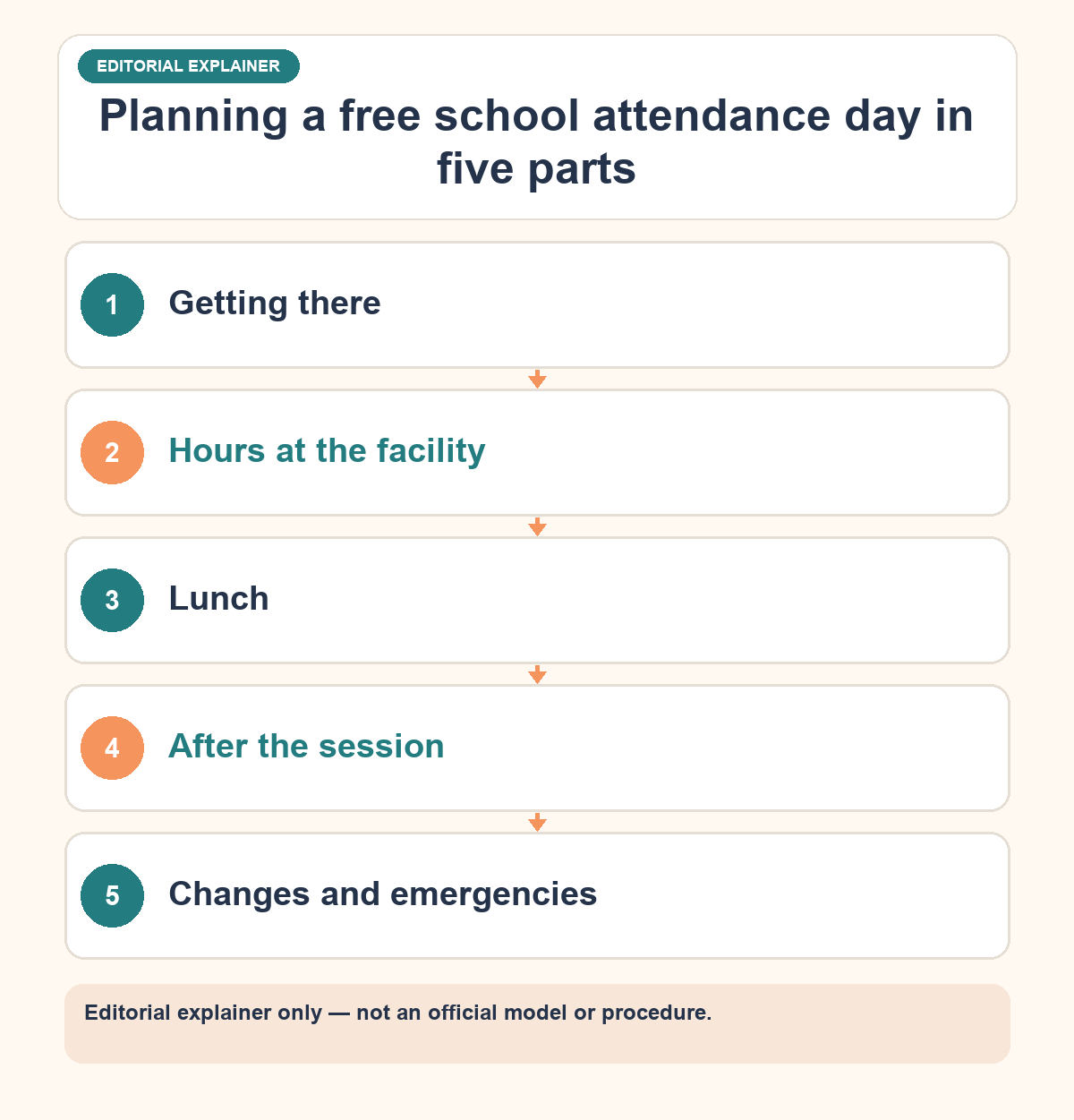
Break the attendance day into five parts
Plan an attendance day as one continuous flow: leaving home, reaching the facility, the time spent there and supervision after returning home. Even if a facility says “transport available” or “lunch provided”, you still need to check the service area, terms of use, fees and times one by one.
Start by sorting out five things: (1) travel from home to the facility, (2) start and finish times, (3) any lunch the facility provides and where children eat, (4) the time from leaving the facility until a parent gets home, and (5) how changes and emergencies are communicated. If you give each one a named person, it is easier not to build an unworkable plan around a parent’s start time alone.
When checking whether the facility’s hours overlap with working hours, add the time you leave home, the commute and travel after work. For example, if a facility finishes at 3 p.m. and a parent finishes work at 6 p.m., there is a three-hour gap. What you need to prepare depends on whether the facility offers extended hours, the child goes home alone, or a family member or local helper can collect them. This is a worked example. It does not show the hours of any particular facility.
The cost of attending may be more than the monthly fee. Estimate a monthly total that includes commuter passes or fares, lunch, learning materials, extended hours, transport services and occasional emergency taxis. If a subsidy or municipal grant is mentioned, check who is eligible, where to apply, the period and the documents required on the municipality’s official website. Do not assume you can use it because a facility says so.
To compare costs, you can assume a number of attendance days and ask the facility to estimate the monthly total. If you use transport or lunch separately, check whether fees are refunded for absent days, whether the monthly fee applies during long school holidays, and whether the first month is charged pro rata. If you cannot tell which period a quoted price covers, ask which months it applies to and whether a revision is planned, so you do not confuse it with an old price list.
If family members take turns with transport, record each person’s work schedule and siblings’ school events on the same calendar. Give the person doing the run more than the facility’s location and phone number. Tell them what words reassure your child, what to do about forgotten items and when to contact the parents. Tell your child early about planned changes in who is collecting them, so they do not feel a stranger has come.
Even older children may feel uneasy about travelling or staying home alone. On the other hand, a child may feel ready while a parent still worries about safety. First ask your child what worries them, then go through concrete situations on the route and at home together. Do not set one rule by age. Discuss the neighbourhood, your housing, your child’s experience and how they can ask for help.
When you make a daily timetable, include more than the arrival time. Note how many minutes your child needs to get ready, where keys and transit cards are kept, when they sign in at the facility and when a parent can make contact after they get home. If your child gets ready alone in the morning, separate what can be prepared the night before from what can only be done on the day. Agreeing in advance whether to go home or call the facility about a forgotten item makes the day less hectic.
When booking a trial day, check whether a parent can come, whether there is time your child spends alone, and whether parents may leave during the trial. If the trial overlaps with working hours, ask in advance on what terms the facility will look after your child then, and how it will contact you. Booking a trial does not mean that the transport, lunch or extended-hours services offered for regular attendance will also be available during the trial.
| Area | What to look at | Main people to check with |
|---|---|---|
| Travel | Departure and arrival, means of transport, transport service area | Facility, child, family |
| Hours of use | Sign-in, activities, extended hours, leaving | Facility |
| Lunch | Packed, bought, storage, where to eat | Facility, child |
| After the facility | Pick-up, “home safely” message, where to wait | Child, family, facility |
| Changes | Contacts for absence, delays and emergencies | Facility, family |
If in-person attendance is hard, comparing online ways of learning can also reduce the transport burden. The Japanese source article pointed to NIJIN Academy, an online free school also run by NIJIN, Inc. Its official Japanese-language site describes its online campus activities and how to take part. Check participation conditions, activity times and links with your child’s registered school separately, with the provider and the school. Before turning to any NIJIN service, remember the public options. In Japan you can talk to your municipality’s child-rearing consultation service. Children can also use the national 24-hour Children’s SOS Dial (see Next steps).
Transport, travelling alone and handovers
When deciding on transport, agree with the facility exactly who hands your child over at which point, and who to contact if plans change. Even where “transport” is offered, the service area, days, eligible school years, extra fees, capacity and whether it is door-to-door or to a set point differ by service.
If a parent does the run, line up the start of work with when the facility accepts children, and the end of work with when it closes. Check who to contact if you are delayed. If the same person cannot always do the run, ask whether a proxy can be registered in advance, how identity is checked and where your child waits if pick-up is late.
If your child travels by public transport or on foot, check whether the facility allows children to arrive and leave alone, and whether a parent must come the first time. Walk the safe route together and look at crossings, sections that get dark, roadworks, the wet-weather route and places to rest. Checking the route once does not guarantee safety, and conditions change with the season and time of day.
In its crime-prevention information, Japan’s National Police Agency lists things intruders check about a home, such as whether anyone is in, how easy it is to get in and how easy it is to escape. For an attendance plan, this helps you consider how your child will manage keys when coming home, whether they need to answer the door and whether they can ask a nearby adult for help. The agency’s information is general crime-prevention guidance. It does not guarantee any particular home-alone arrangement for an individual family.
If your child carries a smartphone, discuss charging, signal, saved contacts and what to do if the phone cannot be used. Decide whether to use a location app with your child’s age, feelings and your family’s approach in mind, and explain its purpose and who can see it. A phone alone does not make your child safe. Also decide who will check with the facility if you cannot reach your child.
If a parent drops your child off before work, do not judge whether you will make it on time only from a map app’s travel time. Include morning traffic, parking or drop-off spots and sign-in. If possible, try the route once at the usual time and find an alternative in case of rain or public transport delays. Also check the deadline by which you would need to tell your workplace if the backup route fails.
If transport plans change often, set a deadline the day before to confirm who is responsible, rather than deciding on the morning. List the next person to call if the responsible person cannot go, the proxy registered with the facility and who will tell your child about the change. Even if you use a family group chat, give your child a way to check it, so they are never the only one who does not know about a change.
If the facility provides transport, ask who drives and who rides along, where children are checked in, what safety equipment is in the vehicle and how delays or cancellations are announced. Ask the facility to explain, in words your child understands, whether to wait where they are, contact a parent or go back to the facility if the vehicle does not come on time. If detailed procedures are written down, read them together and check they match what your child will actually do.
If you have siblings to transport or a parent works far away, look for ways not to load everything onto one parent. List realistic options such as taking turns by weekday, asking relatives or temporarily changing start times at work. Do not write an option into the schedule as settled until someone has agreed to it. Mark it as a candidate that still needs confirming.
At bus or walking meeting points, be clear about when facility staff take charge of your child and when parental supervision ends. Ask whether parents accompany children partway, whether staff walk with them from the meeting point and where your child waits if late. Ask the facility to explain how children get on and off the vehicle, the passenger list, checks on absent children and the contact made after handover. Check anything unclear in writing.
| Method | Check in advance | Changes and emergencies |
|---|---|---|
| Parent drop-off and pick-up | Opening and closing times, parking, sign-in | Phoning about delays, proxy pick-up |
| Facility transport | Area, days, fees, pick-up and drop-off points | Cancellations, boarding checks, delay notices |
| Walking or public transport | Child’s experience, route, time home | Delays, missed stops, phone problems |
Source: National Police Agency, “Sumairu Bohan 110-ban” (home crime prevention, in Japanese)
Bridging opening hours and working hours
To see whether facility hours fit your working hours, include travel, sign-in, extended hours and waiting time after your child gets home. A facility’s business hours may not match the times it accepts children or the times they can join activities.
In the facility’s guide, check more than the open days. Look at how it handles public holidays, long holidays, staff training days, unscheduled closures and trial days. Some facilities close on school holidays, and the usual transport, lunch and supervision may not be available. Ask for an annual calendar and use it in planning parents’ leave and alternatives.
If you ask about extended hours, check more than how late they run. Ask about staffing during that time, extra fees, the booking deadline, same-day changes and where your child will spend the time. Ask whether “extended hours” means childcare, a continuation of normal activities, or something that needs individual supervision. Do not guess what a service involves from its name. Ask to see what the guide or contract says.
On days when a parent works from home, do not simply assume that being at home means being able to supervise. Look at the real day: can you respond during meetings, can your child take lunch and breaks alone, and can you stop work for an unexpected visitor or illness? How much you tell your employer about family circumstances is your choice. If needed, ask whether working hours or breaks can be adjusted.
If there are days when work will not finish before the facility closes, look into specific options: family, relatives, local helpers and your municipality’s child-rearing consultation service. When relying on someone, check whether your child knows them, whether you can share emergency contacts, and whether costs and hours fit your work. Do not plan around someone who “should be available”. Confirm with them and your child which days and on what terms they can help before including them.
If attendance days change from week to week, update them together with work shifts and family plans. Rather than telling your child about changes at the last minute, agree by when the schedule will be fixed and who will tell them about any change. If the person who reports absences to the facility is not the one who tells the workplace about lateness or leave, a shared list helps prevent missed messages.
When discussing changes with your employer, your family can decide how much to say about your child. Check whether a brief explanation such as “I need to leave early for a medical appointment or family reasons” is enough. Look up flexitime, remote work and leave in your work regulations. Schemes and eligibility differ between employers, so do not assume you can use them because a colleague did. To avoid sudden time off, put the facility’s closed weekdays and long holidays into the schedule first.
When a working family plans the logistics, do not just tell your child after the adults have decided. Ask who they want to collect them, whether they want to come home alone, where they want to eat lunch and how they want to be contacted. If something they want is not possible, explain why and look for other options together.
Lunch, allergies and the eating environment
Ask about more than whether lunch is provided: ask about packed lunches, storage, where children eat and what happens if your child finds it hard to eat. Meal policies and facilities vary. Even where lunch is provided, a facility may not be able to cater for every ingredient, allergy or religious requirement.
If your child brings food, check whether there is a fridge or microwave, whether ice packs can be stored, and when and where they eat. If food can be bought on site, ask which days, whether cash or electronic payment is accepted and what happens if it sells out. Ordered lunches may have deadlines and cancellation fees, so parents should know how to order and the deadline for changes.
If your child has allergies or dietary restrictions, discuss what to tell the facility, what happens in an emergency, who checks ingredient labels and how food brought from home is stored. Also check who handles this information, how widely it is shared among staff and how parents can update it. A family’s own judgement cannot guarantee safety. Confirm clearly what the facility can manage, and if it cannot, discuss alternatives such as bringing food.
If your child finds eating in front of others stressful, does not want people to see how much they eat or wants to choose when to eat, ask the facility whether there is a quiet place or time. Do not treat this as fussiness or bad behaviour. You are discussing the conditions your child needs to eat comfortably. Also talk with your child about how much of this support should be shared.
Decide what happens if your child leaves food or forgets lunch. Practice varies: the facility may provide a snack, contact a parent, or let your child buy something. If you give lunch money, agree the amount, how to pay and who to tell if it is lost. If it is hard to take calls at work, ask whom the facility contacts first and whether you can register a backup contact.
When comparing costs that include lunch, check how many days the monthly fee covers, refunds for absent days, ordering during long holidays and how drinks and snacks are handled. Unit prices alone make the monthly cost hard to see, so you can ask the facility to estimate a month based on a typical attendance plan. When comparing with home food costs, include travel costs and parents’ preparation time.
If parents make lunch, it does not have to be the same every day. Check at home what your child can choose, what is easy to eat and what needs to be kept cold. Ask the facility whether your child can buy food if they forget lunch, whether a family member can bring it and whether mealtime can be moved. Also consider that you may get a call about lunch at work, and decide who will deal with it instead.
Share with the facility only the food information needed for your child’s safety and comfort. When giving staff important information such as allergies, check the registration form, how to update it, emergency contacts and which staff handle it. If a service reports daily food intake to families, ask whether your child wants this, why records are kept and who can see them.
Supervision and staying home alone outside opening hours
Do not decide whether your child can stay home alone mechanically by age; consider their wishes, the home, who they can turn to in an emergency and the time of day together. Neighbourhoods and family circumstances differ, so this article cannot give a single age standard or a guarantee of safety.
First ask your child how they feel about being home alone and which times worry them. Go through concrete situations together: can they use the house key, do they think they must answer the phone, how will they deal with visitors and whom will they contact if something goes wrong? Even if they say “I’ll be fine”, they may not be able to handle every situation, so make it easy for them to talk about worries.
Disaster-prevention learning material from Japan’s Fire and Disaster Management Agency explains causes of fire, care when using fire and the dangers of children using fire on their own. At home, check whether your child needs to use cookers, heaters, lighters or chargers alone. Decide on meals that do not need fire while parents are out, and on steps for going outside and asking for help if something seems wrong. This is material for checking safety at home. It does not replace an inspection of your own home.
For contact while your child is alone, set a second contact in case a parent’s phone does not answer, not just the parent’s number. Leave your address, a nearby person who can help and how to call emergency services where your child can understand them. Decide what to do if the smartphone cannot be used. Also check which contacts to register with the workplace and the facility, and with whom your child’s personal information will be shared.
If your child will start coming home alone, one approach is to build up gradually rather than leaving it to them every time from the start. You might practise at home, try short periods alone and have an adult nearby. There is no fixed standard for how long or in what order to practise. Make sure your child knows they can stop or change the plan if they feel uneasy, and can call even when it was not planned.
If you are considering supervision options such as visits from relatives, local childcare, extended facility hours or another place to attend, check each one’s eligible ages, hours, fees and emergency procedures in its official information. Municipal services have different conditions depending on where you live and whether you have registered. Ask about availability and start dates, and do not base work or attendance plans on services that are not yet confirmed.
Even when a parent works from home, they may not be able to respond straight away. Check for long online meetings, times you cannot take calls and times you are in another room, and consider what help your child might need then. Plan not only for the time your child can manage alone but also for a backup contact when a parent cannot respond.
To prepare for time alone, you can put emergency contacts on paper somewhere visible and go through the steps with your child. Talk about practising saying your address, whom to contact if a parent cannot be reached, and how to get to a safe place in an emergency such as an injury or fire, in ways that suit your family. For specific evacuation places and how to call emergency services, also check local information from the fire service and your municipality, and make short steps your child can understand.
Decide as a family whether your child will answer the door if someone comes while they are alone. The National Police Agency’s crime-prevention guidance warns about checking visitors and how homes are identified as empty. Do not just say “don’t open the door to strangers”. Name the people you expect, such as deliveries, school staff or relatives, and agree that your child will contact a parent or a registered adult if unsure.
If school or the facility closes suddenly and your child will be alone at home longer than usual, plan for this separately from normal attendance days. Recheck how long your child will be home, lunch, any outings and when a parent can respond. If you are worried about them staying home alone, talk early to your employer, family or your municipality’s support service. Alternative services may not be available when a facility closes, so check eligibility and availability before including them in your plan.
A contact plan for sudden changes
Decide in advance who will make decisions, and whom they will contact, if school closes suddenly, the facility shuts, transport is delayed or your child becomes unwell. You may not be able to take time off at short notice, so do not rely on a single backup. Confirm which people and services you can actually call on.
Do more than list school and facility contacts: separate routine contact from emergency contact. Check when the facility is open, when its phone is answered, how often email is checked and how parents should call back. When registering, also discuss who reports your child’s absences and whether a proxy can notify the facility when parents are at work and unavailable.
To prepare for sudden closures of the facility or school, you can check how each parent would contact their workplace, whether they can switch to working from home, and the workplace’s rules on annual leave and leave such as care leave for children. Available schemes and conditions differ between employers, so check your work regulations or HR. Discussing how to notify changes in advance, without giving more detail than necessary, reduces the decisions you have to make on the day.
Tell the person you ask to do pick-up the facility’s address, the handover conditions, whether your child knows them and how contact details will be shared. If the facility requires proxies to be registered in advance or to show ID, complete that process. Even with relatives or friends, write them into the schedule only after confirming they can actually come on that day and at that time.
If public transport is delayed, what needs to be communicated depends on whether your child is at the facility or on the way home. Agree concrete actions to suit their age and experience, such as “if you’re delayed, don’t keep changing trains; ask station staff” or “message a parent before leaving the facility”. Follow public transport guidance and the facility’s rules, and decide which adult your child can ask for help when they cannot decide alone.
A contact plan is not finished once it is written. Update it when a parent’s workplace, a proxy, facility staff or contact details change, and explain new arrangements to your child. If you practise for emergencies, explain the purpose as “checking who to talk to when something goes wrong” so it does not worry your child, and review the actual phone numbers and address together.
Do not leave everything in the contact plan to one person. Check when the first contact cannot answer the phone, which weekdays a proxy is unavailable and which days the facility is closed, and prepare the next step for each. Ask anyone who agrees to help in what situations they will be contacted, how they will talk to your child and how much they can do. Adding someone’s name to a contact list does not mean you can ask them to collect or supervise your child.
After a change of plan, look back briefly at whether your arrangements worked. Did your child wait safely at the facility when pick-up was late, did they understand a change to lunch, and did calls get through? Choose one thing to improve next time. If your child says something was frightening, do not brush it off with “it was fine”. Ask what worried them and work out together how to avoid the same situation and whom to ask for help.
| What happened | Check first | Contact next |
|---|---|---|
| Facility is closed | Official notice, opening or make-up days | Parents, workplace, backup supervision |
| Child is delayed | Where they are, a safe place to wait | Facility, parents, transport staff if needed |
| Pick-up is late | Facility’s waiting place and closing time | Facility, registered proxy |
| Child becomes unwell | Where the child is, how the facility responds | Parents, emergency contacts |
10 Frequently Asked Questions
Whether attendance can continue depends not only on a facility’s service terms but also on whether your family’s travel, work and supervision arrangements are realistic.
Do free schools offer transport to and from the facility?
It depends on the facility. Check the service area, days, eligible ages, fees, pick-up and drop-off points, and how absences and delays are communicated. Do not assume your address is covered just because a facility says it offers transport.
Can my child travel to the free school alone?
It depends on the facility’s rules and your child’s situation. Decide after checking with the facility and your child: whether children may arrive and leave alone, whether an adult must come the first time, how arrival is reported, what happens with delays and how getting home is confirmed.
Can the hours fit around parents’ working hours?
Opening hours, activity times and whether extended hours exist, and on what terms, differ by facility. Add commuting and transport time to your working hours, and check how waiting and pick-up after the facility closes will be handled.
Will the free school provide lunch?
Whether lunch is provided, ordering deadlines, costs, storing and heating packed lunches, and where children eat differ by facility. If your child has allergies or dietary restrictions, also discuss what the facility can manage and its emergency procedures.
We both work. What if we are late for pick-up?
Check the facility’s closing time, extended hours, who to contact about delays and how to register a proxy for handovers. Plan family members or services as backups only after confirming their times, costs and your child’s wishes.
From what age can a child stay home alone?
This article cannot give a single age standard. Consider your child’s wishes, how long they would be alone, your home, how they would deal with fire and visitors, who they can ask for help and local conditions. If you are worried, talk to your municipality’s child-rearing consultation service or a similar service.
If I work from home, can I supervise my child?
Even at home there may be times when meetings or calls stop you from responding. Check your work schedule, the time your child will spend alone, lunch and emergency contacts in concrete terms, and plan alternatives for times when you cannot respond.
Is there somewhere my child can go when the free school is closed?
Municipal and local services differ in eligibility, how to apply, availability and cost. Check the conditions in your municipality’s official information, and ask whether registration or an advance interview is needed and whether short-notice use is possible.
Can we change attendance days because of work?
Changing days, reporting absences, make-up sessions and cancellation fees depend on the facility’s contract terms. Before applying, check by when and to whom you must report work-related changes, and whether the monthly schedule can be changed.
Who can we talk to about worries over transport or staying home alone?
You can talk to the facility about hours and handovers on site, your municipality about local supervision and child-rearing support, and your employer about work adjustments. Listen to your child’s worries too, and explain which times need what kind of help.
Next steps
Start with the gaps: write down what each facility has confirmed, what your family still has to arrange and whom to ask about each open point.
- Ask each facility for its official information on hours, closed days, transport, lunch, extended hours and conditions for changes or cancellations. Note which period any quoted fee covers.
- Fill in the basic planning sheet below with your child, and use the optional checks only where they apply.
- For local supervision and child-rearing support in Japan, contact your municipality’s child-rearing consultation service. Check eligibility, registration and availability before relying on a service.
- For children in Japan, the Ministry of Education, Culture, Sports, Science and Technology (MEXT) runs the 24-hour Children’s SOS Dial: 0120-0-78310 (also written 0120-078310). MEXT says it is available 24 hours a day, including nights and holidays, and in principle connects callers to the counselling service of the board of education where they are calling from. This is a Japanese service. Families outside Japan should use their own local services.
- For work adjustments, check your work regulations or talk to HR. Schemes differ between employers.
Editable family planning sheets
Put transport, lunch and supervision after the session on one page to spot unassigned tasks and gaps in time. These sheets are editorial examples. They are not a facility’s safety plan or a municipal application form. Click inside a sheet to edit it.
Basic sheet: family plan for an attendance day
Optional sheet: extra checks to use only if needed
Before printing or sharing, decide who may see workplace and family phone numbers. You can keep one version for the facility and another for home only. Rather than filling in every item, use the sheets to find what is still undecided, and decide whom to ask and when.
References
Sources cited in the original Japanese article (dates are the access dates given in that article; not rechecked for this translation):
- National Police Agency, “Sumairu Bohan 110-ban” (in Japanese) (accessed 6 November 2026, per the original article)
- Fire and Disaster Management Agency, “Disaster and Crisis Management e-College: Fire” (in Japanese) (accessed 6 November 2026, per the original article)
- NIJIN Academy official site (in Japanese) (eligibility and activities; accessed 6 November 2026, per the original article)
- NIJIN Academy, “About NIJIN Academy” (in Japanese) (operator and facility information; accessed 6 November 2026, per the original article)
Checked on 22 November 2026 for this translation:
- MEXT, “About the 24-hour Children’s SOS Dial” (in Japanese)
- NIJIN GLOBAL ACADEMY, Brochure, Opening Updates, Admissions and Contact
The information in this English translation is inherited from the Japanese source article, whose cited sources were accessed on 6 November 2026 and which was last modified on 7 November 2026 (GMT). This translation was prepared on 22 November 2026. Only the NIJIN GLOBAL ACADEMY information and the MEXT 24-hour Children’s SOS Dial were checked on that date; other statements were not newly verified and may have changed.
Conditions for transport, lunch, opening hours and safety when staying home alone differ by facility, family and area. Check the latest information from facilities and municipalities. The family sheets and example questions were created by the editorial team and are not official forms.
About the images: the featured image is an AI-generated illustration. The diagram in the body is a separate editorial diagram of the article’s five planning areas. Neither is a photograph of real school or free school activities.