When your child stops on the way to their international school, or absences start to add up, worries about contacting the school, fees and how they will learn from here can all arrive at once. Begin by asking about your child’s health and what they want. Then deal with the school’s own absence and support procedures separately from checks on Japan’s school-attendance system. The label “international school” alone tells you neither the school’s legal classification nor how absences are treated. This article sets out six things to check and who to ask.
Go to the family consultation notes Go to the 10 FAQs
Key points
- Don’t assume why your child is reluctant. First, separate the strain on your child from the facts you will tell the school.
- Check the international school’s own attendance and credit rules separately from school enrolment and deemed attendance under Japan’s school system.
- Don’t decide on counselling, rest, staying or transferring all at once. Check your child’s wishes and any deadlines one at a time.
Six things to check first when your child is reluctant to go to school
Rather than deciding on the spot whether your child can go to school, treat their wellbeing, talking to the school and checking Japan’s system as separate topics. In Japanese, ikishiburi (often translated as “school reluctance”) is an everyday word for finding it hard to set off for school in the morning, or hesitating to go. It is not a diagnostic term and does not name a cause. Whether to stay home today, whether to stay at the current school and how to check your child’s status under Japanese school rules each need different information and different people to ask. You don’t have to reach every conclusion at once.
In the first conversation, instead of repeatedly asking “Why can’t you go?”, ask just one easy question, such as “What feels hardest this morning?” or “Is there anything you’d like me to tell the school?” If your child doesn’t answer or doesn’t want to talk, don’t immediately read it as refusal or defiance. You can choose ways that put less strain on them: wait a while, let them answer on paper or by message, or contact the school yourself first.
Then split what your family wants to check into six items: (1) your child’s health and what seems possible today; (2) how to report an absence to the school; (3) who handles counselling or support at the school; (4) the international school’s rules on attendance, assignments and progression; (5) where to ask about Japan’s compulsory schooling duty and deemed attendance; and (6) deadlines and costs if you are considering leave, withdrawal or a transfer. None of these is a checklist for parents to judge the system on their own. They are an order for finding the right people to ask.
You don’t need to choose a new school right away. You could report today’s absence first, ask for a meeting with the right staff member, and read the school’s rules later. On the other hand, if there are deadlines where waiting could affect your options, such as a withdrawal notice date, a tuition payment date or safety measures, check with the school early. Don’t rush decisions; just find out first whether any deadlines exist.
When you first ask for help, you don’t need every detail in place. It is enough to share what you know of these: when going to school became difficult, what the school has told you, what your child says about school, and what you want to check. You don’t need to explain a confirmed cause or fill in things your child hasn’t said yet. Ask what the school has noticed too, and compare it with what you have seen at home.
| Item | Who to ask first | What not to decide in a hurry |
|---|---|---|
| Your child’s health and wishes | Your child; parents or professionals as needed | The cause or a diagnosis |
| Absence reporting and school contacts | The contacts given in the school’s guidance | Assuming all schools use the same reporting method |
| Attendance, assignments and progression | Staff at your child’s international school | Applying another school’s rules |
| Japan’s compulsory schooling duty | The municipal board of education where you live | Judging the school’s legal category from its name alone |
| Deemed attendance at a Japanese school | The Japanese school, if your child is enrolled at one | Assuming international school attendance counts automatically |
| Leave, withdrawal, transfer and fees | The current school, the receiving school and, if needed, the board of education | Assuming rules, deadlines and fees are the same at every school |
This table does not cover every legal procedure. The right contact can change with your child’s stage of schooling, residence status and nationality, where you live and the type of school. If what the school says seems to differ from what a public office says, don’t pick one yourself. Note the school’s name, your child’s enrolment status and the procedure you want to check, and consult the board of education.
If you are in Japan and need someone to talk to now, MEXT’s 24-hour Children’s SOS Dial (0120-0-78310) is open to children and parents. See the section on rest below. If safety is at immediate risk, contact local emergency services.
Look at the signs without assuming a cause
Keeping notes is not about judging your child; it is about working out together which situations are hard and why. Families notice different things. A child may struggle to get moving only in the morning, miss more school on certain weekdays, want to leave early after arriving, or avoid talking about school. Don’t jump from a single behaviour to “it’s the English-language lessons” or “it’s their friends”. Keep what you have observed separate from what you are worried about.
An observation sounds like “On Monday morning it took a long time to put on the uniform” or “They went quiet after the school contacted us.” Explanations such as “They must be bullied at school” or “They dislike how we’re handling it” are guesses that haven’t been checked yet. There is no need to blame yourself for having guesses. But when you talk to the school, separating “what we saw”, “what our child said” and “what we as parents are worried about” makes the next step easier to check.
The language of instruction, workload, how assessments are taken, friendships, lunch breaks and moving between classes, the commute, sleep and health can all be starting points for questions. However, you cannot assume a particular problem simply because the school is an international school. How your child experiences specific situations matters more than the type of school.
When you ask your child, start with short questions that don’t narrow the options, and leave room for them not to answer. For example: “Which is harder, before leaving home or during lessons?”, “Is there any time at school when you can be on your own?” or “Today, would you rather stay home and settle down, or have someone contact the school?” Pressing for the “right reason” can make talking itself a burden. Respect a wish not to answer for now, and agree on when you might ask again.
You don’t need a detailed diary covering many days. For a conversation with the school, note what you know of the dates of absences, late arrivals and early departures, your child’s own words, what you observed, and the dates you contacted the school. Gaps are fine. Don’t try to fill in moments you didn’t notice, and don’t ask your child the same question again and again.
| Note field | How to record it | Assumptions to avoid |
|---|---|---|
| Date and situation | Morning, after arriving, during lessons, after coming home, etc. | Deciding there is the same reason every day |
| Your child’s words | Briefly, as far as you remember; leave blank if none | Writing a parent’s interpretation as the child’s words |
| What you saw at home | Facts about behaviour or contact, kept brief | Guessing at personality or a diagnosis |
| Next question | One point you want to check with the school | Expecting one meeting to reveal the cause |
If physical symptoms such as stomach aches, headaches or nausea continue, don’t link them to a psychological cause at home. For health concerns, consult a medical professional or other specialist as needed. This article is not diagnostic or treatment advice. If you are worried about immediate safety, use your local emergency services.
Counselling and support differ from school to school
Don’t just ask “Is there a counsellor?”; ask who takes which concerns and who they pass them on to next. International schools differ in size, grade range, operator and curriculum. The people you can turn to also vary: a homeroom teacher, advisor, grade-level leader, counsellor, nurse or school office. Not every school has a particular role, or offers consultation in Japanese. Use the parent handbook you received on enrolment or the school’s official website to check the absence-reporting contact and the contact for individual consultations separately.
Marist Brothers International School’s official page says its school counsellor supports parents as well as students, and offers online sessions as well as in-person ones. It lists several ways to ask for a session, such as telling the homeroom teacher, using a dedicated app or booking system, or visiting the office. This is one school’s published approach. It does not mean other schools have the same contacts, costs or scope of support.
| School | What the official page describes | What each family may want to check |
|---|---|---|
| Points to check at your child’s school | Who provides counselling, which grades and concerns it covers, how to make contact | Current contacts, meeting language, costs, information sharing, emergency contact route |
| Marist Brothers International School | Counselling for students and parents, in person or online, several ways to book | Currently available dates, meeting language, who information is shared with, emergency contact route |
Source: Marist Brothers International School, “Social Emotional Learning” (checked by Nijiiro on 9 November 2026 for the original Japanese article; not re-checked for this translation). This is an example of one school’s published consultation methods and does not show results or effectiveness.
If you can’t find anyone to contact, tell the school’s main office: “My child has been absent repeatedly. Could you tell me who we can talk to?” You can also ask whether contact is in English only, whether consultation in Japanese is possible, whether parents can talk to staff first on their own, and how your child’s consent will be checked. If the school has no Japanese speakers, it helps to ask whether interpreting or translation is available and how misunderstandings will be checked. Languages and support systems vary by school.
Even where counselling is offered, it is not the same as diagnosis or treatment by a medical provider. Ask what the counsellor can help with, who the content of sessions is shared with, and how emergencies and safety concerns are handled. Even if a school promises confidentiality, ask individually about exceptions for safety and how parents are contacted. Don’t conclude from a website alone that counselling will definitely have a certain effect or that the school will respond in a certain way.
When you contact the school, choose the one situation that is hardest and say how you would like to be updated. If a long phone call is difficult, ask whether you can request a meeting by the school’s designated email or booking form. Replies may not be immediate, so check whether emergency and routine contacts are different. In your contact log, keep only the date, recipient, what you wanted to check and what is still awaiting a reply, and don’t include other students’ personal information.
Specific practices can only be taken as reference within what a school has published. Marist Brothers International School’s system cannot be treated as a standard for all international schools or as proof of effectiveness. Even if a school’s materials mention “support”, “wellbeing” or “counselling”, check who provides it, when, for which grades, at what cost and how to use it during absences, to see whether it connects to the help your family needs.
Check the international school’s own rules on absence, progression and fees
Even the single word “absence” needs separate checks: the school’s attendance record, lessons and credits, and the effect on billing or withdrawal procedures. International schools may set out in their own handbooks the deadline for parents to report absences, welfare checks for unreported absences, how sick days and planned absences are treated, and meetings or forms for long absences. Report day-to-day absences in the way your school specifies, and don’t judge how a long absence will be handled from guidance about short absences alone.
First, ask how the days your child misses are recorded. Rules differ by school on whether absences affect not only attendance days or rates but also attendance by lesson, late arrivals and early departures, coursework, grades, credits earned, and requirements for progression or completion. Some schools have separate rules for the elementary and secondary stages. Tell the school your child’s current school year and course, and confirm which rules apply to their grade.
If the school sets a reporting deadline each morning, ask what happens if you forget to report, and how to report when your child’s health is unsettled and you don’t know until the last minute whether they can go. If you are anxious about being pressed to bring your child back after reporting, you can ask specifically: “After we report an absence, how will the school follow up?” or “Are there assignments we need to submit even on days off?” Note the answers, and don’t treat anything your family hasn’t agreed to as already agreed.
Even if the school sets a threshold for days absent, that alone doesn’t necessarily decide withdrawal or failure to progress. If there is a threshold, check who decides, when parents are notified, and whether other procedures exist, such as make-up lessons or re-assessment. If the school tells you that continued enrolment will be difficult, ask in writing for the reason, the rule it is based on, the deadline and who you can consult. You have the option of talking to your local authority or a prospective school before you submit a withdrawal notice yourself.
How tuition, facility fees, transport, meals and boarding fees are handled is separate from attendance rules. Check the school’s fee schedule and contract: whether tuition stops during an approved leave of absence, whether the date you give notice differs from the official withdrawal date, whether refunds apply and by when, and whether unpaid fees affect enrolment certificates or transcripts. If you are worried about costs, rather than just asking about “monthly fees while absent”, ask about amounts and procedures for leave, withdrawal and mid-year transfer separately. This makes things easier to sort out.
To check that the school’s guidance is current, look for the school year it covers, the revision date or the period it is valid for on the cover or page. Don’t assume contacts or absence thresholds in a previous year’s handbook still apply. If it is written in a language you don’t understand, show the school the relevant page and ask what the current rule is and whether an explanation in Japanese is available. For important answers about fees or enrolment, you can also ask whether you can receive them in writing, not just verbally.
Separating these items keeps the conversation from shrinking to a yes-or-no question about whether your child should go to school. With your child, choose which to deal with first: attendance reporting, learning and credits, wellbeing, fees, or withdrawal and leave procedures. If you have concerns about safety or bullying, read the attendance rules and, at the same time, contact the school through its safety and safeguarding procedures.
Japan’s compulsory schooling duty: check the school’s legal status and your child’s nationality separately
The name “international school” alone does not tell you which category the school falls into under Japan’s School Education Act. According to MEXT’s Q&A on school enrolment administration, some international schools are recognised as schools under Article 1 of the School Education Act (“Article 1 schools”). Others are recognised as miscellaneous schools (kakushu gakko) under Article 134 of the same Act, and some are unapproved. Accreditation by international bodies, an overseas curriculum or mainly English-language teaching are separate matters from the school’s category under Japanese law.
For school-age children of Japanese nationality living in Japan, parents have a duty to have them receive compulsory education. MEXT’s Q&A explains that if a Japanese-national child attends an international school that is not recognised as an Article 1 school, that alone does not fulfil the compulsory schooling duty under the School Education Act. It is important not to extend this explanation about non-Article 1 schools to every international school. Because some international schools are recognised as Article 1 schools, check the formal name and legal category of your child’s school individually.
MEXT explains that guardians of school-age children with Japanese nationality have the compulsory schooling duty even if the child is a dual national. Guardians of foreign-national children, by contrast, have no compulsory schooling duty under the School Education Act. However, MEXT states that foreign-national children should also have the opportunity to attend public compulsory-education schools, and that boards of education will respond to enquiries. If your child has more than one nationality, has arrived from overseas or has moved address, don’t judge the system from nationality alone. Explain your situation to the board of education where you live and check.
Questions to ask the school directly include: “What is this school’s category under Japan’s School Education Act?”, “Under which system are completion certificates and transcripts issued?” and “Are there documents we need to submit to the board of education where we are registered as residents?” If the school’s publicity materials don’t answer these, give the same formal school name to the relevant municipal department. Hearing the school’s and the board’s explanations side by side makes it less likely that international accreditation and domestic procedures get mixed up.
Postponement or exemption from compulsory schooling is not granted automatically just because a child finds it hard to go to school. MEXT’s guidance refers to “unavoidable reasons” under Article 18 of the School Education Act, and says the municipal board of education decides how individual cases are handled. Don’t tell others that enrolment at an international school qualifies a child for postponement or exemption. Equally, don’t conclude there is no room to apply. Ask the board of education whether your case qualifies and what procedures are needed.
Checking the school’s status in the system is separate from deciding now to withdraw or transfer. While putting your child’s health and wishes first, you can sort out both the school’s own measures and the enrolment procedures required in your area. You don’t have to tell the office everything about your family. Start with the school’s name, your child’s age and grade, as much about nationality as is needed to check, your registered address and the procedure you want to know about, and ask the office who you should share further details with.
Sources (in Japanese): MEXT, “Compulsory schooling when school-age children attend so-called international schools”, “Postponement or exemption from compulsory schooling”, “Enrolment procedures for foreign-national children” (checked by Nijiiro on 9 November 2026 for the original article; re-opened for targeted checks on 21 November 2026).
Deemed attendance at a Japanese school is separate from the international school’s register
Days spent at an international school cannot automatically be counted as attendance in a Japanese school’s cumulative guidance record. “Deemed attendance” (shusseki atsukai) refers to how a Japanese school records a student enrolled there in its cumulative guidance record (shido yoroku). It is not the same as being marked present in an international school’s register, or taking lessons at that school. First, check which school your child is enrolled at and that school’s category under the School Education Act.
MEXT’s 2019 (Reiwa 1) notice sets out an approach for compulsory-stage students in long-term non-attendance (futoko) who receive consultation or guidance at public institutions or private facilities outside school. Under it, the school where the student is enrolled understands the situation and decides on deemed attendance in light of set requirements. There are separate requirements for home learning using ICT, and doing such learning does not count as attendance across the board. The principal decides, taking into account the student’s situation, the content of the learning and cooperation between home and school.
Don’t read this notice as making an international school itself the student’s enrolled Japanese school, or as a rule that international school days become Japanese attendance days. If your child is enrolled at a Japanese elementary or junior high school and also learns in other ways, such as attending an international school, using a free school (a private alternative learning space in Japan) or learning at home, ask the Japanese school: “For which activities, based on which documents, and who decides?” If your child is not enrolled at any Japanese school, deemed attendance alone may not be enough to sort out their status in the system, so consult the board of education where you live.
Deemed attendance, grading and progression or graduation are separate decisions. A MEXT notice of August 2024 describes a legal amendment for reflecting, in grades, learning done during absence at the compulsory stage. However, doing the learning does not automatically decide grades or progression. You need to check the enrolled school’s decision, how it understands the learning and whether the criteria are met. Don’t assume that a meeting about attendance days also settled grades or graduation; ask about them separately.
| What you want to check | Where it is recorded or decided | Questions for families to ask |
|---|---|---|
| The international school’s own attendance | That school’s attendance rules and internal records | How are absences reported and recorded, and how do they affect lessons and progression? |
| Deemed attendance in a Japanese cumulative guidance record | Decided by the enrolled Japanese school based on requirements | Which learning or activities will you consider, and based on what documents? |
| Grades and learning assessment | The enrolled school checks learning outcomes and its rules | Separately from deemed attendance, what are the conditions for reflecting learning in assessment? |
| Compulsory schooling duty and transfer procedures | Legal category and procedures of the municipality where you live | What notifications are needed for our address and the school’s category? |
When sharing activities at an outside facility with a Japanese school, discuss how far the facility’s reports or learning records can be used, including your child’s consent and how personal information is handled. No blanket statements can be made, such as “proof of participation always means deemed attendance” or “without deemed attendance, learning can’t be assessed at all”. Separate the scope of the system from individual decisions, and keep the school’s answers with dates.
Sources (in Japanese): MEXT, “On support for students in non-attendance (notice)”, “Attendance treatment in the cumulative guidance record for home learning using ICT”, “Grading of learning done during absence by students in non-attendance (notice)” (checked by Nijiiro on 9 November 2026 for the original article; re-opened for targeted checks on 21 November 2026).
Compare staying, resting and moving without rushing
Instead of a choice between going to school and quitting, look separately at adjusting while staying enrolled, taking a break for a while, and changing environment. Which path suits your child isn’t decided by nationality or a school’s reputation. Talk about your family’s priorities: your child’s safety, what they want to learn, relationships, language, cost, travel and enrolment procedures. It is important not to label staying as “trying hard” and leaving as “failure”.
If you are considering adjustments while your child stays enrolled, name one time of day or lesson that is difficult and ask what the school can do. For example, you can ask about a place to take a break, how assignments are explained, how your child is greeted on arrival, which adult they meet with, and how often parents are contacted. There is no promise that any particular school does these things. Check, one by one, what is possible, what is difficult, any costs and when to review.
If you are considering a break, ask the school about how to report absences, rules for long absences, assignments, exams and credits, and how fees are handled. Don’t make continued learning at home a condition of resting. There will be days when your child doesn’t want to talk or do anything. Even if you set a period of rest or a date to talk again, don’t use it to push your child with a target number of school days. Discuss whether you can agree on it as a plan for reviewing your child’s strain and situation.
If your child is moving to another international school, check with the new school about eligibility, places, language of instruction, curriculum, application timing, support after admission and fees. Ask your current school about the withdrawal notice period, forms, the last day of classes, refund conditions and when enrolment certificates and transcripts can be issued. Submitting a withdrawal notice before you have answers from both schools can make dates and costs harder to arrange. If your child needs to leave immediately for safety, don’t stick to the usual order of paperwork; talk to a trusted adult or a specialist service.
If your child might move to a Japanese elementary or junior high school, or learn alongside enrolment at a Japanese school, consult the board of education where you live in advance, not just the receiving school. Procedures for returning from overseas and for moving from a non-Article 1 international school in Japan may rest on different assumptions. Don’t predict grade placement or completion from age alone. Check the type of school, enrolment status, required documents and who to contact.
| Possible option | What to talk about with your child | What to ask the school or local authority |
|---|---|---|
| Adjust while staying enrolled | Which times or activities feel less hard | Who to consult, possible adjustments, costs, when to review |
| Take a break for a while | Whether they want contact during the break, how they’d like to spend time | Absence procedures, assignments and credits, leave-of-absence rules, fees |
| Move to another international school | What they want to learn, how they’d get there, language | Admission requirements, places, withdrawal deadlines, fees, documents |
| Move to a Japanese school | The environment or support they want to know about | Board of education procedures where you live, grade, documents |
| Combine with learning outside school | How often, and choices on days they want to rest | Link with school attendance, information sharing, individual questions about deemed attendance |
If you combine a free school or online learning, don’t assume that going there counts as attendance at a Japanese school; check its treatment with the enrolled school. Even if a facility says it “supports deemed attendance”, the facility is not the one that decides. Also consider whether your child wants to go there, whether even a visit would be a strain, and whether it is sustainable, including cost. Choosing to combine options does not mean immediately withdrawing from the current international school.
When comparing several options, separate what needs deciding this week from what can wait. Absence reporting and health may need attention first, but you may not need to decide on future pathways or the timing of a transfer straight away. If school deadlines or fee cut-off dates are involved, confirm the facts before deciding. So that your child doesn’t carry final responsibility alone, adults should look into the system and costs, and ask your child about their wishes and worries only as far as they are able to talk.
Talking to the school: keep facts, your child’s wishes and your questions short
In your first contact, rather than fully explaining the cause, share the absence situation and what you want to check, and agree on the next contact person and method. Follow the school’s published guidance on who to contact. If you don’t know whether to go to the homeroom teacher, a form, grade-level staff or the office, ask the main office: “My child has been absent repeatedly, and I’d like to check who to talk to.” Don’t assume that “at international schools you usually talk to the homeroom teacher”; use the route your school specifies.
Include information that lets the school identify your child, such as name and grade, the dates and times of absences or late arrivals, facts known at home, words your child has agreed you can share, and what you want to check. You don’t need to send diagnoses or family details from the start. If you need to share information about safety or health, it helps to check first who will read it and how it will be stored. Avoid attaching detailed medical information or other children’s names to an ordinary email without first checking where and how it should be sent.
As an example, you might write: “I am the parent of a Grade [X] student. This week there were mornings when my child hesitated to go to school, and they will be absent today. My child says they don’t want to talk about the reason yet. Apart from reporting the absence, could you tell me what our family should check and who we can talk to?” This separates what you know from your questions. It is an example of how to structure a message, not a real child’s experience or a school’s response. Follow each school’s guidance on required details and how to submit them.
In a meeting, don’t make “how to get my child to school” the only goal. Choose one first aim, such as “I’d like to hear what the school has seen”, “I’d like to confirm who my child can talk to” or “I’d like to know what contact is needed during absences”. Teachers may have seen something different from what you see at home. Compare your child’s account with staff observations, and instead of deciding at once which is right or wrong, look for what needs checking further.
At the end of the meeting, confirm who will do what, by when they will reply, and how you will contact each other next. For example, you can divide roles: the school introduces a counsellor, the family reads the absence rules in the handbook, and your child doesn’t attend meetings for now while a parent talks first. If your child doesn’t attend, don’t treat it as rude; discuss what you may pass on to them.
If talking to the school doesn’t help, no one seems responsible, or explanations don’t add up, record what you asked, when, and the answers you received. The next contact depends on the problem: the school’s formal procedures or school leadership, and, where needed, your local authority or specialist organisations. For concerns about bullying or safety, keep them separate from ordinary discussions about pathways, and ask for contacts under the school’s safety and safeguarding policy.
Having contacted the school is not a reason to ignore your child’s wishes. Before and after, explain to your child what you told the school and what you didn’t, so that you can discuss what to share later. If your child feels anxious about support the school suggests, tell the school about that too, and ask whether they can choose how to take part, or just observe. Don’t make your child promise to accept support.
Considering a Japanese school? Talk to the board of education first
If your child might return to or move to a Japanese public elementary or junior high school, check the basis of the procedures with the board of education where you live before submitting a withdrawal notice to the international school. MEXT’s Q&A on school enrolment administration addresses cases where a child who has completed the elementary division of a non-Article 1 international school wants to enter an Article 1 junior high school, or to transfer partway through the international school’s junior high division. It also asks boards of education to make sure that children are not left effectively without schooling because of financial circumstances, a change of residence or similar reasons. Whether an individual child can transfer, and into which grade, cannot be decided from an article or a school’s name.
Translator’s note (checked 21 November 2026): the MEXT Q&A states that a child who has finished the elementary division of an international school that is not an Article 1 school would not be permitted to enter an Article 1 junior high school, and that the same applies to transferring into a Japanese junior high school partway through an international school’s junior high division. The page does not address transfers into elementary school. Municipal practice may vary, so this makes early consultation with your board of education more important, not less.
When you consult the board of education, prepare your address, your child’s age and grade, nationality, the formal name of the current school, the period of enrolment and documents showing the school’s legal category. Also ask what the school can issue, such as an enrolment certificate, transcripts or course records, attendance records and completion certificates. Required documents can differ by municipality and circumstances, so not every family needs the same ones. Before submitting originals, check whether copies are acceptable, whether translations are needed and whether documents go directly to the school.
The basis in the system may differ between returning from a school overseas and moving from a non-Article 1 international school in Japan. Don’t apply your child’s grade or curriculum at an overseas school directly to a period of enrolment at an international school in Japan. Ask about the board of education’s decision on the designated school and grade, and check with the prospective school about the start date and any preparation needed.
When considering a new school, check not only whether your child can be admitted, but also the start date, grade, required documents, materials, how to describe your child’s learning so far, and who to contact. If you fix only the withdrawal date at the current school before the new school is decided, there may be a gap between school rules and local procedures. If deadlines are pressing or there are safety concerns, explain the situation as it is and ask the school and local authority what order to proceed in.
It is important not to decide outcomes in advance, such as “If we leave the international school, my child will automatically go into the local grade” or “Graduating from the international school completes Japanese compulsory education.” Equally, there is no need to hold back from consulting because you have concluded from past enrolment alone that your child can’t return. Consulting your local authority to check how the procedures differ is the next step.
Source (in Japanese): MEXT, “Compulsory schooling when school-age children attend so-called international schools” (checked by Nijiiro on 9 November 2026 for the original article; re-opened for the translator’s note on 21 November 2026).
Protect rest and your child’s say, and choose what to share
While you contact the school and check the system, don’t hand your child the job of “finding an answer quickly”. Time off school doesn’t have to be filled with extra work to catch up or interviews for a new school. Depending on how your child is that day, there can be time to talk when they want to, sleep, do things they enjoy, or spend time without deciding anything. Don’t treat rest as laziness, or count only the days your child managed to go to school as progress.
At the same time, adults shouldn’t decide on a break or a transfer alone. Explain to your child what they need to know and what is worrying you, in a way that suits their age and state. If you separate “what isn’t decided yet”, “what adults will check because of deadlines” and “what we want to decide after hearing your wishes”, it is less likely to sound as if the decision has been made. If choosing is hard for your child, don’t force a choice between two options; let “I won’t talk today” or “I’ll think about it later” be options too.
When you give records to the school, protect your child’s privacy. Check the purpose of sharing, who will read it, how long it will be kept and how you will explain it to your child, and don’t pass on all family conversations or medical and developmental details by default. If information is needed for safety or support, discuss with a specialist service what should be shared and with whom. Share other children’s names, family circumstances or social media screenshots only after checking whether it is necessary and how personal information will be handled.
Don’t judge days when your child feels unwell or low only by whether they can go to school. Your child’s rest, contact with the school and consultation with the board of education can all go on at the same time. When it is too much for parents to carry alone, talk to someone suited to the issue, such as your family doctor, consultation services outside school or local education counselling. MEXT presents its 24-hour Children’s SOS Dial as a way for children and parents to reach education counselling. Check how to use it and where it connects on the official page.
Added for this translation (checked 21 November 2026): MEXT’s page gives the 24-hour Children’s SOS Dial number as 0120-0-78310. It is for children and parents with worries, it is available 24 hours a day including nights and holidays, and calls are in principle connected to the consultation service of the board of education for the area you are calling from. It is a Japanese domestic number. Families outside Japan should use local services where they live.
When your child receives support, check whether they want it and which way of taking part puts the least strain on them. You can ask the school whether methods can change, for example if talking face to face in the counselling room is hard, if parents want to hear about it first, or if your child would like to hand over questions on paper. Rather than promising that requests will always be accepted, check together what the school is able to do.
Consultation service (in Japanese): MEXT, “24-hour Children’s SOS Dial” (checked by Nijiiro on 9 November 2026 for the original article; re-opened on 21 November 2026).
10 Frequently Asked Questions
Separating whether you are asking about the school’s rules or Japan’s system makes it easier to choose who to ask next.
Is school reluctance the same as futoko (long-term school non-attendance)?
No. They are not interchangeable official terms. ‘School reluctance’ (ikishiburi in Japanese) is an everyday word for hesitating to go to school, not a diagnosis. How futoko is officially treated depends on the definitions used in each document and on the type of school. Don’t decide the cause or the support needed from the label; check your child’s situation and the rules of the school they attend.
What should I tell the school when I contact them for the first time?
Share what you know about absences and late arrivals, any wishes or words your child has agreed you can pass on, and what your family wants to check. You don’t need to fully explain a cause or a diagnosis. Ask whether absence reporting and counselling meetings use different contacts, and follow the contact method the school specifies.
If my child attends an international school, does that count as attendance at a Japanese school?
Not automatically. An international school’s own attendance record is separate from deemed attendance (shusseki atsukai) in a Japanese school’s cumulative guidance record. If your child is enrolled at a Japanese school, tell that school about the activities and the documents involved, and ask about the requirements relevant to the principal’s decision. If your child is not enrolled at any Japanese school, also consult the board of education where you live.
Does Japanese nationality or dual nationality change what I need to check about compulsory schooling?
MEXT explains that guardians of school-age children with Japanese nationality have a duty to have them receive compulsory education, even if the child is a dual national. Enrolment at an international school that is not an Article 1 school does not, by itself, fulfil that duty. Check the school’s formal legal category and the procedures with your board of education.
If a foreign-national child attends an international school, is there no need to contact the local authority?
Not necessarily. Guardians of foreign-national children do not have a compulsory schooling duty under the School Education Act, but MEXT states that foreign-national children should have the opportunity to attend public compulsory-education schools and that boards of education respond to enquiries. You can consult them about where you live, your child’s enrolment and the procedures you are considering.
Does combining a free school or online learning count as attendance?
Using them does not in itself count as attendance. For a child enrolled at a Japanese school, learning at facilities outside school and learning at home each fall under a framework set out in MEXT notices, and the principal of the enrolled school decides, taking into account cooperation with the school and the child’s learning. Check with the school before you start.
Where can we turn if the school has no counsellor?
First use the school’s main office or handbook to ask for contacts such as the homeroom teacher, grade-level staff, school leadership or external consultation services. If you don’t know who is responsible, you can say: ‘My child has been absent repeatedly; please introduce someone we can talk to.’ Also ask your local municipality whether consultation services outside school are available to you.
Do we still pay tuition while our child is not attending?
It depends on the school, the contract and how leave or withdrawal is handled. Check tuition, facility fees, refunds, notice deadlines and how the official withdrawal date is set in your school’s latest rules. Reporting an absence does not necessarily complete a leave-of-absence or withdrawal procedure.
If we plan to move back to a Japanese public school, should we withdraw from the international school first?
Before withdrawing, it is safer to consult the board of education where you live and the prospective school, and to confirm the procedures, grade, required documents and start date. The basis of the procedure may differ between moving from a non-Article 1 school in Japan and returning from overseas. Ask about your current school’s withdrawal deadlines and fees at the same time. Translator’s note: MEXT’s Q&A states that completing the elementary division of an international school that is not an Article 1 school does not allow entry to an Article 1 junior high school, and that the same applies to mid-course transfers, so early consultation is especially important.
What can parents do when a child doesn’t want to talk about school?
Instead of trying to draw out reasons, you can say ‘You don’t have to talk now’ and ‘Tell me if there is anything you want me to pass on to the school’, and then wait. Parents can handle absence reporting and checks on the system while explaining to the child what has been shared. If you are worried about health or safety, don’t leave it to the school alone; contact a specialist service.
What you can do today
Today’s step is not deciding about school or a transfer; it is checking that your child is safe and confirming one school contact.
If your child is able to talk, ask about just one thing that is hard at school. If they don’t want to talk, don’t press them. Report the absence in the way the school specifies, and find out which adult you can talk to next. If you have urgent concerns about health or safety, don’t wait for an ordinary school consultation; contact a medical provider or local emergency services.
Next, look in your international school’s handbook for the pages on absence reporting, long absences, progression and fees. If you have questions about Japan’s compulsory schooling duty or deemed attendance, sort out the school’s legal category and your child’s enrolment status, then contact the board of education where you live. Keep anything you don’t know marked “not yet checked”, and record the school’s answers and the local authority’s answers separately.
If your child wants to rest, respect that while adults handle the necessary contacts and procedures. Once you set the next meeting or contact date, tell your child too what has been decided and what hasn’t. Checking things little by little helps you move forward without your family having to hold all the answers alone.
Family consultation notes: four basic items, extras optional
These notes don’t replace school forms or certificates; they help your child and you keep track of what you have checked. You don’t need to fill in every field. Write only the items you want to use when contacting the school, and don’t write your child’s health information, passwords or residence card numbers. Before giving anything to the school, it helps to check with your child that it is all right to share.
There are four basic fields: (1) the school name, grade and date checked; (2) wishes or difficulties your child has agreed you can share; (3) what you want to ask the school; and (4) the next contact and date to check. If your child hasn’t said anything yet, leave it blank rather than writing your own interpretation. Report absences in the way the school specifies, and don’t use these notes as an official report.
Extra notes, only if you need them
Before copying or printing, review whether names or contact details really need to be included. If you have written personal information, limit who you share it with, and don’t leave notes kept at home anywhere public. If your child doesn’t want the notes seen, or keeping records is itself a burden, a parent can keep just the necessary items. Don’t use blank fields or days without notes to question your child.
Once your notes are ready, mark only what is done, such as “Reported today’s absence” or “Found out who explains the school’s rules”. Leave anything without a reply as “checking”, and don’t make unresolved items your child’s responsibility. If there are several places to ask, sorting questions into school, board of education, and medical or counselling services reduces the burden of explaining the same story again and again.
References and related articles
The information in this English translation comes from Nijiiro’s original Japanese article, whose sources were checked by Nijiiro on 9 November 2026. This translation was prepared on 21 November 2026. Only the items listed as targeted checks (the cited MEXT pages, the 24-hour Children’s SOS Dial, Nijiiro’s editorial-team page and the NIJIN GLOBAL ACADEMY pages) were re-opened on 21 November 2026. All other statements, including the Marist Brothers International School example, are inherited from the original article and have not been newly verified.
The featured image is an AI-generated illustration. It is not a photograph of a real school, family or activity.
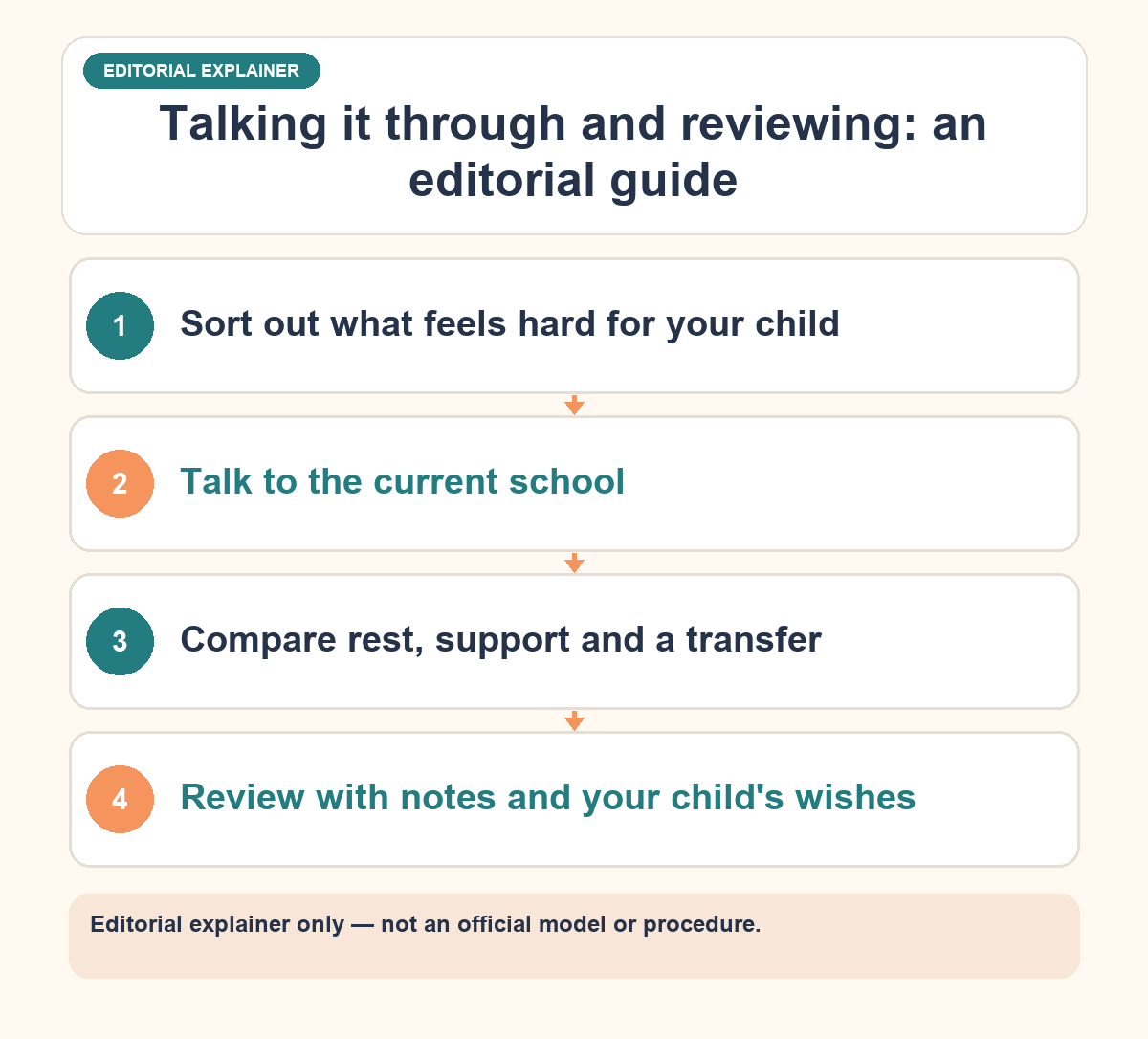
The body diagram is an editorial diagram made by Nijiiro to summarise the steps in this article. It is not an official model, a form or a record of any school’s activities.
Rules and school information may change. Check your school’s latest handbook and the guidance of the board of education where you live. The example message, note-taking method and option tables in this article are Nijiiro’s editorial examples. They do not guarantee any decision under the system or any particular school’s response.
Public primary sources (in Japanese)
- MEXT, “Compulsory schooling when school-age children attend so-called international schools” (legal categories of international schools; Japanese-national school-age children. Checked 9 November 2026 for the original; re-opened 21 November 2026)
- MEXT, “Postponement or exemption from compulsory schooling” (Article 18 of the School Education Act; dual nationals. Checked 9 November 2026 for the original; re-opened 21 November 2026)
- MEXT, “Enrolment procedures for foreign-national children” (school opportunities for foreign-national children and the role of boards of education. Checked 9 November 2026 for the original; re-opened 21 November 2026)
- MEXT, “On support for students in non-attendance (notice)” (consultation and guidance at outside facilities and deemed attendance by the enrolled school. Checked 9 November 2026 for the original; re-opened 21 November 2026)
- MEXT, “Attendance treatment in the cumulative guidance record for home learning using ICT” (requirements for home learning and the principal’s decision. Checked 9 November 2026 for the original; re-opened 21 November 2026)
- MEXT, “Grading of learning done during absence by students in non-attendance (notice)” (dated 29 August 2024; assessment is checked separately from attendance records. Checked 9 November 2026 for the original; re-opened 21 November 2026)
- MEXT, “24-hour Children’s SOS Dial” (education consultation service. Checked 9 November 2026 for the original; re-opened 21 November 2026)
Example from a school’s official information
- Marist Brothers International School, “Social Emotional Learning” (school counselling and how to ask for it. Checked 9 November 2026 for the original; inherited, not re-checked)