Many families want to move a child from a Japanese elementary school (shogakko) into the middle-school stage of an international school. The first questions are usually which year group the child’s current grade corresponds to at the new school, how much English is needed, and how many report cards and support records have to be submitted. This guide sets out two school-specific examples, The American School in Japan (ASIJ) and The British School in Tokyo (BST), without presenting them as common rules. It also links to an editable preparation sheet and an English enquiry email.
Key Points
- Grade or Year numbers cannot be mechanically converted into Japanese school years; each school decides placement from the entry date, age, school history, available places, its curriculum and its admissions policy.
- English requirements, EAL (English as an Additional Language) support and eligibility conditions differ by school. The ASIJ and BST details below apply to those schools only.
- Requesting report cards, enrolment certificates and teacher recommendations from a Japanese school can take time, so plan backwards from the deadline.
- For Japanese-national children, attending an international school that is not an Article 1 school under Japan’s School Education Act does not fulfil the guardian’s statutory compulsory-schooling duty. Ask your municipal board of education about procedures before making a move.
This page is a preparation aid. Give priority to each school’s latest admissions information, individual answers from the school, and guidance from your local board of education. If your child or your family in Japan is struggling and needs someone to talk to, MEXT’s 24-Hour Children’s SOS Dial is available on 0120-0-78310 (toll-free within Japan, 24 hours). Calls are generally connected to the counselling service of the board of education for the caller’s area. This is a domestic Japanese service, and MEXT’s page does not say that it is offered in English.
Do Not Convert Grades or Years Directly into Japanese School Years
A school’s year-group names are tied to its own calendar, age cut-off and curriculum. ASIJ calls Grades 6–8 its Middle School. BST uses Year Groups, and Years 7–13 form its Secondary School. These labels alone cannot tell you which year of Japanese junior high school (chugakko) they correspond to. Give the school your child’s age and date of birth, current grade and completion status, intended entry month and previous curriculum, then ask which year group is being considered and how placement is decided. ASIJ’s Admissions Guidelines also describe their own approach for applicants from calendar-year schools. BST had announced that applications for 2027–2028 would open in mid-November 2026. Review and any required interviews follow from February of the next year, and decisions can run from spring into summer depending on places. This is BST’s timetable for that year, not a schedule shared by other schools.
Translator’s note (checked 19 November 2026): BST’s applications page now states that applications for the 2027–2028 academic year are open. It describes review and interviews/assessments (if required) from February into late June, and decisions from early March into summer. For full year groups, openings may not be clear until May or later.
Transfers also depend on places in the desired year group. ASIJ states that it does not allow mid-year transfers for families currently living in Tokyo. This guidance alone does not say whether the same restriction applies to families living elsewhere in Japan. ASIJ asks families new to Japan to check seat availability first. Tell the school your intended timing, where you live and the year group, and ask when entry is possible and how waiting lists are handled.
If the age cut-off is unclear, give the date of birth and ask in writing: “Which Year/Grade would be considered for this entry year?”, “Who decides placement in a year group?” and “Do you need proof of my child’s current grade or completion from the Japanese school?” Even if the application form asks for a year group, do not convert from the Japanese grade on your own; confirm with the school before submitting. When moving from a school whose year starts in a different month, children of the same age may have covered different content. Explain what your child has studied so far and when the current year ends, and ask what content they would start with in the intended entry month.
Check English Requirements and EAL Support Separately from the Admission Decision
Even where lessons are taught in English, the level of preparation required and the support offered after entry differ from school to school. BST’s applications page states that because all subjects are taught in English, English proficiency is an entry requirement, and that it assesses the spoken and written English of applicants whose first language is not English. Its pre-application checklist lists several conditions: the applicant is proficient in English, at least one parent is also proficient in English, at least one parent holds a valid non-Japanese passport, and the child lives with at least one parent within commuting distance and commutes from home. These are BST’s eligibility conditions, not requirements shared by other schools. All families, including Japanese families, should give the school their current nationality and passports, planned residence and commuting arrangements, and confirm eligibility. Separately, BST’s Student Support Services page describes EAL specialists working with students, teachers and families. An EAL page alone does not mean that applicants at a given English level will be admitted, or that individual support is guaranteed. Ask directly about the year groups covered, selection criteria, and the format, frequency and cost of support.
ASIJ’s guidelines say that admissions decisions take into account factors such as the applicant’s English, the need for an English-medium education, and the support resources the school can provide. ASIJ has no general entrance examination but may carry out additional academic, English or other screening where needed. It asks for records of past or current supplementary services, including EAL/ELL. However, the guidelines checked do not specify middle-school EAL eligibility criteria or support hours. Do not guess the conditions; ask individually.
Avoid assuming either “our child’s English isn’t good enough” or “the school has EAL, so it will be fine”. Check the listening, speaking, reading and writing skills lessons require, how students are assessed on entry, whether support happens within lessons or in separate sessions, and when support is reviewed.
| Item | ASIJ | BST |
|---|---|---|
| Year-group names | Middle School = Grades 6–8 | Secondary School = Years 7–13 |
| Timing and places | No mid-year transfers for families currently living in Tokyo; families new to Japan asked to check seat availability first | Applications for 2027–2028; review and any interviews from February; decisions spring to summer depending on places |
| English | Considered in decisions; no general entrance exam, but additional English, academic or other screening may be requested | Entry requirement; spoken and written assessment for applicants whose first language is not English |
| Other eligibility listed | At least one parent needs to be fluent in English; ASIJ communication is in English | A parent proficient in English; at least one parent with a valid non-Japanese passport; living with a parent within commuting distance |
| Support records and services | Reports on past or current supplementary services (including EAL/ELL) required before a decision | Student Support Services including EAL, Learning Support, counselling and transition sessions |
Admissions Look at More Than English: Placement, Places and Fit
At the middle-school stage, some schools have different teachers for each subject and several kinds of assignments and submission methods. Check which curriculum the school follows, which subjects are taught in which language, and how it views learning experience and attainment outside English. ASIJ’s guidelines list considerations for admissions decisions. These include alignment between the family’s educational goals and the school’s philosophy, diversity across grade levels and divisions, support resources, and the need for an English-medium education. BST states clearly that all subjects are taught in English. Both are school-specific explanations and do not describe another school’s admissions criteria.
Selection is not always “submit a form, then sit an exam”. ASIJ has no general entrance examination; it reviews report cards, tests and recommendations and may carry out academic, English or other screening where needed. BST’s timetable also notes that interviews and assessments may be required. Rather than only asking whether there is a test, ask who assesses what, in which language, whether it is online or on site, and whether further documents may be requested later. This makes preparation easier.
When preparing for an assessment, do not just drill your child to “give the right answers” in an interview. Help them explain, in their own way, how they learn best, how they ask for help when something is hard, and what they would like to try at school. Interview formats, participants and content differ by school. Ask whether both parent and student interviews take place, and whether interpretation or reasonable adjustments can be discussed in advance. Being open about the languages your child speaks and how they express themselves also gives the school information for planning support after entry.
Whether a student can be admitted and whether the school is a place where they can learn well after entry are separate questions. On visits, check a typical school day, how assignments are set, how tests and grades are reported, how learning is communicated during absences, and who to turn to for help. If possible, let your child attend a school information session and have time to ask questions in their own words. This can surface worries a family might miss.
If you are considering several schools, send each the same questions and record the answers as “published conditions”, “individual answers” or “unconfirmed”. General information on a school’s official website is different from an individual decision about this year’s places in the desired year group or about your child’s assessment. If you receive an answer by phone, note the date, department, main points and the next documents needed, and reconfirm important conditions by email or similar.
Plan Backwards from Who Issues Each Document, Well Before the Deadline
First set a provisional entry date, then look up each school’s application opening date, when to enquire about places, and booking slots for visits and assessments. Next, find out how long it takes your current elementary school to issue report cards, enrolment certificates, and recommendations or teacher comments. Documents that need the homeroom teacher’s or principal’s input may fall across school holidays or the end of a term, so a request made just before the deadline may not be ready in time. If translation is needed, check first whether the school accepts a parent’s translation or requires a certified translation or a specific form.
ASIJ asks Grade 6–8 applicants for recommendations and a student essay. Recommendations are requested from teachers through the school’s application system. The public BST pages checked for the original article did not show a detailed list of required documents, so do not guess; follow the official list provided after you enquire. Before applying, also ask whether all documents must be submitted together, or whether you can first enquire about places or attend an information session.
Translator’s note (checked 19 November 2026): BST’s applications page still does not show a full document list. It does state that a non-refundable application fee of JPY 40,000 is required on the Application Form. An applicant enters the application pool once all checklist items are submitted and a reference is received from their current school or teacher.
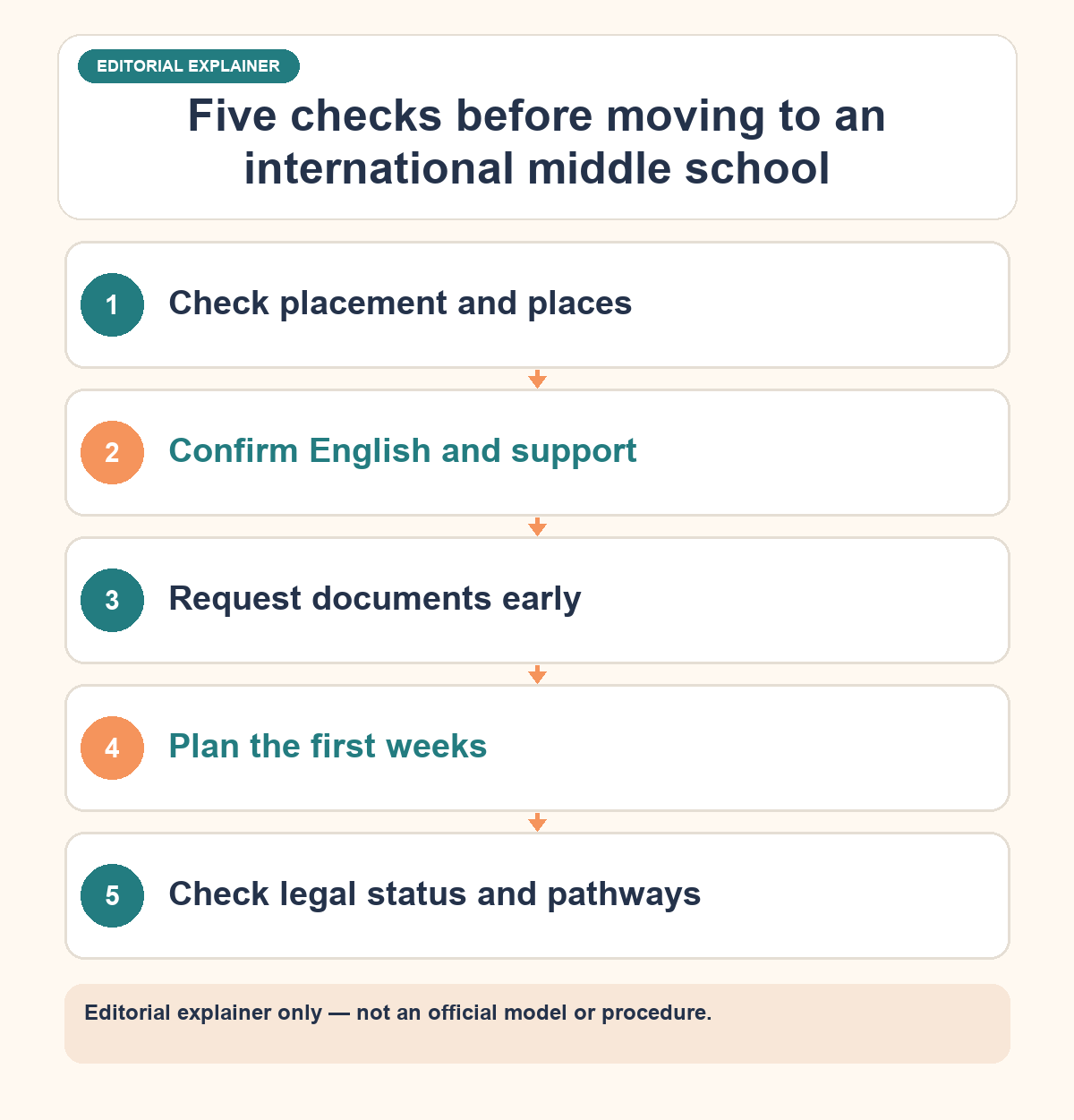
- As a family, sort out the intended timing, a realistic commuting area and your child’s wishes.
- Ask candidate schools about places, how the year group is decided and the application timetable.
- Obtain the official document list and ask your current school to issue documents and recommendations.
- Confirm the schedule for English assessment, interviews, visits and any additional documents.
- After the result, check deadlines for enrolment fees, tuition and other payments, and refund conditions.
- Set up contacts for after entry and a date for the first support meeting.
This order is a suggested plan for families. Some schools require an application form or fee before you can enquire. If a school specifies an official order of procedures, follow it.
Gather Records of How Your Child Learns and Any Support Needed, Not Only Grades
For Middle School (Grades 6–8) applicants, ASIJ lists two years of report cards including the most recent, teacher recommendations (two for Grade 6, three for Grades 7–8), a student essay, standardised test results and contact details. For Grades 2–12, it asks for report cards and progress reports for each term of the previous two school years, plus similar reports for the current year. Standardised test results from the last 18 months should be submitted, and ASIJ says English language proficiency tests are not accepted for this purpose. These are ASIJ’s requirements.
| Item | What ASIJ describes |
|---|---|
| Report cards | Two years, including the most recent; for Grades 2–12, each term’s reports for the previous two school years plus similar reports for the current year |
| Teacher recommendations | Grade 6: two; Grades 7–8: three; requested from teachers through the application system |
| Student essay | Required |
| Standardised tests | Results from within the last 18 months; language proficiency tests are not accepted for this purpose |
| Supplementary services | Reports and assessments on past or current services such as EAL/ELL, learning support, counselling and speech and language therapy, submitted before a decision |
Before asking your school, check whether its report cards show the grading scale, subject names and school year, whether it can issue documents in English, and when mid-term reports become available. If only Japanese-language report cards (tsuchihyo) are issued, ask the receiving school whether it accepts translations and whether the original must be submitted alongside a student’s or parent’s translation. For recommendations, check the deadline for the school’s designated form, any required role or subject for the recommender, and whether the student or parents can see the content. Tell the homeroom teacher the purpose of the request early.
ASIJ also asks for reports and assessments relating to past or current supplementary services, such as EAL/ELL, learning support, counselling and speech and language therapy, before an admissions decision. This includes descriptions of adjustments needed and reports after support has ended, and the school may request further assessment. Discuss with your child, other guardians and the current school what to share with the receiving school, and confirm the specified method and timing. This describes one school’s submission requirements, not a rule for all schools.
The public BST application pages checked for the original article showed the 2027–2028 timetable, English requirements, Year Groups and campuses. They did not show a full set of middle-stage requirements such as report cards and recommendations. Obtain the official checklist, and confirm with your current school what it can issue: English transcripts, enrolment certificates, teacher comments, and whether and how translation is needed.
Ask about transition support in concrete terms rather than judging by the name of a service. BST describes Student Support Services, including Learning Support, EAL and counselling, and mentions transition sessions run by its counselling team. The public information checked does not show that all new students receive the same induction programme. Ask who is responsible in the first week, about orientation, who to contact for help, how absences are communicated and when support plans are reviewed; this makes life after entry easier to picture.
After an Offer: Plan Support for the First Few Weeks
Preparation for the move continues after an offer arrives. Before term starts, check the route and journey time, morning routine, timetable, lunch, devices, uniform and materials, where homework is submitted and how to report absences. Because the environment will change a lot, write on one page what needs to be ready by when, and share it in a form your child can follow. This helps everyone see what is coming.
At the first meeting after entry, confirm who your child can contact, in which language, and how, when they run into difficulty. Ask whether the main contact is the homeroom teacher or a year-group leader, how often parent meetings take place, and when progress in English and subject learning is reviewed. If you need to discuss support, talk not only about what the school will do but also about how to share useful information. This might include your child’s preferred ways of learning, environments where they settle more easily, and times of day when tiredness shows.
BST describes multidisciplinary Student Support Services, EAL and Learning Support, and says its counselling team runs sessions on transitions. However, its public pages do not set out the conditions that apply to each student or the number and content of sessions. Check who the meetings are for, how to book, whether there is a cost, and whether support time overlaps with regular lessons. ASIJ includes the availability of support resources in admissions decisions, but the guidelines checked did not show a specific induction programme for new middle-school students. Confirm the support available at each school individually, including how the two schools differ.
If difficulties continue after entry, having an agreed contact and review point makes it harder to keep putting off a conversation. Ask whether the school has standard meeting opportunities, such as just after entry, at the end of the first term and at later milestones. Also find out how a family can request a meeting if needed.
Decide in advance how much your family will tell the school. With your child’s views in mind, share information relevant to lessons and safety, for example signs that getting to school in the morning is becoming hard, what helps them calm down when tired, phrases that make it easier for them to ask for help, and situations in which the school should contact parents. Rather than routinely submitting diagnoses or personal information, ask why the school needs it, which staff will handle it, and how it will be stored and shared. Things that are hard for a family to talk about can be kept to an outline in a first general enquiry, with the submission method confirmed at a formal meeting. When describing the support you hope for, combine observations and questions rather than fixed demands: “this is where they tend to struggle”, “this is what has helped before”, “how should we raise concerns after entry?” This makes it easier to work things out with the school.
Confirm Costs and the Pathway Beyond Middle School in Writing Before Enrolling
When comparing school costs, look beyond tuition. Check application fees, enrolment or registration fees, facility fees, materials and devices, uniforms, transport, lunch, extracurricular activities and exam fees separately. Note any fees that vary by year group or entry date, whether EAL or learning support costs extra, payment deadlines, instalments and refund conditions. If you miss the year a fee was published for, you may budget with old figures. Ask candidate schools for the fee schedule for that school year and an estimate of the total first-year cost for the relevant year group.
Nijiiro’s list of international schools in Tokyo (in Japanese) gives an overview of fee items and entry conditions at several schools. Once you have estimates from your preferred schools, compare the total first-year cost, payment timing and refund conditions item by item. Do not assume support fees or bus fares missing from a published fee schedule are free; ask directly.
When choosing a middle-school stage, also check which programmes your child can move on to in a few years. A school having a middle and high school section is not the same as its graduation leading to a Japanese high-school diploma or eligibility to enter a Japanese high school. Ask the school about the curriculum name, the certificates or qualifications awarded at each stage, accrediting bodies, any additional exams required, and the grade and credit records issued if your child transfers.
MEXT’s Q&A explains, for example, that graduating from the middle division of a foreign school in Japan does not by itself give eligibility to enter a Japanese high school. It does not treat all international schools as one category. If your child may go on to high school in Japan, check the school’s legal status and curriculum, and the rules that will apply around the expected graduation date, with the candidate school, the high school you are considering and the local authorities. Families who have not yet decided on a future path can still ask early which official documents could be issued later if needed; this is useful for comparison.
In the first year, registration fees and other payments may be due shortly after an offer. Check how many tuition invoices there are and when they are due, refunds for absence or relocation, sibling discounts for simultaneous applications, transport options and bus places, and extra charges for after-school activities, and draw up a month-by-month spending outlook. If you cannot find the fee schedule for the desired year group, do not apply figures from another year group; ask the school for a written estimate. Support costs can vary with the services and assessments needed, so ask about eligibility for support and its fees separately. Base the decision not only on tuition but also on commuting time, the load on your child, and a payment plan your family can sustain.
Check Japan’s Compulsory-Schooling Duty and Future Eligibility Separately
MEXT (Japan’s Ministry of Education) explains that guardians who are Japanese nationals have a compulsory-schooling duty to have their child receive six years of elementary and three years of junior high education. In addition, the school-enrolment administration Q&A explains that if a guardian sends a child with Japanese nationality to an international school in Japan that is not recognised as an Article 1 school, this does not fulfil the statutory compulsory-schooling duty. The original article described this child as “including dual nationals”. On the other hand, some international schools are recognised as Article 1 schools. Check your child’s nationality and the school’s legal status, and ask your current school and the board of education of your municipality about the procedures needed. This is not a statement that the child attending the school is acting unlawfully; it is about the guardian’s compulsory-schooling duty and the school’s legal status.
Translator’s note (checked 19 November 2026): The dual-nationality point is stated in a different MEXT Q&A, Q&A 7 on children returning from abroad. It says that guardians of school-age children who hold Japanese nationality bear the duty even if the child is a dual national. MEXT’s compulsory-education page also says that guardians of foreign-national children are not subject to this duty under the School Education Act, but that boards of education are encouraged to admit such children to public compulsory schools if they wish.
| Situation | MEXT’s explanation | What to check |
|---|---|---|
| Guardian is a Japanese national; child has Japanese nationality (including dual nationals) | Duty to provide 6 years of elementary and 3 years of junior high education; attending a non-Article 1 international school in Japan does not fulfil the duty | The school’s legal status and procedures, with your municipal board of education |
| Guardians of foreign-national children | Not subject to the duty under the School Education Act; boards of education are encouraged to admit children to public compulsory schools if they wish | Options and procedures, with your municipal board of education |
| Later entry to a Japanese junior high or high school | Specific conditions apply to non-Article 1 international schools and foreign schools in Japan | Transfer and eligibility conditions before enrolling, with the board of education and target school |
MEXT’s Q&A also sets out points to note for a child who wishes to enter a Japanese junior high school after completing the elementary division of an international school that is not an Article 1 school, and for a child transferring from such a school’s middle division into a Japanese junior high school. If your child may return to a Japanese school, check the transfer conditions with the board of education before enrolling, and discuss with each school how enrolment status, school registration and documents will be handled. General explanations online cannot decide whether a particular child can transfer.
Translator’s note (checked 19 November 2026): The MEXT Q&A states that, for example, a request to enter an Article 1 school from junior high by someone who completed the elementary division of a non-Article 1 international school “would not be accepted” (認められないこととなります). It says the same applies to a transfer into a Japanese junior high school partway through such a school’s middle division. The same Q&A also reminds municipal boards of education to avoid situations in which a school-age child is effectively left without schooling because of unavoidable circumstances such as financial hardship or a change of residence. This guidance does not guarantee a particular admission or transfer decision. Ask your municipal board how the rules and this safeguard apply before making a change.
High-school entry also does not depend on whether a school’s name includes “international”. MEXT’s Q&A on high-school entrance eligibility explains that graduating from the middle division of a foreign school in Japan does not by itself confer eligibility to enter high school, and sets out separate conditions for programmes at schools abroad. Check the curriculum and accreditation of your preferred school, the qualification awarded at graduation, and the conditions for going on to Japanese high schools and universities, individually with the school and with the relevant board of education or institution.
Leaving a Japanese school and your child wanting a change of environment are also separate questions. Use visits and meetings to look at the pace of lessons, break times and how to ask for help together with your child, and talk it through without rushing to a conclusion.
10 Frequently Asked Questions
Conditions differ by school, so treat these answers as starting points for your own questions.
Will a Japanese sixth-grade elementary pupil enter Grade 6 or Year 7 at an international school?
When should we start preparing a middle-school application?
Is there always an English entrance test?
If a school offers EAL, can a beginner in English be admitted?
Can report cards from a Japanese elementary school be used?
Do we need to submit records of learning support or counselling?
Is there orientation or transition support after entry?
What happens to compulsory-schooling procedures when a Japanese-national child moves to an international school in Japan?
If my child graduates from the school’s middle division, can they go on to a Japanese high school?
Should we rush the application if our child is unsure?
What You Can Do Today
Today, give candidate schools your intended timing and current enrolment details, and ask five questions. They are: (1) places and the candidate year group, (2) English assessment and EAL eligibility, (3) the list of report cards, recommendations and support documents, (4) who to contact after entry, and (5) the curriculum and future qualifications. Look for visits and meetings together with your child, and check both the school’s explanation and the guidance of your municipal board of education. For compulsory-schooling or return-to-Japanese-school questions, the board of education for your area is the public point of contact. For worries or distress, children and parents in Japan can call the 24-Hour Children’s SOS Dial on 0120-0-78310.
Preparation Sheet and Enquiry Email
Start with the basic items below and ask candidate schools about places, application timing and your intended entry date. Fill in the optional items when a school asks for them or when you reach the stage of discussing specific support. Share medical or psychological information only after confirming why it is needed and who will receive it, and do not include excessive personal information in a first general enquiry.
Middle-School International Transfer: Enquiry Preparation Sheet
Edit, copy or print. This is an unofficial family note. Fill in the basic items first and organise only the additional documents a school asks for. The Grade/Year line can stay blank until the school confirms it.
This is not an official document for submission to a school. Give priority to school-specified forms and official certificates. It is an unofficial enquiry aid and does not replace application forms, transcripts, recommendation letters or translation formats specified by a school. Copy or print your notes before closing the page.
Sample English Enquiry Email (Edit Before Sending)
Replace the parts in square brackets with your family’s details and delete any questions you do not need. In a first enquiry, do not attach detailed health information or certificates; ask about required documents and the official way to submit them. Check the recipient, names and intended timing before sending.
This is a sample, not an official document. Give priority to any school-specified forms and procedures.
References and Sources
The school, admissions and legal information in this English translation is inherited from the Japanese original, whose sources were checked on 29 October 2026; the original’s modification date (31 October 2026) is not a fact-check date. This translation is dated 20 November 2026. Only the statements marked as translator’s notes and the public consultation details were checked against official sources, on 19 November 2026, and the NGA information and BST applications page were rechecked on 20 November 2026; other inherited statements have not been newly verified and may have changed.
Original article’s sources (checked 29 October 2026). Admissions years follow each source’s own wording. Ask each school about future places and entry conditions.
- ASIJ Admissions Guidelines: public guidance as of 2026–27, including next year’s timetable (checked 29 October 2026)
- The British School in Tokyo: Applications: 2027–2028 application timetable (checked 29 October 2026)
- BST Student Support Services: current content, no school year stated (checked 29 October 2026)
- MEXT: Enrolment in elementary and junior high schools (in Japanese): current explanation of the system (checked 29 October 2026)
- MEXT: High-school entrance eligibility Q&A (in Japanese): current Q&A, including older disaster-related questions (checked 29 October 2026)
- NIJIN GLOBAL ACADEMY admissions (in Japanese): listed as planned to open in September 2027 (checked 29 October 2026)
- MEXT school-enrolment administration Q&A: compulsory schooling when attending an international school (in Japanese): current Q&A (checked 29 October 2026)
Additional sources checked for this translation (19–20 November 2026)
- MEXT Q&A 7: Enrolment procedures for school-age children returning from abroad (in Japanese)
- School Education Act, Article 16 (e-Gov Law Search API record, in Japanese)
- MEXT: 24-Hour Children’s SOS Dial (in Japanese)
- Ministry of Health, Labour and Welfare: Telephone consultation services, including the 24-Hour Children’s SOS Dial (in Japanese)
- NIJIN GLOBAL ACADEMY: Tuition and Admissions
- NIJIN GLOBAL ACADEMY: Contact Us
- NIJIN GLOBAL ACADEMY: FAQ
Related Nijiiro articles (in Japanese): International school entry conditions; International schools in Tokyo: fees, entry conditions and school list; When international school homework is not getting done.
Image notes: The featured image for this article is an AI-generated illustration. The diagram in the article body is an editorial diagram made for this article. Neither is a photograph of a real school, real students or NGA activities.