Menu
BASICS
How Japanese schools work Japanese phrases for school Glossary of school termsWAYS TO LEARN
Free schools Education support centers Online schools Homeschooling in Japan International schools Correspondence high schoolsMORE
Neurodivergent children Where to get help Attendance and costs Learning Place Finder 日本語サイトへChild Mixes Japanese and English in One Sentence? How to Tell Ordinary Mixing From Early Loss
The short answer, in four lines
Stop listening to the vocabulary and start listening to the frame. In any mixed sentence, one language is supplying the structure — the word order, the particles, the verb endings — and the other is contributing words into it. The language supplying the structure is the one your child’s system is actually running on. The other one is decoration.
If your child says チーズをお皿において with an English noun where チーズ is, the frame is Japanese and an English word is a guest inside it. That is ordinary, efficient, and nothing to act on. If your child says “Can you put the cheese on the お皿?”, the frame is English and the Japanese word is the guest. Same two languages, same two words, opposite diagnosis. The direction of the borrowing is the whole signal.
Four things follow from this, and the rest of the article is the detail behind them:
- Mixing inside a Japanese frame is not a problem and almost never needs intervention.
- Mixing inside an English frame, where Japanese words appear as isolated nouns, means Japanese has become the embedded language — the one being quoted rather than the one being spoken.
- The first parts to switch over are not nouns. They are the connectors and the hesitation sounds, and most parents do not notice them at all.
- What you do about it depends entirely on which of the two you have, and the standard advice — repeat it back correctly, ask them to say it again in Japanese — actively damages the second case.
“Mixing” is not one behaviour. It is two, and they look identical
When a bilingual child produces a sentence containing both languages, there are two quite different things that may have just happened inside their head, and the sentence that comes out does not distinguish them.
In the first, the child has both words available and chose one. This is the kind linguists describe as a competence: it takes a working command of both systems to splice them without breaking either. A child who says もうrecessになったよ has produced a perfectly well-formed Japanese sentence, inserted an English noun for a thing that happens in English at an English-speaking school, and attached the Japanese particle to it correctly. Nothing is missing. The child is doing what bilingual adults do all day: using the word that is closest to hand for the concept, in a context where the listener will understand it.
In the second, the child intended a Japanese word, did not retrieve it in time, and substituted. The sentence that comes out may look very similar. But the mechanism is a gap, not a choice, and gaps grow. A child in this state is not demonstrating two systems; they are running one system with holes in it and filling the holes from the other.
Parents are routinely told the first story about children who are living the second. That is the actual problem with the advice in circulation — not that it is wrong, but that it answers only one of the two questions and is presented as if it answered both.
A caution about what this article is and is not. Nothing here is a developmental or clinical assessment, and mixing by itself is not evidence of a language disorder — the research consensus on that point is firm and we are not disputing it. What we are describing is the difference between a stable bilingual system and a shifting one, which is a question about language environment, not about your child. If you have separate concerns about speech or language development in either language — late first words, difficulty being understood by familiar adults, a loss of skills your child previously had — that is a question for a speech and language professional, and the number of languages at home is not the reason.
Why the reassurance you have read may not fit Japanese
Almost everything written for parents about children mixing languages rests on a body of research built on Spanish and English. That is not a criticism of the research; it is simply where the data is. Spanish–English bilingualism in the United States has been studied for decades at a scale no other pairing comes close to, and the general conclusions — that mixing is rule-governed, that it does not confuse children, that it is a mark of competence — are well supported.
The trouble is the step after that, where a general conclusion gets applied to a specific pair of languages that behave differently. And there is direct evidence that the step does not always survive. In an early study of Japanese–English bilingual children in Tokyo, Sandra Fotos found that the structural constraints developed to describe Spanish–English switching did not consistently hold for Japanese–English switching, because of syntactic differences between the two pairs. Her study is small — four children in two sibling pairs, around forty minutes of analysed speech — and we are not going to pretend it is more than it is. But the finding is the kind that does not need a large sample to be worth knowing: it is a demonstration that the rules are pair-specific.
Fotos also reported a breakdown of what was actually being switched, and it is more useful to a parent than almost anything in the general advice. Forty-four per cent of switches were single lexical items — nouns at 16 per cent of all switches, conjunctions at 14 per cent, and fillers at 14 per cent. Only 16 per cent were switches of whole sentences. The younger children switched within sentences more often than the older ones (65 per cent against 52 per cent).
Hold on to the conjunctions and the fillers. We will come back to them, because that is where the signal lives and it is the part no one tells parents to listen for.
The frame, not the vocabulary
The idea that makes all of this usable comes from Carol Myers-Scotton’s Matrix Language Frame model, which has been the standard way of describing the structure of mixed speech for thirty years. Its central claim is that the two languages in a mixed sentence are not equal partners. One of them — the Matrix Language — supplies the grammatical frame. The other — the Embedded Language — contributes material into that frame.
Myers-Scotton states this as two principles. The Morpheme Order Principle: only one language supplies the morpheme order to a bilingual clause. The System Morpheme Principle: only the Matrix Language supplies the morphemes that indicate grammatical relationships across the clause — the structural glue, as opposed to the content words.
Translated into something you can use at a kitchen table: in every mixed sentence your child produces, one language is driving and the other is a passenger. The content words — the nouns, often the verbs — can come from either. The glue cannot. And the glue is what tells you which language your child’s sentence-building machinery is currently set to.
This is why counting English words is useless. A sentence can be sixty per cent English by word count and still be a Japanese sentence, structurally. A sentence can contain four Japanese nouns and be entirely an English sentence. Word counts measure the passengers. You want to know who is driving.
Why Japanese is unusually easy to read this way
Here is the thing that makes this practical rather than theoretical, and it is a genuine advantage that families raising Japanese have over families raising most other languages: Japanese marks the frame out loud.
In Japanese, the grammatical relationships are carried by particles that are separate, audible syllables — は, が, を, に, で, へ, と — and by verb endings that are equally audible: した, てる, ちゃった, ない. In English, the same work is done largely by word order and by small changes you can miss. This means a Japanese–English mixed sentence wears its structure on the outside in a way that, say, a French–English one does not.
The word order helps too, because the two languages are opposites in the one place it is easiest to hear. Japanese puts the verb at the end; English puts it in the middle. So a mixed sentence that ends on a verb is almost always running on a Japanese frame, and one that puts the verb before its object is almost always running on an English frame. You do not need to know any grammatical terminology to hear this. You need to notice where the sentence stops.
Three things to listen for, then, and all three are audible without any special training:
- The particles. Are は・が・を・に still there, attached to whatever noun appeared — including the English ones?
- The verb. Is the verb Japanese, and is it inflected — past, negative, continuous — rather than sitting in a bare dictionary form?
- Where the sentence ends. On the verb, or on the object?
Run this on any mixed sentence your child produces. You are not grading the child — you are identifying which language is supplying the structure
| What to listen for | Japanese is still the frame | English has become the frame |
|---|---|---|
| Particles | Present and attached correctly, including to English nouns (my teacherが) | Absent, or only on an isolated Japanese noun inside an English sentence |
| The verb | Japanese and inflected (した、なかった、ちゃった) | English, or a Japanese verb stem with English tense done around it |
| Word order | Ends on the verb | Verb before the object |
| Connectors and fillers | でも、だから、えーと、やっぱり | but, so, um, like, actually |
| What happens if you wait | Child self-repairs or supplies the Japanese word a beat later | Child cannot retrieve it, repeats the English, or abandons the sentence |
A rough field guide for parents, not a diagnostic instrument. Children produce both patterns in the same conversation; what matters is which one dominates over a week, not which one appeared once. General tendency, as at October 2026.
Four real sentences, read properly
Abstract rules are hard to apply to your own child at speed, so here are four sentences of the kind that actually get said in bilingual households, read using the five questions above. The point is not the verdict on each one. It is to show you that the verdict is readable.
1. “ほら、my water bottle を 忘れちゃった”
Frame: Japanese, unambiguously. There is a Japanese discourse opener, the English noun phrase is marked with を, the verb is Japanese, inflected, carries the ちゃった ending that adds regret, and sits at the end. The child has borrowed a three-word English noun phrase for an object that lives in an English-speaking school. Nothing here needs any action at all. This is a competent bilingual sentence.
2. “えーと、先生が said that we need to bring it tomorrow”
Frame: this one is genuinely split, and it is the most common shape of all. The sentence opens in Japanese with a filler and a correctly marked subject, then switches at the verb and never comes back. The verb is the hinge, and the verb went to English. In Myers-Scotton’s terms the clause has changed hands partway through. Worth noticing, not worth reacting to — this is normal in reported speech, which is one of the classic places switching happens. But if nearly every sentence breaks at exactly this point, the verb system is the thing to work on.
3. “I want to eat the おにぎり that おばあちゃん made”
Frame: English. Two Japanese nouns, no particles on either, English verbs, English word order, English relative clause. The Japanese words that survive are the two with no real English equivalent — a food and a kinship term. This is the pattern to pay attention to. It does not mean the child has lost Japanese; they may well switch into a fully Japanese frame with a different person. It means that with you, in this moment, Japanese is the embedded language.
4. “それは… um… the one です”
Frame: Japanese, but under strain. The structure is intact at both ends — topic marker at the front, copula at the back — and the middle has been outsourced because the Japanese noun did not arrive. Crucially, the child kept building the Japanese sentence around the hole rather than abandoning it. This is a vocabulary gap inside a healthy frame, which is the easiest of all the cases to fix, because the machinery is working and only the parts are missing.
Four sentences, four different readings, and the thing that produced the reading was never the proportion of English.
The signal most parents miss: fillers and connectors
Go back to Fotos’s numbers for a moment. Among single-item switches, nouns were 16 per cent — and conjunctions and fillers were 14 per cent each. Taken together, the little structural words were switching at nearly twice the rate of nouns.
Parents almost never register this, for an understandable reason: a child saying “um” instead of えーと does not sound like a language event. It sounds like a child thinking. And a child saying “but” instead of でも in the middle of an otherwise Japanese sentence barely registers as English at all. These are not content. They are the sound of the sentence being assembled.
Which is exactly why they matter. Fillers and connectors are produced by the system that is planning the sentence, not by the part that is retrieving words. When a child reaches for a noun in the other language, that is lexical access. When the hesitation sound itself comes out in the other language, the planner has switched. In practice this is the earliest audible sign that the frame is migrating, and it typically arrives months before anyone notices that the nouns have gone.
So if you listen for one thing this week, listen for these:
- Does the hesitation come out as えーと / あのー, or as um / uh?
- Does the child join two clauses with でも、だから、それで, or with but, so, and then?
- Does agreement come out as うん、そうなんだ, or as yeah, right?
- When they are surprised, is it えっ?えー~?, or what?
A child whose nouns are mostly Japanese but whose connectors have all gone to English is, on this reading, further along than a child whose connectors are still Japanese but who borrows English nouns constantly. That is the opposite of what a word count would tell you, and it is the single most useful thing in this article.
When mixing is genuinely fine
It is worth being concrete about the cases where the reassuring version of the advice is simply correct, because they are common and they do not deserve the anxiety they often get.
Borrowing for things that live in the other language. A child who attends school in English will say recess, show and tell, field trip, Mrs Patel. These are not gaps. There often is no natural Japanese equivalent for the specific thing being referred to, and the child is being precise rather than lazy. Adults in Japan do the same thing constantly in the other direction.
Borrowing where Japanese has already borrowed. A great deal of modern Japanese vocabulary is itself imported, and a child saying テーブル or デザート or オンライン is not mixing at all; they are speaking Japanese. The line between a borrowed word and a code-switch is blurry, and parents sometimes count ordinary Japanese as English.
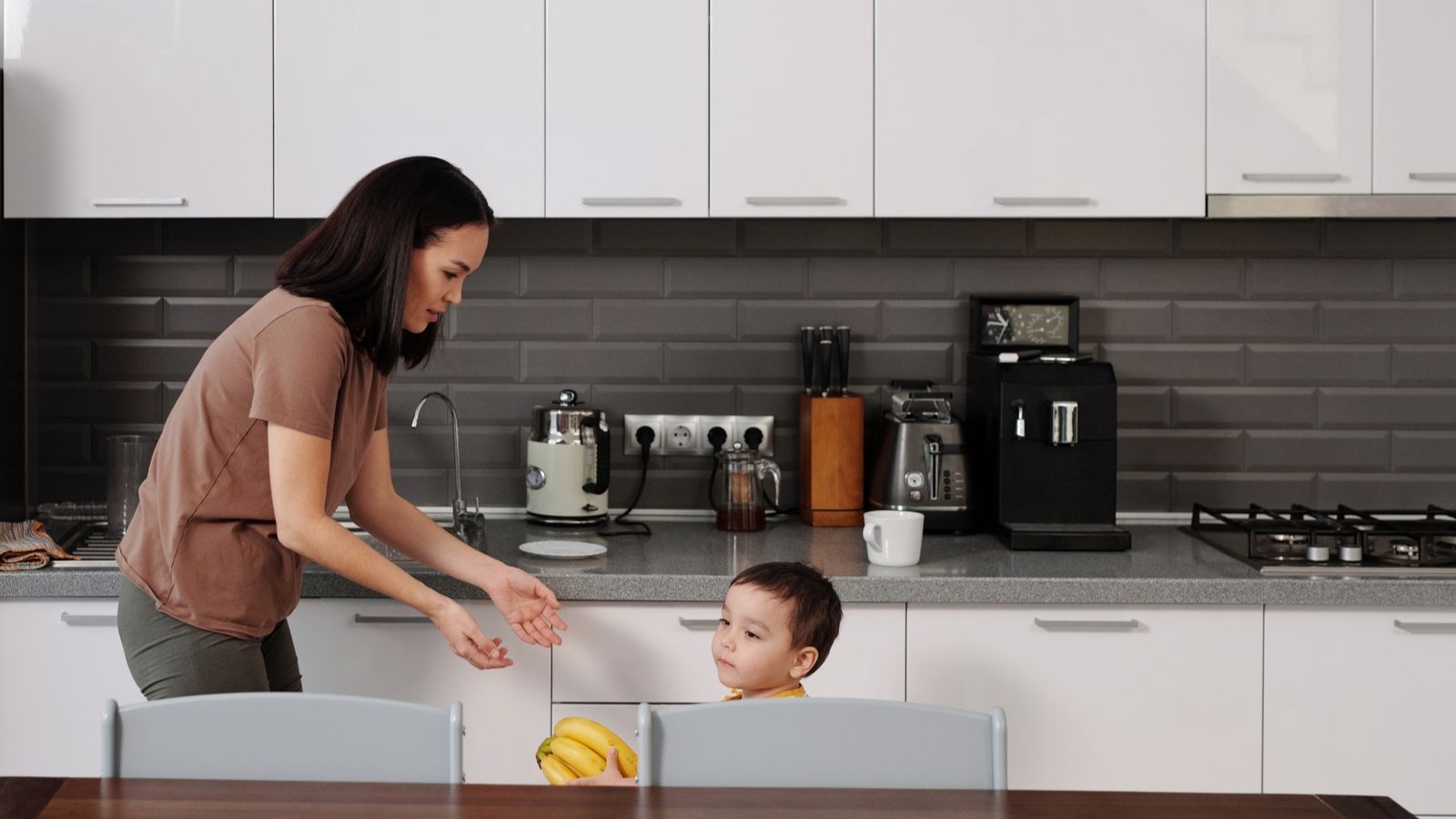
Switching by person. A child who speaks Japanese to one parent and English to the other, and mixes freely only with a sibling or with a bilingual friend, is demonstrating that they have working control of both and a social map of when to use which. That is a more advanced skill than monolingual production, not a lesser one.
Switching for effect. Quoting someone in the language they said it in. Delivering a punchline in the language it is funny in. Saying something emotionally difficult in the language that puts a little distance on it. Each of these is a deliberate use of two languages by someone who has two.
The young child who mixes and then stops. In the preschool years mixing is routine and the proportion generally falls as vocabulary in each language grows. If the frame is Japanese and the only issue is that words are occasionally missing, time and exposure do most of the work — the standard advice is well aimed at exactly this case.
When mixing is the visible edge of a retrieval problem
And here is the other set, where the same reassurance is misdirected. The pattern that matters is not the presence of English; it is the loss of the structural scaffolding, and the inability to repair.
Watch for these in combination rather than individually. One of them means little. Three or four of them together, sustained over weeks, describes a system that is shifting rather than one that is stable:
- Particles are disappearing — not used incorrectly, which is ordinary in a developing child, but simply absent, with nouns strung together.
- Verbs are no longer inflected. The child uses a Japanese verb but handles the tense in English around it, or reverts to a bare form.
- The sentence can no longer be repaired. You pause, you look interested, you wait — and the Japanese word does not arrive, this time or later.
- Connectors and fillers have gone over, as described above.
- The mixing is one-directional. English words appear in Japanese sentences, but Japanese words no longer appear in English sentences except for food and family terms.
- The child avoids whole topics in Japanese rather than attempting them, and changes subject when the vocabulary gets harder.
- Output is shrinking. Shorter sentences, fewer of them, more one-word answers — while comprehension stays completely intact.
That last point is the one that catches families out, and it is worth stating plainly because it is the central mechanism behind almost everything in this series: understanding is maintained very cheaply, and speaking is not. A child can keep following Japanese perfectly for years — from you, from video, from visits — while their ability to produce it quietly erodes, because nothing in their week requires them to produce any. Mixing is often the first place that erosion becomes audible, which is precisely why it is worth reading carefully rather than waving away. We have written separately about what that looks like once it is well established, in the child who understands Japanese but will not speak it.
Which direction is the drift going?
If you take nothing else from this article, take the direction test. It costs nothing, it needs no equipment, and over a week it is remarkably stable.
Pick three or four moments across a normal week — not set-piece moments, just whatever happens. Afterwards, for each mixed sentence you can remember, ask one question: which language would have been left standing if you removed every borrowed word? If removing the English leaves a Japanese sentence with a hole in it, the frame is Japanese. If removing the Japanese leaves a complete English sentence, the frame is English and the Japanese words were ornaments.
| What you observe | Japanese frame, English words in it | Mixed, breaking at the verb | English frame, Japanese words in it |
|---|---|---|---|
| Remove the borrowed words and what remains | A Japanese sentence with a gap | Half of each | A complete English sentence |
| Particles on borrowed nouns | Present | Present early in the sentence only | Absent |
| Who supplies the verb | Japanese, inflected | English, after a Japanese opening | English |
| Fillers and connectors | Japanese | Mixed | English |
| What it usually means | Stable bilingual system; borrowing by choice | Verb and sentence-building vocabulary are the weak point | Japanese has become the quoted language |
| What it asks of you | Nothing beyond what you already do | Targeted work on verbs and connectors | A change in who your child speaks Japanese to |
○ stable △ worth watching × act on it. A general pattern for parents, not a clinical measure; children move between columns depending on who they are talking to. Observed over a week rather than a single conversation. As at October 2026.
One honest caveat about the middle column, because it is where most children in English-speaking countries actually sit: a sentence that opens in Japanese and finishes in English is not a halfway house on the road to loss. It is an extremely common and well-documented shape, and plenty of stable bilinguals produce it for years. What makes it informative is the trend, not the instance. Three months of sentences that break at the verb, with the break point moving steadily earlier, is a different thing from three months of sentences that break at the verb and stay there.
What changes with age
The same behaviour means different things at different ages, and this is where a lot of well-meant advice goes wrong by being age-blind.
Under five. Mixing is near-universal and carries almost no diagnostic weight. Vocabulary in each language is still small, the child is still working out that there are two systems at all, and borrowing is the obvious solution to a missing word. Fotos’s younger children switched within sentences more often than her older ones, which fits the general picture. Read the frame if you like, but do not act on it yet.
Five to eight. This is the window where the frame question starts to be meaningful, because it is when school takes over the majority of the child’s waking speech and the balance of the week tips decisively. A child whose frame is still Japanese at eight, after two or three years of full-time English schooling, has a genuinely robust system. A child whose frame has flipped in that period has not done anything wrong — the environment did it — but the flip is real and it is the right moment to respond, because it is still cheap to respond to.
Nine to twelve. The gap between what the child can say and what they can think widens sharply, and mixing often increases rather than decreases — not because Japanese is getting worse, but because the ideas are getting more complicated and the Japanese vocabulary has not kept pace. This is also when reading and writing start to matter enormously, which we come back to below.
Thirteen and up. Mixing stops being a straightforward signal about ability, because by now it is also a social statement — about identity, about who the child is willing to be in front of whom. The mechanics change enough that we have treated that age separately in what changes when a teenager refuses to speak Japanese. If your child is over thirteen, read the frame by all means, but do not expect changing the input to change the output the way it would have at seven.

If the frame is still Japanese: what to do this month
Good news first: if the frame is intact, your job is to feed vocabulary into a working machine, which is far easier than rebuilding one. You do not need lessons, a curriculum, or a change in routine. You need to stop the holes from widening.
Supply the word without taking the floor. When your child stalls and borrows, say the Japanese word quietly, at normal speed, as part of your own next sentence — and then carry on with the conversation. Do not stop. Do not ask them to repeat it. The word goes in; the conversation does not break. This is the single highest-yield habit available to a parent and it takes no extra time, because you were going to reply anyway.
Name the gap categories, not the words. Over a week you will notice the holes cluster: school things, feelings, arguments, anything technical, anything about the body. The clusters tell you where the child’s Japanese life has no coverage. Fix the cluster by creating an occasion rather than by teaching a list — a weekly video call that is specifically about school, for instance, forces the school vocabulary into existence much faster than a vocabulary list ever will.
Protect the connectors deliberately. Because connectors go first, they repay direct attention more than nouns do. Use でも、だから、というか、やっぱり、たしかに audibly and often in your own speech. They are high-frequency, they are short, and they are picked up by exposure alone — but only if the child hears them.
Ask questions that cannot be answered in one word. どうだった? invites うん. そのあとどうなったの? invites a sentence, and a sentence needs a verb, and a verb needs the frame. The structure you want to preserve only gets exercised when the child has to build something longer than a phrase.
Leave the reading alone for now, with one exception. If spoken production is the issue, reading drills will not fix it and may crowd out the thing that would. The exception is if your child is already at the point where the written language is the bottleneck — which is a different problem with a different answer, covered in why a child who speaks Japanese fluently still cannot read or write it.
If the frame has already flipped: what to do instead
If the honest reading is that your child is now producing English sentences with Japanese decoration, then more input from you will not turn it around, and this is the part where most families lose a year or two finding out the hard way.
The reason is structural rather than motivational. Your child can switch to English with you. They know you understand it. Every sentence they build with you is therefore optional — they can start in Japanese and bail out at the verb, and nothing breaks, because you follow either way. A child only has to maintain a working Japanese frame when they are talking to someone with whom bailing out is not available.
That is not a criticism of anything you have done. It is a feature of the situation: the parent who is most motivated to maintain the language is structurally the worst-placed person to require it. Grandparents who speak no English are better placed. Monolingual Japanese-speaking children are better placed still, because peers generate far more speech per hour than adults do and because children do not politely slow down.
So the useful question stops being “how do I get more Japanese into the house” and becomes “who, in my child’s actual week, cannot be switched away from?” If the honest answer is nobody, that is the thing to change, and it is the only thing on this list that reliably moves a flipped frame back.
The hardest part of this to arrange from inside the house is other children who do not speak English. TOMODACHI JAPAN runs small online classes that put children growing up abroad together with peers in Japan, grouped by what each child can actually say rather than by age — which is what makes a sentence have to be finished in Japanese. The school guide is free to read.
The four things that make it worse
These are all well-intentioned, all common, and all counterproductive — particularly in the flipped-frame case, where they do real damage.
1. Correcting the sentence. “日本語で言って” delivered as a response to a mixed sentence teaches the child that speaking Japanese to you carries a risk of being stopped, and that speaking English does not. You have just made one of the two options more expensive. Children optimise for this quickly and without reflection.
2. Pretending not to understand. This is widely recommended and it works on some children, but it has a specific failure mode that is worth knowing: the child who concludes not that they must try harder, but that talking to you is tiring. With a young child who has the frame intact it is usually harmless. With an older child whose frame has flipped, it tends to reduce the total amount of talking, which is the opposite of the goal.
3. Making the mixing a topic. Discussing your child’s language — how much they have lost, how worried you are, how much better it used to be — converts a background condition into a subject they now have feelings about. Those feelings are rarely useful ones. Almost everything in this article is for you to act on quietly, not to explain to the child.
4. Adding a lesson as the first move. Formal study is genuinely valuable, but it treats the problem as a knowledge deficit. If the frame has flipped because nobody in the week requires Japanese, then an hour of instruction a week adds knowledge the child still has no occasion to use. Lessons work best when they are paired with an occasion — which is why the peer-group question above comes first, not second.
Modelling instead of correcting
There is one technique that is recommended almost everywhere and that we think is right, but the usual description of it leaves out the part that makes it work.
The technique is modelling: when the child produces a mixed sentence, you reply using the Japanese version, naturally, as part of your own turn. Child says “今日、we had a substitute teacher”; you reply “へー、今日代わりの先生だったの?どんな先生?” The missing words are supplied in context, the child hears them attached to the thing they were just trying to say, and the conversation continues.
The part that gets left out is why this works when correction does not, because the two can look superficially similar — in both cases the parent says the Japanese words the child did not. The difference is what the child has to do next. After a correction, the child owes you a repetition; the floor comes back to them with a task attached. After modelling, the child owes you an answer to a question about a substitute teacher; the floor comes back to them with a conversation attached. In the first case Japanese costs something. In the second it buys something.
Which means modelling fails in the one situation where parents most want to use it: when it is done pointedly. A model delivered with emphasis, or with a pause afterwards, or with raised eyebrows, is a correction wearing a costume, and children read it accurately. The whole technique rests on the child not noticing it is a technique.
Why mixing predicts the reading wall
One reason to read the frame now, rather than waiting to see whether it resolves, is that the written language is coming and it is unforgiving in a way that conversation is not.
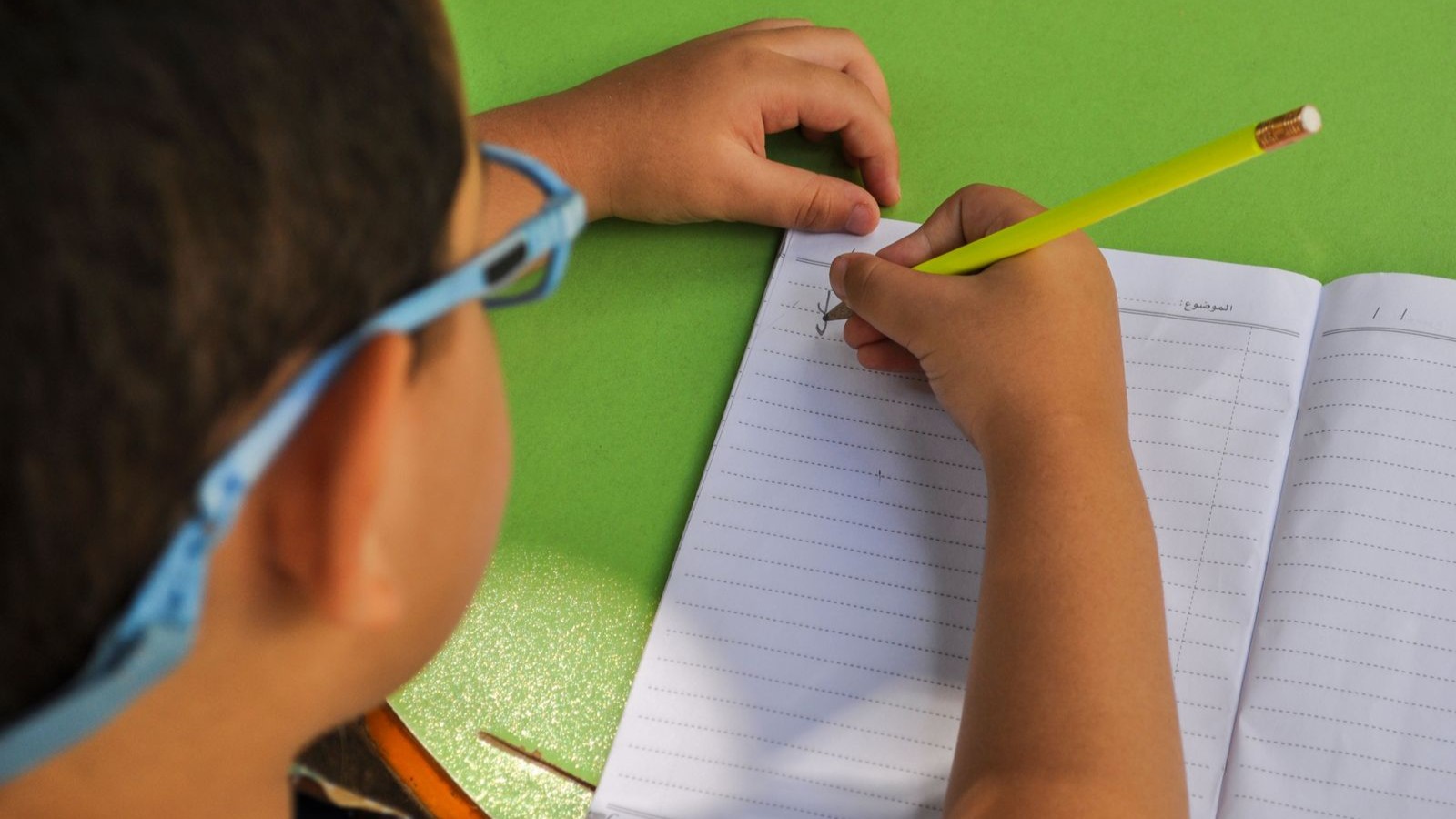
A child can hold a conversation around a gap. They can borrow, gesture, choose an easier sentence, or let you finish it for them. A page of Japanese offers none of those exits. The grammatical scaffolding that mixing erodes first — particles, verb inflection, the connectors that join clauses — is exactly the scaffolding that written Japanese depends on most heavily, because writing has longer sentences, more subordination, and no face in front of you to read.
The size of what is coming is worth stating in plain numbers. Japan’s grade-by-grade kanji allocation runs 80, 160, 200, 202, 193 and 191 characters across the six years of elementary school — 1,026 characters by the end of year six. The general-use list that an adult reader is expected to handle contains 2,136. The difference, 1,110 characters, is what arrives after elementary school. That arithmetic is simply the gap between two official documents, and it is the reason a delay that looks small at eight does not stay small.
And there is a national-scale version of the same point. Japan’s education ministry counts 84,759 children and students in Japanese schools who need Japanese-language instruction, of whom 11,446 hold Japanese nationality — a figure that includes returning families. Among that group, university-level progression runs at 41.2 per cent against 75.0 per cent for all students. We cite this not to alarm anyone whose child is happily growing up abroad with no plan to move, but because families who might move should know that the language question becomes a schooling question on arrival. The specific timing problem that creates is covered in what to do with the runway before you move back to Japan.
Run the five-question read on three or four ordinary conversations. Note which column your child is mostly in and, separately, where the connectors and fillers are coming from. Resist acting during this period — a fortnight of accurate observation is worth more than a month of unfocused effort, and you will not get a clean reading once you have started intervening.
Start supplying missing words inside your own replies, without stopping the conversation. At the same time, create one recurring occasion each week where Japanese is the only option — a call with a relative who speaks no English, with you out of the room, is the cheapest version. One real occasion beats three hours of good intentions.
Re-run the read. You are not looking for less English; you are looking for particles returning, verbs being inflected again, and connectors coming back into Japanese. Those move first. If nothing has shifted by week twelve, the missing ingredient is almost certainly a person who cannot be switched away from, not more effort from you.
What we could not verify, and therefore have not claimed. We looked for quantitative data on how often Japanese–English code-mixing in children precedes measurable heritage-language attrition, and on what proportion of children who mix at a given age go on to lose productive Japanese. We did not find primary research we could stand behind, and so we have not put a number on it anywhere in this article. The structural account above — matrix language, system morphemes, the order in which elements switch — rests on published work we have cited. The predictive claim does not, and is presented as a pattern families and we have observed, not as a measured probability. We have also deliberately not cited the frequently repeated figure that a heritage language needs some fixed percentage of a child’s input to survive, because we have not been able to confirm it against an original source.
Frequently asked questions
The sources behind this article
Everything in this article that is presented as a finding comes from one of the following. Where we could not verify a claim against a primary source, we have said so rather than softening it.
- Fotos, S. S., “Japanese-English Code Switching in Bilingual Children”, JALT Journal 12(1), 1990, pp. 75–98. Source of the switch-type breakdown (44 per cent single lexical items; nouns 16 per cent, conjunctions 14 per cent, fillers 14 per cent; 16 per cent whole sentences; intra-sentential switching 52 per cent for the older children and 65 per cent for the younger) and of the finding that Spanish–English constraints did not consistently transfer to Japanese–English. An exploratory study of four children in two sibling pairs, with roughly forty minutes of analysed speech. We have treated it as indicative of pattern, not as a population estimate.
- Myers-Scotton, C., “Uniform structure: Looking beyond the surface in explaining codeswitching”, Rivista di Linguistica 17.1, 2005, pp. 15–34. Source of the Matrix Language Frame model, the Morpheme Order Principle and the System Morpheme Principle, which underlie the whole “read the frame, not the vocabulary” approach.
- Ministry of Education, Culture, Sports, Science and Technology (MEXT), Survey of the enrolment of children and students requiring Japanese-language instruction, as at 1 May 2025. Source of the 84,759 and 11,446 figures and of the 41.2 per cent against 75.0 per cent progression comparison.
- MEXT, Commentary on the Elementary School Course of Study, Japanese Language. Source of the grade-by-grade kanji allocation (80, 160, 200, 202, 193, 191 — 1,026 characters).
- Agency for Cultural Affairs, List of Characters for General Use (常用漢字表), Cabinet notification, 2010. Source of the 2,136 figure. The 1,110 difference is our own arithmetic between this document and the one above.
If you want the rest of this series, the overview page is keeping Japanese alive when you live abroad, which links the whole set — including the one on households where only one parent speaks Japanese, which is where mixing most often starts.

Everything in this article comes back to the same point: a child keeps a Japanese frame when someone in their week cannot be switched away from. TOMODACHI JAPAN puts children growing up abroad into small online classes with peers in Japan who do not speak English, grouped by what each child can actually say rather than by age. The school guide is free to read.
Published: 7 October 2026 / Last updated: 7 October 2026