Menu
BASICS
How Japanese schools work Japanese phrases for school Glossary of school termsWAYS TO LEARN
Free schools Education support centers Online schools Homeschooling in Japan International schools Correspondence high schoolsMORE
Neurodivergent children Where to get help Attendance and costs Learning Place Finder 日本語サイトへTeenager Refuses to Speak Japanese? What Changes at Thirteen, and What Still Works
The short version
If you read nothing else, read this.
- Refusal at this age is almost never about Japanese. It is about who decides. The language has become the visible edge of a much larger argument your teenager is having about authorship of their own life, and they will keep winning that argument as long as Japanese is something you want from them.
- The lever you used when they were eight no longer exists. Younger children acquire a language because you can construct a situation in which it is the only way to get something they want. You cannot construct that for a teenager, because they can now decline, and declining costs them nothing you control.
- Three different refusals look identical from the outside — I can’t, it costs me too much here, and it is yours, not mine — and they need close to opposite responses. Most parents are treating an authorship refusal as if it were a capability refusal, which is why more lessons make it worse.
- The goal has to change, and it is better to change it deliberately than to fail at the old one. For the great majority of families whose teenager has stopped speaking, the honest target is not fluency by eighteen. It is leaving the door openable — enough spoken Japanese, enough reading, and enough intact feeling about the language that your child can walk back through it at twenty-four, when the decision is theirs and the motivation is real.
- The most useful thing you can do this month is subtract, not add. Correcting, translating for them, commenting on their accent, and making Japanese the subject of the car journey are each cheap for you and expensive for them. Stopping all four changes the temperature faster than any new class.
- What still works is the same one condition that works at every age, arranged differently: a person your child wants to talk to who genuinely cannot switch to English, plus a reason to talk to them that your teenager chose. At thirteen or older, that person is almost never you, and it is almost never a tutor who speaks English.
What actually changed when your child turned thirteen
It is worth being precise about this, because the vagueness is what keeps parents cycling through solutions that cannot work.
When your child was six, your household had something close to monopoly control over three inputs: who they spent unstructured time with, what was on the screen, and what happened on Saturday morning. Language maintenance at that age is largely an exercise in using that monopoly well. You arrange the people, you arrange the hours, and the child’s own preferences are a factor but not a veto. Nearly every piece of practical advice that circulates among parents of bilingual children — set a language zone in the house, choose media in the heritage language, find a playgroup, book the Saturday school — is a way of spending that monopoly.
By thirteen, all three inputs have moved. Unstructured time is spent with peers your child chose, in a language those peers share, in places you are not. The screen is a private device with a feed shaped by an algorithm that has never heard of your language policy. Saturday morning now competes with a sports fixture, a job, an exam timetable and a social life, and — this is the part parents underestimate — your teenager is now capable of attending a class physically while withholding everything that makes a class work. You can still buy the seat. You can no longer buy the participation.
At the same time, something has arrived that did not exist before: a self that is being actively constructed, in public, against things. Adolescence is in part the work of deciding which of the things you were handed are going to be yours. Everything a parent is visibly invested in becomes material for that work. A language that your child was simply inside at six is, at fifteen, an object with your fingerprints all over it. When a teenager pushes it away, they are frequently not rejecting Japanese. They are checking whether anything in their life is genuinely theirs, and Japanese is the nearest thing to hand that is unambiguously yours.
There is a third change, less discussed and in the long run the most important: the clock stopped being open-ended. When your child was six, there was no deadline, so there was no need to prioritise. You had a decade. With a fifteen-year-old you have perhaps three years of living in the same house, after which your influence becomes logistical rather than daily — you can pay for something, you can arrange a trip, you can send a book, but you cannot put a person in the room. Three years is not nothing. It is, however, short enough that spending it on the wrong target is a real cost.
Three refusals that look the same and need opposite answers
From the kitchen doorway, all refusal looks like refusal. But there are three distinct things going on underneath, and the response that helps one makes the others worse. Before you change anything, work out which one you are looking at.
Your child’s receptive Japanese is intact — they follow the conversation, they laugh at the right moment — but production has degraded to the point where speaking is genuinely effortful and genuinely embarrassing. They cannot find the word, the particle comes out wrong, and a younger cousin corrects them. This is the refusal that most resembles laziness and is least like it. A teenager with a strong sense of their own competence will avoid any activity in which they are visibly worse than a nine-year-old, and they will avoid it by appearing not to care. The tell: they will speak Japanese when nobody who matters is listening, and they will do almost anything to avoid speaking it in front of peers or younger relatives.
Capability is fine. The issue is local and social. Speaking Japanese in this kitchen, with this sibling present, in front of this friend, marks your child as something they are currently working hard not to be marked as. This is strongly situational: the same teenager who will not say a sentence to you at the breakfast table will talk for forty minutes to a Japanese friend on a game voice channel. The tell is exactly that inconsistency. Parents read it as deliberate unkindness — so you can speak it, you just won’t speak it to me — which is accurate and also the least useful possible interpretation.
This one is about ownership, and it is the one that gets misdiagnosed most often. Japanese has been, for your child’s whole life, a thing associated with your effort, your disappointment, your reminders, and your idea of who they should be. Refusing it is a way of establishing that they are the author of their own life. The tell is that the refusal gets stronger in direct proportion to how much you want it, and that it is accompanied by arguments rather than avoidance — why should I, you only care because of what your family thinks, it’s not even useful. You cannot out-argue this, because the content of the argument is not the point.
Here is why the distinction matters so much. A capability refusal responds well to instruction, and badly to being pushed into social situations. A cost refusal responds well to a change of setting and badly to instruction. An authorship refusal gets worse with both — more lessons and more arranged conversations are both read as more of your project — and responds only to genuinely handing over control, which feels to most parents like giving up.
Most families we hear from are dealing with a mixture, usually a capability problem that was never addressed, which created a cost problem, which hardened over two or three years into an authorship problem. That order matters: the authorship layer is on the outside, so it has to be addressed first, even though it is the hardest.

How to find out which one it is, in one week, without asking
Do not ask your teenager why they do not want to speak Japanese. The question is an invitation to produce a reason, and the reason they produce will be the most defensible one available rather than the true one. Instead, observe four situations over a week and note what happens. None of these require your child’s cooperation or even their awareness.
Four situations, and what each one tells you about which refusal you are dealing with
| Situation | If capability is the problem | If cost is the problem | If authorship is the problem |
|---|---|---|---|
| A video call with a relative in Japan who speaks no English, with you out of the room | Short, halting, visibly uncomfortable; ends it early | Goes surprisingly well once nobody familiar is listening | Refuses to take the call at all, or takes it and says four words |
| A Japanese-language game, show or streamer they found themselves | Watches with subtitles, does not repeat anything | Engages fully, occasionally repeats phrases privately | Engages fully but will not discuss it with you |
| You say something to them in Japanese and wait, without repeating it in English | Answers the content in English — they understood | Answers in English with visible irritation at the manoeuvre | Names the manoeuvre out loud and refuses on principle |
| A stranger in Japanese needs something practical (ordering, directions, a shop) | Pushes you forward to do it | Does it competently when there is no audience they know | Does it, and is annoyed that you noticed |
A rough field guide, not a diagnostic instrument. Most teenagers show a mixture, and the pattern often differs between speaking and reading. Observations are more reliable than a conversation about motivation. Compiled October 2026.
Two warnings about this exercise. First, do it quietly. If your teenager works out that the week’s events are a test, the test is over. Second, if the answers all cluster in the right-hand column, resist the temptation to feel it as rejection of you. An authorship refusal is a developmentally ordinary thing happening to an unusually visible target. The teenagers who most need to push the language away are frequently the ones for whom it carries the most weight.
Why the standard advice stops working at this age
If you search for help with a child who will not speak a home language, you will find the same list in a dozen places: celebrate the benefits of bilingualism, put media on in the language, designate times or zones for it at home, find speakers in your community, mark the holidays. It is a reasonable list. Most of it is written for and about younger children — the case studies tend to stop somewhere around eleven — and most of it is addressed to teachers rather than to the parent standing in the kitchen. Applied to a fifteen-year-old, four items on that list actively backfire.
“Explain the benefits.” Teenagers are not short of information about the usefulness of languages. Telling a fifteen-year-old that bilingualism will help their career is an argument from a future they do not yet inhabit, delivered by the person whose project this is. The argument is not wrong. It is simply filed as more parental advocacy, and it raises the ownership stakes rather than lowering them.
“Set a Japanese-only time at home.” With a younger child this is a container. With a teenager it is a rule, which means it is a thing to be complied with or resisted, and resistance is cheap — they can simply be elsewhere, or be silent. A household rule that your teenager can defeat by saying nothing is worse than no rule, because it converts every meal into a test they are failing.
“Put the language on in the background.” Exposure maintains comprehension. It does essentially nothing for production, and production is the thing that has stopped. A teenager who has watched four hundred hours of Japanese television and spoken nine sentences will have excellent listening and no more ability to hold a conversation than when they started. Passive input is not a small win here; for this specific problem it is close to zero.
“Find speakers in your community.” Right instinct, wrong implementation at this age. Community Japanese speakers who are adults, and who are introduced to your child by you, are two strikes before anyone says hello. What a teenager needs is peers, and ideally peers they met through something they care about rather than through their mother.
We should be fair to the list: it is correct that the family’s stance matters enormously, and correct that community and media help. The problem is that it was built for a child whose environment a parent still controls, and nobody rewrote it for the point at which that stops being true.
The lever you have lost, and the one that replaces it
Across this whole series we keep arriving at the same finding from different directions: comprehension is maintained by exposure, but speech is built by other people who cannot switch. A child produces language when producing it is the only route to something they want, and the cheapest way to arrange that is a person who genuinely does not have your child’s stronger language available. That principle does not change at thirteen. What changes is who is able to be that person.
At six, you can be it. You can decide to stop understanding English for an hour, and your child, who has nowhere else to go and nothing else to do, will meet you there. At fifteen, you cannot be it, for a reason that has nothing to do with willpower: your child knows that you speak English, and the pretence is now visible as a pretence. Worse, the attempt is itself an exercise of parental authority over the thing that is already contested. Every parent of a teenager who has tried the I will only answer in Japanese approach has discovered that it produces a shrug and a departure, not a sentence.
A tutor who speaks English cannot be it either, for the same reason, with a commercial twist: the tutor is being paid, by you, to be patient, which means your child can be minimally cooperative with no consequence. One-to-one lessons with a bilingual adult are excellent for literacy and nearly useless for breaking a production freeze, because there is no social cost to not speaking and no social reward for speaking.
The people who can be it, at this age, are a short list: relatives in Japan with no English; peers in Japan, met through a shared interest or a class, who do not speak English well enough to rescue the conversation; and classmates in a group that is conducted in Japanese, where the other children are also young and the social stakes are therefore real. That is roughly the whole list. Notice that none of them are in your house, and none of them are you. Your job has quietly changed from being the language environment to being the person who arranges access to it — and then leaves.
If you want the underlying mechanism in more detail, we have written it up at length for younger children in the case where a child understands Japanese but will not speak it, and for households where only one parent has the language in our piece on half-Japanese children and the one-parent problem. This article does not repeat that groundwork; it deals with what you do once the child in question is old enough to say no.
A note on what we could not find
We looked for research specifically about adolescents and Japanese as a heritage language, and we did not find enough to quote. There is good evidence about which family language patterns predict whether young children end up speaking a minority language at all — we use it below — and there is a substantial literature on heritage language loss in general. What we could not locate was reliable, primary, quantitative work on Japanese-speaking teenagers abroad: how many stop speaking, at what age, how many resume later, and what predicts resumption. We have therefore written this article from the mechanism and from what families report, and we have not dressed either up as a statistic. If you see a confident percentage about teenagers and heritage language refusal, ask where it came from before you plan around it. We are also not quoting the widely repeated figure for how many years academic catch-up takes in a new school language, for the same reason: we have not been able to read it in a primary source ourselves.
What success honestly looks like at eighteen
This is the section most likely to annoy you, and it is the one that changes outcomes most.
If your fifteen-year-old has not spoken Japanese voluntarily for two years, the probability that they will be comfortably fluent, literate and confident in Japanese by the time they leave home is low. Not zero — it happens, usually because something outside the family intervened — but low enough that organising the next three years around it means organising them around a likely failure. And the cost of a visible three-year failure is not neutral. It is a teenager who leaves home associating Japanese with disappointing their mother.
There is a different target available, and it is both more achievable and, in the long run, worth more.
What you are optimising for over the next three years, and what each choice costs
| Target A: fluency by eighteen | Target B: the door stays openable | |
|---|---|---|
| What it requires | Sustained weekly instruction plus regular production, with the teenager’s active cooperation, for three years | Maintained comprehension, a floor of spoken survival Japanese, functional kana, and an intact relationship with the language |
| Who has to agree | Your teenager, repeatedly, every week | Your teenager, once, to a much smaller thing |
| What failure looks like | Three years of conflict, then a young adult who associates Japanese with your disappointment | Slower progress than you wanted, with the option intact |
| What success looks like at twenty-five | Fluent, if it worked | Able to restart in earnest, in a year or two, by choice — which is when most of the adults who did restart actually did it |
| Honest assessment of odds from a standing refusal | Low | High |
A framing, not a prediction about your child. Families whose teenager is still cooperating with instruction should not downgrade the target; this comparison is for households where refusal is already established. October 2026.
Target B is not surrender. It is a specification, and it has four parts: comprehension kept alive, because it is cheap to keep and extremely expensive to rebuild; a floor of spoken Japanese that covers arriving, asking, apologising and getting help, because that floor is what makes a future trip possible rather than terrifying; functional kana and enough kanji not to be illiterate in a shop or a station; and — the part most families sacrifice first and should sacrifice last — a feeling about Japanese that is not primarily about guilt.
The adults who come back to a heritage language in their twenties almost all describe the same precondition. They did not come back because their parents pushed harder. They came back because there was something they wanted in the language — a grandparent while there was still time, a job, a partner, a city, a piece of work — and because the language had not been so thoroughly poisoned by the home conflict that reaching for it felt like capitulation. You have more control over that second condition than over anything else on this list.
The reading problem nobody mentions until it is late
While the speaking argument is consuming the household, something quieter is happening that is harder to reverse, and it is worth understanding the shape of it even if you decide to do nothing about it.
Spoken ability is sticky. A teenager who stops speaking for three years still has a great deal of Japanese in them; it is buried under disuse, and it comes back faster than anyone expects once production restarts. Literacy does not behave that way. Reading Japanese rests on a long sequence of taught characters, and that sequence does not advance by exposure. If nobody teaches it, it simply stays where it stopped — and the gap to age-level does not hold still, because peers in Japan keep moving.
Where the 2,136 everyday-use kanji actually sit, and why the second half is the part that quietly disappears
| Assigned across the six primary years | The remainder of the everyday-use list | |
|---|---|---|
| Number of characters | 1,026 (80 / 160 / 200 / 202 / 193 / 191 by year) | 1,110 of the 2,136 characters on the list |
| Taught when | Primary school, on a published year-by-year schedule | Secondary school |
| Delivered by | Explicit instruction, in sequence | Explicit instruction, in sequence |
| What exposure alone does | Maintains what was already taught | Essentially nothing — untaught characters stay unlearned |
| Where a teenager abroad typically is | Somewhere inside this block, often around years two to four | Not started |
Primary allocations from the Ministry of Education’s commentary on the national curriculum for Japanese language; the everyday-use list of 2,136 characters is the Cabinet-notified list published by the Agency for Cultural Affairs. The 1,110 figure is the arithmetic difference between the two. Sources are listed at the end of this article. Figures as at October 2026.
Two things follow from that table. The first is that literacy is the one part of this problem that money and scheduling can genuinely solve, because it does not require your teenager to be sociable or enthusiastic — only present. The second is that literacy is also the part where reduced targets are most sensible. Getting a disengaged fifteen-year-old from year-three kanji to the full everyday-use list in three years is not realistic. Getting them from year-three to confidently reading signage, menus, instructions, a train map and simple text messages is realistic, is worth a surprising amount in practice, and is a target they can be told about without feeling insulted.
If reading and writing is the dominant part of your situation rather than speech, we have written about that case on its own terms in our piece on children who can speak Japanese but cannot read or write it.
What a teenager needs is not more adult patience — it is other young people who cannot switch to English. TOMODACHI JAPAN runs small online classes that put children growing up abroad together with peers in Japan, grouped by what each child can actually say rather than by age. The school guide is free to read.
Handing over authorship: four moves that actually shift it
If the refusal has an authorship layer — and after two years of conflict it almost always does — nothing else you do will take hold until the ownership question changes. These four moves are the ones families report as having moved it. All four are uncomfortable, and three of them involve you giving something up.
1. Say out loud that it is their decision, and mean it. Not as a tactic, and not with a rider attached. Something close to: I have been pushing this for years and I am going to stop. Japanese is yours to do something with or not. I will pay for anything you ask for and I will arrange anything you want arranged, and I am not going to raise it again unless you do. Then do not raise it again. The reason this works is not psychology-as-trick; it is that it is true, and your teenager has probably been waiting to hear it. The reason it is hard is that you will spend the following three months watching nothing happen, which feels like the end of the language rather than the beginning of their relationship with it.
2. Change what you are asking for, from Japanese to a specific small thing. “Speak Japanese” is unanswerable: it has no end state and no unit. “Will you do the ten-minute call with Grandma on Sundays, and I will not be in the room” is a request with edges, and edges are negotiable. Teenagers can agree to bounded things. They cannot agree to open-ended identity commitments, and asking them to is why so many of these conversations go nowhere.
3. Let the reason be theirs, even if the reason is embarrassing to you. The motivation that restarts a teenager is almost never the one you would have chosen. It is a game with Japanese servers, a band, a person, a university exchange, a part-time job where Japanese is useful, a plan to live in Tokyo for a year at twenty. It is frequently not family at all, which stings if the whole point for you was your parents. Take it anyway. A reason your child owns is worth more than a better reason they do not.
4. Pay for something they chose, not something you chose. This is the concrete version of move one, and it is the point at which your teenager finds out whether you meant it. If they ask for a tutor, a class, a trip, a textbook, or a subscription, say yes with as little commentary as you can manage, including when the thing they chose is not the thing you would have chosen and will clearly be less efficient. Efficiency is not the constraint here. Consent is.
One thing to brace for: the first visible result of handing over authorship is frequently a drop in activity. Your teenager will stop attending the thing you used to make them attend. This is not the plan failing — it is the removal of the compliance that was masking the real level of engagement, and you need to see the real level before anything can be built on it.
What to say in the six moments it actually comes up
Most of the damage in these households is done in fifteen-second exchanges, not in planned conversations. Here is what to have ready.
They answer you in English and you were speaking Japanese. Answer the content, in whichever language you like, and say nothing about the language. Every single time. The exchange where you point it out costs you more than the sentence you did not get was worth, and it happens perhaps four hundred times a year.
They get a word wrong in front of a relative. Do not correct it, do not translate it, and above all do not apologise for them. Let the relative deal with it; relatives are usually better at this than parents, because they are not carrying the project. If the sentence genuinely did not land, repeat the content in your own words as a normal conversational move, the way you would with an adult.
A relative asks, in front of your child, why their Japanese is so poor. This is your moment, not your child’s, and your child will remember what you do. Take the question yourself, keep it light and factual — they live in English all day, so Japanese gets the leftovers; we are working on it — and change the subject. Do not join in. One parent siding with the relative undoes months.
They say Japanese is useless. Agree with the part that is true, which is more than you want to admit: for a sixteen-year-old living in Manchester or Melbourne, Japanese has very little daily utility, and pretending otherwise is why they stopped listening. Yeah, right now it mostly isn’t useful. It’s the kind of thing that’s useless for ten years and then suddenly isn’t. Then stop. Do not deliver the career argument.
They ask for something — a trip, a game, a tutor, a visit — that has Japanese attached. Say yes faster than you think is wise, and do not point out the language angle. If you say see, this is exactly what I’ve been telling you, you have just taken ownership back and the request will not be repeated.
You lose your temper about it. You will. Repair it specifically rather than generally: name what you did, not what they did. I shouldn’t have said that at dinner. It’s your call, and I keep forgetting that I said that. Teenagers forgive specific repairs remarkably well and are unmoved by general ones.
What to stop doing this week
Subtraction is faster than addition here, and it is free. Four things to stop, in rough order of how much they are costing you.
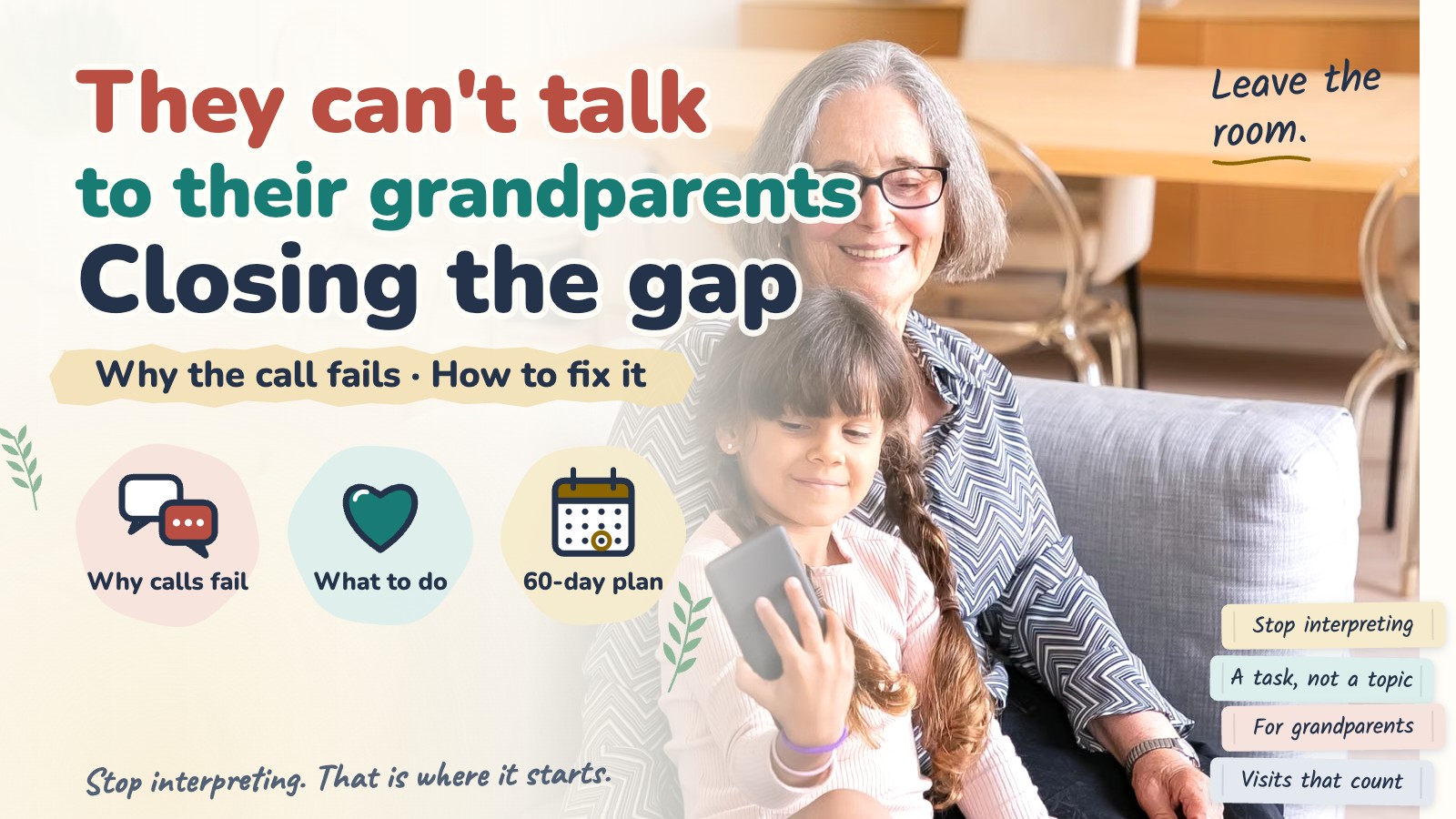
Stop interpreting. If you are in the room translating between your child and a Japanese-speaking relative, you have removed the only genuinely unswitchable listener your child has access to. It feels like helping. It is the single most effective way to guarantee that no production ever happens. Hand over the phone, say you need to do something, and leave.
Stop commenting on their Japanese at all — including the compliments. “That was really good!” tells a fifteen-year-old that their language is being graded, that you were watching, and that there is a standard. Praise of performance is surveillance from the inside.
Stop making Japanese the topic of captive conversations. The car, the walk to school, the ten minutes before bed: these are the moments your teenager cannot leave, which is exactly why raising it there is experienced as an ambush. Whatever you need to say about Japanese, say it once, somewhere they can walk away from.
Stop reporting progress to relatives in front of them. A teenager who hears you give their grandmother a bulletin on their Japanese learns that their language is a performance delivered to an audience they did not agree to, and the fastest way to stop performing is to stop speaking.
Where the realistic options actually differ
Assuming your teenager has agreed to something — which is the whole precondition — the three routes that exist are not interchangeable, and the usual way they are compared (price, convenience) is not the way that matters.
| What a teenager actually needs | Weekend supplementary school | One-to-one tutor who speaks English | Small online class with peers in Japan |
|---|---|---|---|
| Creates a social cost for not speaking | △ | × | ○ |
| Delivers the kanji sequence in order, with instruction | ○ | ○ | △ |
| Survives an exam year and a part-time job | × | ○ | ○ |
| Works even if the teenager is unwilling | △ | △ | × |
| Puts your child with age peers rather than much younger children | × | ○ | ○ |
| Produces a record a Japanese school or university recognises | ○ | × | × |
○ generally yes △ depends on the provider and the child × generally no. General tendencies as at October 2026, not a statement about any particular school. The highlighted column is the type of provision our own TOMODACHI JAPAN offers, and we have marked the two places where it is the weaker choice: it depends on at least minimal willingness, and it does not by itself produce a transcript. A weekend supplementary school is the stronger option if a documented record matters to you, and a one-to-one tutor is the stronger option if literacy alone is the goal.
The row that decides most cases is the fourth one. If your teenager is genuinely unwilling, nothing in the third column will work, and the honest sequence is: fix the ownership problem first, then choose. Buying provision in the hope that it will generate motivation is the most common and most expensive mistake in this whole area.
If there is almost no Japanese left
Some families arrive at this point later than others. If your sixteen-year-old understands almost nothing, the picture is different but not hopeless, and it is worth being clear about what is and is not true.
What is true: a teenager starting from near zero is in roughly the position of any motivated foreign learner, and foreign learners get further than people expect — teenagers are efficient at explicit instruction in a way that six-year-olds are not. What is also true, and less often said, is that they carry an advantage that is easy to miss: the sound system. A child who heard Japanese for their first five years will almost always pronounce it without the accent that takes adult learners years to approach, and that single fact changes how they are received by Japanese speakers, which changes how willing they are to keep going.
What is not true is that starting from near zero makes it an ordinary foreign-language project. The emotional load is entirely different. Learning Japanese from scratch at sixteen, when it is also your family’s language that you did not get, carries a grief and a shame that a classmate learning it for fun does not have to deal with. That is the thing to be careful of. Framing the restart as an ordinary subject — a class with other beginners, a course with a syllabus, a grade — is often kinder and more effective than framing it as reclaiming a heritage, precisely because it lowers the stakes.
If moving to Japan is still on the table
A meaningful minority of families in this situation are also contemplating a return, which changes the arithmetic sharply, because a deadline converts a vague project into a scheduling problem. We have written about the planning of that runway in detail in our article on moving back to Japan and the months before the move. Three things are worth knowing here specifically because your child is a teenager.
First, the official provision thins out at exactly your child’s age. In Japan’s own schools, the Ministry of Education counted 84,759 children and students needing Japanese-language instruction as at 1 May 2025, of whom 11,446 hold Japanese nationality — the category most returnee children fall into. At the compulsory-education stage, 52,725 of them, about 76 per cent, were receiving instruction under a special curriculum designed for the purpose. At the upper-secondary stage, that figure was 947 students, about 16 per cent. Support at high-school age exists, but it is far thinner on the ground.
Second, the downstream numbers are worth looking at squarely rather than being frightened by. Among students needing Japanese-language instruction, 91.5 per cent went on to upper secondary education against 98.9 per cent of all students; 41.2 per cent went on to university or equivalent, against 75.0 per cent of all students. These are averages across a population dominated by children who arrived with no Japanese at all and no family literacy in it, so they are not a forecast for a bilingual returnee household. They are, however, a reasonable description of what happens when a language gap at secondary age is not actively worked on.
Third, the infrastructure you may be counting on is designed for younger children. The Ministry’s own count of overseas educational facilities — 94 Japanese schools with 16,134 pupils and 242 supplementary schools with 20,822 pupils, as at 15 April 2024 — covers the compulsory-education stage. If your child is fifteen or sixteen abroad, the weekend-school route that worked for other families is largely behind you.
Who this is not right for
We try to say this in every article, because advice that fits everyone fits nobody.
If your teenager is still willingly attending a class and still speaking Japanese sometimes, do not take the reduced target in this article. You are not in a refusal situation; you are in a maintenance situation, and the ordinary advice applies. If the refusal is one part of a broader withdrawal — sleep, friends, school attendance, mood — then Japanese is a symptom and not the thing to work on, and the language can wait as long as it needs to. If there is a reason to suspect a speech, language or hearing difficulty rather than a motivational one, a professional assessment comes before any of this; nothing here is diagnostic, and we are not qualified to be. And if your household is in a situation where Japanese is tangled up with a separation, a bereavement or a conflict between the adults, the ownership conversation we describe above is likely to need help from someone outside the family before it can happen at all.
A realistic twelve months
Three-month plans are for problems that move in three months. This one does not. Here is a year, with the ordering that matters.
Stop all four of the things in the subtraction list, including the compliments. Have the ownership conversation once, clearly, and then do not reopen it. Expect activity to fall and expect to find that unbearable. Keep comprehension alive by continuing to speak Japanese yourself, to your child and in the house, with no expectation of a Japanese reply — this is the cheapest and highest-value thing in the entire plan. Do not buy anything yet.
Say yes to whatever is asked for, quickly and without commentary. In parallel, do the one thing that is yours rather than theirs: secure a single regular unswitchable listener — a relative, a family friend, a cousin — and make it a fixed, short, low-ceremony slot that you are not present for. Ten minutes weekly beats an hour monthly. If literacy is the dominant gap and your teenager is willing to be merely present, this is also when instruction starts, framed as a subject rather than a heritage project.
By now something will have a reason attached to it, and it will probably not be the reason you wanted. Fund that. If a trip to Japan is possible at any point in the next two years, book it early and let it be about the thing your teenager cares about rather than about the language; a destination they chose does more for spoken Japanese in two weeks than a year of arranged practice. Then review honestly: comprehension, a spoken floor, functional reading, and a relationship with the language that is not primarily guilt. Those four are the deliverable.
Frequently asked questions
Sources used for this article
- Ministry of Education, Culture, Sports, Science and Technology (MEXT), Survey of the enrolment of children and students requiring Japanese-language instruction (as at 1 May 2025) — 84,759 students; 11,446 of Japanese nationality; 52,725 (76.4%) at the compulsory stage and 947 (15.6%) at the upper-secondary stage receiving instruction under a special curriculum; progression to upper secondary 91.5% against 98.9%, and to university or equivalent 41.2% against 75.0%.
- MEXT, Commentary on the national curriculum for primary school, Japanese language — the year-by-year kanji allocation of 80 / 160 / 200 / 202 / 193 / 191 characters, totalling 1,026.
- Agency for Cultural Affairs, The list of characters for everyday use (Cabinet notification, 2010) — 2,136 characters in the main table. The 1,110 figure used in this article is the arithmetic difference between that list and the 1,026 primary-school characters.
- MEXT, Statistics on Japanese educational institutions overseas (as at 15 April 2024) — 94 Japanese schools with 16,134 pupils and 242 supplementary schools with 20,822 pupils, compulsory-education stage.
- De Houwer, A. (2007). Parental language input patterns and children’s bilingual use. Applied Psycholinguistics, 28(3), 411–424. DOI 10.1017/S0142716407070221 — 1,899 families; minority-language use by children at 96.9%, 74.2% and 35.7% under the three parental patterns described above.
Where we could not confirm a figure in a primary source we were able to read ourselves, we left the claim out rather than softening it. In particular, we have not quoted any statistic about how many teenagers stop speaking a heritage language or how many later resume, because we could not find reliable primary data on it, and we have not quoted the commonly cited number of years for academic catch-up in a new school language for the same reason. National figures describe a population and never a particular child; the figures on students needing Japanese-language instruction in Japan are dominated by children who arrived with no Japanese at all, and should not be read as a forecast for a bilingual household.
The thing a teenager cannot get at home is a reason to speak that is not their parent. TOMODACHI JAPAN puts children growing up abroad into small online classes with peers in Japan who do not speak English, grouped by what each child can actually say rather than by age. The pilot opens in December 2026, and the school guide is free to read.
Published: 7 October 2026 / Last updated: 7 October 2026