Menu
BASICS
How Japanese schools work Japanese phrases for school Glossary of school termsWAYS TO LEARN
Free schools Education support centers Online schools Homeschooling in Japan International schools Correspondence high schoolsMORE
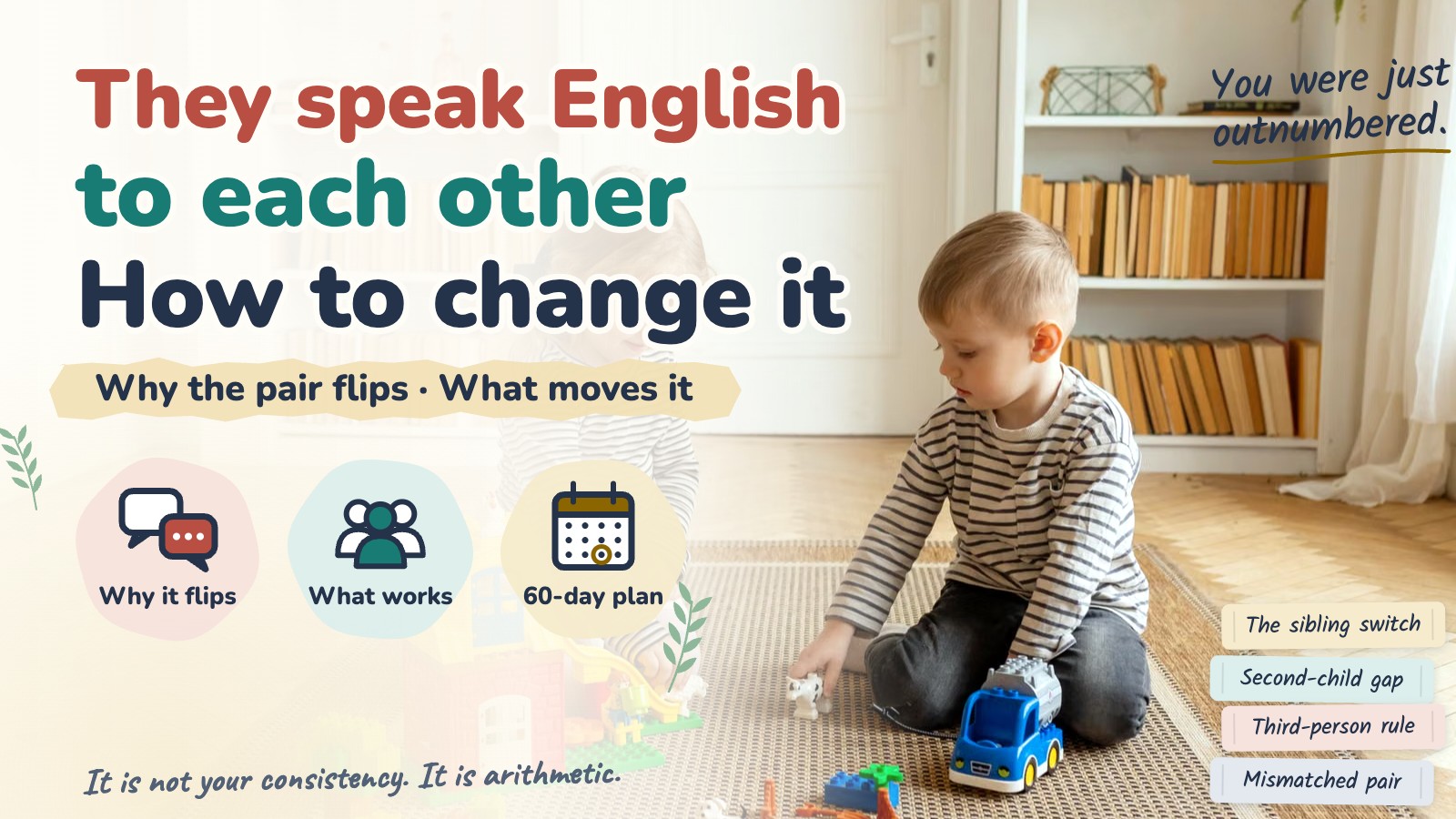
Neurodivergent children Where to get help Attendance and costs Learning Place Finder 日本語サイトへRaising a Half-Japanese Child Who Actually Speaks Japanese, When Only One Parent Has the Language
- The one statistic that explains why this household is harder, and why it is not your fault
- Why “one parent, one language” underperforms exactly here
- What the non-Japanese parent controls — the largest unused lever in most of these families
- Identity: when a child decides they are “not really Japanese”, and what that does to the language
- What happens when the Japanese parent travels, works late, or is simply outnumbered
- How to get real value out of a trip to Japan instead of a nice holiday
- A 90-day plan built for a household where Japanese is nobody’s default
The short version
In a household where one parent speaks Japanese and the other speaks only the local language, Japanese is structurally a minority language inside its own home. It is available from one adult, for a fraction of the day, and it is excluded from every moment the whole family shares — dinner, weekends, holidays, the car — because those have to run in the language everybody understands.
That is not a failure of discipline. It is arithmetic, and the research bears it out with uncomfortable precision. The usual advice — be more consistent, speak only Japanese to your child — is aimed at a problem you probably do not have. Most Japanese parents in this situation are already consistent. What is missing is not effort from one adult. It is a household design, plus a source of Japanese from outside the house.
The number that explains your household
Annick De Houwer surveyed 1,899 families in Flanders, Belgium, in which at least one parent spoke a language other than the majority language at home — roughly 4,500 children. She sorted the families by what the parents actually used, and counted how many ended up with at least one child who spoke the minority language.
Which households keep the home language — and which do not
Find your household in this table. The spread between the top and bottom rows is the whole story.
| What the parents used at home | Families where a child spoke the minority language |
|---|---|
| Both parents used only the minority language | 96.9% |
| One parent minority only; the other used both | 93.4% |
| Both parents used both languages | 79.2% |
| One parent minority only; the other majority only — classic “one parent, one language” | 74.2% |
| One parent used both; the other majority only | 35.7% |
De Houwer, A. (2007), “Parental language input patterns and children’s bilingual use”, Applied Psycholinguistics 28(3). The differences between the top two patterns and the bottom three were statistically significant. Flanders, not Japan — but the mechanism is not country-specific.
Read the bottom two rows carefully, because almost every international-marriage family is in one of them.
If you hold strict one-parent-one-language — the Japanese parent speaks only Japanese to the child, the other parent only the local language — you are at 74.2%. Better than even, but a long way from the 96.9% at the top, and far below what the advice implies.
If the Japanese parent uses both languages, which happens in practically every household eventually, you are at 35.7%: the weakest of the five patterns. Roughly one family in three.
And the Japanese parent nearly always ends up using both. Not through weakness, but because the family has a non-Japanese-speaking member in it. You switch to include your partner at dinner. You switch in front of their parents. You switch when a teacher is in the room. Each of those is the right call socially, and each one moves your household down the table.
Why “one parent, one language” underperforms here
OPOL is the most-recommended strategy in bilingual parenting and it is genuinely useful. But it was never designed to carry a language on its own, and in this household it is usually asked to.
OPOL specifies what each parent says to the child. It says nothing about the language of the family — the dinner table, the car, the weekend — which in this household is always the local language. The child therefore learns that Japanese is a private channel with one person, not the language of their life.
If the Japanese parent travels, works late, is ill, or simply has a bad month, the child’s entire Japanese input stops. In a household where both parents speak the language, nothing happens. Here, everything does.
OPOL creates input. It does not create need. The child knows the Japanese parent understands English perfectly, so answering in English costs nothing. Strict OPOL households very often produce excellent comprehension and almost no speech.
None of this means abandon it. Keep speaking Japanese to your child — it is what keeps comprehension alive, and comprehension is the asset everything else is rebuilt from. Just stop expecting it to produce a speaking child by itself, and stop reading your child’s English answers as evidence that you did it wrong.

What the non-Japanese parent controls
This is the section most families have never been given, and in our experience it is where the largest unused gains are.
The non-Japanese parent usually believes they are a neutral party in this — supportive, but structurally irrelevant, because they do not speak the language. That is wrong in a specific and useful way. Children do not work out what a language is worth from the parent who speaks it. They work it out from the parent who does not.
A child watching a father who never learned a word, who leaves the room during Japanese calls, who says “ask your mother”, draws a conclusion: Japanese is Mum’s thing, and this family manages fine without it. A child watching a father who knows thirty words, asks what something means at dinner, tries the greeting badly and laughs about it, and defends the Saturday slot when something else wants that time, draws the opposite conclusion. Neither father has taught any Japanese. They have taught entirely different things about whether Japanese is worth the effort.
- Learn thirty words and use them badly, in front of the child. Not to become bilingual — to demonstrate that an adult in this house considers Japanese worth being bad at. This is more powerful than it sounds, especially with children aged 6–10.
- Ask what things mean, genuinely. “What did you two just say?” asked with interest, not suspicion, turns Japanese from an exclusion into a thing the family is curious about.
- Protect the slots. You are usually the one who can say “no, that’s the Japanese call, we’ll do football after”. The Japanese parent asking for that sounds like self-interest. You asking for it sounds like a family decision.
- Never joke about the language or the accent. Including affectionately, including about your partner’s English. Children file all of it.
- Handle the logistics. Pay for the classes, book the flights, set the reminders. It changes who is seen to be carrying the project.
- Say out loud, once, that you want this. Many children have never heard the non-Japanese parent state that they want their child to speak Japanese. It lands.
One caution, because it comes up. None of this requires the non-Japanese parent to be excluded from their own family’s conversations. A household where one adult is routinely shut out of dinner to protect a language is not a sustainable household, and children read the resentment accurately. The aim is a partner who is visibly on the side of the language, not a partner who is sitting outside it in silence.
Identity: when a child decides they are “not really Japanese”
In families with one Japanese parent, the language problem and the identity problem arrive together, and they make each other worse.
Somewhere between about seven and twelve, most of these children work out that they are categorised. They are asked where they are really from. They are told their Japanese is good “for a foreigner”, or that they do not look Japanese, or — on a visit to Japan — are praised extravagantly for a single sentence in a way that makes clear they are being judged as an outsider. The English word that reaches most of these families is hāfu, and children notice early that it is a word for half of something.
The language consequence is direct. A child who concludes that they will never be accepted as Japanese has little reason to pay the social cost of speaking imperfect Japanese. Giving up the language is a reasonable response to being told you are not a real member — and it is often misread by parents as laziness.
The identity signals that precede a drop in speaking
| What you hear | What is often underneath | What tends to help |
|---|---|---|
| “I’m not really Japanese.” | They have been told so, somewhere, by someone whose opinion mattered. | Agree with the complicated version rather than arguing: “You’re both. People will get that wrong and it’s annoying.” |
| “My Japanese is bad.” | Usually a comparison with a cousin or a classmate, not an assessment. | Name the real cause: “You haven’t had people to speak it with. That’s a situation, not you.” |
| “Don’t speak Japanese here.” | Being visibly different in public has become costly — often around ages 8–11. | Respect it in public, keep it at home. Fighting this in a supermarket costs you the language. |
| “Why do I have to?” | They have never been given a reason that belongs to them rather than to you. | Attach it to a person or a plan they care about — a cousin, a trip, a game — not to heritage in the abstract. |
Patterns reported by families and teachers working with children of international marriages abroad. Every child is different; use this to listen, not to diagnose.
The most useful move available to parents here is also the simplest: give the child Japanese-speaking peers who are also from mixed families. A child who has only ever compared themselves to monolingual Japanese cousins concludes they are a failed Japanese person. A child who knows five other children who live between two countries concludes that this is a normal way to be. The second child keeps speaking.
When the Japanese parent is outnumbered
A household with one Japanese-speaking adult has a single point of failure, and most families discover it the hard way.
The Japanese parent travels for work, or starts a job with longer hours, or has a second baby, or spends three months dealing with something difficult. The child’s Japanese input does not reduce; it stops. In a two-Japanese-parent household the other adult absorbs it. Here there is nobody to absorb it, and six quiet weeks is enough for a seven-year-old’s active Japanese to drop noticeably.
What protects a household against this is redundancy — having Japanese arrive from more than one place.
Where else Japanese can come from, and how reliable each one is
| Source | Reliability | Produces speech? | Notes |
|---|---|---|---|
| The Japanese parent | High, until it is not | △ | Essential for comprehension. Cannot create a reason to speak, because the child knows you understand English. |
| Grandparents on a standing call | Medium — depends on health and time zones | ○ | The best free option. Works when the grandparent needs something, not when they test the child. |
| Local Japanese community | Varies wildly by city | ○ | Excellent where it exists. Many families have none within an hour. |
| A regular group class with Japanese-speaking peers | High — it is in the diary | ○ | The most reliable purchasable version of the thing that works. |
| Media, apps, tutoring | High | × | Useful for vocabulary and literacy. Does not produce spontaneous speech on its own. |
“Produces speech” means the child has to be understood by someone who cannot switch to the local language.
The practical test for your household: if the Japanese parent were unavailable for two months, how much Japanese would your child hear and speak? If the honest answer is “almost none”, that is the gap to close — and it is a scheduling problem, not a parenting problem.
Trips to Japan: how to get a language gain instead of a nice holiday
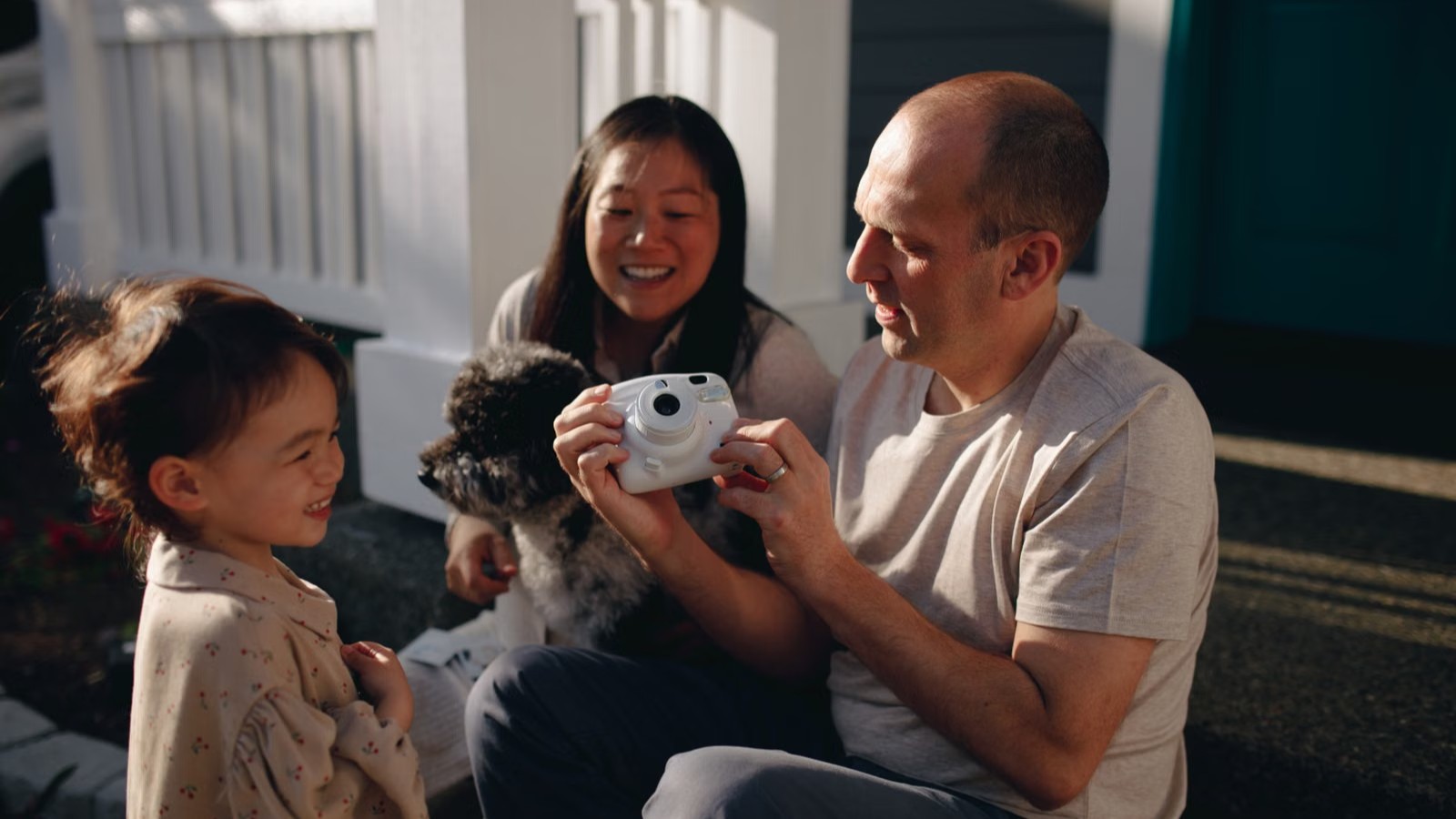
Three weeks with cousins does more for spoken Japanese than a year of lessons. Every family in this situation has either seen it or been told about it. But the same three weeks can also produce nothing at all, and the difference is almost entirely in how the trip is arranged.
| How the trip is arranged | Japanese input | Need to speak | What usually happens |
|---|---|---|---|
| Staying with grandparents, adults around, sightseeing | ○ | × | A lovely holiday. The child is talked at affectionately and spoken for by the Japanese parent. Language gain is small. |
| The Japanese parent interprets throughout | ○ | × | The single most common mistake. The child never has to produce a sentence, because a fluent adult is always half a second ahead. |
| Several days with cousins, parents elsewhere | ○ | ○ | The strong version. Children do not interpret for each other, and the child is forced into real-time Japanese within days. |
| A short local activity — day camp, club, swimming | ○ | ○ | Excellent and underused. A week of anything with Japanese children does more than a month of family visits. |
Three rules that make the difference, and the first is hard for the Japanese parent.
Stop interpreting. When a shopkeeper asks your child a question, say nothing for five seconds. The silence will feel unbearable to you and it is where the language happens. Interpreting for your child is the kindest possible way of preventing them from speaking.
Buy time without you. Half a day with cousins, a day camp, an afternoon at a relative’s house. Any arrangement in which no bilingual adult is available is worth more than a week of supervised family time.
Prepare the first fortnight before you fly. A child who arrives with no Japanese spends the first ten days silent and humiliated, and the trip is half over before anything starts. A child who has been speaking to Japanese-speaking peers weekly for three months beforehand starts talking on day two. The trip multiplies what already exists; it does not create it from nothing.

What it costs if nothing changes
Three costs, in the order families actually feel them.
The grandparents go first. This is usually the earliest real loss, and it is the one that makes parents cry in our inbox. A child who cannot hold a conversation in Japanese cannot have a relationship with a grandparent who does not speak English — only a supervised fifteen minutes on a screen, with a parent interpreting. The grandparents rarely say anything about it.
The parent’s own relationship with the child changes shape. Lily Wong Fillmore’s research on language-minority families in the United States — around a thousand families, 690 in the main sample and 311 in a comparison group — found that where children were schooled in English only, about 51% of parents reported the home language being displaced, against just over 10% in the comparison group, and around 12% said their children now spoke the home language poorly or not at all. Her argument was not about vocabulary. It was that parents lose the ability to say complicated things to their own children.
And if you move to Japan, the cost becomes measurable. As of 1 May 2025, 84,759 children in Japanese public schools needed Japanese-language instruction, and 11,446 of them were Japanese nationals. Among students needing that instruction, the rate of going on to university and similar institutions was 41.2%, against 75.0% for students overall. A dual-national child with a Japanese passport gets no exemption from this; the system responds to what the child can do in Japanese, not to what is in their family register.
If a move is on your horizon, our guides on Japanese public elementary school for foreign children and returnee children struggling after arrival cover what happens next. If your child understands but will not speak, the core guide to that pattern is the one to read first, and if you have more than one child, the sibling guide covers the conversation that is probably the largest in their day.
And if your child can no longer really talk to their grandparents in Japan, the grandparent guide covers the weekly call — the cheapest source of real Japanese most families already have and almost never use properly. All of these sit in our Keeping Japanese Alive hub.
What does not work in this household specifically
Some of the standard bilingual advice is actively counterproductive when only one parent has the language. An honest ranking:
| What families try | Builds comprehension | Produces speech | Honest verdict |
|---|---|---|---|
| Japanese parent speaks only Japanese, more strictly | ○ | × | Already running in most of these homes. Keeps comprehension alive, which matters — but the child knows you understand English, so it creates no need to answer. |
| Pretending not to understand the child’s English | × | △ | Riskier here than in other households, because you are the child’s only Japanese relationship. If it costs you conversation, you have lost the main channel too. |
| Japanese-only rule at family meals | △ | × | Excludes the non-Japanese parent from their own family. Children read the resentment accurately and attach it to the language. |
| Apps and worksheets | ○ | × | Useful for kana and vocabulary. No app has ever made a child need to be understood. |
| One-to-one online tutoring | ○ | △ | Good for literacy and exams. The tutor accommodates the child — waits, infers, accepts half-sentences — which is precisely the accommodation that lets a child avoid producing a full one. |
| Local hoshuko (Saturday school) | ○ | ○ | Strong where it fits. But it assumes grade-level Japanese, and children of international marriages are often placed with classmates far ahead of them — which is how a child decides Japanese is not for them. |
| Regular peer conversation with children who cannot switch | △ | ○ | The only item that targets speech directly, and the one most of these households have never had. |
The hoshuko row deserves a note, because it is the most common disappointment in this group. Supplementary schools are built around the curriculum of a Japanese school year, and they work beautifully for children who can already follow it. A child from a one-Japanese-parent household frequently cannot, arrives behind, is the slowest in the room every Saturday, and concludes within a term that they are bad at Japanese. The school did nothing wrong and neither did the child. It was a placement problem, and it is why grouping by current speaking ability rather than by age matters so much in this particular household.
The language of the house, not just the parent
One-parent-one-language tells you what each adult says to the child. It says nothing about the household, and in this configuration the household is where the language is actually lost.
Think of your family’s week as a set of contexts rather than as a rule. Some of them can be Japanese without excluding anybody; some of them cannot, and trying to force those is what produces the resentment that children attach to the language for the rest of their childhood.
Where Japanese can realistically live in a mixed-language household
| Context | Realistic language | Why |
|---|---|---|
| Whole-family meals, weekends, holidays | Local language | Do not fight this. A household that excludes one adult from dinner to protect a language is trading something more important than the language. |
| Bedtime, bath, the school run | Japanese, reliably | One-adult-one-child time. This is where the daily anchor belongs, and it survives because nobody is excluded. |
| Calls to Japan | Japanese, child leading | The highest-value slot in the week, and the one most often wasted by a parent interpreting. |
| Cooking, errands, admin with one parent | Japanese, opportunistically | Side-by-side activity produces more natural speech than face-to-face conversation, especially with self-conscious children. |
| Screens | Japanese by default | Free, and it costs nobody anything. It builds comprehension and shared references, though not speech. |
| Friends and the outside world | Local language | Not negotiable, and not worth a single argument. |
The aim is not more Japanese everywhere. It is Japanese reliably in the places where it does not cost the family anything.
Two things follow from that table that families find liberating.
You are allowed to let the family language be English. The households at the top of the De Houwer table are the ones where both adults speak the minority language — which is not available to you. Trying to simulate it by imposing Japanese on shared family time does not move you up the table; it just makes the language unpleasant. What moves you is the daily anchor plus an outside source.
Side-by-side beats face-to-face. A child who will not answer a direct question in Japanese will often narrate freely while chopping vegetables, walking, or building something. If your evenings have become an interview that your child is failing, change the geometry before you change anything else.
Designing the household instead of hoping
Everything above points at the same conclusion: in this configuration, Japanese will not happen by itself, and it will not happen through one adult trying harder. It has to be built, the way you would build a musical instrument into a child’s week. That sounds like more work. It is also more controllable, because design is something you can actually change on a Tuesday.
What a working one-Japanese-parent household looks like
| Slot | What goes in it | Who owns it | Realistic minimum |
|---|---|---|---|
| Daily anchor | One predictable part of the day that is always Japanese — bedtime, the school run, breakfast. | Japanese parent | 15–20 minutes, most days |
| Family signal | The non-Japanese parent using words, asking what things mean, protecting the slots. | Non-Japanese parent | Daily, and free |
| A person who cannot switch | Peers, a grandparent who needs something, a group class. The only slot that produces speech. | Whoever books it | Twice a week |
| A reason that belongs to the child | A cousin, a game, a trip, a plan. Not heritage in the abstract. | The child, eventually | Ongoing, and mostly out of your hands |
Most families in this situation have the first slot and nothing else. The second is free. The third is the one worth paying for.
If you can only change one thing this term, change the third slot. The first is almost certainly already running, the second costs nothing but a conversation with your partner, and the fourth cannot be forced. The third is the one that is missing in nearly every household that writes to us, and it is the only one that reliably converts comprehension into speech.
Age by age, in this household
The pressure points are different when Japanese comes from one adult. What to prioritise, and what to let go of.
Where the effort pays in a one-Japanese-parent family
| Age | What matters most | What to stop worrying about |
|---|---|---|
| 0–5 | Volume from the Japanese parent, and getting the non-Japanese parent bought in early. This is the one period where household input alone can carry the language, because school has not taken the day yet. | Reading, writing, formal anything. Also mixing — children sort the languages out on their own. |
| 6–9 | Adding the outside source, before self-consciousness arrives. A child who joins a Japanese group at seven treats it as normal; the same child at ten experiences it as an exposure of weakness. | Perfect grammar. Correcting at this age costs more speech than it gains accuracy. |
| 10–13 | Identity and company. Peers from mixed families matter more than lesson content now. Protect dignity above all — never place them where they are the slowest in the room. | Trying to increase hours. At this age, who they speak Japanese with matters far more than how long. |
| 14+ | Their reason, not yours — a trip, a plan, a person, a game, a university thought. Your role shifts from arranging to funding and not interfering. | Household rules about language. That lever is gone, and pulling it now costs you the relationship rather than gaining the language. |
Children differ widely. Use this to decide what to try first, not as a timetable.
The 6–9 row is the one worth acting on if your child is in it. There is a window, roughly between starting school and the arrival of real social self-consciousness, in which a child will join a Japanese group without experiencing it as a judgement on them. Families who get the outside source in place during that window report a completely different experience from families who try to introduce it at eleven. If your child is seven and you have been waiting until their Japanese is “good enough” to join something, that is exactly backwards: the group is what makes it good enough, and the cost of joining rises every year you wait.
The 14+ row is the one worth believing. Plenty of children in this configuration go almost silent between nine and fourteen and come back later, often sharply, when Japanese stops being their mother’s language and becomes connected to something they want. The job in the quiet years is not to extract speech. It is to keep comprehension alive and keep the language a pleasant place, so that when the reason arrives the door is still open.
Where an online Japanese school fits — and where it does not
The honest obstacle is supply. In Osaka you would simply enrol your child in something. In Manchester, Munich or Melbourne there may be no Japanese-speaking children of the right age within an hour, and the cousins are eight time zones away.
TOMODACHI JAPAN (ともだちじゃぱん) is an online Japanese school built by NIJIN for children growing up abroad. The features that matter for this particular household:
- Grouped by what a child can currently say, not by age or school year. A ten-year-old with the Japanese of a five-year-old is placed with children they can actually talk to — which is the difference between a child who speaks and a child who sits silently being the slowest in the room.
- Beginners from zero are expected, not tolerated. If your child has thirty words, that is a starting point rather than an embarrassment.
- Children in Japan are in the classes, through NIJIN’s sister school NIJIN Academy (over 1,000 students enrolled to date) — peers who genuinely do not have the English.
- Other children from families like yours. Being one of several children who live between two countries does more for a child’s willingness to speak than any amount of reassurance from a parent.
- No commute, time zones accounted for, daily or weekends and after-school only — which matters when the Japanese parent travels.
In a family where one parent speaks Japanese, the missing piece is never input — it is a person your child has to be understood by. TOMODACHI JAPAN is an online Japanese school with classes of eight, grouped by what a child can actually say, alongside children in Japan who do not speak English. The pilot opens in December 2026.
Who this is not right for
- If both parents speak Japanese. Your household is in the 93–97% band and this guide is aimed at a harder problem. The core guide is more useful.
- If your child needs an exam — GCSE, HSC, VCE, AP Japanese — use a specialist tutor or an exam course.
- If the issue is reading and writing rather than speaking. A hoshuko or a literacy-focused tutor is the closer fit.
- If your child’s refusal looks like distress rather than reluctance — silence across settings, not just in Japanese — start with support for that. Our guide to selective mutism in a bilingual child explains how to tell them apart.
- If you need something this month. It does not open until December 2026.
A 90-day plan for a one-Japanese-parent household
This month belongs to the non-Japanese parent. Thirty words, used badly and often. Ask what things mean at dinner. Say out loud, once, that you want your child to speak Japanese. Meanwhile the Japanese parent stops correcting entirely and holds one daily anchor. Nothing is bought and nothing is enrolled yet.
A standing call with a grandparent who needs something real from the child, a local Japanese family, a group class, a trial at an online school. Twice a week beats once. This is the slot that produces speech, and it is the one most households have never filled.
Pick something concrete the child can aim at — a trip, a cousin they will stay with, a game they want to play with Japanese players. Then stop steering. Compare against a note you made on day one, not against a monolingual cousin.
One final thing, and it is the one worth holding onto on a bad week. A child of an international marriage who ends up with partial Japanese — good comprehension, clumsy speech, the ability to get by with their grandmother — has not failed, and neither have you. That child can rebuild quickly whenever they decide to, because the system is built and the door is open. The outcome worth avoiding is not imperfect Japanese. It is a closed door, and the research is clear that doors close by default in this configuration unless somebody designs against it.
Frequently asked questions
Sources used for this article
- De Houwer, A. (2007), “Parental language input patterns and children’s bilingual use”, Applied Psycholinguistics 28(3) — survey of 1,899 families: doi.org/10.1017/S0142716407070221
- Wong Fillmore, L. (1991), “When learning a second language means losing the first”, Early Childhood Research Quarterly 6, 323–346: doi.org/10.1016/S0885-2006(05)80059-6. Sample figures as reported in Education Week, May 1991: edweek.org
- Colorín Colorado, “What are BICS and CALP?”, summarising Cummins and Collier & Thomas (1995): colorincolorado.org
- MEXT, survey of the acceptance of children requiring Japanese-language instruction, figures as of 1 May 2025 (published June 2026): mext.go.jp (PDF)
- MEXT, overview of Japanese educational institutions overseas — 94 Japanese schools and 242 supplementary schools worldwide, as of 2024: mext.go.jp
- Ministry of Foreign Affairs of Japan, Annual Report of Statistics on Japanese Nationals Overseas, as of 1 October 2025 — 1,298,170 Japanese nationals abroad, of whom 588,486 are permanent residents: mofa.go.jp
- TOMODACHI JAPAN official website — class size, grouping, schedule and opening dates: tomodachi-japan.nijin.co.jp
Your child does not need another adult who speaks Japanese. They need peers who cannot switch to English, and children like them who make being in between look normal. TOMODACHI JAPAN groups children by what they can actually say, so a beginner is never the slowest in the room. The pilot opens in December 2026 and the school guide is free.
Published: 5 October 2026 / Last updated: 5 October 2026