Menu
BASICS
How Japanese schools work Japanese phrases for school Glossary of school termsWAYS TO LEARN
Free schools Education support centers Online schools Homeschooling in Japan International schools Correspondence high schoolsMORE
Neurodivergent children Where to get help Attendance and costs Learning Place Finder 日本語サイトへYour Children Speak English to Each Other: The Sibling Switch, and How to Undo It
- Why your children’s conversations with each other outweigh your own input
- What a 2021 study of bilingual toddlers with older siblings actually found — and what it did not
- Why the second child usually ends up with weaker Japanese than the first
- The exact moment the pair switches, and why it is so hard to reverse
- What does not work, including the rules most parents impose first
- The one principle that does change a sibling pair: a third person who cannot switch
- Age-by-age tactics for 3–6, 7–9, 10–13 and teenagers
- What to do when one child speaks Japanese and the other does not
The short version
Parents measure their own consistency. They count whether they spoke Japanese at dinner, whether they let an English answer slide. Meanwhile the household’s real language economy is being decided by two children in a bedroom, and that negotiation is not about Japanese at all. It is about speed, jokes, and who gets to be funny.
Once two siblings establish English as the language of their relationship, that choice is extremely stable. It is not a habit in the way that brushing teeth is a habit. It is the medium of a relationship, and changing it feels, to them, like being asked to be a different person with their own brother or sister. This is why “speak Japanese to each other” produces a few stilted sentences and then silence, and why the pair reverts the moment you leave the room.
The good news is that sibling language is not fixed by willpower on either side. It is decided by who else is in the conversation. Add a person the pair cannot use English with — reliably, repeatedly — and the pair’s own language shifts, because the shared activity now runs in Japanese. That is the whole mechanism, and almost everything useful in this guide is a variation on it.
Why the sibling pair outweighs you
Do the arithmetic once and the problem stops being mysterious.
A school-age child is awake for roughly thirteen hours. Six or seven of those are at school, in the majority language. Of the hours left, a meaningful share is homework, screens, transport and the bits of the evening where nobody is talking much. Your actual conversational contact — the minutes in which you and your child are genuinely exchanging sentences — is often under an hour, spread thin across a tired evening.
Two siblings in the same house, on the other hand, are in each other’s company for most of the non-school day and talk continuously while doing it: negotiating a game, arguing about a turn, narrating a video, teasing. For most families with two or more children, the sibling conversation is the single largest block of spoken language in the child’s day after school itself.
Where a child’s talking hours actually go
Exact numbers vary enormously by family. The shape does not.
| Context | Language | Share of the child’s talking |
|---|---|---|
| School, friends, clubs | Majority language | The largest block, and not negotiable |
| Siblings | Whichever the pair settled on | The second largest — and the only one you can still influence |
| Parent conversation | Japanese, if you hold it | Smaller than parents assume; concentrated in tired hours |
| Screens | Mostly majority language | Input, not output. Does not build speech |
The point is not the precise split. It is that the sibling block is large, it is in the home, and it is the one most families never try to influence.
This also explains a pattern that confuses a lot of parents: the family where the adults are rigorously consistent in Japanese and the children still stop speaking it. Nothing went wrong with the parents. They were simply outvoted by volume.
What the research actually found
The clearest study on this is not about attrition at all. Dimitra Tsinivits and Sharon Unsworth looked at Greek–Dutch bilingual toddlers in the Netherlands and compared those with an older, school-age sibling against first-borns.
The findings are worth stating precisely, because they are often exaggerated.
What an older sibling changes in a bilingual home
| Measure | Toddler with an older sibling | First-born | What it means |
|---|---|---|---|
| Majority-language exposure at home (median) | 40 | 24.5 | The home becomes markedly more majority-language |
| Majority-language use at home (median) | 49 | 20 | The younger child speaks far more of it at home |
| Input from parents specifically | No significant difference | The parents had not changed. The children had | |
| Majority-language vocabulary (productive, median) | 599 | 70 | A very large gap in the majority language |
| Heritage-language measures | No significant difference | At toddler age, the heritage language was not yet damaged | |
Tsinivits, D. & Unsworth, S. (2021), “The impact of older siblings on the language environment and language development of bilingual toddlers”, Applied Psycholinguistics 42, 325–344. Greek–Dutch families in the Netherlands; medians as reported.
Two things follow, and the second is the one that matters for you.
First, the older sibling changes the home, not the parents. Parental input was statistically the same in both groups. What differed was how much of the majority language the household contained — because an older child brings school home every afternoon and speaks it to the baby. If you have felt that something shifted in your house without you changing anything, this is it.
Second, and importantly: this study found no heritage-language damage at toddler age. It is not evidence that siblings destroy the home language. The honest reading is that the sibling effect first shows up as a rise in the majority language, and whether the heritage language then declines depends on what happens over the following years — which is where the rest of this guide lives. Anyone telling you that research proves siblings kill the home language is overstating it.
Why the second child usually has weaker Japanese
Almost every family with two or more children abroad reports the same thing: the eldest speaks the most Japanese, and each subsequent child speaks a little less. This is not favouritism and it is not imagination. It falls out of the arithmetic above.
Before school, your eldest spent years in a house where you were the main conversational partner. That window was effectively a Japanese immersion period. The second child is born into a house that already contains a school-age sibling speaking the majority language all afternoon — so that window is much smaller, or never exists.
Younger siblings imitate older siblings far more eagerly than they imitate parents. If the four-year-old’s favourite person narrates everything in English, that is the model being copied, several hours a day, with enormous motivation attached.
The honest one. The deliberate, patient, language-rich conversation you had with your first child at bedtime is harder to repeat with the second, because you are now running a household of two. Nobody should feel guilty about this, but it is part of the picture.
The practical consequence: if you are expecting a second child, or your first has just started school, you are at the highest-leverage moment you will ever have. Setting the sibling language before the pair has settled is far easier than changing it afterwards. If that moment has passed, the rest of this guide is about the harder version.
The moment it flips
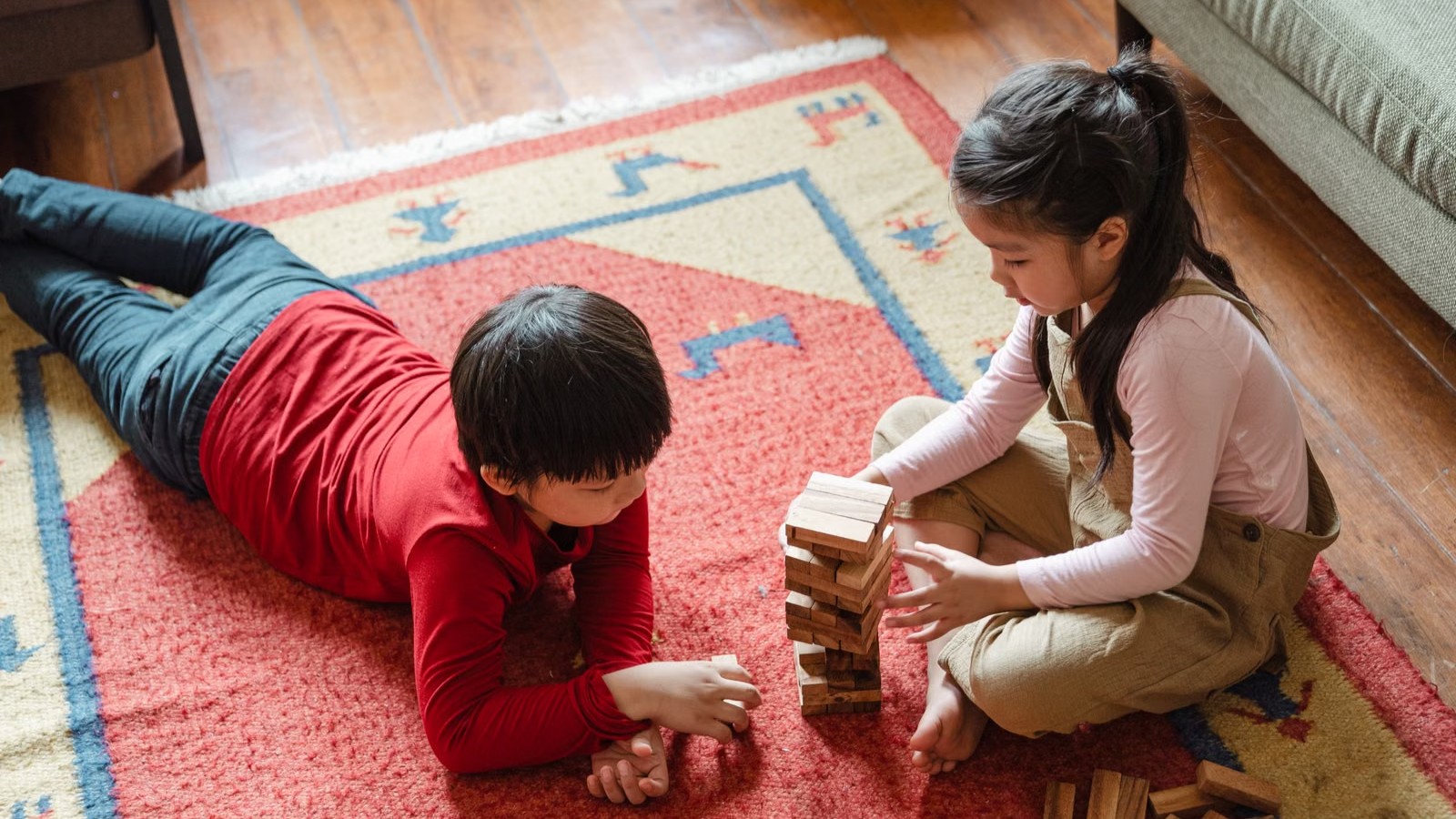
Sibling language does not drift. It switches, usually inside a few months, and almost always around one of four events.
Four switch points, and what you will notice
| Trigger | What happens | How obvious it is |
|---|---|---|
| The younger child starts school | They arrive home with the school language and a vocabulary for play that only exists in it. Within a term, the pair has switched. | The most common single cause, and the most abrupt |
| A shared screen interest arrives | A game, a series, a YouTube channel. The vocabulary of the thing they both love is English, so the conversation about it is English. | Easy to miss, because it looks like a hobby rather than a language event |
| Friends enter the house | The pair speaks English in front of visitors, correctly and politely — and then simply does not switch back after the friend leaves. | Gradual. Parents often notice months later |
| A move, or a change of school | Any upheaval resets habits. The language of the new situation becomes the language of the pair. | Fast, and usually attributed to the move rather than the language |
Pattern reported consistently by families and teachers working with children abroad. Your family may switch on one of these and not the others.
What makes the switch so durable is that it is not stored as a rule. It is stored as a relationship. Two siblings have a particular register with each other — the shorthand, the running jokes, the specific way they wind each other up — and all of it is built in whichever language they settled on. Asking them to speak Japanese together is not asking for a translation. It is asking them to be slower, less funny, and less themselves with the person they are least formal with in the world.
That is why the usual intervention fails so reliably. “Speak Japanese to each other” gets you a few flat exchanges performed for your benefit, followed by a drop in how much they talk at all, followed by a return to English the moment the supervision ends. You have not changed the language of the relationship. You have added a tax to being in the same room as you.
What siblings get from the majority language — and why Japanese cannot compete on those terms
To change the pair, it helps to be honest about what they are choosing. Three things, none of which are about language learning.
Speed. Children’s play is fast. Arguments about rules, narration of a game, the exact timing of a joke — all of it collapses if either party has to search for a word. Whichever language is quicker for both of them wins, automatically and permanently. This is why the pair tends to settle on the weaker child’s stronger language.
Vocabulary for the actual content. If what they do together is a game, the words for it are in the game’s language. A child who does not know how to say “respawn”, “shuffle the deck” or “you’re out” in Japanese is not going to invent them mid-play. The content drags the language with it.
Equality. This is the subtle one. In English, the siblings are matched — both fluent, both able to argue. In Japanese, one of them is usually noticeably better, and the gap turns play into a lesson with a built-in winner. Children avoid activities where one of them is permanently the slow one, and they are right to.
What does not work
Families arrive at the same five interventions. Here is an honest ranking, including why the popular ones backfire.
| What families try | Changes the pair’s language | Side effects | Honest verdict |
|---|---|---|---|
| “Speak Japanese to each other” as a house rule | × | × | Produces performance in front of you and reversion out of earshot. Usually reduces the total amount the children talk. |
| Rewards and charts for Japanese | △ | △ | Works briefly with younger children. Stops the day the reward stops, and teaches that Japanese needs paying for. |
| Making the older child teach the younger | × | × | The worst option on this list. Turns a sibling into an authority figure and makes Japanese the thing they fight about. |
| Japanese screen time together | △ | ○ | Genuinely useful: it supplies shared vocabulary and shared references, which is half the problem. But watching is not speaking. |
| A shared activity that only exists in Japanese | ○ | ○ | The only reliable lever. The language rides in on the activity instead of being imposed on it. |
One of these deserves defending. Japanese screen time together is better than its reputation, as long as you are clear about what it does. It will not make your children speak Japanese to each other. What it does is give the pair a shared world with Japanese words attached — characters, catchphrases, the names of things — and shared reference is exactly what a sibling register is made of. Children who have watched the same Japanese series together have something to be funny about in Japanese, which is the raw material everything else needs.
What does work: the third-person principle
Here is the mechanism, stated plainly.
A sibling pair changes language when a third person joins their activity and cannot be spoken to in the majority language. Not a parent — the children know you understand English. Someone outside the family, ideally another child, whose presence makes English useless rather than forbidden.
What happens next is the part parents find surprising. The siblings do not just speak Japanese to the newcomer. They start speaking Japanese to each other, within that activity, because switching back and forth mid-conversation is more effort than staying in one language. The pair’s language is set by the group it is embedded in, and you have changed the group.
Every family who has spent a summer in Japan has seen the strong version of this. Two siblings who speak only English at home arrive at their cousins’ house, and within about ten days are arguing with each other in Japanese without noticing. Nobody made a rule. The group changed, so the pair changed.
This is also why one-to-one tutoring, which helps individual children a great deal with reading and grammar, does almost nothing for sibling language. A tutor works with one child, in a session the sibling is not part of, with an adult who could switch to English if needed. None of the three conditions are met.
Age by age: what actually shifts a pair
The third-person principle is the same at every age. What changes is what counts as an activity worth joining.
What to try, and what to stop trying
| Age | What tends to work | What to avoid |
|---|---|---|
| 3–6 | This is the window. Japanese-speaking playmates, a Japanese playgroup, cousins on a standing call, a childminder who speaks no English. At this age the pair has often not finalised its language and can still be set. | Formal lessons. Nothing at this age needs to look like study. |
| 7–9 | Group activities with Japanese-speaking peers around a real interest — a club, a class, a game they both play with others in Japanese. Shared Japanese series to build a common vocabulary. | Rules and charts. Self-consciousness has arrived; being corrected in front of a sibling is now humiliating. |
| 10–13 | Give each child their own Japanese context rather than treating them as a unit — separate groups, separate friends, separate interests. Oddly, splitting them up is often what brings the pair back. | Anything that makes the younger one the slow one in front of the older one. |
| 14+ | Their own reasons: music, games, a trip they want, a university plan. At this point you are supporting a decision rather than creating one. | Trying to legislate the sibling language at all. That window has closed; work on each child individually. |
Children vary. Treat this as a way to choose what to try first, not a schedule.
The 10–13 row surprises people, so it is worth spelling out. Parents instinctively look for something the children can do together in Japanese. But by this age, a sibling pair with a Japanese gap will reproduce that gap in any shared activity — the stronger one carries the conversation, the weaker one goes quiet, and both conclude that Japanese is where they are mismatched. Giving each child a separate Japanese group, at their own level, removes the comparison. When both come home having had a good time in Japanese, the pair sometimes starts using it between themselves for the first time in years.
When one child speaks Japanese and the other does not
This is the most common version of the problem, and it needs a different answer from the general case.
Typically the eldest, who had the pre-school Japanese window, is reasonably comfortable, and a younger sibling born into a two-language house is not. Parents then do the natural thing: they ask the fluent one to speak Japanese to the less fluent one. It is a reasonable idea and it tends to make everything worse, for a reason worth understanding.
For the older child, speaking Japanese to a sibling who struggles is unrewarding: they have to slow down, simplify, repeat, and they get a worse conversation for the effort. For the younger child, every exchange is a reminder of the gap. The relationship picks the language where they are equals, and it is right to.
What helps instead:
- Group by ability, not by family. If you enrol them in anything, they should be in classes that match what each of them can currently say — not placed together for convenience. Being in a group where they are each unremarkable is the single biggest relief for both.
- Protect the older child from the teacher role. They can be a sibling in Japanese; they cannot be a sibling and an instructor at once.
- Give the younger child a Japanese context the older one is not in. Something that is theirs, where nobody remembers that their sibling is better at this.
- Narrow the gap from the bottom, not the top. Fifteen minutes a day of the younger child speaking to someone who cannot switch will close more of the gap in three months than a year of being corrected by a brother.
- Stop comparing out loud, including favourably. “Your sister can say it” and “you’re nearly as good as your sister” do the same work.

What it costs if the pair never changes
It is worth being concrete about why this is worth any effort at all, because “bilingualism is good for them” is too vague to motivate anybody through a difficult Tuesday.
The research on what happens to families, not just to languages. Lily Wong Fillmore surveyed around a thousand language-minority families in the United States — 690 in the main sample and 311 in a comparison group — about what happened when their children were schooled in English only. As reported at the time, about 51% of parents in the main sample said their home language was being displaced by English, against just over 10% in the comparison group whose children were in primary-language programmes. Around 12% said their children now spoke the home language poorly or not at all, against 1.6% in the comparison group.
Her point was not about vocabulary. It was that when children lose the home language, families lose the ability to talk to each other about anything that matters — which is the thing parents in this situation are actually afraid of, usually without saying so.
And if you ever move to Japan. The Japanese government’s figures make the practical cost measurable. As of 1 May 2025, 84,759 children in Japanese public schools needed Japanese-language instruction, and 11,446 of them were Japanese nationals — overwhelmingly children who grew up overseas and returned. Among students needing that instruction, the rate of going on to university and similar institutions was 41.2%, against 75.0% for students overall. A sibling pair that kept speaking Japanese to each other arrives in a Japanese classroom with a working language. One that did not, arrives with a project.
If a move is realistic for your family, our guides on Japanese public elementary school for foreign children and what returnee children struggle with cover what happens after you land. And if the broader pattern in this article sounds familiar — children who understand everything and answer in English — the companion guide to why children stop speaking Japanese and what brings it back covers the individual version of this problem.
Two related situations have their own guides: if only one parent in your household speaks Japanese, that configuration is the hardest in the research and has its own levers; and if your children can no longer really talk to their grandparents, the grandparent guide covers the call that most families are running wrongly. Everything sits in our Keeping Japanese Alive hub.
How to run a Japanese-only activity at home that survives past week two
Most families cannot buy their way to a third person immediately, and the home version is worth doing anyway. The reason home attempts collapse is almost always the same: the activity was really a lesson wearing a costume, and children can tell within about four minutes.
What survives has four properties.
Why some home activities last a year and others last a week
| Property | What it means in practice | What it rules out |
|---|---|---|
| The activity has a point other than Japanese | Cooking something you will eat, building something, a game with a winner, a video call where a real person wants something. | “Japanese time”. Naming it after the language guarantees it is read as homework. |
| Nobody is corrected | Mistakes pass without comment. You repeat the correct form inside your own next sentence and move on. | Any version where an adult is listening for errors. |
| It is short and fixed | Fifteen to twenty minutes, same slot, same days. Frequency beats length by a wide margin. | “Let’s do an hour on Sunday.” One long session a week does far less than four short ones. |
| Both children can win | The task is chosen so the weaker speaker can succeed — physical, visual, or luck-based rather than verbal-skill-based. | Quizzes, reading aloud, anything where the stronger sibling is structurally ahead. |
These are the properties families report in the activities that lasted. None of them are about teaching method.
Concretely, the things that tend to last: cooking a Japanese recipe where the instructions are in Japanese and dinner depends on getting it right; a card or board game whose rules you only ever explain in Japanese; a standing video call with a grandparent or cousin who needs something from the children rather than testing them; building something from Japanese instructions. The things that tend to die: flashcards, reading practice, writing practice framed as a shared activity, and anything with a progress chart on the fridge.
One more rule, and it is the one parents find hardest. Do not use the activity to check progress. The moment a child senses that the cooking is really an assessment, it becomes an assessment. If you want to know whether their Japanese is improving, find out some other way — not by turning the one enjoyable Japanese thing in the week into a test.
What to say when you hear English between them
You will hear it several times a day, and what you do in that two-second window either costs you something or quietly builds something. Six common moments:
| The moment | What usually gets said | What works better, and why |
|---|---|---|
| They are mid-argument in English | “In Japanese!” | Nothing. Let it go. Interrupting a real disagreement to change its language teaches that Japanese is what adults impose when children are upset. |
| They are telling you something together | Letting it run in English because it is faster | Answer in Japanese and keep the conversation going. You cannot set the pair’s language, but you can keep your own line open — which is where the vocabulary comes from. |
| One child uses a Japanese word by accident | “See, you can do it.” | Use the word back, naturally, and carry on. Drawing attention to it tells them you are monitoring, and monitoring is what makes the pair switch back to English when you enter a room. |
| They ask you for a word mid-game | “What do you think it is?” | Give it instantly, with no lesson attached. You want asking you to be the cheapest possible option, because every time they ask, the activity stays in Japanese a little longer. |
| The weaker sibling goes quiet in Japanese | Encouraging them to try | Change who else is there, not how hard they are trying. Silence next to a fluent sibling is a sensible response to a bad matchup, not a lack of effort. |
| Someone says their Japanese is bad | “That’s not true, you’re great.” | Agree with the fact and remove the verdict: “You haven’t had many people to speak it with. That’s the bit we’re fixing.” It is true, and it puts the problem outside the child. |
The pattern across all six is that you are trying to stay out of the sibling relationship while keeping your own channel wide open. Parents who police the pair lose both. Parents who leave the pair alone and talk a great deal themselves usually find the pair becomes reachable later, when the group around it changes.
Is a full switch back realistic?
Usually not, and it is worth saying so plainly rather than letting you measure yourself against something that rarely happens.
Families who do everything in this guide, consistently, for a year generally do not end up with two children who speak Japanese to each other all the time. What they end up with is a pair that is mixed: Japanese in certain contexts — around certain people, during certain activities, on calls to Japan, on visits — and the majority language the rest of the time. That is a real and durable outcome, and it is enough.
It is enough because of what it protects. A child who can switch into Japanese with their sibling when the situation calls for it has kept the machinery working: the retrieval speed, the willingness to be imperfect, the sense that Japanese is a thing their family does together rather than a subject their mother cares about. That child can rebuild quickly at fifteen, or in a summer in Japan, or in a Japanese classroom. A pair that has gone entirely to English for a decade has to start from a much colder place — and the research on language attrition is consistent that the longer the gap, the more the re-entry feels like failure rather than return.
So set the target honestly: not a flip, but a pair that still has Japanese available to it. Measure against your own baseline from day one, not against a cousin in Tokyo, and treat any unprompted Japanese between your children as evidence that the machinery is still there.
Where an online Japanese school fits — and where it does not
The hard part of the third-person principle is supply. If you live in Leeds, Lyon or Lagos, there may be no Japanese-speaking children within an hour of your house, and the cousins are nine time zones away.
TOMODACHI JAPAN (ともだちじゃぱん) is an online Japanese school built by NIJIN for children growing up abroad, and the parts of its design that matter here are specific:
- Classes of eight, grouped by what a child can currently say — not by age or school year. This is the one that matters for siblings: your two children can attend at their own levels rather than being placed together, which removes the comparison that keeps the pair in English.
- Children in Japan are in the classes, through NIJIN’s sister school NIJIN Academy (over 1,000 students enrolled to date) — peers who genuinely do not have the English, which is the condition that does the work.
- Conversation and projects rather than grammar drills, starting from what each child is interested in — so they come away with something to talk about, not a worksheet.
- No commute, and time zones are accounted for. Daily, or weekends and after school only.
- Beginners from zero are expected, which matters when one sibling is far behind the other.
The reason siblings stay in English is usually that one of them is the slow one. TOMODACHI JAPAN groups children by what they can actually say, so each of your children sits with peers at their own level — alongside children in Japan who do not speak English. The pilot opens in December 2026.
Who this is not right for
- If your children already speak Japanese to each other. Do not fix what is working. Protect the conditions that produced it.
- If the problem is reading and writing rather than speaking. A hoshuko or a literacy tutor is a closer fit than conversation classes.
- If one child needs an exam — GCSE, HSC, VCE, AP Japanese — use a specialist for that child and treat the sibling question separately.
- If you only have one child. None of this applies; the individual guide linked above is the relevant one.
- If you need something this month. It does not open until December 2026.
A 60-day plan for the sibling pair
Drop any existing “speak Japanese to each other” rule entirely — it is costing you conversation and buying nothing. Instead, three times in two weeks, note roughly what proportion of a ten-minute sibling conversation is in Japanese. You need a baseline, because change here is slow enough to be invisible without one.
Pick one series, game or interest the pair genuinely likes and establish the Japanese version of it as the household default. You are not teaching; you are stocking the pair with shared words and jokes in Japanese. Watch with them sometimes and use the words yourself.
Put at least one of your children — ideally both, separately and at their own level — into a regular group where Japanese is the only option. Twice a week beats once. Then leave the sibling pair alone and re-measure at day 60 against your baseline.
Expect the first sign of change to be small and odd: a single Japanese word dropped into an English sentence between them, usually a word from the thing they watched together. That is not a token gesture. That is the register starting to move, and it is the thing to notice out loud — or better, to notice and say nothing about at all.
Frequently asked questions
Sources used for this article
- Tsinivits, D. & Unsworth, S. (2021), “The impact of older siblings on the language environment and language development of bilingual toddlers”, Applied Psycholinguistics 42, 325–344: cambridge.org
- De Houwer, A. (2007), “Parental language input patterns and children’s bilingual use”, Applied Psycholinguistics 28(3) — survey of 1,899 families: doi.org/10.1017/S0142716407070221
- Wong Fillmore, L. (1991), “When learning a second language means losing the first”, Early Childhood Research Quarterly 6, 323–346: doi.org/10.1016/S0885-2006(05)80059-6. Figures for the 690 and 311 family samples as reported in Education Week, May 1991: edweek.org
- MEXT, survey of the acceptance of children requiring Japanese-language instruction, figures as of 1 May 2025 (published June 2026): mext.go.jp (PDF)
- MEXT, overview of Japanese educational institutions overseas — 94 Japanese schools and 242 supplementary schools worldwide, as of 2024: mext.go.jp
- Ministry of Foreign Affairs of Japan, Annual Report of Statistics on Japanese Nationals Overseas, as of 1 October 2025: mofa.go.jp
- TOMODACHI JAPAN official website — class size, grouping, schedule and opening dates: tomodachi-japan.nijin.co.jp

A sibling pair changes language when the group around it changes. TOMODACHI JAPAN puts each of your children in a class of eight at their own level, with children in Japan who do not speak English — which is the one condition that moves a pair. The pilot opens in December 2026 and the school guide is free.
Published: 5 October 2026 / Last updated: 5 October 2026