Menu
BASICS
How Japanese schools work Japanese phrases for school Glossary of school termsWAYS TO LEARN
Free schools Education support centers Online schools Homeschooling in Japan International schools Correspondence high schoolsMORE
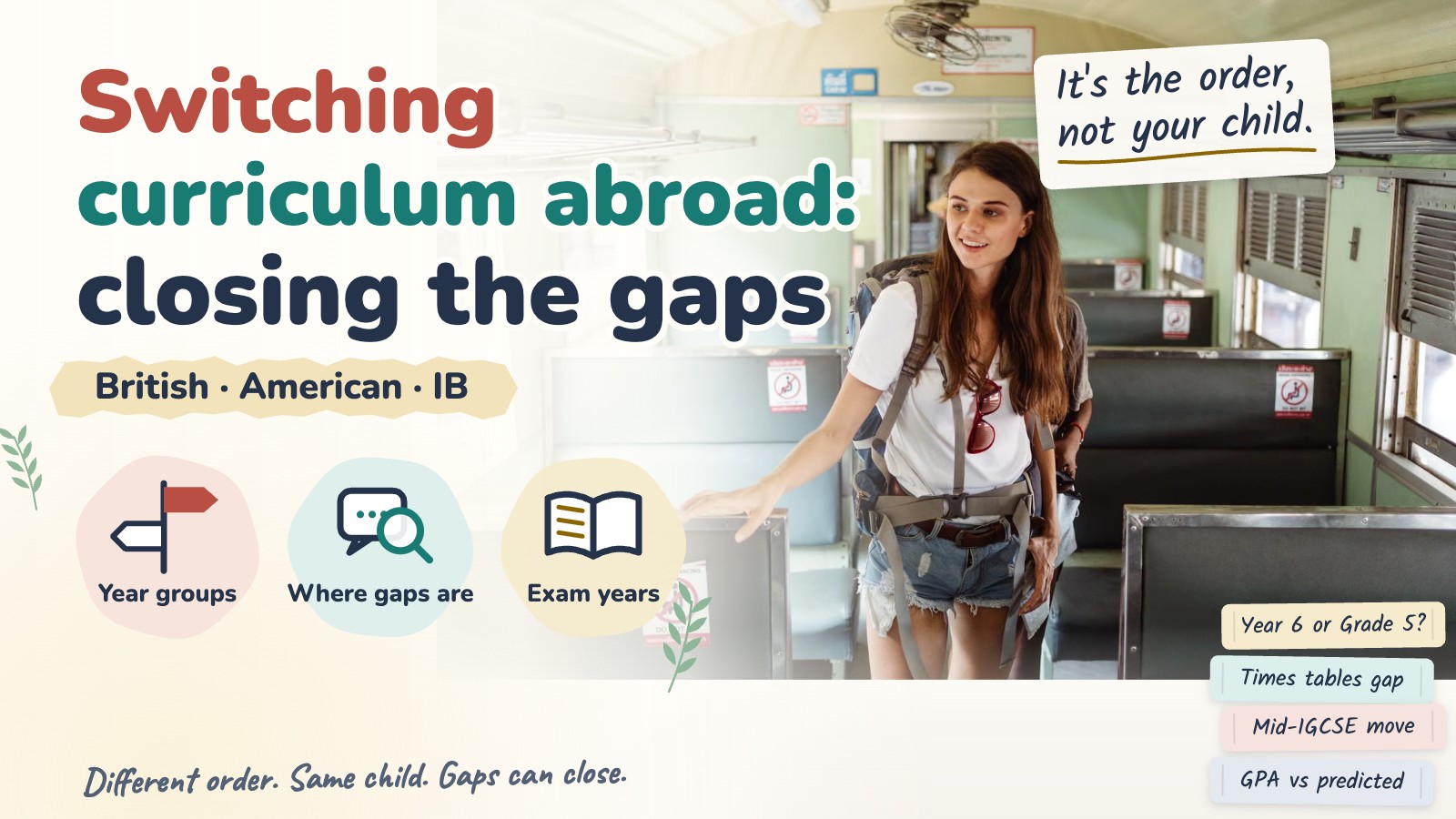
Neurodivergent children Where to get help Attendance and costs Learning Place Finder 日本語サイトへSwitching Curriculum: British, American and IB Gaps Explained
- How US grades, English year groups, IB programmes and Australian years roughly line up — and why age cut-offs catch families out
- Where gaps show up: math sequencing, phonics and handwriting, history and civics, science, second language
- What changes when grading moves from coursework and GPA to terminal exams and IGCSE, A Level or IB grades
- The exam-years trap: what Cambridge and IB rules actually say about moving mid-course
- A first-term plan: what to request from the old school, what to ask the new one, how to get a baseline
- An honest comparison of staying put, switching now, or keeping one system online
This is general information for parents, not legal or placement advice. There is no official worldwide table that converts one system’s year group into another’s. Every equivalence below is a general guide built from official age bands; schools decide placement case by case, often only after seeing your child’s reports.
What actually changes when the curriculum changes
Parents assume the hard part of a curriculum switch is content, and that new and repeated topics even out. In practice three things change at once. The first is sequence: the same material comes in a different order, so a child can be ahead in one strand and behind in another, in the same subject, on the same day. The second is the rules of the game — whether grades come from daily coursework or one set of exams. The third is confidence: a child who has always been “good at math” and suddenly cannot follow the method on the board does not conclude that the method is different.
It is rarely the content that hurts
Most families plan for content gaps. These three cause the wobble.
01
Different order
The same topics appear at different ages. Being ahead in one strand and behind in another within a subject looks like inconsistency to a new teacher.
02
Different rules
What earns a good grade changes: daily coursework in one system, one terminal exam in another. Children read the old rules into the new report card.
03
Identity wobble
Being suddenly lost in a subject you were good at is a blow to how a child sees themselves. Name this one out loud at home, early.
Moving mid-year has its own logistics and timing: see our guide to changing international schools mid-year. This article stays with the learning.
How year groups line up across systems
Here is what the official pages say. England’s national curriculum sets key stages by year group and age: Year 1 is ages 5–6, Year 6 is 10–11, Year 11 is 15–16. The IB publishes age bands, not year labels: PYP “for students aged 3 to 12”, MYP “for students aged 11 to 16”, DP “for students aged 16 to 19”. Cambridge describes Cambridge Primary as for 5–11 years and Cambridge Upper Secondary as “for 14–16 year olds”. For the United States, the National Center for Education Statistics says only that students “normally complete the entire program through grade 12 by age 18”. So the table below is a general guide built from official age bands, not a conversion table.
| Age in school year | England | US grade | IB / Australia (NSW) |
|---|---|---|---|
| 5–6 | Year 1 | Kindergarten | PYP / Kindergarten |
| 8–9 | Year 4 | Grade 3 | PYP / Year 3 |
| 10–11 | Year 6 | Grade 5 | Most PYP schools end here / Year 5 |
| 11–12 | Year 7 | Grade 6 | MYP starts / Year 6 |
| 15–16 | Year 11 | Grade 10 | MYP ends / Year 10 |
| 16–17 | Year 12 | Grade 11 | DP year 1 / Year 11 |
| 17–18 | Year 13 | Grade 12 | DP year 2 / Year 12 |
Three warnings. The US column is worked backwards from the NCES statement, and states set their own entry ages, so a child of a given age can legitimately sit in either of two grades. The Australian column uses New South Wales and is worked backwards from its Kindergarten cut-off in the same way; other states differ. England’s Years 12 and 13 are post-16 study, outside the national curriculum key stages, so they are included here only for age comparison.
The age cut-off problem
The reason two equally able children of the same age end up a year apart is the cut-off date, and every system has a different one. In England a child “must start full-time education once they reach compulsory school age”, which falls “on 31 December, 31 March or 31 August following their fifth birthday — whichever comes first”. In New South Wales children “can start kindergarten at the beginning of the school year if they turn 5 on or before 31 July” — in a school year starting in late January.
| System | Year starts | Official cut-off rule |
|---|---|---|
| England | September | Compulsory school age on 31 Dec, 31 Mar or 31 Aug after the 5th birthday |
| United States | Usually Aug–Sept | No national rule; states set entry ages. NCES says only that grade 12 is normally finished by 18 |
| NSW, Australia | Late January | Kindergarten if the child turns 5 by 31 July; compulsory by the 6th birthday |
| IB schools | Varies | IB publishes age bands only: PYP 3–12, MYP 11–16, DP 16–19 |
| Cambridge schools | Varies | Cambridge Primary 5–11; Cambridge Upper Secondary 14–16 |
Moving from a September-start system to a January-start one can leave a child repeating or skipping half a year, depending on birth month. Ask the new school in writing which year group they propose and why, and whether it is reviewed after a term. Note too that in England “academies and private schools do not have to follow the national curriculum” — so even two English-curriculum schools may not teach the same thing in the same year.
Where the content gaps usually appear
Gaps cluster in a few predictable places. Knowing them lets you ask targeted questions instead of worrying about everything at once.
Math sequencing and notation
This is the most common source of a sudden dip, and official documents show why. In England the multiplication tables check “became statutory in 2022”, is taken “at the end of year 4, when most pupils are age 9”, and expects pupils to have “memorised their multiplication tables up to and including the 12 multiplication table”. The US Common Core standard for Grade 3 says: “Fluently multiply and divide within 100 … By the end of Grade 3, know from memory all products of two one-digit numbers.” Two official expectations, a year apart, with a different ceiling. Neither child is behind in absolute terms; each looks behind in the other system for a while.
Notation is the quieter half: layouts for division, ways of recording subtraction, even decimal separators differ. Ask the new school which written methods they expect, and for a sample of marked work so your child sees the layout before being graded on it.
Phonics, spelling and handwriting
England runs a statutory phonics screening check “designed to confirm whether pupils have learned phonic decoding to an age-appropriate standard”, comprising “20 real words and 20 pseudo-words that pupils read aloud”. Most take it in Year 1, and those below the expected standard must be considered for a retake. A child arriving from a system that taught reading differently can be assessed on decoding they were never explicitly taught — which says nothing about whether they can read.
Handwriting is a documented difference. England’s national curriculum expects Year 2 pupils to “start using some of the diagonal and horizontal strokes needed to join letters”, and Years 3–4 to “use the diagonal and horizontal strokes that are needed to join letters”. A child who has only ever printed needs teaching, not correction. Spelling convention is a house-style decision; ask which one is marked, and tell your child, because most assume they are simply getting it wrong.
History, civics, science and the second language
History and civics are the most nationally specific subjects there are, and we could find no cross-system mapping for them at all. Expect whole topics to be repeated or missed. Ask the new school which units this class has already covered this year.
Science is the middle-years surprise, because systems differ on when integrated science splits into separate biology, chemistry and physics. Ask when that split happens, and whether your child has done the practical work the class is building on.
Second language is the one people forget. The MYP “organizes teaching and learning through eight subject groups”, one of which is language acquisition; the DP’s six groups include both “studies in language and literature” and “language acquisition”. A child arriving into the MYP or DP from a system where a second language was optional may be starting from scratch in a subject classmates have studied for years. If your child is also learning in a new language, see our guide on a child at a local school who doesn’t speak the language.

Grading and reports: the rules of the game change
A curriculum switch usually comes with a grading switch, and that causes more family arguments than content ever does. A child used to a grade point average built from homework and quizzes lands in a system where most of the grade arrives at the end, from externally marked papers — or the reverse, and finds three missed homework tasks in September have dented a running average for good.
| System | How the grade is built | What to watch |
|---|---|---|
| US high school | Letter grades and a running GPA from coursework across the year | Early terms count permanently; a settling-in dip is hard to undo |
| Cambridge IGCSE | A*–G or 9–1, depending on the syllabus the school enters | Cambridge says universities “will treat students with 9–1 grades and students with A*–G grades equally” |
| IB Diploma | “A mark from 1 (lowest) to 7 (highest) for each subject taken”, plus the core | For the full diploma the “minimum passing score is 24 points” |
| IB assessment mix | External written exams plus “internal assessment which is facilitated by DP students’ own teachers” | Internal assessment follows the course, so a mid-course move hits work already underway |
One term deserves explaining, because families often meet it mid-application. A predicted grade in the IB is “the teacher’s prediction of the grade the candidate is expected to achieve in the subject, based on all the evidence of the candidate’s work and the teacher’s knowledge of IB standards.” A teacher who has known your child six weeks has less evidence than one who has taught them eighteen months. That is arithmetic, not unfairness — but if you are moving in the year before applications, ask how and when predictions are made.
The exam-years trap
If you take one thing from this article: a move in the middle of an IGCSE, A Level or IB Diploma course is a different category of decision from a move at any other time. Subject choices may not carry over, and completed work may not travel with your child.
| If you move during… | What the official rules say |
|---|---|
| Cambridge IGCSE | Carry forward rules: candidates “can only carry forward marks from the same syllabus with the matching syllabus code”; IGCSE marks “can only be carried forward once”; and “all marks must be carried forward within 13 months” |
| Cambridge AS to A Level | “Marks for Cambridge International AS Level can only be carried forward twice” — so the staged route depends on the new school entering the same syllabus |
| IB Diploma Programme | General regulations, Article 3.2: “students must complete all requirements within the two-year period of the programme” |
| A DP subject the new school lacks | Article 10.3: “A school may accept an external student from another IB World School … if the school the student normally attends does not offer a particular IB subject” |
In plain terms: schools choose which syllabuses and options they offer, and the new school may not teach the history option, math route or language your child has spent a year on. That is timetabling, not obstruction — but it makes one question the first you should ask: can you take my child in exactly these subjects, at these levels, with the same syllabus codes or IB subject choices? Get it in writing, from the examinations officer or DP coordinator.
Options exist, but all cost something: sitting an exam at a different center, dropping a subject for one the new school offers, or repeating a year. Some families keep the child in the original system online until the exam series is over, then move. Ask each school to spell out the consequence for the exam timetable, not just for enrollment.
A practical plan, and how long to allow
You cannot prevent a curriculum gap. You can find it quickly, name it, and close it deliberately — in that order — instead of meeting it in a report card in March.
Baseline first, then plan, then review
The mistake is to start tutoring before anyone knows what the gap actually is.
01
Get the records
Before you leave, request full reports, any test scores, the topic list for the year so far, and — for exam years — syllabus codes and coursework already completed.
02
Ask for a baseline
Ask the new school to assess reading, math and writing in the first few weeks and say specifically where your child sits — not just “settling in well”.
03
Review on a date
Agree a written review point in the calendar, so progress is checked on a date rather than when somebody finally gets worried.
If nobody has given you specifics by the review date, that is the thing to raise, rather than your child’s effort.
| Ask the old school for… | Ask the new school… |
|---|---|
| Full written reports and any test data | Which year group, and on what basis? |
| The topic list covered so far this year | Will you do a baseline assessment, and when? |
| Exam syllabus codes and option choices | Can you offer the same subjects and syllabuses? |
| Coursework and internal assessment completed | Who catches my child up, and in which lessons? |
| Any learning support plan in place | When will we review the placement in writing? |
How long should it take? We could not find an official figure for how long children take to catch up after a curriculum change, and we would be cautious of anyone who quotes one. Expect the shape of the problem to be visible within a term, and judge direction rather than position: is the gap narrowing, can your child start homework unaided, has the dread gone out of Sunday evenings? If none of those is moving by the second term, ask to meet the learning support lead.

Supporting learning at home without over-tutoring
The instinct after a system change is to buy workbooks for everything. It rarely helps, and it can turn a temporary gap into a permanent belief that the child is slow. Go narrow and time-limited: one or two named gaps, a fixed number of weeks, then stop.
| Instead of… | Try… |
|---|---|
| Tutoring every subject at once | One or two gaps the school has named |
| “You’re behind, we need to catch up” | “They taught this in a different order — we’ll fill in the missing bit” |
| Correcting handwriting and spelling constantly | Agreeing one convention with the school, practiced briefly and daily |
| Open-ended extra study every evening | A short fixed slot with an end date |
Protect what your child is still good at, too. A sport, an instrument or a club does more for a child’s willingness to struggle through a hard term than any workbook. If the new placement leaves your child under-stretched rather than behind, see our guide on a gifted child who is bored at an international school; if the move brought a wider loss of footing, school anxiety in third culture kids.
University admissions: questions worth asking early
Families think about universities last, but decisions made in the first month can close doors two years later. Ask the receiving school three things: what qualification will my child leave with — a diploma and GPA, IGCSEs and A Levels, an IB Diploma, a national certificate? Does it meet entry requirements where we are likely to apply? And who writes the reference and predicted grades, on what evidence?
Where a child ends up with grades from two scales — some IGCSEs on A*–G, some on 9–1 — Cambridge states that “universities have made it very clear that they will treat students with 9–1 grades and students with A*–G grades equally”, and notes “three anchor points where standards are benchmarked between the two systems”. A mixed transcript is not automatically a problem; an unexplained one is. Ask for a short covering note about the move, and keep the old reports.

Stay, switch, or keep one system online?
Sometimes there is no choice: the posting moves, and the only school with a place teaches a different curriculum. Where there is a choice, lay the three routes side by side — including keeping one system that travels with the family.
Stay, switch, or keep one system
| Stay in same system | Switch systems now | Online, one system | |
|---|---|---|---|
| No curriculum catch-up | ○ | × full reset | ○ |
| Fits the host country | △ if available | ○ | △ time zones |
| Works if you move again | × | × | ○ portable |
| Keeps exam courses intact | ○ | × options differ | △ intake dates |
| Campus life, local friends | ○ | ○ | × |
○ = generally yes △ = depends × = generally no / General tendencies, not a judgment on any particular school. As of September 2026.
An online school is not a way of avoiding a curriculum decision — it is a way of making one and keeping it. The trade is visible in the last row: no campus, no playground, no friends made at the school gate. Friendships have to come from somewhere else — our guide on helping a child make friends after moving abroad is about exactly that.
One online option: NIJIN GLOBAL ACADEMY
NIJIN GLOBAL ACADEMY (NGA) is an online international school for ages 6–18, run by NIJIN, the company behind this site — so read this as disclosure rather than recommendation, and read the limitations as carefully as the features. We include it because one portable system is a possible answer to the problem described here.
| What NGA says it offers | Why that matters to a family changing systems |
|---|---|
| Optional Cambridge IGCSE and A-Level | A recognized route that does not restart if the family relocates |
| Described as “portable”: learning continues if the family moves | The curriculum is not tied to where you happen to live |
| Timetables for Asia and Oceania time zones | Good fit inside that region; less convenient elsewhere |
| Classes of eight, same group daily, daily morning circle | A gap is likelier to be spotted early in a group that size |
| Bilingual English and Japanese mentors stay with each group | A named adult who sees the child across subjects |
| No entrance exam, no English requirement, no rankings | No need to “prove” readiness after a disrupted year |
NGA opens in September 2027, so it is not an answer for a gap this term. Tuition has not been published; NGA describes it as far more affordable than a typical international school and says exact fees will be shared first with its email community. Timetables are built for Asia and Oceania time zones, which will not suit every family. There is no physical campus, and NGA does not issue a Japanese high-school diploma. Its FAQ says mentor hiring criteria, absence policies and enrollment and withdrawal policies — including mid-year joining — are still being prepared, so we cannot say how a mid-course transfer would be handled. Figures such as “1,000+ students” or a 97% attendance-recognition rate belong to its sister school, NIJIN Academy.
NIJIN GLOBAL ACADEMY is an online international school for ages 6–18 with classes of eight, bilingual mentors, and optional Cambridge IGCSE and A-Level. It opens in September 2027, and free trial classes are planned monthly from September 2026.
Frequently asked questions
Sources used for this article
- GOV.UK, “School admissions: school starting age” (checked September 2026): gov.uk
- GOV.UK, “The national curriculum: key stages” (checked September 2026): gov.uk
- GOV.UK / Standards and Testing Agency, “Phonics screening check assessment and reporting arrangements” (statutory guidance): gov.uk
- Explore Education Statistics (Department for Education), “Multiplication tables check attainment: methodology”: explore-education-statistics.service.gov.uk
- GOV.UK, “National curriculum in England: English programmes of study” (2013, key stages 1 and 2, handwriting): gov.uk
- Common Core State Standards Initiative, “Grade 3 » Operations & Algebraic Thinking » 3.OA.C.7”: thecorestandards.org
- National Center for Education Statistics (US Department of Education), “The Structure of American Education”, Mini-Digest of Education Statistics: nces.ed.gov
- International Baccalaureate, “Programmes” (PYP, MYP, DP, CP age ranges): ibo.org
- International Baccalaureate, “MYP curriculum” (eight subject groups) and “DP curriculum” (core and six subject groups): MYP / DP
- International Baccalaureate, “IB student assessment” (grades 1–7, minimum passing score 24, predicted grades): ibo.org
- International Baccalaureate, General regulations: Diploma Programme (2026), Articles 3.2 and 10.3: ibo.org (PDF)
- Cambridge International, “Cambridge Primary” (5–11 years) and “Cambridge Upper Secondary” (14–16 year olds): Primary / Upper Secondary
- Cambridge International, “Carry forward entry rules” (Cambridge Exams Officers’ Guide): cambridgeinternational.org (PDF)
- Cambridge International, Cambridge IGCSE: A guide to A*–G and 9–1 grades: cambridgeinternational.org (PDF)
- NSW Department of Education, “Primary school enrollment” (Kindergarten age and compulsory schooling): education.nsw.gov.au
- NIJIN GLOBAL ACADEMY, official English site and FAQ (checked September 2026): nijinglobal.academy

NIJIN GLOBAL ACADEMY is designed to be portable: small online classes for ages 6–18 across Asia and Oceania, with optional Cambridge IGCSE and A-Level. Tuition has not been announced yet, the school opens in September 2027, and free trial classes are planned monthly from September 2026.
Published: 23 September 2026 / Last updated: 23 September 2026