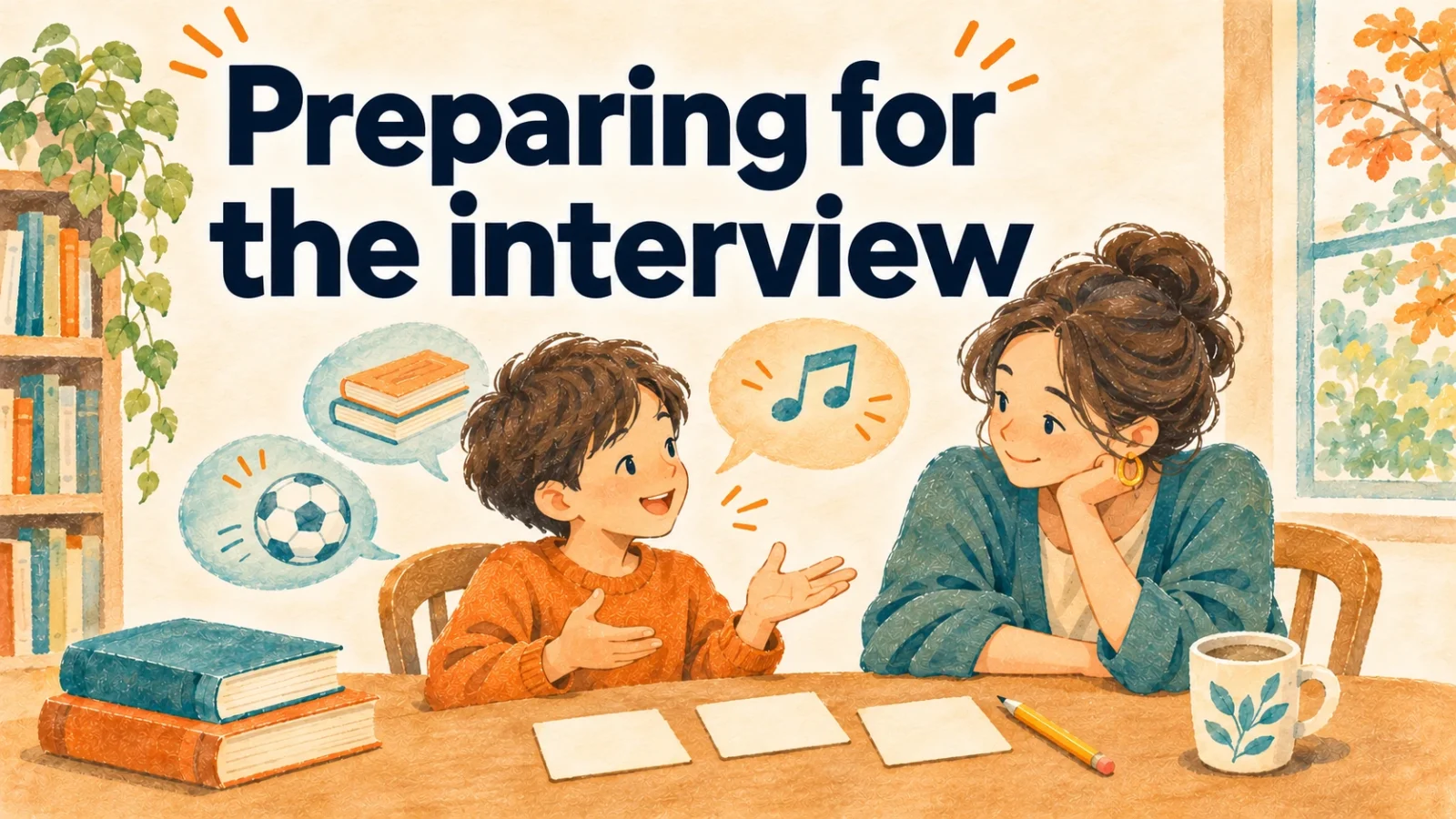
At international school admission interviews, schools may combine questions for parents, a conversation with the child, academic assessment and observation, depending on the school. Not every school asks the same questions, and memorising model answers does not guarantee a place. This guide shows how parents and children can sort out what they want the school to know and go into the day calmly.
Disclosure: Nijiiro is operated by NIJIN, Inc. NIJIN GLOBAL ACADEMY (NGA), which appears in this article, is also a NIJIN, Inc. service, and the sections about it are PR. We describe campus schools that use interviews or written tests separately from NGA, a planned online school that describes a trial conversation and trial class instead, so that the differences are clear.
Jump to the 10 FAQs | Jump to the editable worksheets
Key points
- Interview questions and assessment methods differ by age, grade, school and the places available.
- Children can describe everyday experiences; parents can explain fit with the school and the support needed, using concrete examples.
- Check whether there is an interview, who attends, the language and any fees in the official admissions information of each school you apply to.
Interviews check fit between family and school, not "correct" answers
An international school interview is a chance for the school to learn about your child’s learning experience and support needs, and about what your family expects from the school. What interviewers ask is not standardised. Some schools use the interview as one part of admissions selection; others vary interviews and assessments according to the grade or the documents submitted.
Official school information shows the range. Hokkaido International School says it interviews all incoming students with at least one parent or guardian, in person or via Google Meet. For transfer admission, LCA International Elementary School combines a basic written test for the child with a parent interview that checks the family’s educational approach. Nagoya International School says the assessment stage may include interviews and tests depending on the student’s age and educational background. There is no common list of questions that every school is certain to ask.
The purpose of preparing is not to build answers the school seems to want. It is to explain, with concrete examples, when your child becomes motivated, what support helps them learn, and what your family wants to discuss with the school. For an overview of eligibility, grades and English requirements, see Nijiiro’s article on international school admission requirements (in Japanese).
| Example question theme | Material to prepare | How you might answer |
|---|---|---|
| Why are you considering this school? | What you saw on a visit; interest in the curriculum or lessons | Go beyond "my child will pick up English" and say which activities you felt would suit your child. |
| What is your child interested in? | Something they enjoyed recently; play or learning they spent time on | Give one specific scene and say what your child was thinking about. |
| How does your child ask for help when stuck? | How they got through a difficult situation in the past | Separate what they can already do from what they still need adult support with. |
| What support do you hope the school will give? | Anything you need to share about language, learning, daily life or health | Rather than only a diagnosis or label, describe the difficulties your child tends to have and the responses that help. |
These themes are for preparation only; they do not predict the actual questions at any school. An official Nagoya International School (NIS) blog post gives "Why did you become interested in NIS?" as the first question an admissions staff member asks families visiting the school, but it was published in 2022 and concerns school visits. It is not a guarantee of current admissions questions, so check the latest guidance from the schools you apply to.
Schools and options whose interview formats can be checked in official information
We chose examples whose official admissions information states at least one of the following: who takes part in interviews or assessments, the format, or the fee, so that parents can check before applying. They are listed from Hokkaido southwards to show differences in region and grade, with the online option last. The order is not a ranking or recommendation. School types and admission conditions differ, so listing them together does not mean they share the same entry requirements or education system.
Each card uses the same headings: grades served, location and type, interview and assessment, participants and language, published fees, and timing and where to apply. Information that is not published is marked "ask the school". Grade and level names are given as each school uses them; Japanese school grades, US grades and UK Years are not converted here. The Japanese article checked these pages on 25 October 2026; for this English version we re-opened them on 15 November 2026 and updated wording where the pages had changed.
Hokkaido International School (HIS)
- Grades
- Early Years (EY3, EY4), Elementary School (K–5), Middle School (6–8) and High School (9–12), as named by the school.
- Location and type
- International school in Sapporo, Hokkaido.
- Interview and assessment
- Interviews are conducted for all incoming students. Before offering a place, the school may request more documents, an English proficiency test or MAP entrance tests.
- Participants and format
- The child and at least one parent or guardian. In person or via Google Meet. Interview language: not stated; ask the school.
- Fee
- One-time, non-refundable application fee of ¥30,000.
- Timing and where to apply
- Applications are accepted year round, but the page says 2026–2027 applications are being added to a waitlist. Check the latest status on the official HIS Admissions page.
LCA International Elementary School
- Grades
- Elementary school. Transfer admission is offered for Japanese elementary school grades 1 to 5, only where the relevant grade has a vacancy.
- Location and type
- International elementary school in Midori-ku, Sagamihara, Kanagawa Prefecture.
- Interview and assessment
- For transfers: a basic written test for the child in Japanese language, mathematics and English, plus a parent interview that checks the family’s educational approach.
- Participants and format
- Parent interview of about 30 minutes, conducted in Japanese. The child takes the basic test separately. Check conditions for general entry and transfers by admission category.
- Fee
- Transfer examination fee of ¥30,000.
- Timing and where to apply
- Transfers are accepted at any time of year; ask the school first whether there is a vacancy. Official transfer admission page (in Japanese).
Nagoya International School (NIS)
- Grades
- Preschool through Grade 12, with separate application forms for ELC Preschool & Kindergarten and for Grades 1–12.
- Location and type
- International school in Moriyama-ku, Nagoya, Aichi Prefecture.
- Interview and assessment
- Depending on age, educational background and previous schooling, the stage may include an admissions interview with the student and parents, classroom observation (ELC applicants), an English language assessment, and placement or entrance testing where appropriate. The Admissions FAQ says conditional acceptance can, on certain occasions, be granted without an interview.
- Participants and format
- The student and parents. The interview is scheduled at a mutually convenient time after all documents are submitted. Language and method: not stated; ask the school.
- Fee
- Non-refundable application fee of ¥50,000 per applicant.
- Timing and where to apply
- The Admissions FAQ says applications are accepted at all times of the year. It asks for a minimum of two weeks between the school receiving the application and the interview, and says applications typically take 4–6 weeks to process if testing or assessments are needed. Official Applying to NIS page and Admissions page.
Horizon Japan International School (HJIS)
- Grades
- Early Learning, Elementary School, Middle School and High School, as named by the school.
- Location and type
- International school in Yokohama, Kanagawa Prefecture.
- Interview and assessment
- The Eligibility page says all students go through a level test (except Early Years Programme students) and an individual interview, and that parents sit an enrolment interview. The separate Admissions Steps page says the student may be invited for an interview and placement assessment, and its FAQ says this depends on the child’s age.
- Participants and format
- The child and parents. Ask the admissions team about dates, method and language.
- Fee
- The Admissions Steps page mentions paying an application fee, but no amount is shown on the public pages we checked; ask the school.
- Timing and where to apply
- Rolling admissions depending on availability in each grade level. Official Eligibility & Grade Placement page and Admissions Steps page.
PR | NIJIN GLOBAL ACADEMY (NGA)
- Ages
- 6–18. A planned online international school run by NIJIN, Inc., the operator of Nijiiro. Official pages say it is scheduled to open in September 2027; it is not yet operating.
- Location and type
- Online, with no campus to attend. It cannot be compared directly with in-person school interviews.
- Interview and assessment
- The terms of service (last updated 1 September 2026) say there is no entrance exam and that enrolment is accepted monthly after a trial conversation and trial class. The English admissions page lists the planned steps as opening-updates signup, an online information session and conversation, a free trial class, then enrolment. This does not guarantee admission or an available place.
- Participants and format
- Online. Official pages describe bilingual mentors who support students in Japanese while they learn English, and say there is no English requirement; this does not mean all instruction is in English. Who takes part, how long sessions last and which language is used: confirm with NGA.
- Fees
- Official pages say trial classes are free and that there are no hidden costs such as enrolment, facility or uniform fees. Tuition has not yet been published.
- Timing and where to apply
- Official pages describe free trial classes monthly from September 2026. On the pages we read, we could not confirm that a trial class can currently be booked, and no student application form or window was open. Check the official admissions page or contact page.
Children talk about experiences; parents talk about support and family views
In a parent–child interview, the child and the parents will not necessarily be asked the same questions. Find out in advance whether a parent may add to a short answer from the child, whether there is separate time with each, and whether interpreting or Japanese-language support is available. Do not assume the school only rewards fluent answers; check the assessment method the school describes.
What the child can prepare
- Explain one thing they like: choose something your child can picture clearly, such as recent play, something they made, something they read or a project they worked on.
- Look back on a difficult moment: in their own words, sort out what was hard, who they asked for help and how, and what they would do now.
- Think of something to ask the school: one question about teachers, friends, lessons or break time.
- Do not force memorisation: rather than memorising whole answers, talk through the main points as a family, and tell your child it is fine to rephrase.
What parents can prepare
- Explain your reasons in your family’s own words: based on visits and official materials, say which policies, lessons or support caught your interest.
- Share your child’s current situation concretely: as far as needed, describe strengths, situations they find hard and support that has helped before.
- Sort out the support you want to confirm after admission: for English, learning, health and relationships, separate what you want to discuss with the school from what you can do at home.
- Turn unclear points into questions: check the scope of language support, what happens with absences, costs and how the school communicates.
Prepare separately for questions, tests and observation
Even when a school calls it an "interview", it may in practice include several selection methods: a parent meeting, an individual conversation with the child, an English assessment, a written test, or observation during a class. Check the school’s own terms and separate what each part requires you to prepare.
| Format | What to confirm | How to prepare |
|---|---|---|
| Parent interview | Who attends, length, language, topics, whether interpreting is possible. | Organise your reasons, your family’s educational approach, and your child’s strengths and support needs with concrete examples. |
| Child’s individual interview or conversation | Ages covered, format, whether a parent sits in, whether it can be online. | Your child talks in their own words about what they like, what they want to try at school and how they ask for help. |
| Written, language or placement assessment | Subjects, duration, what to bring, how results are used, any extra fee. | Check only the scope the school describes; do not prepare by guessing past papers or questions. |
| Observation or trial lesson | Whether the child takes part, the activity, where parents wait, how it relates to selection. | Confirm what to bring, what to wear and timing. Do not ask your child to perform; adjust the load on the day. |
HIS says it may request additional documents, an English proficiency test or MAP entrance tests before offering a place. LCA describes a test for the child and a parent interview for transfers, and NIS describes interviews and assessments that depend on age and educational background. These examples are not a shared exam standard. Give priority to the items each school tells you about.
Questions to ask the school before the interview
If the admissions guidance does not answer something, feel free to ask the admissions office. Sending your questions by email in advance makes it easier to use the interview itself to talk about your child and school life.
- Who attends the interview: the child, both parents, or one parent or guardian?
- Are the parent interview and the child’s interview held together or separately?
- What language is the interview in, and is interpreting, Japanese-language support or an online option available?
- Apart from the interview, is there a written test, English assessment, trial lesson or observation?
- What are the interview length, arrival time, dress, items to bring and the place where parents wait?
- If my child is unwell or very anxious, can we discuss a break, another date or switching to online?
- Will the adjustments and learning information we share at the interview be passed on to the staff who provide support after admission?
Rather than disclosing diagnoses or family details beyond what is needed, explain concretely the adjustments your child needs to take part in the interview and the support needed to keep learning. A school may not be able to change its interview format, so plan around the school’s answer.
After the interview, record what you heard and the next steps
Straight after an interview, the family’s impressions easily get mixed up with confirmed information from the school. Recording facts, impressions and items still to be confirmed separately, as in the table below, helps you keep preparing while you wait for the result.
| Record | Examples | Next check |
|---|---|---|
| Facts from the school | Date results will be sent, additional documents, assessment method, who handles support after admission. | Check the contact person’s name, contact method and deadlines against emails and the admissions guidance. |
| Your child’s impressions | Moments they felt at ease, questions they found hard, places they wanted to see. | Listen calmly and note the reasons your child gives. |
| Parents’ impressions | Explanations in response to questions were specific; the commute was longer than expected. | Decide whether you need documents or another meeting to back up the impression. |
| Not yet confirmed | Total cost, how often support is provided, conditions for joining mid-year. | Ask by email and keep the reply and its date. |
Acceptance and admission decisions follow each school’s selection process. If questions remain after the interview, contact the admissions office before the formal deadline. Admission requirements and the school system are separate issues, so check a school’s legal status with your local board of education where needed.
10 Frequently Asked Questions
These answers are general; each school’s official admissions guidance takes priority.
What do international school admission interviews ask about?
Questions vary by school, grade and the purpose of the interview. You can prepare topics such as your child’s interests and experiences, why you chose the school and the support your family needs, but not every school asks the same questions. Check the official guidance from each school you apply to.
Should my child memorise answers for the interview?
There is no need for your child to memorise whole answers. Talk at home about things they enjoy and times they found something hard, so they can explain naturally in their own way. If the school has described its interview method or what it assesses, follow that guidance.
Do both parents need to attend a parent–child interview?
It depends on the school. Some schools ask for the child and at least one parent or guardian; others tell each family who should attend. When booking, confirm who should attend, whether there is time with the child alone and the conditions for joining online.
Will the interview be in English?
The language depends on the school, the grade and the type of interview. Ask the admissions team whether it will be in English or Japanese, whether interpreting or a parent’s presence is possible, and which language the documents are in.
Are there written tests or English tests as well as the interview?
Some schools add written tests, English assessments, grade placement tests or classroom observation to the interview. Check the grades covered, subjects, duration, fees and how results are used in the official admissions guidance.
Should we mention school non-attendance or learning delays at the interview?
Share accurately, within what the school asks, the information needed to plan your child’s learning and support after admission. Rather than giving only a diagnosis, describe the situations your child tends to find hard, the adjustments that have helped and the support you would like.
Can we talk to the school in advance if we worry our child will not stay calm during the interview?
First ask the school what can be discussed, such as length, breaks, who attends, an online interview or a separate room. Requests are not always granted, so plan your child’s preparation around the school’s answer.
Does attending an interview mean my child will be admitted?
An interview is one part of selection, and attending does not by itself decide acceptance or admission. Schools decide together with other conditions they set, such as available places, documents, English or academic assessments and grade placement.
How much does an interview cost?
Interview and application fees differ by school. Some schools charge a selection or application fee that covers the application or written tests rather than the interview alone. Check the latest admissions guidance, including refund conditions.
What should I do if I get stuck answering a question as a parent?
You do not need to invent an answer when you are unsure; it is fine to say you will check and get back to the school. When describing your child’s situation, separating the facts, what you do at home and what you want to discuss with the school makes the conversation easier to continue.
Next steps
- List the schools you are considering and open each one’s current official admissions page. Treat each school’s published guidance, not this article, as the final word on interviews, tests and fees.
- Email the admissions office the questions from the section above that the guidance does not answer, and save the replies with their dates.
- Fill in the basic worksheet below with your child, then the parent part on your own.
- After the interview, use the optional worksheet to separate facts, impressions and open questions.
Editable preparation worksheets
Click inside a worksheet to type. Use Copy to paste your notes elsewhere or Print to keep a paper copy. Nothing you type is sent to Nijiiro.
Basic worksheet: before the interview
Child
One thing I like or worked on recently, and one moment I remember:
A time something was hard, who I asked for help, and what I would do now:
One thing I want to ask the school (teachers, friends, lessons, break time):
Parent
Why we are considering this school (what we saw or read):
My child’s strengths, situations they find hard, and support that has helped:
Support we want to discuss with the school / what we can do at home:
Who attends, language, format, tests or observation (confirmed by the school on):
Optional worksheet: after the interview
School and date of interview:
Facts from the school (result date, extra documents, assessment, contact person, deadlines):
My child’s impressions and the reasons they gave:
Parents’ impressions, and whether we need documents or another meeting:
Not yet confirmed (total cost, frequency of support, mid-year entry):
Questions emailed on / reply received on:
References
The information in the Japanese article was checked on 25 October 2026; the article’s later modification date (12 November 2026) is not a fact-check date. This English translation was prepared on 15 November 2026. On that date we reopened the school admissions pages, the NGA pages and the municipal compulsory-education guidance listed below; references marked "original reference" are carried over from the Japanese article with their original dates and were not re-verified for this translation.
Rules and admissions details can change, so always check the latest guidance when you apply.
- Hokkaido International School, "Admissions" (grades, interviews, additional assessment, application fee, waitlist; checked 15 November 2026)
- LCA International Elementary School, transfer admission page (in Japanese) (grades, child’s test, parent interview, examination fee; checked 15 November 2026)
- Nagoya International School, "Applying to NIS" (application fee, interviews and assessment; checked 15 November 2026)
- Nagoya International School, "Admissions" (interview scheduling, minimum two weeks before interview, processing time and application FAQs; checked 15 November 2026)
- Nagoya International School blog, questions often asked on school visits (in Japanese) (an admissions staff example published in 2022; original reference, checked 25 October 2026)
- Horizon Japan International School, "Eligibility & Grade Placement" (levels, interviews, assessment; checked 15 November 2026)
- Horizon Japan International School, "Admissions Steps" (interview and placement assessment, rolling admissions; checked 15 November 2026)
- MEXT, compulsory schooling when school-age children attend so-called international schools (in Japanese) (Japan only; original reference, checked 25 October 2026)
- Yokohama City Board of Education, enrolment at international schools and similar schools (in Japanese) (Japan only; Japanese-only and dual nationals, contact; checked 15 November 2026)
- City of Hiroshima, "Elementary Schools/Junior High Schools for International Residents" (Japan only; foreign-national children, fees, where to apply; checked 15 November 2026)
- NIJIN GLOBAL ACADEMY official site (ages, planned opening, free trial classes, language support; checked 15 November 2026) – PR
- NIJIN GLOBAL ACADEMY, "Tuition and Admissions" (planned admissions steps, fees status; checked 15 November 2026) – PR
- NIJIN GLOBAL ACADEMY terms of service (trial conversation and trial class, enrolment procedure; checked 15 November 2026) – PR
Information dates: Japanese article, 25 October 2026; targeted checks for this English version, 15 November 2026.
PR and operator disclosure: Nijiiro is operated by NIJIN, Inc., which also operates NIJIN GLOBAL ACADEMY (NGA). The NGA card and the two NGA boxes in this article are PR. NGA is a pre-opening school; signing up for opening updates is not an application and does not reserve a place.
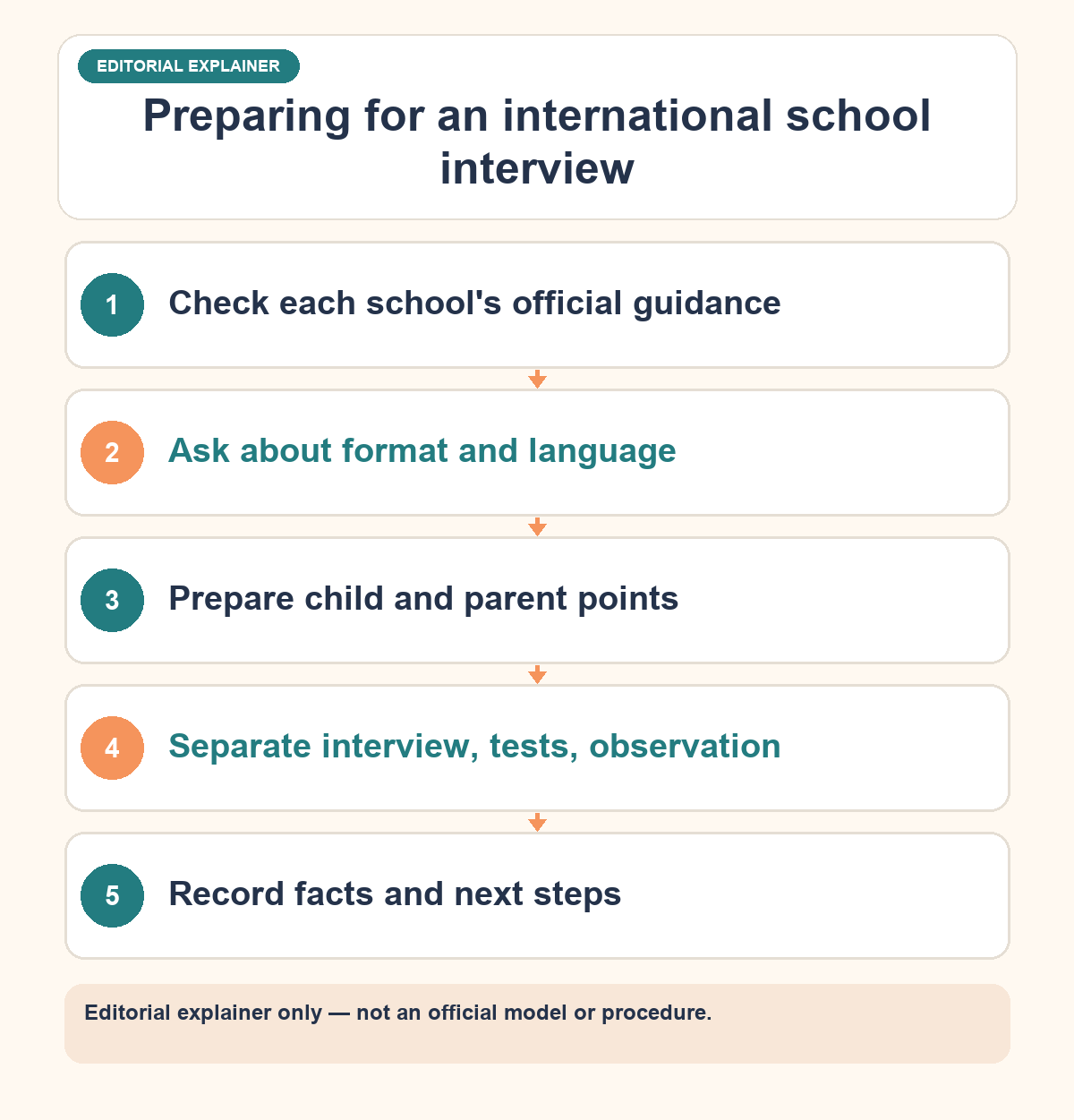
Featured image: an AI-generated illustration. The body image is an editorial diagram. Neither is a photograph of a real school or activity.