Moving from a Japanese middle or high school into an international high-school programme is not a simple grade conversion. A vacancy, admission eligibility, language readiness, transfer credit, a school’s graduation credential and university entrance eligibility are separate questions. This guide translates the Japanese article last modified on October 31, 2026, whose school information was checked on October 29, 2026. Points that were checked again on official pages for this English version on November 20, 2026 are labelled as such.
Use the family checklist and editable inquiry email below to record what each school confirms. The checklist is an unofficial planning aid, not an application form or a school’s decision.
Go to the comparison checklist · Go to the 10 questions
Key points
- Ask which year group can accept an application for your intended start date.
- Get a written credit review, remaining graduation requirements and expected completion date.
- Check the exact credential and target university’s entry rules separately.
- Treat fees as year-specific and request a current written estimate.
Separate the questions before applying
Admission, placement, graduation and university eligibility are separate decisions; confirm each with the organisation responsible for it.
A school may list Grade 9–12 or Year 10–13, but that does not mean it has a vacancy in every year group or accepts students at every point in the school year. The admissions team decides whether an applicant meets current entry rules and whether a place is available. The academic office may separately decide how earlier courses count toward the school’s graduation rules. A university or admissions authority decides whether the resulting credential meets an application route. One “yes” does not answer all three questions.
Write down four separate outcomes before comparing options: the year group the school may offer; the courses and credits it will accept; the credential it expects to issue after completion; and whether that credential fits a university route you may use. A school can accept an applicant while recognising only some previous coursework. A course can also be described as a high-school programme without guaranteeing that every student completes it or meets a university’s subject and grade requirements.
| Question | Who can answer it | What to request |
|---|---|---|
| Can the student apply for this start date and year group? | Destination school admissions office | Eligibility, vacancy, deadline, assessment and placement basis |
| Which earlier courses count? | School academic office or programme coordinator | Accepted credit, unmet requirements, course sequence and projected completion |
| What credential will be issued? | Destination school | Exact award name, issuing body and completion conditions |
| Can it be used for a particular application? | Target university and relevant admissions authority | Current eligibility route, subjects, grades and documents |
Keep the school’s graduation rule separate from Japanese university entrance-eligibility routes. A school may offer an international curriculum, but the award depends on completed courses, examination results and other conditions. A university may set competitive selection requirements above minimum entrance eligibility.
“International school” is not one academic or legal category. Schools can follow different curricula, hold different authorisations and issue different awards. Do not infer recognition from a school name, the language of instruction or the fact that other graduates entered university. Ask about the particular course and credential, then ask the target university about that award.
Do not convert Japanese grades to Grade or Year numbers mechanically
Japanese school years, US-style Grades and UK-style Years have a general age correspondence, but cut-off dates, entry months, school history, grades and vacancies differ by school. According to the Japanese article (information as of October 29, 2026), BST places students mainly by age on August 31. YIS’s current FAQ, checked on November 20, 2026, says placement is primarily based on age as of September 1 in the academic year of entry. ASIJ’s current guidelines say applicants from calendar-year schools apply for the grade they are currently attending for August entry, and for the grade they have just completed for January entry. Do not decide from a chart that, for example, Japanese high-school Year 1 equals Grade 10. Give the school the student’s date of birth, current year, reports and intended start month, and ask which year group it would consider.
At schools that start in August or September, a Japanese student who finishes a school year in March may face a gap of several months. Work backwards from the application deadline, English assessment, the date reports can be issued, the last day at the current school and the date tuition starts, and discuss the timing with both schools. Ask when placement can be confirmed, when the timetable becomes final, when records are due and when fees become payable. If one answer arrives after another deadline, that sequence can affect whether the proposed route works.
If the move involves a school transfer within Japan or later study at a Japanese school, also check with the current school and the local municipality or board of education. For a school-age child, procedures can depend on the child’s nationality and circumstances; a foreign curriculum alone does not answer them. This article is not case-specific legal guidance. If a change of school is causing a child serious worry, MEXT lists the 24-Hour Children’s SOS Dial (0120-0-78310), a line in Japan that children can call about worries such as bullying, going to school or friendships. MEXT’s page is in Japanese and does not mention language support.
Compare the published conditions at ASIJ, BST and YIS
Compare each school’s own admissions rules and current curriculum; there is no shared transfer standard.
The table is not a ranking of schools under identical conditions. It picks out the entry, language and curriculum points that families entering at high-school level may want to check first. Points marked as checked on November 20, 2026 were reopened on the schools’ official pages; others come from the Japanese article (information as of October 29, 2026). None of them establishes that an individual applicant qualifies or that a place is available.
| School | Published high-school structure / entry information | Questions for a transfer applicant |
|---|---|---|
| ASIJ | Grades 9–12. Guidelines checked November 20, 2026 list two full-year report cards (including the most recent), three teacher recommendations, an essay and a standardised test result. No general entrance exam; additional academic, English or other screening may be requested. No mid-year transfers for families currently living in Tokyo. | Is the start date eligible? How will prior study be assessed? Can the remaining time meet the four-year/eight-semester, 24-credit diploma requirement? |
| BST | Years 10–11: (I)GCSE (per the Japanese article); Years 12–13: IB Diploma Programme (checked November 20, 2026). Current applications describe applicant and parent English, a parent’s non-Japanese passport and residence conditions; all subjects are taught in English. | Which year group is accepting applications? Do current criteria fit the family? Can the student complete the proposed course sequence? |
| YIS | Grades 9–12; MYP in Grades 9–10, then IB DP courses, internally assessed courses or a combination (checked November 20, 2026). Japan-resident Grade 12 applicants are considered only for start-of-year entry; January-entry guidance for overseas applicants excludes Grades 11 and 12. | Confirm eligibility, entry month, available place, course fit and fees for the intended year directly with YIS. |
ASIJ: check documents and remaining time to graduation
ASIJ’s current admissions guidelines, checked on November 20, 2026, describe a high-school application with two full-year report cards including the most recent, three teacher recommendations, a student essay and a standardised test result. The school says it has no general entrance examination, although it may request additional academic, English or other screening. Its guidance says standardised-test results from the previous 18 months can be submitted; language-proficiency tests do not count. For high-school applicants, the three confidential recommendations should come from a mathematics teacher, an English teacher, and a counsellor or principal. Check the instructions for the applicant’s grade and current cycle rather than relying on a saved list.
ASIJ says families currently living in Tokyo cannot transfer mid-year. Its school year runs from August to June, and applications for the following August open in mid-November. A Grade 12 listing therefore does not promise that a student can enter in the final year and graduate on the same schedule. Ask how previous high-school attendance and courses would be evaluated.
ASIJ states that its diploma requires four years, or eight semesters, of high-school attendance and 24 credits. This is ASIJ’s own graduation rule. It does not establish that a transfer student’s prior credits count. ASIJ also says it offers a range of Advanced Placement (AP) courses. That describes ASIJ’s course offering; it does not promise an AP credential, examination pass or university outcome. Request a subject-by-subject review, remaining requirements and projected completion date before making a withdrawal plan.
BST: distinguish the current course from older descriptions
According to the Japanese article (information as of October 29, 2026), BST offers (I)GCSE in Years 10 and 11 and the IB Diploma Programme in Years 12 and 13, and the IB’s official directory lists BST’s authorisation on April 16, 2025 with the DP. BST’s Senior School page, checked on November 20, 2026, says BST is now delivering the IBDP in Years 12 and 13; the IB directory could not be reopened for this translation. The Japanese article also reports that BST described its final cohort on the former A-level course as completing during 2024–26. Do not confuse the current offer with older A-level descriptions. Ask for the course options and examination route for the intended entry year.
Current BST application information, checked on November 20, 2026, says the applicant must be proficient in English; at least one parent must be proficient in English; at least one parent must hold a valid non-Japanese passport; and the applicant must live with a parent within commuting distance. These are BST-specific conditions, not a rule for all international schools. BST says all subjects are taught in English and that it assesses spoken and written English when English is not the applicant’s first language. Applications are required each year, and applications for 2027–28 are open. For a year group that is already full, BST says it may not know whether a vacancy will open until May or later. This is uncertainty, not a promise of a May vacancy or a May deadline. Verify how each condition applies to the family before preparing the full application.
If the student would enter Year 10 or 11 after a Japanese middle school, ask how completed subjects fit the (I)GCSE options. For a proposed Year 12 entry, ask whether the student can begin and complete the two-year DP sequence with the needed subjects available. Ask which subjects are offered in the relevant year, what prerequisites apply, whether entry after the course begins is possible, and how internal assessments or extended coursework would be handled. If an answer depends on a future timetable, record it as provisional until the school confirms the actual subject set.
YIS: separate published rules from an individual decision
YIS’s current high-school page, checked on November 20, 2026, describes Grades 9–12, the MYP in Grades 9–10, and a choice of externally assessed IB DP courses, internally assessed courses, or a combination. It lists the IB Diploma, IB Certificates, the YIS Diploma and the Global Citizen Diploma as possible credentials. Attending YIS does not mean every student follows or earns the full IB Diploma.
The Admissions page lists applications for 2026–27 and 2027–28. For Japan-resident high-school applicants seeking an August 2027 start, it lists January 29, 2027 as the deadline and the end of February 2027 for the first notification. Overseas applications are reviewed on a rolling basis, with applications by early February encouraged for August entry. For overseas applicants, the January-entry guidance (apply by early November) covers all grades except 11 and 12, and families considering Grades 11 and 12 are asked to contact admissions. For Japan-resident applicants, Grade 12 applicants are considered only for entry at the start of the academic year, and mid-year entry may be considered if space is available, eligibility is met and the relevant principal approves. The FAQ says interviews are more commonly requested for Grades 11 and 12. None of this shows that a particular grade has a vacancy; ask YIS admissions for a written answer tied to the intended year and start date.
YIS’s current Admissions page says Japanese nationals are eligible if they were primarily educated at a non-Japanese school overseas or at an accredited international school in Japan; foreign nationals are also eligible. At least one residing parent must be fluent in speaking, reading and writing English, and the student must live with at least one parent within commuting distance while enrolled. Its FAQ says high-school students need strong academic English and must earn credit equivalent to four full years of high-school English to graduate. These are YIS-specific conditions, not general rules for international schools. Applicants coming from Japanese middle or high schools should confirm eligibility before preparing documents.
For all three schools, ask the same core questions in the same order, but do not treat differences as a ranking. A requirement may apply at one school and not another. Admission cycles, year-group availability, language assessment and fees can change. Save the date and page title for each answer, and distinguish a published rule from an individual assessment or a place expected to become available.
Check language demands and transfer credit
Conversational English does not by itself show whether a student can handle a particular course’s reading, writing and assessment demands.
In high school, language is part of nearly every subject task. A student may be comfortable talking with classmates but still need time to read a long history source, follow a multi-step science instruction, explain evidence in writing or manage several deadlines. ASIJ may request additional English screening, BST assesses spoken and written English, and YIS requires strong academic English, but no shared test score is published. Ask what the school assesses and what support is available instead of relying on one test score or a general impression of fluency.
Before an admissions conversation, the family can review recent work the student is comfortable sharing: a written explanation, project, science report or reading task. These examples do not replace the school’s assessment; they help the family describe which tasks feel manageable and which require more time. Ask whether an assessment covers reading, writing, speaking, subject knowledge or several of these, and whether its result affects placement, support or both.
- Can the student follow explanations in class and ask questions or give opinions?
- Can the student read textbook and assignment instructions alone and understand deadlines and submission methods?
- Can the student show learning in the required format, such as writing, charts or presentations?
- If work cannot be finished, how does the student ask for help, and is extra language support available?
- Is language support given within class or separately, and are there fees or eligibility conditions?
Ask whether language support is available in the intended year group and how teachers are informed of a student’s needs. Request a course outline before choosing subjects. A school may describe support without promising a place, schedule or outcome, so ask what is actually available in the intended term.
Transfer credit needs similar detail. Two courses with similar names may differ in contact hours, topics, laboratory work and assessment. A transcript gives grades but may not show enough to determine whether a course meets a prerequisite or graduation requirement. Ask what the receiving school needs: syllabi, subject descriptions, learning hours, assessment samples or official transcripts. Do not send sensitive records until you know the school’s approved submission method.
| Record to prepare | What it helps establish | Follow-up question |
|---|---|---|
| Official transcript and grading scale | Subjects completed and grades recorded | Which credits can be recognised under the school’s rules? |
| Course outline or syllabus | Topics, sequence, level and learning hours | Does the course match a prerequisite or required subject? |
| Assessment description | Exams, practical tasks and internal assessment | Are any assessments incomplete or non-transferable? |
| Calendar and attendance period | When and for how long the course was studied | Is a minimum study period required? |
| Current choices and goals | What the student hopes to continue | Are those subjects available at the proposed entry point? |
The IB Diploma Programme is a two-year course usually taken by students aged 16 to 19. According to the IB guidance cited in the Japanese article, a transfer during the DP assumes that the receiving IB World School accepts the student and offers the needed subjects, and subject choices vary by school. Give the DP coordinator the current subject and level, assessment status, examination session and deadlines. Ask which components can continue and what must be completed again; the same subject name does not guarantee the same level or timetable.
For ASIJ, ask how its four-year/eight-semester and 24-credit diploma requirement applies to prior study. For BST, ask how a proposed entry at the (I)GCSE-to-DP transition fits the sequence. For YIS, ask whether credits from earlier study count and request the expected graduation date; its published high-school English requirement is not an automatic award of transfer credit.
If the school proposes a different year group, ask for the academic reason and a sample course plan. Compare the expected graduation date, age and peer group, available subjects, and any added year of fees. Also ask who the student can approach when language or workload becomes difficult. Do not rush a decision on English ability alone; weigh the student’s own wishes together with the support the school can offer.
Distinguish a school diploma from university eligibility
Identify the exact award and route, then ask each target university whether it meets the rules for the intended application year.
The Japanese article cites MEXT’s University Entrance Eligibility Guide (May 2026 edition), which sets out several routes, including a regular 12-year foreign school course, the IB qualification, GCE A Level and International A Level, and completion of a 12-year course at a school accredited by specified bodies. That PDF could not be read as text for this translation. MEXT’s eligibility web page, checked on November 20, 2026 and labelled as of June 2024, lists the same kinds of routes, including completion of a 12-year course at a school accredited by WASC, CIS, ACSI, NEASC, Cognia or COBIS. Each route has conditions; a school’s accreditation, course length, award and certificates all matter, and a general statement that a school prepares students for university does not identify which route applies to an individual.
Keep three things distinct: the school’s diploma or completion certificate; evidence that the student meets a university entrance-eligibility route; and the target department’s competitive admissions requirements. University entrance eligibility is only the minimum requirement to apply. A student may qualify through one route and still need specified subjects, grades, language scores, examinations or documents. Requirements vary by university, faculty and year.
The IB distinguishes the full Diploma from DP Course Results in individual subjects. According to the IB’s official Assessment FAQ as cited in the Japanese article (information as of October 29, 2026), the Diploma requires six subjects plus Theory of Knowledge (TOK), the Extended Essay and CAS, and a candidate normally needs at least 24 of 45 points as well as meeting other conditions. The IB page returned an access error when reopened for this translation, so this is an inherited statement, not a new check. Taking DP subjects or receiving course results is not the same as earning the full Diploma. Also check separately whether the intended school offers the needed subjects and accepts transfer students.
Cambridge International says A Level typically takes two years and AS Level typically one year; a school may offer AS in its own right or as a step toward A Level. MEXT names GCE A Level and International A Level routes, not every Cambridge examination. Do not treat AS Level, IGCSE and A Level as interchangeable. Confirm the exact qualification title, subjects, awarding body and results with the target university’s current admissions guide.
A diploma from an overseas or international school cannot automatically be taken to mean “high-school graduation” under Japan’s School Education Act. Ask the school for the official award name, issuer, accreditation, course length and proof of completion, and ask the target university directly whether that certificate can be used to apply. If a school transfer or progression within Japan is involved, also check with the current school and the municipality or other relevant office.
Ask whether the intended subjects meet prerequisites for the field; when final results are due; whether predicted grades are accepted; how transcripts are issued; whether translation or certification is required; and whether an interview or entrance test applies. For universities outside Japan, use that university’s rules rather than applying MEXT’s Japanese routes abroad.
Accreditation or membership may matter, but a logo alone does not identify the applicable route. Ask which body accredits the school, campus and programme, the current validity period, and the student’s exact award. Send those details to the university admissions office and save its answer with the academic year.
NGA’s official English FAQ, checked on November 20, 2026, says NIJIN GLOBAL ACADEMY is not a Japanese “ichijō” school (a school under Article 1 of the School Education Act) and does not itself issue a Japanese high-school diploma. It describes optional Cambridge IGCSE/A-Level study and says some matters, such as enrolment policies and Japanese-language arrangements, are still in preparation. These pages do not establish an individual’s eligibility for a named university. Ask the university about the precise qualification and check NGA’s final rules before relying on a future pathway.
If the target university is not yet known, first identify the credential the school can actually provide and list possible fields with common subject prerequisites. Once a target is clearer, compare the current admissions guide and ask about the exact route. Avoid paying for optional examinations or changing a course sequence based only on a general claim that a credential is “internationally recognised.”
Build a first-year cost estimate
Compare a dated first-year total, not tuition alone, and request an estimate for the intended entry year.
The comparison uses the 2026–27 fee schedules displayed by ASIJ, BST and YIS when checked on November 20, 2026. The amounts match those in the Japanese article. Applications for 2027–28 are open at BST and YIS, but no 2027–28 tuition was confirmed. Treat the totals as calculations from listed items, not an all-inclusive quote or an offer for an individual applicant.
| School and published year | Example total from listed items | Separate items to confirm |
|---|---|---|
| ASIJ, 2026–27, Grades 9–12 | ¥3,826,000 tuition + ¥50,000 application + ¥300,000 registration + ¥1,525,000 Building Maintenance Fee + ¥250,000 annual Capital Assessment = ¥5,951,000 | Bus: ¥390,000 per year for students registered for the regular bus service. Food, a required MacBook, trips and some activities are additional. Confirm late-entry charges and refund rules. |
| BST, 2026–27, Years 10–13 | ¥3,070,000 tuition + ¥40,000 application + ¥500,000 enrolment + ¥680,000 educational resources + ¥100,000 Capital Development Tuition Fee = ¥4,390,000 | Lunch, non-curricular trips, SEN support, some examination fees and optional activities are excluded. The page shows a ¥50,000 application fee for 2027–28; request that year’s full schedule. |
| YIS, 2026–27, Grades 9–12 | Grades 9–11: ¥3,345,000 tuition + ¥50,000 application + ¥1,480,000 registration + ¥399,000 Campus Development Fee = ¥5,274,000. Grade 12: the listed ¥3,440,000 tuition gives a listed-item total of ¥5,369,000. | Tuition is billed in two equal instalments (due July 17 and December 7, 2026); this applies to tuition, not all first-year costs. The Campus Development Fee is not prorated for mid-year entry. Bus, uniform, cafeteria and some extracurricular costs are billed separately. Ask YIS for the current cycle’s schedule and transfer-year calculation. |
These are calculations from listed items, not invoices. They do not guarantee a place or entry into the named grade. Application fees may be non-refundable, while registration, building or campus fees may have different refund rules. Ask which payments secure a place, when they are due, and what happens if the intended year group is unavailable. The fee structures also differ: ASIJ has large one-time charges at entry, while BST adds a capital development charge to its annual fees, so compare first-year and later-year totals rather than tuition alone.
Mid-year enrolment may be charged by term or academic quarter. ASIJ says attendance for any part of an academic quarter requires payment for the entire quarter. BST says fees are calculated by term, with the full or half term charged depending on the date. Do not divide an annual amount by 12 and assume that is the transfer price. Request a quote for the actual start date and grade.
Separate mandatory school charges, likely use-based costs, optional items and a contingency. Depending on the route, a family may also need transport or housing costs for a long commute, meals, a required computer or replacement, uniforms, medical insurance, examination registration, document translation, delivery, visa procedures, specialist learning support or university tests. These vary; do not add a generic estimate where the school or test body has not supplied one.
Ask whether the fee covers textbooks, standard trips, insurance or learning support. Check currency and exchange-rate effects, instalments, late-payment rules, deposits, withdrawal notice and refunds. For a transfer, ask if costs are prorated, charged by term or due in full for partial attendance. If an employer may contribute, confirm its policy and any employment or tax conditions separately rather than subtracting a possible benefit from the school invoice.
Prepare one estimate for the first year and another for a typical later year. Label every item with its source and date, and compare only after receiving the school’s latest formal estimate. This makes it possible to compare the effect of a longer placement, commute or examination route without presenting an uncertain estimate as a final price.
10 Frequently Asked Questions
Use these answers as prompts for school-specific questions, not as a substitute for a current school or university decision.
Can a student transfer from a Japanese high school to an international high-school programme?
It depends on the destination school, year group, start date, vacancy, residence rules and assessment. Also ask whether the student could complete that school’s graduation requirements after transfer. ASIJ says families currently living in Tokyo cannot transfer mid-year. YIS’s current Admissions page says Japan-resident Grade 12 applicants are considered only for entry at the start of the academic year and asks overseas families considering Grades 11 and 12 to contact admissions. Prepare the current school’s reports and course list, then ask whether the intended date and year group are open.
Does Japanese high-school Year 1 automatically equal Grade 10 or Year 11?
No universal conversion applies. Schools may use different age cut-off dates, calendars and placement criteria. Give admissions the student’s date of birth, current grade, school history and intended start date, then ask which year group it would consider and why.
Is there a standard minimum English test score for high-school entry?
There is no single score shared by all schools. BST’s current application information says it assesses spoken and written English when English is not the applicant’s first language; ASIJ may request additional academic or English screening; YIS’s current FAQ says high-school students need strong academic English and must earn English credit equivalent to four full high-school years to graduate. Ask what each school assesses, whether writing, subject understanding or an interview is involved, what evidence it accepts and what language support is available.
Can a student apply in the middle of a school year?
Only if the school’s current policy, year-group vacancy and course sequence allow it. A listed year group does not guarantee mid-year entry. ASIJ says families currently living in Tokyo cannot transfer mid-year. YIS’s current Admissions page says Japan-resident applicants may be considered for mid-year entry if space is available, eligibility is met and the relevant principal approves; Grade 12 entry is considered only at the start of the year, and its January-entry guidance for overseas applicants excludes Grades 11 and 12. Ask about the exact start date, your place of residence and the grade.
Will courses or credits from a Japanese high school transfer?
The receiving school decides under its own rules. Provide the official transcript and any requested syllabi, course hours and assessment information. Ask which items it accepts, which requirements remain, whether extra study time is needed and the expected graduation date. Admission does not mean every earlier credit counts.
Can a student continue the same IB subjects after changing schools?
The receiving school must accept the transfer and offer the subject and level; subject choices differ between schools. Give the DP coordinator the current subjects, levels, internal assessment status, exam session and deadlines; ask which components can continue and what must be completed again.
Is an international-school diploma the same as a Japanese high-school graduation certificate?
Do not assume they are equivalent. Ask for the exact award name, issuing body, school or programme recognition, course length and completion conditions. Japanese university entrance eligibility is separate from graduation under Japan’s School Education Act. If study or a transfer in Japan is involved, consult the intended school or university and the relevant administrative office about the exact route.
Does attending an IB school or taking IB subjects automatically qualify someone to apply to a Japanese university?
No. Distinguish attending an IB school, taking IB subjects and earning the IB Diploma. MEXT’s eligibility page, which labels its list as of June 2024, includes the IB qualification among university entrance-eligibility routes, subject to conditions. Results in individual DP courses are not necessarily the same as the full Diploma, and the target university may set its own subject, grade and examination requirements. Check the exact award the student expects to receive against the university’s admissions guide for the intended year.
Can A Level, AS Level or IGCSE be used for a Japanese university application?
MEXT’s official eligibility page, whose list is marked as of June 2024, names GCE A Level and International A Level routes subject to their conditions. Cambridge says A Level typically takes two years and AS Level typically one year; these awards are not interchangeable with one another or with IGCSE. Confirm the exact award, subjects, grades and awarding body with the target university for the intended entry year.
Does NIJIN GLOBAL ACADEMY issue a Japanese high-school diploma or guarantee university eligibility?
No such guarantee is stated. NGA’s official English FAQ, checked on November 20, 2026, says NGA is not a Japanese “ichijō” school and does not itself issue a Japanese high-school diploma. It describes optional Cambridge IGCSE/A-Level study. Taking these is not a guarantee of earning a qualification or of eligibility for a particular university. Eligibility, required subjects and grades differ by university, faculty and admissions year, so confirm the exact award with each target university.
What to do today
Start with the intended entry date and current courses, then ask only the questions that determine the next decision.
Talk with the student about the preferred start date, the subjects studied at the current school and situations in which English coursework may be difficult. Choose one or two schools and copy the current admissions information for the intended grade, eligibility, residence conditions, language assessment, deadline, graduation requirements and fees into the same table. Send a focused question only for unclear conditions and save each answer with its date.
Request a credit review and course plan. Ask for exact remaining requirements, whether necessary subjects can be taken in sequence and the earliest expected completion date. Separately identify the expected award, then ask the target university or its admissions office whether that credential and course history fit its current eligibility and selection rules.
Request the intended year’s fee schedule and a transfer-date estimate, including one-time charges, excluded services, payment dates and withdrawal conditions. Do not set a leaving date at the current school, purchase optional examination entries or commit to a longer course plan until the receiving school has answered the relevant questions and the student has discussed the proposed change.
If NGA is also being considered, treat it as a separate planned online learning option, not as one of the high-school diploma routes above, and ask it questions at the same level of detail. Its official English pages, checked on November 20, 2026, say it plans to open in September 2027. The updates page is an information signup, not a student application.
Use a family checklist and inquiry email
Record the school’s answer, its date and what remains open so that entry, credit, graduation and cost decisions stay distinct.
This unofficial worksheet is for comparing options at home. It is not an application form, transcript, credential evaluation or university decision. Do not put passport numbers or other sensitive identifiers in comparison notes. Use the school’s secure process for formal records and share only requested documents.
Start with the four basic items: target school and campus; intended entry timing and year group; current grade and enrolment period; and current English and subject-learning situation. Open the optional details only when they are useful. Save a dated answer or official page for decisions affecting placement, completion timing or eligibility.
The optional area is not a list of mandatory requirements. Use only relevant lines. If the school has a prescribed portal or form, follow that process instead. This checklist does not replace official certificates or application forms and does not guarantee admission, credit recognition, graduation or university eligibility. Your entries are not sent or saved anywhere; copy or print them before closing the page.
Edit the bracketed text and remove questions that do not apply, and check the recipient, names and intended start date before sending. Do not attach detailed health information or certificates to a first inquiry; ask which documents are needed and how to submit them formally. Send this only through the school’s stated contact route. It is not an official document and does not guarantee a reply or an admissions decision.
References and source notes
Information dates: the Japanese article (last modified October 31, 2026) reports school and qualification information checked on October 29, 2026. This English translation was prepared on November 20, 2026. Statements described as checked on November 20, 2026 were reopened on the official pages listed under “Checked for this translation”; all other statements are inherited from the Japanese article and keep its October 29, 2026 information date or the source’s own date, and they have not been newly verified. Admissions rules, vacancies and fees can change, so confirm current details with each school and university.
Checked for this translation (November 20, 2026)
ASIJ Admissions Guidelines — high-school application documents, screening, mid-year transfer rule, calendar-year applicants and application timing.
ASIJ High School — four-year/eight-semester and 24-credit diploma requirement; AP courses.
ASIJ Tuition & Fees — 2026–27 schedule and quarter-based charging.
BST Applications — 2027–28 applications, vacancy timing, English, passport and residence conditions.
BST Senior School: IB — IBDP in Years 12–13.
BST Fees — 2026–27 schedule, 2027–28 application fee and term-based charging.
YIS Admissions, YIS Admissions FAQs, YIS High School and YIS Tuition & Fees — application years and deadlines, entry timing, eligibility, placement age, English requirement, pathways and 2026–27 fees.
MEXT, University Entrance Eligibility (Japanese) — routes listed as of June 2024.
Cambridge International AS & A Level — typical course length.
MEXT, consultation lines for children (Japanese) — 24-Hour Children’s SOS Dial.
NGA FAQ, NGA Opening Updates and NGA Contact — planned September 2027 opening, status, diploma statement and signup/contact purpose.
Inherited from the Japanese article (not re-checked)
MEXT, University Entrance Eligibility Guide (Japanese) — May 2026 edition; information date October 29, 2026. The PDF could not be read as text for this translation.
IB Diploma Programme Assessment FAQ — Diploma requirements and transfers; information date October 29, 2026. Returned an access error on November 20, 2026.
IB school directory: The British School in Tokyo — authorisation April 16, 2025; information date October 29, 2026. Returned an access error on November 20, 2026.
BST’s (I)GCSE in Years 10–11, August 31 age basis and former A-level cohort — reported in the Japanese article from BST’s official pages (information date October 29, 2026); not restated on the BST pages reopened for this translation.
Related Nijiiro articles (Japanese): transferring into or out of an international school, how to choose an international school and international schools in Tokyo — 2026 versions.
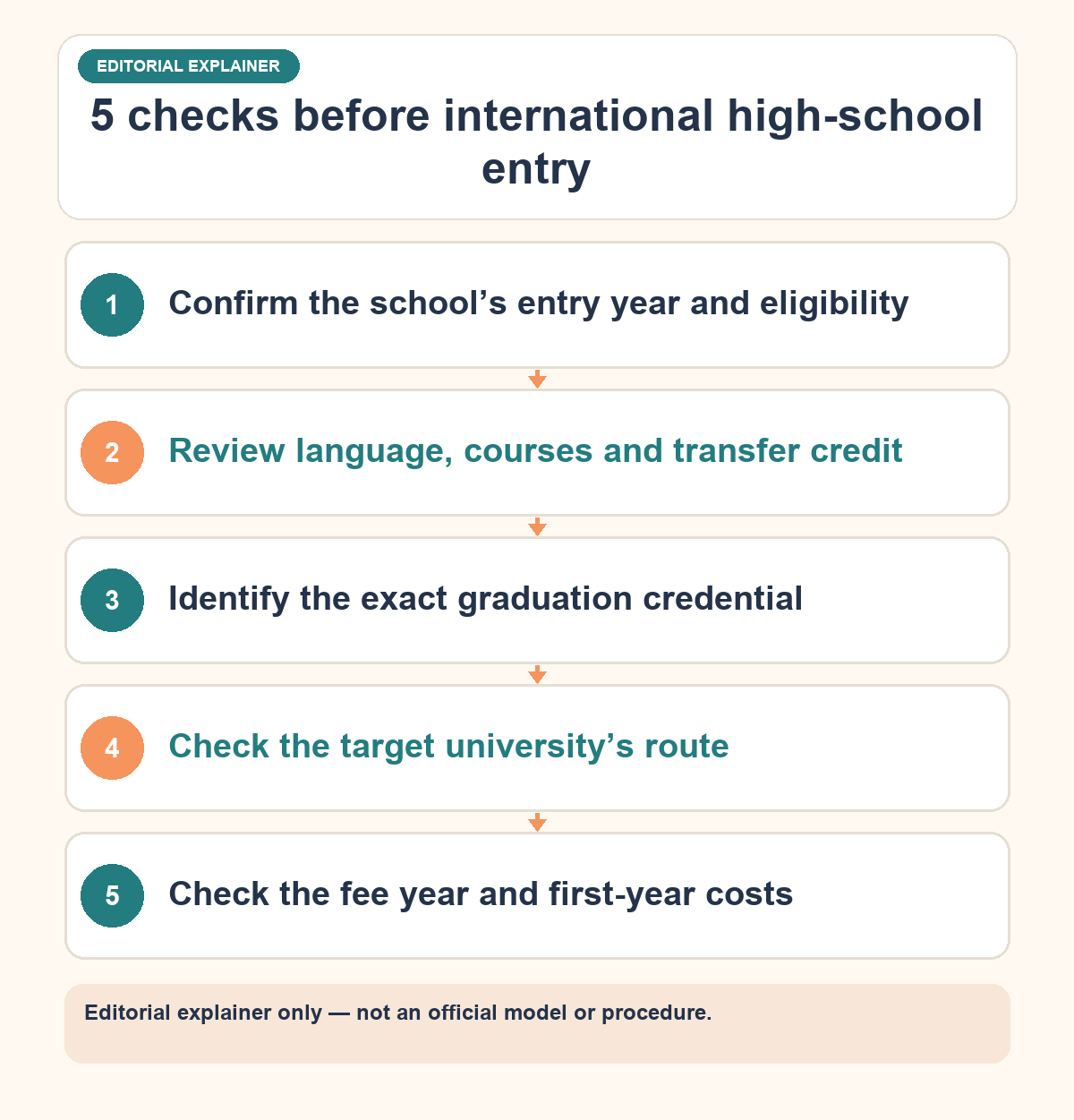
The featured illustration is AI-generated and is for explanation; the editorial diagram is an editorial illustration of this article’s steps. Neither is an activity photograph of a real school, student or NGA.