

Do children need both the ISEE and SSAT? Should a CAT4 be prepared for with workbooks? A test name alone does not tell you whether your child must take it or how to prepare. First confirm the test, registration level and purpose specified by the school.
This guide separates assessment-provider descriptions from individual school requirements. Before filling the calendar with practice, clarify how to describe your child’s learning history, how the test will be taken and what questions to ask when results arrive.
Jump to the FAQs Jump to the family checklist
Key points
- Ask the school which assessment and level apply to your child’s intended entry year and grade.
- ISEE, SSAT, MAP Growth and CAT4 have different purposes, formats and score interpretations.
- Use the provider’s current instructions and the school’s own directions; one does not replace the other.
- Plan the practical arrangements and the next conversation with your child, not only a score target.
Start with the test name, level and purpose
Begin by asking the school what your child will take, at which level, and what the result will be used for.
Admissions assessments can include written tests, interviews, participation in a class, submitted work or other evidence. Some schools use standardised tests from an outside provider; others set their own tasks. A friend’s child may have taken a different assessment, so start with the instructions sent to your family for this application.
Seeing the word “assessment” does not mean you should immediately add more Japanese entrance-exam study. Ask what the school wants to understand: curriculum knowledge, following directions in English, reasoning with numbers or diagrams, or something else. Clarify whether the result informs admission, year-group placement, subject choices or support after entry. Those are different purposes.
Find the admissions guidance for the intended entry year and grade. A test name on a school’s general webpage may not apply to every age group or programme. Tell the admissions team whether your child is applying for a mid-year place, a transfer into a senior programme or through an overseas process, and ask which instructions govern that application.
“You can sit this test” and “our school accepts this result for your application” are not the same answer. Before booking, confirm which result type the school accepts, which test dates count and how the score report must be sent. If your child already has a result from an external test, ask whether it can be used instead of repeating the assessment.
Keep three pieces of information distinct: your child’s current grade in Japan, the year group sought at the new school and the child’s date of birth. A school may use a British Year group while a test provider defines levels differently. Do not convert one label into another by yourself. Ask the school to confirm the application year group, then match it to the provider’s registration guidance.
Questions about the result are useful too. Ask whether the family will receive an explanation and whom to contact if the assessment suggests a learning need after admission. Thinking ahead about support helps keep test preparation connected to the child’s daily learning rather than focused only on a pass-or-fail outcome.
When you explain the assessment to your child, focus on what the day will look like and whom they can ask for help. A growing pile of tasks without a clear picture can make every family conversation about scores. While waiting for the school’s reply, keeping a steady rhythm for current learning and daily life is also part of preparation.
| Item | What to confirm | What to do with the answer |
|---|---|---|
| Name and version | Exact test name and registration level | Compare it with the provider’s level definitions |
| Purpose | Admission, placement or support planning | Note whom to ask about the result |
| Format | Test centre or online, and device requirements | Follow the school’s stated procedure |
| Submission | Test date, result deadline and delivery method | Coordinate these dates before booking |
Public guidance first: if your child is a Japanese national of compulsory school age living in Japan, Japan’s Ministry of Education (MEXT) states that enrolling the child in an international school that is not recognised as an Article 1 school does not fulfil the legal school-attendance duty. Ask your municipal board of education about procedures before changing schools. That MEXT statement concerns Japanese-national children; families of foreign-national children and families outside Japan should check the applicable rules with the relevant local education authority. If a child in Japan is worried or distressed, MEXT’s 24-hour Children’s SOS Dial is 0120-0-78310 (toll-free, including nights and holidays).
ERB: Admissions with ISEE (source check date in the Japanese original: 14 November 2026).
Tokyo International School: Admissions FAQs (checked 20 November 2026).
MEXT: Compulsory education when a school-age child attends an international school (Japanese) and MEXT: 24-hour Children’s SOS Dial (Japanese) (checked 20 November 2026).
ISEE and SSAT: distinguish their content and registration levels
ISEE and SSAT are different assessments; do not book both unless the school tells you to.
ERB describes the ISEE as assessing reading comprehension, verbal reasoning, quantitative reasoning and mathematics achievement. It is not accurate to treat it as only a test of memorised facts, nor as completely unrelated to a student’s learning history. Ask how the school combines the score with the other application materials.
The ISEE preparation page maps Primary 2, 3 and 4 to applications for Grades 2, 3 and 4. It lists Lower for applications to Grades 5–6, Middle for Grades 7–8, and Upper for Grades 9–12. Use the grade being applied to, not only the grade your child currently attends in Japan.
The SSAT page defines Elementary for Grades 3–4, Middle for Grades 5–7 and Upper for Grades 8–11. It assesses verbal, mathematics and reading skills and includes a non-scored writing sample. Similar-sounding level names do not mean that ISEE and SSAT categories match.
If a school names either test, ask for the registration level before opening a booking form. Give the child’s birth date, current grade, intended entry year and target year group. Also note the provider’s correction contact in case the wrong level is selected; creating multiple registrations on your own can add cost without resolving the question.
Testing format matters. The SSAT says options vary by grade and location, and that SSAT at Home is available only in the United States, including U.S. territories, and Canada, and only for Middle and Upper Level students. Eligibility depends on the student’s physical location on test day. Having an address in another country does not establish that a child can test at home while in Japan. Check both seat availability under the provider’s rules and the formats the school accepts.
Budget for more than the test fee. Travel, a parent’s time, a possible date change and the time needed for results to reach the school can affect the plan. Ask for the date by which the school must receive the report; taking the test before an application deadline may not be enough if the score arrives later.
From the outside, a family cannot tell whether one sitting will be enough or whether the school will ask for additional information. Do not assume that taking a test several times is always an advantage. Ask whether retakes are accepted and which result the school wants. Testing-frequency rules can change, so do not rely on the dates in an old family account.
| Assessment | Provider’s level examples | What to ask the school |
|---|---|---|
| ISEE | Primary 2–4; Lower, Middle and Upper levels linked to application grades | Which level matches the intended entry grade, and how are results submitted? |
| SSAT | Elementary Grades 3–4; Middle Grades 5–7; Upper Grades 8–11 | Which level and test format are accepted at the child’s test-day location? |
ERB: Admissions with ISEE (source check date in the Japanese original: 14 November 2026).
Admission.org: ISEE Preparation (checked 20 November 2026).
Admission.org: About the SSAT (checked 20 November 2026).
MAP Growth, CAT4 and English tests are not interchangeable
Different assessment scores cannot be turned into one ranking of a child’s ability or worth.
NWEA describes MAP Growth as an adaptive assessment used to understand achievement and growth over time, including through its RIT scale. If a school mentions “MAP,” ask which subject and test it uses and what admissions decision the result informs. A learning assessment used during the school year is not automatically an admissions test.
With an adaptive assessment, a test feeling difficult does not by itself tell you the result. A child’s impression matters, but “it felt hard, so admission is impossible” or “it felt easy, so every answer must be correct” are not reliable conclusions. Rather than asking your child to recreate the questions, wait for the school’s explanation of the result.
GL Assessment describes CAT4 as covering verbal, non-verbal, quantitative and spatial reasoning. It is not simply a school-subject exam; reports can help a school consider learning and planning. A score is not a medical diagnosis and should not be treated as a fixed statement about a child’s future attainment or pathway.
GL Assessment lists CAT4 for ages 6–17+ and gives approximate test durations of three 45-minute sections for ages 8–17+, or two 30-minute sections for ages 6–8. These are test-section durations, not necessarily the full time a family spends at a school, including arrival, instructions, breaks or interviews. Use the school’s schedule for the day.
A school may also use a separate English assessment, such as the Oxford English Placement Test. English comprehension and reasoning with mathematics or diagrams are not the same thing. Confirm the exact product name, version, language and purpose; a similarly named test or age range may refer to a different assessment.
When your child describes a difficult task, separate the reason it felt difficult. Was the instruction in English hard to follow, or was the mathematical method not yet taught? That context can help you describe the learning history to the school. It is not a request for a parent to rescore the test.
If a report contains unfamiliar abbreviations, ask what the score represents and what comparison group is used. Do not search for an average from another test and add or average the numbers together. Different scales and domains answer different questions.
| Assessment | Provider description | Question for the school |
|---|---|---|
| ISEE | Reading, verbal reasoning, quantitative reasoning and mathematics achievement | Which application level and score-report route apply? |
| SSAT | Verbal, mathematics and reading skills, with a non-scored writing sample | Which level and format are available at the child’s location? |
| MAP Growth | Achievement and growth over time, using the RIT scale | Which subject, purpose and explanation of results apply? |
| CAT4 | Verbal, non-verbal, quantitative and spatial reasoning | Which version, schedule and purpose has the school selected? |
| English assessment | A school-selected test or task in English | What is the official name, what does it assess and what support conditions apply? |
NWEA: MAP Growth (source check date in the Japanese original: 14 November 2026).
GL Assessment: CAT4 (checked 20 November 2026).
Rugby School Japan: Admissions (checked 20 November 2026).
Use official school examples to check your own application
A school’s admissions page is an example of that school’s process, not a requirement for every school.
Rugby School Japan’s admissions page says applicants complete CAT4, the Oxford English Placement Test and an interview with a member of the Senior Leadership Team. It describes a pre-screening interview with a member of the Admissions Team before the tests. For Year 12 applicants, it lists A Level assessment papers in English and mathematics, plus three or four subjects chosen by the applicant. This shows that, even within one school, what is checked can increase by programme; do not infer that another school uses the same tests.
The practical lesson is to ask about order before booking. If a preliminary interview comes first, find out what the school needs to know at that stage. Put the application form, references, interview, assessment and result submission in one simple timeline so you can see what the school is waiting for and what your family needs to do next.
Tokyo International School’s FAQ says assessments for Grade 1–11 applicants are given only when the school considers them necessary and once a place has been identified. Its FAQ describes kindergarten screening and Diploma Programme admissions separately. It is not a general instruction that every child must sit the same external test first, and siblings of different ages may not need the same preparation.
The Tokyo International School (TIS) FAQ states a specific rule for Japanese applicants: they must be “peer competitive” in English at admission, and TIS does not accept Japanese students who require English as an Additional Language (EAL) support. This is an applicant-eligibility restriction, not a support option that can be waived because of the cohort. Separately, TIS says admission of new English language learners depends on the current cohort’s language makeup. Keep that cohort-dependent policy distinct from the exclusion for Japanese students who need EAL. A school that mentions English support does not necessarily offer it on the same terms to every applicant; ask TIS (or any school) to clarify the rule for your child’s nationality, learning history and entry year before paying for an assessment.
A school with more named tests is not necessarily better, and fewer written exams do not automatically mean easier admission. Schools may give different weight to interviews, documents or classroom tasks, and may not publish every assessment detail. Compare whether your child can take part in the required format and what learning support is available, rather than ranking schools by the number of tests.
If a general webpage and an individual email appear inconsistent, do not assume which is out of date; give the admissions team the intended entry year and grade and ask which instruction applies. Procedures can differ for mid-year entry or applicants overseas. Keep the title or link of the document and the date of the reply so your family can refer to the same answer.
When the school requests an additional assessment, ask what it is intended to clarify. A subject task used to check readiness for a course is different from a review of previously taught material. Do not send a large collection of reports or work samples without asking what is needed and how it should be submitted.
| School example | What its page says | What a family should confirm |
|---|---|---|
| Rugby School Japan | CAT4, Oxford English Placement Test and senior-leadership interview; pre-screening interview first; additional A Level papers for Year 12 | Current application year, required sequence and subjects for the child’s year group |
| Tokyo International School | Grade 1–11 assessments only if considered necessary after a seat is identified; Japanese applicants must be peer competitive in English, and Japanese students needing EAL are not accepted. ELL admission separately depends on current cohort language makeup. | Whether an assessment is needed, current eligibility and any support available to this applicant |
Rugby School Japan: Admissions (checked 20 November 2026).
Tokyo International School: Admissions FAQs (checked 20 November 2026).
Follow each test’s guidance without overloading preparation
Familiarising a child with a test format and drilling test questions are not the same approach.
The ISEE preparation page offers sample tests and guides so families can understand the format. Choose the material for the relevant level. Before purchasing a large set of practice questions, look at the provider’s official sample and identify what is genuinely new for your child, such as navigating the online interface or understanding the instructions.
GL Assessment takes a different position for CAT4: it strongly advises against practice ahead of the test and says each section contains examples to familiarise students with the style and format of the questions. Do not apply another assessment’s preparation method to CAT4 just because other admissions tests have official practice. Follow the school’s pre-test instructions as well.
Keeping up with ordinary learning is different from memorising questions from a particular test. A child can talk about a book they are reading, review current classwork or practise asking for clarification when confused. None of these activities promises a particular score or admission outcome.
For a short practical check, focus less on getting questions right and more on finding instructions, moving through the screen and knowing what to do when something is unclear. Keep any practice within the official rules, and ask the school whether the family needs to recreate the testing environment at home for long periods. There is no need to add to the schedule just to match other families’ stories.
If your child is tired, reducing the extra work is a reasonable choice. You can use one day to read the school’s directions and another to organise documents. Agree on a time to stop, so preparation does not continually displace rest or the child’s current school life.
A tutoring or materials advertisement that names a school or test does not establish that the school endorses that service. If you consider paid help, check what it includes, the child’s workload, cost and contract terms. Do not change an application plan based on claims to reproduce non-public live questions or guarantees of admission.
If you notice a practical difficulty, share the specific situation with the school before increasing the coaching at home. For example, your child may find long English instructions hard to follow or may have little experience entering answers on a device. Explain what you have observed and ask what the school can clarify in advance about participation.
| Preparation area | What to check | Keep in mind |
|---|---|---|
| ISEE materials | Sample or guide for the assigned level | Using them does not guarantee admission |
| CAT4 participation | School directions and the examples in each section | The provider strongly advises against advance practice |
| Equipment and travel | Device, venue, start time and contact route | Do not improvise steps or assistance on the day |
| Routine and rest | When preparation ends and what the child prefers | Do not keep adding tasks because of anxiety |
Admission.org: ISEE Preparation (checked 20 November 2026).
GL Assessment: CAT4 (checked 20 November 2026).
Confirm location, timing and arrangements before the test
Before booking or testing, confirm the test-day conditions and the school’s and provider’s procedures for any support the child may need.
When the instructions arrive, note the test date, arrival time, start time, expected finish and the exact venue and check-in point separately. For an online test, ask which time zone the invitation uses. If converting to Japan time, confirm it with the school rather than relying only on a calendar invitation.
Ask whether the child should bring a device or use one supplied by the school, which models are accepted, what connection is needed and what preparation is required. A tablet used every day may not meet the test requirements. If an official login or app is required, follow the provider’s instructions; do not copy a password into a family note that is passed around before the test.
If an accommodation may be needed, ask where to apply, by what deadline and what documents are required. The SSAT says accommodations must be approved before registration. Telling the school about a need does not necessarily complete the provider’s process; confirm who submits the request and who issues the approval.
It can help to describe the part of the test day that is difficult, rather than relying only on a diagnosis label. Examples might include sitting for a long period, a noisy room, instructions in English, or writing by hand versus typing. Share only what the child and family want the school to know, confirm what documents are needed and where they go, and do not put sensitive details into a general enquiry form all at once.
Breaks, read-aloud support, assistive equipment or a parent’s presence are not automatically available. Ask what is permitted before the test day instead of introducing a new arrangement at the venue. A school’s own assessment and an external test may have different contacts; write down who answered each question.
Check whether the test fee is included in the application fee or paid separately and which rules cover rescheduling or absence. A question to admissions is not the same as a formal cancellation or change request. Confirm by the day before how to report illness, so the family is not pushed into going ahead on the morning of the test.
Once the adults have checked the arrangements, share only the details the child needs: whom to speak to after arrival, or to raise a hand when something is unclear. The child does not need to carry the adults’ uncertainty about payments and bookings; a parent can manage those administrative tasks.
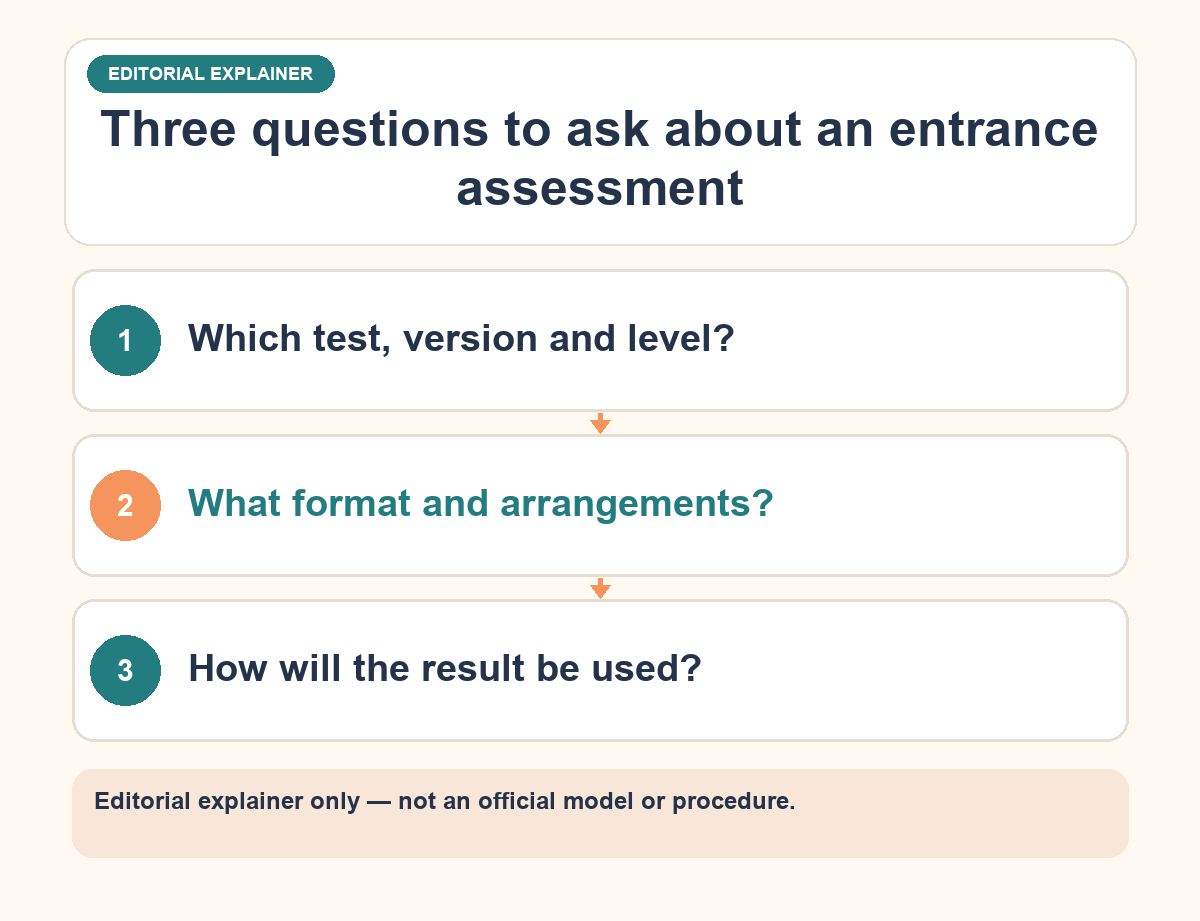
Admission.org: About the SSAT (checked 20 November 2026).
Support participation on test day, not the answers
A parent’s role is to help the child participate under the stated conditions, not to answer for them.
On the morning of the assessment, check the time, required items and route instead of adding new practice questions. If the child is unfamiliar with the journey, identify somewhere they can settle after arriving. Follow the venue’s rules about waiting and food; do not assume a parent may enter the testing room simply because the test is held at a school.
For an online assessment, read what the parent may and may not do. Helping with the connection is different from translating a question or suggesting an answer. Do not assume you can advise from off-screen; follow the proctor’s directions. If a technical issue occurs, use the named contact route rather than repeatedly disconnecting on your own.
If what happens at the venue differs from the instructions, ask the staff member to clarify before urging the child to begin. Check that the child is registered for the correct level, the required equipment is available and any arrangements discussed in advance have reached the test team. The aim is to align the school’s instructions, not to negotiate scoring conditions on the spot.
Immediately afterward, try asking whether your child is tired or wants a break instead of beginning with “How many did you get right?” Listen if they want to talk; there is no need to schedule a retest at once. In line with the test rules, do not ask them to recall and record the questions in detail or share them with other families.
When you do reflect, separate what happened from how the child felt. A lost connection or difficulty finding check-in is a concrete fact to share with the school. “Everything was hard” or “I do not want to do it again” is a feeling to listen to and respect. Not turning feelings straight into a score prediction makes the next conversation easier.
If the child is still attending their current school during admissions, avoid packing the following day too tightly. Follow that school’s guidance on absence and missed work. Sitting an assessment does not itself decide that a transfer will happen. Keep current learning and daily life stable while you wait for the outcome.
Within the family, avoid comparing the child’s account with a sibling’s or friend’s. The same test name may involve different levels and circumstances. Note what the child felt went well and what they want to ask next, one at a time, without turning the entire discussion into a judgement of the score.
Understand what the result means and what the school decides next
Separate the score report, the school’s decision and the next required step.
A result notice may contain a score report, the school’s explanation, a request for additional documents or an invitation to another meeting. First identify which assessment the notice is about and what action the family must take. If no numerical score is shared, you can ask what range of information the school can explain.
When a standardised report is provided, read the scale, domains and comparison group rather than relying on a broad impression. A percentile is not the same as percent correct. Do not compare numbers from different tests as though they used the same scale; check unfamiliar terms with the explanation from the school or provider that issued the report.
If the school asks for another English check or subject task, ask its purpose and deadline. It may be an admission requirement or information for a support plan after entry. An additional assessment by itself does not tell you that the child has been rejected; clarify exactly what conditions remain.
If the result is not what you hoped for, ask what options the school can explain: a reassessment, a later application period or additional learning-history materials, for example. These depend on the school’s rules. A higher score should not be read as a guaranteed place; check availability and other admission requirements separately.
A strong result does not remove the need for support. A test may not show how the child experiences reading and writing, classroom participation, the commute or group life. In a pre-entry meeting, ask for time to explain, separately from the score, the situations where your child may struggle and what the family wants the school to know.
Keep the test date, name and level together with the school’s explanation. If another school requests the report, use the official submission method and do not send only a cut-out part of the report. These are records about a child’s assessment; do not post them on public social media or a publicly accessible link.
NWEA: MAP Growth (source check date in the Japanese original: 14 November 2026).
ERB: Admissions with ISEE (source check date in the Japanese original: 14 November 2026).
Look beyond the test to learning after admission
Preparing for an entrance test and deciding whether a child can keep learning well at a school are separate questions to work through.
When test preparation takes a long time, taking the assessment can become the goal by itself. Pause to talk about what your child hopes to learn in the school’s lessons and what would make participation easier. Check that the priorities your family had when it began comparing schools have not disappeared under the test timetable.
When asking about English support, go beyond “Do you offer it?” Ask who provides it, in which lessons, how it fits with the regular timetable, whether there is an additional fee and how the family receives updates. The school’s capacity and the child’s needs have to be considered together; a statement that support exists is not a promise that every applicant can use it.
Ask which subjects a child will use straight away and where the pace may differ from their previous school. If there are topics they have not covered, ask what is needed and by when. Parents do not have to decide that every gap must be self-taught before entry; clarify which support the school provides and what can reasonably be done at home.
A child’s view is not something to ask about only once. A visit may feel exciting, while an assessment raises new impressions. Do not assume that taking the test means the child will enrol. Ask about both what they are looking forward to and what concerns them. The assessment fee already paid and whether the child can keep attending are different decisions.
If you reconsider the application, ask the school for the formal cancellation or change procedure. An email asking a question may not cancel an application. Before making hard-to-reverse decisions such as withdrawing from a current school or moving home, confirm the school’s steps and how fees are handled.
A useful stopping point is not the complete absence of anxiety. It is having the necessary steps confirmed and the child having a picture of the day. If something remains unclear, it is enough to decide whom to ask. Rather than researching every test, start by understanding, together with your child, the one set of instructions your application needs.
10 Frequently Asked Questions
Use general test descriptions as a starting point, then confirm what applies to your own application.
Do we need to take both the ISEE and SSAT to apply?
Ask the school you are applying to which assessment, if any, it requires. A test being available from its provider does not mean the school requires it. Give the school name, intended entry year and grade, then confirm the required test and level and the date by which results must arrive before booking. Taking both does not automatically improve an application and may add cost and strain.
Can I choose a test level based on my child’s Japanese grade?
Do not decide from the current Japanese grade alone. Match the school’s placement decision with the test provider’s level definitions. ISEE levels are described by the grade being applied to, while SSAT levels use their own grade bands. Give the school your child’s date of birth, current grade and intended entry date, and ask which registration level to use.
Can my child take the SSAT at Home from Japan?
The SSAT’s page lists SSAT at Home for the United States, including U.S. territories, and Canada only; availability is based on the student’s physical location on test day. An overseas address by itself does not establish eligibility to test from Japan. Check which formats the school accepts and where and when the provider permits your child to test.
Should my child practise with CAT4 workbooks?
GL Assessment strongly advises against practice ahead of a CAT4 test and says that each section includes examples to familiarise students with the question format. Do not transfer another test’s preparation advice to CAT4. Follow the school’s instructions, confirm the practical arrangements and allow time for rest.
Can MAP and CAT4 scores be compared to identify strengths and weaknesses?
Not by comparing the numbers directly. MAP Growth is described as measuring achievement and growth, while CAT4 covers several reasoning domains; their purposes and scales differ. Ask the school to explain the score type, comparison group and intended use. A single score should not be treated as a diagnosis or a fixed prediction of a child’s future.
If a school offers English support, does that mean an English score is not required?
Not necessarily. Tokyo International School says Japanese applicants must be “peer competitive” in English at admission and does not accept Japanese students who require EAL support. Its separate policy says admission of English language learners depends on the language makeup of the current cohort; that condition does not create an exception for Japanese applicants who need EAL. Ask the school which rule applies to your child before booking an assessment.
When should we ask about accommodations for reading, writing or attending a test centre?
Ask the school and test provider about the process before booking or registering. The SSAT says accommodations must be approved before registration. A conversation with the school may not complete the provider’s formal process. Confirm the documents, deadline, responsible office and how approval will be communicated, while sharing only the information needed through the designated channel.
Does a high test score guarantee admission?
No. A school may consider interviews, application materials, eligibility conditions and available places alongside an assessment. When results arrive, ask whether an admission decision has been made or whether more assessment or documents are needed. Even an offer may have separate acceptance and payment steps.
Should we book a retest right away if the result is disappointing?
Before booking again, ask how the school treats a retest or additional materials and listen to how your child feels. Request an explanation of the result and the next available options, then decide whether another assessment is needed. Retesting does not guarantee admission. Include rest and current learning in the plan.
What should I ask my child after the test?
First ask whether they are tired or would like a break. If they want to talk, listen; later, you can note any unclear instructions or questions for the school. There is no need to reconstruct the test or predict a score by comparing experiences with friends. The conversation can return to whether your child wants to learn at that school and what support they may need.
What you can do today
Open one admissions page for your target school and write down the test name and who can confirm the next step.
Save the guidance for your intended entry year and grade alongside the message sent to your family. If the test name or level is missing, ask the admissions contact before booking. There is no need to buy a collection of new materials while you wait for the answer.
Then ask your child for one thing they want to understand about the school, such as what lessons are like, which device they will use or how they can ask for help. The adult can handle application details while the child gets a clear picture of participation. Include rest in the plan.
If your family lives in Japan and is considering leaving a Japanese school, add your municipal board of education to the list of contacts to check, as described in the first section.
Family checklist and email template for an entrance assessment
Start with four basic details and add optional notes only when they help answer a real question.
This is an editorial family worksheet, not an official school or test-provider form. The basic checklist, optional notes and email example can be edited, copied and printed separately. Do not put names, diagnoses, account passwords or other sensitive details in this worksheet; use the school’s designated secure route for information it requests.
Optional details to add only if needed
The email below is a starting point for asking about requirements. It is not a test booking or a formal accommodation request. Edit the year group and other details, and check the wording before sending it to the school’s designated contact.
References
The Japanese original states that its sources were checked on 14 November 2026. Its page last-modified timestamp (14 November 2026) is not a fact-check date. This English translation was prepared on 20 November 2026. On that date, five of the seven assessment-provider and school pages cited in the original (ISEE Preparation, About the SSAT, CAT4, Rugby School Japan and Tokyo International School), three NIJIN GLOBAL ACADEMY pages linked in this article, two MEXT pages and Nijiiro’s editorial-structure page were reopened for targeted checks of specific claims. The ERB and NWEA pages and all other statements are carried over from the Japanese original with its 14 November 2026 source date and have not been newly verified. Admissions requirements, testing arrangements, fees and support vary by school, course, year and family circumstances; confirm current details, including the edition of admissions guides and fee schedules for the relevant year, with each organisation.
- ERB: Admissions with ISEE — test domains and admissions context (inherited from the original; 14 November 2026).
- Admission.org: ISEE Preparation — ISEE levels and sample resources.
- Admission.org: About the SSAT — levels, test-day location, formats and accommodation timing.
- NWEA: MAP Growth — achievement, growth and RIT scale (inherited from the original; 14 November 2026).
- GL Assessment: CAT4 — reasoning domains, duration and preparation guidance.
- Rugby School Japan: Admissions — its assessment sequence and Year 12 papers.
- Tokyo International School: Admissions FAQs — when assessments are used and school-specific English/EAL conditions.
- MEXT: Compulsory education and international schools (Japanese) — Japanese-national children and Article 1 schools.
- MEXT: 24-hour Children’s SOS Dial (Japanese) — public consultation line in Japan.
- NIJIN GLOBAL ACADEMY: Opening updates — information signup; planned September 2027 opening; not an application.
- NIJIN GLOBAL ACADEMY: Tuition and admissions — planned ages and pre-opening admissions steps; tuition not yet published.
- NIJIN GLOBAL ACADEMY: Contact — question channel; no stated response time.
Related articles (Japanese)
The featured image is an AI-generated illustration of fictional people, not a photograph of a real school, family or activity. The body image is an editorial diagram, not an official model or form. Neither image is a photograph of real school activities.