
Which boarding school in Japan might fit your child—and what should you compare before applying? Four schools illustrate very different curricula, entry routes, costs and residential routines. Use the examples to build questions for each school; they are not a ranking or a complete directory.
The Japanese article checked its sources on 9 November 2026. Each amount and admissions condition below is labelled with the academic year it applies to.
Key points
- “Boarding” describes where a student lives. On its own, it does not tell you the school’s legal status, curriculum or diploma.
- Compare each school’s current entry route, costs for the relevant year, holiday arrangements and support contacts.
- Keep Japanese school-system rules separate from international credentials and from each university’s own admissions requirements.
What does “full boarding” mean, and how is it different from a school with a dormitory?
A family looking for an English-language education in Japan may ask whether a full-boarding school can take over all daily care. That is not a safe assumption. “Full boarding” or “boarding” describes a residential arrangement. It is not a single legal category in Japan, and it does not tell you whether the curriculum is Japanese, British-style, International Baccalaureate (IB), or a combination. A school may also offer different programmes by year group. For Japanese-national children of compulsory-school age, formal school status can affect how the rules apply. MEXT’s Q&A is a public starting point, and your municipal board of education can advise on an individual case.
Before choosing a dormitory, check three things together: the programme the student will follow, the days they will return home, and who they can contact when something goes wrong. With weekly boarding, plan for the journey home, the time classes or activities finish, and who will collect the student. A seven-day boarding option still may not cover every week of the year. The school calendar may require students to leave during long holidays or on specified closure dates. Ask where the student is expected to stay when the dormitory is closed, and how transport and extra costs are handled.
Harrow International School Appi describes a full-boarding British-style school. Rugby School Japan lists day, weekly and full boarding options. Meikei Gakuen has both day students and boarding students and offers international education, including an IB Diploma Programme (IBDP) course. Do not assume that every student at an “international” school studies every subject in English, lives in a dormitory, or takes the same qualification.
This article uses four schools as examples of questions to ask. It is not a ranking or an exhaustive list, and the order means nothing. The published fee figures below are tied to their stated academic or school year. Some are for 2026–27, Rugby has also published 2027–28 amounts, and Meikei’s 2027 high-school recruitment guide lists 2026 fee amounts. None of them is a quote for a future intake. Ask each school for a written estimate for the intended entry year, year group and boarding arrangement.
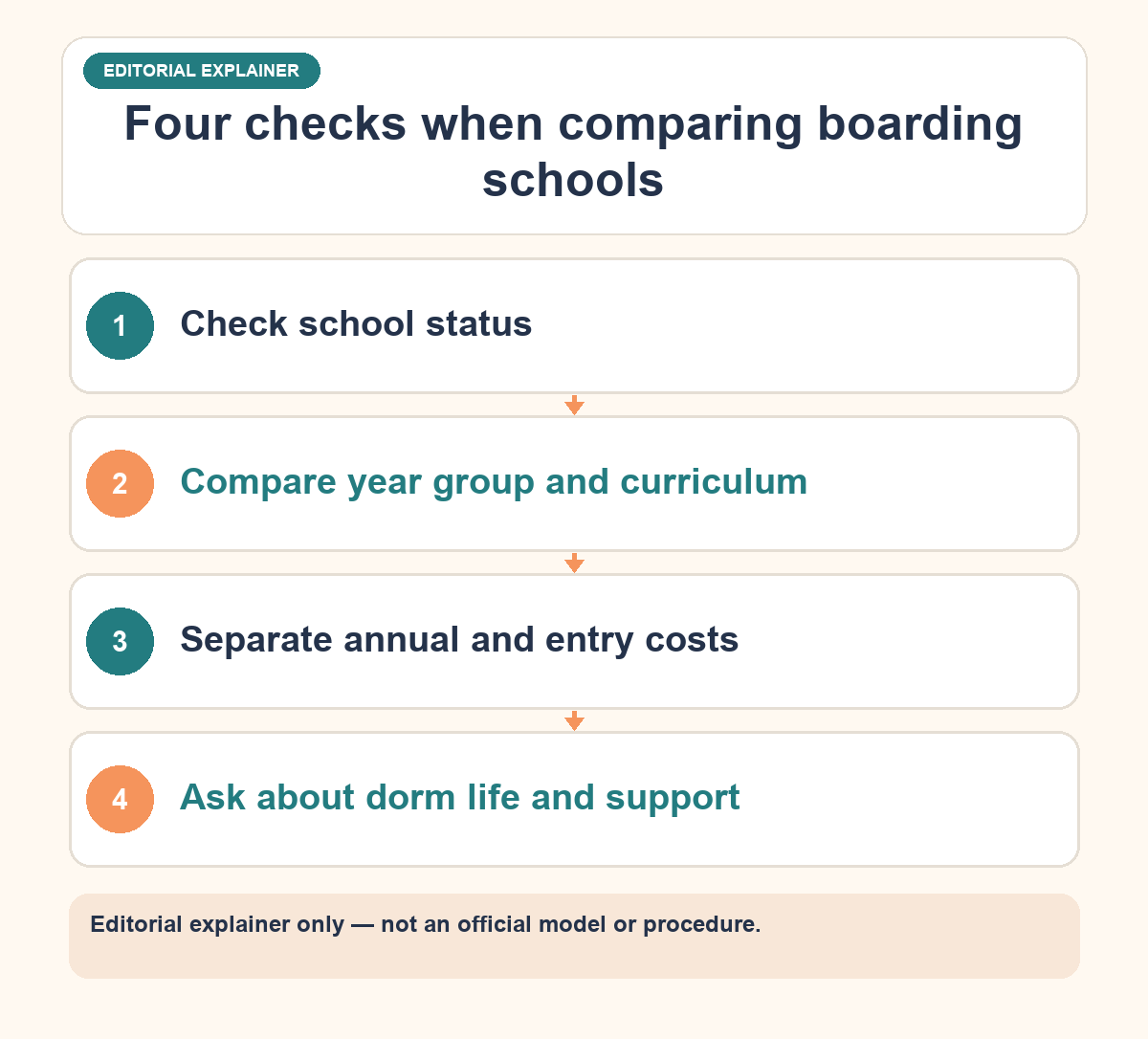
A useful first comparison has four fields: the year group the student may enter, the programme or credential they would follow, what is payable at entry and each year, and how weekends, holidays and support are arranged. A polished campus tour cannot tell you whether a student can rest on a difficult day or get home when the dorm closes. Picture a Sunday evening or a day the student is unwell, and ask about those situations directly.
Boarding means sharing routines with other people, but some children also need reliable time alone. A parent’s wish for a child to become independent and the child’s own reason for wanting residential school are different questions, so ask about them separately. If the student is not ready to decide, looking at a prospectus or visiting without applying can be a smaller next step. A visit is not an application.
A dorm may not be the only option, and other learning arrangements may be worth comparing. The NGA information linked below concerns a planned online international school. It is not a boarding place or a route into the four schools below. NGA’s FAQ says it is not an Article 1 school under Japan’s School Education Act and does not itself issue a Japanese high-school diploma. Its official site says it plans to open in September 2027, so it is not described here as an operating school.
Compare the pathways and residential options at four schools in Japan
Harrow Appi and Rugby School Japan describe British-style education. Rugby links its courses to IGCSE and A Levels. UWC ISAK Japan describes high-school routes that lead to the IBDP. Meikei Gakuen is a Japanese secondary school with several courses, including an IBDP course. “International education” is too broad a label to show how subjects are taught, when a qualification begins or which language a particular class uses.
A school’s overall year range is not the same as the year groups open to new students this year. Harrow’s current admissions FAQ lists entry to Years 7, 8, 9, 10 and 12. Year 11 is accepted only in exceptional circumstances, and the school’s age guidelines say Year 13 entry is not accepted. Rugby’s admissions overview says applications are accepted into Years 7–12, but its placement chart says Year 11 is not usually admitted. That is a question for the admissions office, not something a family should resolve by guessing. UWC ISAK accepts direct applications for Grade 10 and has separate routes for Grade 11. It does not accept Grade 12 entry or mid-year transfers. Meikei publishes separate requirements for its middle- and high-school selection routes.
Do not convert a Japanese school year into a UK Year or an international Grade by matching the number. Send the school the child’s date of birth, current year of enrolment, subjects studied and intended start date. Ask which year group and course the school will assess, whether the student can complete the planned programme, and whether there is space in that intake.
Harrow Appi is in Hachimantai, Iwate. Rugby School Japan is in Kashiwa, Chiba, and family life looks different depending on whether the student attends as a day pupil or boards. UWC ISAK Japan is a high school in Karuizawa, Nagano. Meikei Gakuen is in Tsukuba, Ibaraki, and its middle- and high-school guides need to be read separately. Location matters for transport, access to family and what happens in practice if a student needs to return home.
According to Meikei, its IB course has a preparation period in the first year of high school, and DP study begins in January. Do not assume that an IB label means the student takes every subject under the same conditions from the first day. Ask when course choices are made, which language each subject is taught in, and whether the course the student wants involves a selection process.
Having a dormitory does not guarantee a room for a particular intake. Confirm the available year groups, space, any interview or selection for boarding, required local contacts and any support the student may need. Families living outside Japan should also ask who can act locally if an urgent return home or in-person meeting is required.
A comparison table that does not rely on year numbers alone
The table is a starting point for opening each school’s own materials, not a scorecard. Once you have two or so candidates, send each one the same questions and record the date of the reply. If a cell is still unanswered, leave it as a question for the school rather than filling it with a guess.
| School | Published pathway example | Residential arrangement | Entry question to check |
|---|---|---|---|
| Harrow Appi (Iwate) | British-style curriculum across Years 7–13 | Full boarding | Admissions FAQ lists entry to Years 7, 8, 9, 10 and 12; Year 11 only in exceptional circumstances. Age guidelines say Year 13 entry is not accepted. |
| Rugby School Japan (Chiba) | British-style courses leading to IGCSE and A Level | Day, weekly (five-day) and full (seven-day) options | Overview says Years 7–12; placement chart says Year 11 is not usually admitted. Ask about the intended year. |
| UWC ISAK Japan (Nagano) | Grade 10 entry to a three-year programme; IBDP in Grades 11–12 | Residential school | Grade 10 and Grade 11 have different application routes; no Grade 12 or mid-year entry. |
| Meikei Gakuen (Ibaraki) | Japanese secondary-school courses, including IB and other courses | Day students and boarding students | Check the middle-school, high-school or course-specific guide. |
Harrow Appi: admissions FAQ · Harrow Appi: admissions process and age guidelines · Rugby School Japan: admissions and year placement · UWC ISAK Japan: eligibility criteria · Meikei Gakuen: IB course
Check school status, graduation credentials and university eligibility separately
Schools with similar boarding arrangements do not necessarily share the same status in Japan’s school system. The Japanese source article (sources checked 9 November 2026) cites the MEXT IB Education Promotion Consortium’s school list as of 30 September 2026. It reports that list as placing Meikei Gakuen High School and UWC ISAK Japan in its Article 1 school section. The list could not be opened for this translation on 20 November 2026 because the server returned an error, so that placement is carried over from the Japanese article, not newly verified. Separately, UWC ISAK Japan’s governance page, read on 20 November, says the school is a MEXT-recognised high school under Article 1 of the School Education Act and an IB World School. Some schools that offer international education are Japanese high schools. Recording boarding and legal status in separate columns helps when you come to plan for university.
Rugby School Japan appears in Chiba Prefecture’s list of private miscellaneous schools (kakushu gakkō), dated 1 May 2026 and updated 15 June 2026, where it is categorised as a foreign school. Article 1 schools and miscellaneous schools are different legal categories. Do not infer a school’s status from its school corporation, a link to a UK school or the chance to earn international qualifications. The Japanese source article also reports that Harrow Appi appears in Iwate Prefecture’s list of miscellaneous schools as of 1 May 2026. That PDF could not be read for this translation, so the statement is carried over from the 9 November article. Keep these two schools’ classification separate from that of the two Article 1 schools. If current status matters to your decision, ask the prefecture or the school.
Japanese high-school graduation, an IB or A-Level qualification, and eligibility to apply to university each need to be checked separately. MEXT’s university-eligibility page, which says its information is as of June 2024, lists several routes. They include graduating from a Japanese high school, holding a qualification such as the IB, GCE A Level or International A Level, and completing a 12-year programme at a school accredited by a specified body. A school’s name or one programme description cannot show that a particular student will have completed every requirement for a particular university or course.
Check each university’s own application conditions
Even if a student meets a general university-entry qualification, the target university and faculty may have their own selection routes, required subjects, grades, language evidence and document rules. Treat a school’s list of graduate destinations as information about those graduates, not a promise about the next student. Ask the target university which credential and subject combination it will accept for the intended application year.
If the student is changing schools during high school, ask how existing credits will be treated and how many years graduation will take. Do not assume that a first-year Japanese high-school student moves straight into Year 12. Show the receiving school the student’s reports and an explanation of the subjects studied. If the subjects do not fit the qualification the student wants, the year group or graduation date may need to change. Get the receiving school’s final decision in writing.
For a Japanese-national child of compulsory-school age, a separate question comes before university planning. MEXT explains that if a guardian enrols a child with Japanese nationality at an international school that is not recognised as an Article 1 school, the legal duty of school attendance is not fulfilled. High school is not compulsory education, so keep middle-school and high-school questions apart. MEXT’s explanation is framed around children with Japanese nationality. Tell your municipal board of education the child’s nationality, including any dual nationality, and current enrolment, and ask how the rules apply.
MEXT IB Consortium school list cited by the Japanese source (as of 30 September 2026; not reopened) · UWC ISAK Japan: governance and curriculum accreditation · Chiba Prefecture: private miscellaneous-school list · Iwate Prefecture: miscellaneous-school list as of 1 May 2026, PDF p. 1 (cited by the Japanese source; not readable for this translation) · MEXT: university admission eligibility (page states June 2024) · MEXT: compulsory-school attendance and international schools
Check entry year, English expectations and application route
Before booking an English test or ordering transcripts, send the school the student’s intended start date and current academic history. Confirm which year group, course and application route can be considered, then work from that route’s own document list and assessment method. If a school runs general entry, international-student selection and IB-course selection separately, do not merge their criteria into one list.
Rugby School Japan’s current admissions page says applications are accepted into Years 7, 8, 9, 10, 11 and 12. It says places are strictly limited and applications are rolling, and year groups can close once full. Its placement chart says Year 11 is not usually admitted, so ask admissions about the actual intake. Assessment includes CAT4, the Oxford English Placement Test and an interview. Year 12 applicants also sit English and mathematics papers plus three or four subjects of their choice. Its FAQ says there is no fixed English requirement but expects age-appropriate English so that the student can take full part in the curriculum. “No fixed score” does not mean “no English preparation needed.” It helps to discuss specific subject situations, such as reading a science explanation in English, asking questions in class or writing a report.
Harrow Appi’s current FAQ lists entry to Years 7, 8, 9, 10 and 12. Year 11 is considered only in exceptional circumstances: for example, when a student is already studying for GCSEs, or when a review of previous reports and additional tests shows the student can catch up. The school’s age guidelines say Year 13 entry is not accepted. The FAQ sets a minimum English level of CEFR A2 for Years 7–8, B1 for Year 9 and B2 or above for Year 10 and older. Check the current requirements and assessments for the specific year group.
Application routes differ by school
UWC ISAK Japan accepts direct applications for Grade 10, which leads to a three-year programme that includes the IBDP in Grades 11 and 12. Grade 11 applicants use either a UWC national committee or the Global Selection Programme (GSP); the school does not accept direct Grade 11 applications. The GSP is for students who can pay full fees and offers no financial assistance, while the national-committee route allows applicants to seek assistance. The school does not accept Grade 12 entry or mid-year transfers. Check the application route and the assistance conditions together, rather than looking only for the school’s application form.
The current UWC ISAK eligibility page says that all classes except Japanese and foreign-language study are taught in English. It asks applicants to have studied English for at least three years and to speak, read and write at an intermediate level. Test scores are not required, though the page lists recommended scores. These criteria belong to UWC ISAK and are not a standard for other schools.
The Japanese source article (9 November 2026) summarises Meikei’s 2027 high-school recruitment guide. For the international-student special selection A/B routes, eligibility includes either a qualifying period of overseas schooling or EIKEN Grade Pre-1 or above. These are not requirements for every Meikei applicant. Route C and the IB-student special selection have different conditions, and there are common conditions such as expected graduation. Middle-school international-student criteria cannot be carried over to high school. The guide PDF could not be reopened for this translation, so these details are carried over from the Japanese article.
Record the target intake year, selection route and deadline next to each school’s name. A single guide can include routes whose application period has already ended. The Japanese article reported the application period for Meikei’s 2027 international-student special selection as 2–16 October 2026, and it had already closed by that article’s 9 November check. Do not treat it as an open window. If one route is closed, check the conditions and dates of any other route rather than assuming they carry over. A school’s admissions web page may be updated before every downloadable guide, so ask which document governs the intended intake.
Rugby School Japan: admissions and placement chart · Rugby School Japan: English and admissions FAQ · Harrow Appi: admissions FAQ · Harrow Appi: admissions process and age guidelines · UWC ISAK Japan: eligibility and routes · Meikei Gakuen: 2027 high-school recruitment guide, pp. 2–3 (cited by the Japanese source)
Compare tuition, boarding and one-time costs in separate columns
A line labelled “annual tuition” may include boarding and meals at one school but not at another. A usable family budget separates three things: the cash needed at entry, the fees paid every year, and costs that depend on what the student uses or takes part in. If a deposit is refundable subject to conditions, record it as a deposit. Do not count it as money you can spend until you know it will come back.
Harrow Appi’s official 2026–27 fee page lists tuition including boarding at ¥10,548,740 a year for Years 7 and 8, payable in three instalments before each term. The same page lists a ¥50,000 application fee and a ¥1,000,000 enrolment fee. It also lists a refundable deposit of ¥440,000 for students who do not need visa support or ¥880,000 for those who do, refundable under the school’s terms. Required extras include a year-group trip, uniform, clothing for the mountain environment and a laptop, and there are optional extras on top. “Boarding included” does not mean every cost from application to the trip home is included. Check what is covered against the formal invoice.
Rugby School Japan lists tuition and boarding separately, plus an annual facility-maintenance fee. For Year 7 full boarding in 2026–27, those three published amounts add up to ¥8,200,000: ¥4,500,000 tuition, ¥3,200,000 boarding and ¥500,000 facility maintenance. Meals for full boarders are billed separately and total ¥830,000 across the three terms, which brings these listed items to ¥9,030,000. Application, enrolment and development fees come on top.
The school has also published its 2027–28 amounts: Year 7 tuition of ¥4,600,000, full boarding of ¥3,800,000 and an annual facility fee of ¥570,000, a total of ¥8,970,000 before meals. Full-boarder meals for the three terms total ¥960,000, giving ¥9,930,000 for those items combined. Application, enrolment and development fees are listed separately. The page also says paying by term costs 2% more than paying annually. A family planning for a 2027 start should not budget from the previous year’s boarding charge, and should check the conditions of any discount or support before counting it.
Read IB school and Japanese high-school fees by line item
UWC ISAK Japan lists its fees as 2026–27 amounts. Tuition, boarding and facilities total ¥7,225,000 for Grade 10 and ¥7,455,000 for Grades 11–12, which includes a ¥230,000 IB-years fee. New students also pay a one-time ¥300,000 enrolment fee. The page says assistance is need-based, depends on the application route, and that about 70% of students receive some support. That school-wide figure does not tell you how much any one family’s fees would fall. Grade 10 direct applicants can apply for assistance, while GSP applicants cannot. Grade 11 applicants through a national committee should ask that committee.
The Japanese source article reports that Meikei’s 2027 high-school recruitment guide lists annual tuition at 2026 rates: ¥390,000 for the MG/AC courses and ¥960,000 for the IBDP. These are annual amounts paid in 12 instalments, not monthly figures. Boarders also pay separate charges for dormitory management, meals, shared facilities, utilities and other items. Do not use tuition alone as the yearly budget for a boarding student. The guide PDF could not be reopened for this translation, so these amounts are carried over from the Japanese article’s 9 November check.
Ask for estimates based on the same intended year group, entry year and boarding option, and list the extra costs in the same place. Check item by item whether school fees cover transport, accommodation during holidays, devices and optional activities. Fees may be revised over the years between applying and graduating, so keep the current published total separate from any longer-term estimate when you discuss it as a family.
| School and published year | Example amount | Separate items to check |
|---|---|---|
| Harrow Appi, 2026–27, Years 7–8 | Tuition including boarding: ¥10,548,740 | Application ¥50,000; enrolment ¥1,000,000; refundable deposit ¥440,000 or ¥880,000 depending on visa support; trips, uniform, clothing and laptop. |
| Rugby School Japan, 2026–27, Year 7 full boarding | Tuition ¥4,500,000 + boarding ¥3,200,000 + annual facility fee ¥500,000 = ¥8,200,000; meals add ¥830,000, for ¥9,030,000 across these items. | Application, enrolment and development fees. Uniform, EAL/SEN support, transport, overseas trips and devices are excluded from tuition and boarding. |
| Rugby School Japan, 2027–28, Year 7 full boarding | Tuition ¥4,600,000 + boarding ¥3,800,000 + annual facility fee ¥570,000 = ¥8,970,000; meals add ¥960,000, for ¥9,930,000 across these items. | Application, enrolment and development fees, plus items the school excludes. |
| UWC ISAK Japan, 2026–27 | Grade 10: ¥7,225,000; Grades 11–12: ¥7,455,000, including the ¥230,000 IB-years fee. | New-student enrolment fee ¥300,000; assistance depends on individual conditions and route. |
| Meikei high school, 2027 guide showing 2026 amounts (from the Japanese article) | Annual tuition: MG/AC ¥390,000; IBDP ¥960,000. | Education-enhancement and association fees, boarding charges, materials, events and supplementary lessons. See next table. |
These examples cover different years, inclusions and programmes. Rugby’s 2027–28 schedule is not comparable with Meikei’s 2026 amounts just because both appear here. Use the relevant entry year and the school’s contract to compare like with like.
| Item | Published amount | Who / note |
|---|---|---|
| Education-enhancement fee / parent association fee / student association fee | ¥216,000 / ¥24,000 / ¥4,200 | Day and boarding students |
| Dormitory management fee / dormitory meals | ¥252,000 / ¥363,000 | Boarding students; meals exclude August |
| Dormitory meal shared-facility fee / dormitory utilities, heating, cooling and sanitation | ¥342,000 / ¥102,000 | Additional annual charges for boarders |
| Dormitory parent association fee | ¥7,200 | Teaching materials, events and special supplementary lessons are billed separately again |
| Entry payment (not annual) | Day: ¥410,000; boarding: ¥650,000 | Separate from the annual items above; amounts may be revised each year |
Harrow Appi: 2026–27 fees · Rugby School Japan: 2026–27 and 2027–28 fees · UWC ISAK Japan: 2026–27 fees and assistance · Meikei Gakuen: 2027 recruitment guide, p. 6, 2026 amounts (cited by the Japanese source)
Look beyond weekdays to weekends and school holidays
On a visit, ask less about lesson times and more about what happens between the end of lessons and bedtime. How dinner, study time, bathing, laundry and free time are arranged affects when a student can rest. A structured timetable is one thing; whether a particular child can keep to it comfortably is another. Ask whether students can use a quiet space.
Meikei’s dormitory page lists an 18:30 curfew and lights-out at 22:00 for middle-school students and 23:00 for high-school students. Its dormitory FAQ says parents must apply in advance for overnight stays away and trips home. These are Meikei’s rules only, so do not assume other schools set the same curfew. Check each dormitory’s rules in the materials for the intended entry year, and ask whether exceptions apply during events or exam periods.
Even with seven-day boarding, plan separately where the student will stay and how they will travel during long holidays. Meikei says students in principle return home during long holidays and the dormitory closes over New Year, and an approved stay during a holiday costs extra. Do not assume a “full boarding” label means year-round accommodation. Check the closure dates on the school calendar and ask whether belongings can stay in the room.
Build trips home, contact and meals into the schedule
If the student comes home every weekend, the travel time and cost are part of daily life. Ask when Friday or Saturday classes and activities end, when students must be back, and who to contact if public transport is delayed. If there may be weeks when no parent can collect the student, ask whether the boarding arrangement can change temporarily, what notice is needed and whether there is an extra fee. Do not plan around an arrangement the school has not confirmed.
For phones, knowing whether they are allowed is not enough. Check when a student can contact a parent, what alternative is available if phones are handed in, and how a student can raise health or relationship worries privately. For example, Meikei describes managing middle-school students’ phones on weekdays and contact by email or the dormitory telephone. It helps to go through the methods the student will actually use together before they move in.
For food, go further than asking whether three meals are provided. Ask about allergies or necessary health-related arrangements, what happens on days a student cannot eat or returns late from an activity, and meal times on holidays. If a child needs an individual arrangement, a general menu photo is not enough. Speak to the person responsible, and record what the school can provide, what the family needs to supply and any extra cost.
Meikei Gakuen: a day in the dormitory and meals · Meikei Gakuen: dormitory FAQ on trips home, closures and devices · Rugby School Japan: day, weekly and full boarding
Discuss your child’s preferences and ask about support in concrete situations
No personality type is automatically suited to boarding. A child who enjoys talking to people may still need time alone, and a child who finds new people difficult may cope if there is someone to talk to and a predictable routine. Instead of labels like outgoing, shy or independent, ask separately what the student is looking forward to and which situations worry them.
Try everyday sentences: “After class I want quiet time in my room,” “If I don’t understand an assignment in the evening, can I ask someone?” or “If I don’t get on with my roommate, who can I talk to?” If the student cannot answer yet, do not push for a conclusion; keep the question for a visit. Parents do not have to resolve every worry before the child can take part.
Ask not only whether staff are available, but when, from whom and how a student can ask for help. Feeling ill at night, being unable to attend a lesson and having a problem with a roommate may each involve a different person and response. A general description does not promise round-the-clock medical care or specialist support. Ask specifically about the support the student may need.
Questions about illness and about times when it becomes hard to continue
Meikei’s dormitory FAQ describes a dormitory head, housemasters and a nurse, and says the school may ask the family to take the student home depending on their condition. A nurse on site does not mean a parent will never need to collect the child. If the family lives far away, work out how many hours it would take to reach the school after a call, whether someone in Japan could act in your place, and what the school requires of emergency contacts.
If a child has been reluctant to go to school or has stopped attending, moving into a dormitory cannot be assumed to solve it. The support worth looking at depends on whether the strain comes from the language of instruction, relationships, group living or health. Rather than pressing the child for details, tell the school what currently helps the child feel settled and safe, and ask both what support it can offer and what would be difficult.
If the child needs rest or local support before any move, keep that time as an option too. Ask each school whether it offers trial stays or a taster experience of the dormitory; do not book on the assumption that it does. Even a good visit or trial cannot fully predict life after moving in. Agree as a family when you will review how things are going and how the student can come home and talk things over if it becomes difficult. That makes it easier to start the conversation early.
If a child is worried or distressed now, about school, dormitory life or anything else, MEXT lists the 24-hour Children’s SOS Dial, 0120-0-78310, a toll-free line for children in Japan. A doctor, school counsellor or municipal consultation service can also help. Families outside Japan should use support services in their own country.
Meikei Gakuen: dormitory staffing and illness or injury · MEXT: children’s SOS consultation services
Check contracts, leaving the dorm and transferring with actual dates
While preparing to enrol, it can feel awkward to ask about leaving. But a parent’s job move, a change in family finances or a need to rest for health reasons can happen however keen the student is to join. Asking about withdrawal is a way to understand the procedure in advance, not a sign of distrust. Put a concrete date on the question, for example: “If the student had to come home partway through the year, what would we need to do and by when?”
Leaving the dormitory, withdrawing from the school and declining to renew for the next year are not necessarily the same procedure. Ask whether a student can stop boarding and continue as a day student, and how fees are handled if so, separately from withdrawing from the school altogether. Tuition, dormitory fees, meals, facility fees, deposits and optional activities may each have different refund conditions. A statement that “refunds are available” does not mean everything comes back.
When you receive a policy, first check which academic year and entry cohort it covers. A school’s website may show fees for several years, and you may end up holding only an older year’s refund policy. Ask the school for the current contract and fee policy, and confirm which document applies to your family’s contract. A previous year’s policy is not proof that the same terms apply now.
Match the dates to the formal documents
Turn a phrase such as “one term’s notice” into a calendar date based on the student’s planned last day. Ask whether the formal withdrawal date and the last day of attendance are the same, when a notice counts as received, and what form it must take and where it must be sent. Check whether an email to a staff member also counts as formal notice. If you get an answer by phone, confirm the dates and fee items in writing to avoid misunderstandings.
If a transfer is possible, find out first which documents the receiving school needs, such as reports, proof of enrolment or a description of subjects studied. Ask how long each takes to issue, where it must be sent and whether any documents go directly between schools. Before leaving the current school, check when the next school can take the student and in which year group, and talk as a family about how any gap would be spent.
For a minor living away from home, setting aside money for emergency travel and temporary accommodation, on top of school fees, makes it easier to respond to a change of plan. The amount depends on where the family lives and how they would travel, so there is no single national figure. Agree between parents how much the family could cover, so that worries about money do not delay contacting the school if the student needs to come home.
Use a worksheet for visits, fees and dorm life
During a visit it is easy to concentrate on listening and later forget which school said what. Keeping one page per school, with the staff member’s name and the date of each reply, makes comparison easier. The basic fields below cover the four essentials, and detailed questions about support and contracts are in a separate optional sheet. You do not need to fill everything in at once.
Mark each item as “confirmed in a published school document”, “asked the school, awaiting reply” or “still under family discussion”. Do not fill an unanswered condition with another school’s policy or someone’s anecdote. If the school’s answer differs from what parents hoped for, do not jump to a verdict on fit; check what can be adjusted and what cannot. The student’s own wishes can go in a separate field or margin, apart from the school’s answers.
For costs, write down the first payment date as well as the annual amount, so the sheet connects to an actual cash plan. An enrolment fee due soon after an offer and tuition due before the next term fall at different times. Costs as the student moves up, re-review of financial support and how much optional activity to use can go in the optional sheet. When copying published figures, note the academic year, and do not treat them as a confirmed future invoice.
This is an informal family comparison sheet. It does not replace a school’s application form, health or medical forms, dormitory contract or formal withdrawal notice. Nothing you enter here is sent to a school, and it is not saved automatically. Check that copying and printing work before entering personal details, and keep what you need somewhere safe.
A first email in English can be short. Give the student’s year group, intended start date and boarding option, then ask who the right contact is and which current documents apply. Do not send detailed medical records, test results or addresses to a general enquiry address before checking what the school needs and how to submit it safely.
Basic sheet: four fields for comparing a school
Optional sheet: support, subjects and contracts
10 Frequently Asked Questions
Start with the questions that matter to you, then apply each answer to the specific school and entry year you are considering. These answers explain how to read the rules and published materials. They do not guarantee admission, financial support or any qualification.
Are there full-boarding international schools in Japan?
Yes. Harrow Appi describes full boarding. Rugby School Japan lists day, weekly and full boarding, and Meikei Gakuen has both day and boarding students. Compare the year groups, curriculum and holiday arrangements at each school rather than relying on the label “full boarding.”
If boarding is included, are there no additional annual costs?
Not necessarily. Application, enrolment, deposit, uniform, trips or transport may be charged separately. Compare what the school says is included with the invoice or current estimate for your child’s year group and boarding option. Separating one-time payments, recurring fees and usage-based costs makes budgeting easier. The amounts in this article do not cover every possible expense.
Does attending a full-boarding school in Japan mean my child will receive a Japanese high-school diploma?
Boarding does not determine school status or the diploma. The Japanese source article (9 November 2026) cites a MEXT IB Consortium list as of 30 September 2026 placing Meikei Gakuen High School and UWC ISAK Japan in its Article 1 section; that list could not be reopened for this translation. UWC ISAK’s governance page states that it is a MEXT-recognised Article 1 high school. Chiba Prefecture lists Rugby School Japan as a private miscellaneous school. Check Japanese graduation, international qualifications and university requirements separately.
Can a student apply without strong English?
It depends on the school, year group and route. Rugby School Japan says it has no fixed English requirement but expects age-appropriate English for its curriculum. Harrow Appi and UWC ISAK publish their own language expectations. Tell the admissions team about the student’s English learning so far, and ask how English is assessed and what support follows entry. “No fixed score” does not mean no English preparation is needed.
Can a student in the second year of a Japanese high school enter the same year group?
Not automatically. The receiving school decides based on its open year groups, subjects already studied, time remaining for the qualification and available places. UWC ISAK does not accept Grade 12 entry or mid-year transfers. Share reports and course information with the admissions team rather than converting Japanese grade numbers directly into Years or Grades.
Can a student stay in a seven-day dormitory during summer and New Year holidays?
A seven-day label does not guarantee year-round accommodation. Check the annual calendar for closure dates, periods when students must go home, and the conditions and extra charges for staying. Meikei says students in principle return home during long holidays and its dormitory closes over New Year. Do not apply this to other schools; check each school’s current rules.
Will a UWC ISAK applicant automatically receive financial assistance?
No. Awards and amounts are not guaranteed: assistance is need-based and depends on the application route. The Grade 11 Global Selection Programme offers no financial assistance. Do not treat the school-wide share of students receiving support as your own reduction rate; check where to apply, which fees are covered, and review and renewal conditions in the official information.
If a dormitory has a nurse, does a parent never need to collect the student?
Not necessarily. What the dormitory can handle, whether a parent must accompany a student to a doctor, and when the school asks for a student to go home all vary by school. Meikei’s FAQ says it may ask a student to return home depending on their condition. Families who live far away should confirm night-time contacts, who will collect the student and travel time before the move.
Should a family recommend boarding to a child who has had difficulty attending school?
Boarding cannot be assumed to solve it. First separate what the child finds hard now from the environment they would like to live in. Respect any need for rest, and ask about the limits of the school’s support and how to come home and review the plan if it does not work out. Do not decide on parents’ hopes alone; start from steps the child can take part in, such as asking questions or visiting.
Will tuition be refunded if a student leaves the dormitory or school partway through the year?
It depends on the school, the fee item, when notice was given and the formal procedure. Ask separately about leaving only the dormitory and leaving the school. Get the rules that apply to your contract year, and ask the school in writing about the notice deadline, how notice is accepted, remaining charges and which items are refundable. Do not calculate a refund from another year’s published policy.
What you can do today: put your child’s wishes and school information on one page
Today does not have to be the day you choose where to apply. Ask the student for one thing they would like to try in a dormitory and one thing that worries them, and set those next to the parents’ questions about cost and trips home. “I want to go to a university abroad”, “I want to try living away from home” and “I want to change my current environment” are different wishes, so do not merge them into one answer.
Next, open each candidate school’s admissions guide for the intended entry year, its fee schedule, curriculum information and dormitory information on the official website. Save each file name and academic year, and contact the school only about what you cannot find. Older PDFs sometimes appear first in search results, so follow links from the school’s admissions page to the latest version to avoid mix-ups.
Your first message to a school can be limited to three questions: which entry route is open, what the cost estimate covers, and how trips home and support work. Once the school replies, move on to subjects, rooms, devices and other details; the school will also understand your situation better by then. While you wait, you can check how long your current school needs to issue documents and plan dates for visits.
Finally, review what you have collected together with the student. Parents can handle the budget and school-status checks, while explaining daily routines, rooms and ways of getting help in words the student can follow. Applying now, visiting before deciding, or continuing to learn at home this year are all valid next steps, and the right size of step differs by family. At any stage, it helps not to rush into a contract while important conditions are still unknown.
References
Information dates: the Japanese source article states that its public sources were checked on 9 November 2026; the page’s modification date of 14 November 2026 is not a fact-check date. This English translation is dated 20 November 2026. Statements carried over from the Japanese article keep their original dates and were not newly verified unless listed here. On 20 November 2026 the following official pages were reopened for targeted checks: Harrow Appi’s 2026–27 fees, admissions FAQ and age guidelines; Rugby School Japan’s fees, admissions and FAQ pages; UWC ISAK Japan’s eligibility, fees and governance pages; Chiba Prefecture’s private miscellaneous-school list; MEXT’s university-eligibility, compulsory-attendance and children’s SOS consultation pages; and NIJIN GLOBAL ACADEMY’s English FAQ, opening-updates and contact pages. The MEXT IB Consortium school list (as of 30 September 2026), Iwate Prefecture’s miscellaneous-school list PDF (as of 1 May 2026) and Meikei Gakuen’s 2027 high-school recruitment guide PDF could not be read on 20 November, so details from them remain as reported by the Japanese article on 9 November. Meikei’s IB-course and dormitory pages and Harrow Appi’s Japanese home page were not reopened. Admissions, fees and rules change; confirm current details with each school or authority before applying or signing.
- Harrow Appi: 2026–27 fees and financing
- Harrow Appi: admissions FAQ
- Harrow Appi: admissions process and age guidelines (2026–27 and 2027–28 charts)
- Harrow Appi: school and full-boarding information (Japanese)
- Rugby School Japan: 2026–27 and 2027–28 fees
- Rugby School Japan: admissions and placement chart
- Rugby School Japan: FAQ
- UWC ISAK Japan: eligibility and application routes by grade
- UWC ISAK Japan: 2026–27 fees and financial assistance
- UWC ISAK Japan: governance and curriculum accreditation (Japanese)
- Meikei Gakuen: 2027 high-school recruitment guide, fees at 2026 rates (PDF, Japanese)
- Meikei Gakuen: IB course (Japanese)
- Meikei Gakuen: dormitory life (Japanese)
- Meikei Gakuen: dormitory FAQ (Japanese)
- MEXT IB Education Promotion Consortium: school categories (as of 30 September 2026, Japanese)
- Chiba Prefecture: private miscellaneous-school list (as of 1 May 2026, Japanese)
- Iwate Prefecture: miscellaneous-school list (as of 1 May 2026, PDF, Japanese)
- MEXT: university admission eligibility (page states June 2024, Japanese)
- MEXT: compulsory-school attendance and international schools (Japanese)
- MEXT: children’s SOS consultation services, including the 24-hour Children’s SOS Dial (Japanese)
- NIJIN GLOBAL ACADEMY: FAQ
- NIJIN GLOBAL ACADEMY: opening updates (information signup, not an application)
- NIJIN GLOBAL ACADEMY: contact form (general enquiries, not an application)
Related Nijiiro articles linked from the Japanese article (in Japanese; not rechecked for this translation): International schools and compulsory education, enrolment status and graduation credentials, Withdrawal, transfer and tuition refunds and The basics of choosing an international school.
The featured image is an AI-generated illustration. The body image is an editorial diagram of the article’s comparison steps. Neither is a photograph of a real school, student or activity.