“What is the difference between a foreign school and an English-medium international school?” “Can Japanese children attend? What about further education and help with fees?” The two labels overlap, so a school’s name alone will not tell you the difference. This guide sets out what to check before enrolment from five angles: school status, language and curriculum, pathways, costs, and your child’s daily life.
This is an English translation of a Japanese article from Nijiiro. The legal, schooling and support rules it describes apply in Japan. Families living outside Japan should also check the rules in their own country.
Go to the 10 FAQs Go to the school comparison notes
Key points
- “Foreign school” and “English-medium international school” are not mutually exclusive categories.
- Check a school’s authorisation, language of instruction, curriculum and the eligibility it gives for further study separately.
- For high school fee support, separate the new system, the transitional measures and the budget programme, as well as your child’s own conditions.
“Foreign school” and “English-medium international school” are overlapping labels
Compare the conditions of the course your child would actually attend, not the school’s name.
If you start by asking whether a foreign school or an international school is better, you may get stuck, because the same school can fit both labels. The two are not mutually exclusive. One label is linked to the education of children with roots in other countries, and the other calls to mind schools that teach mainly in English, and they overlap. Instead of sorting candidate schools into two boxes, try putting each school’s information into the same set of columns.
MEXT (Japan’s Ministry of Education, Culture, Sports, Science and Technology) explains that Japanese law has no single set of rules for foreign schools. Some are recognised as schools under Article 1 of the School Education Act (“Article 1 schools”), some are authorised as miscellaneous schools (kakushu gakko), and some are unauthorised. MEXT’s Q&A on school enrolment procedures also says there is no specific legal provision for international schools. So you cannot conclude that a school is a miscellaneous school because it is a foreign school, or that it is approved by the state as an English-language school because it is an international school.
Sources: MEXT, “To foreign schools” (Japanese); MEXT, Q&A on school enrolment procedures, Question 11 (Japanese) (checked by the original editors on 10 November 2026).
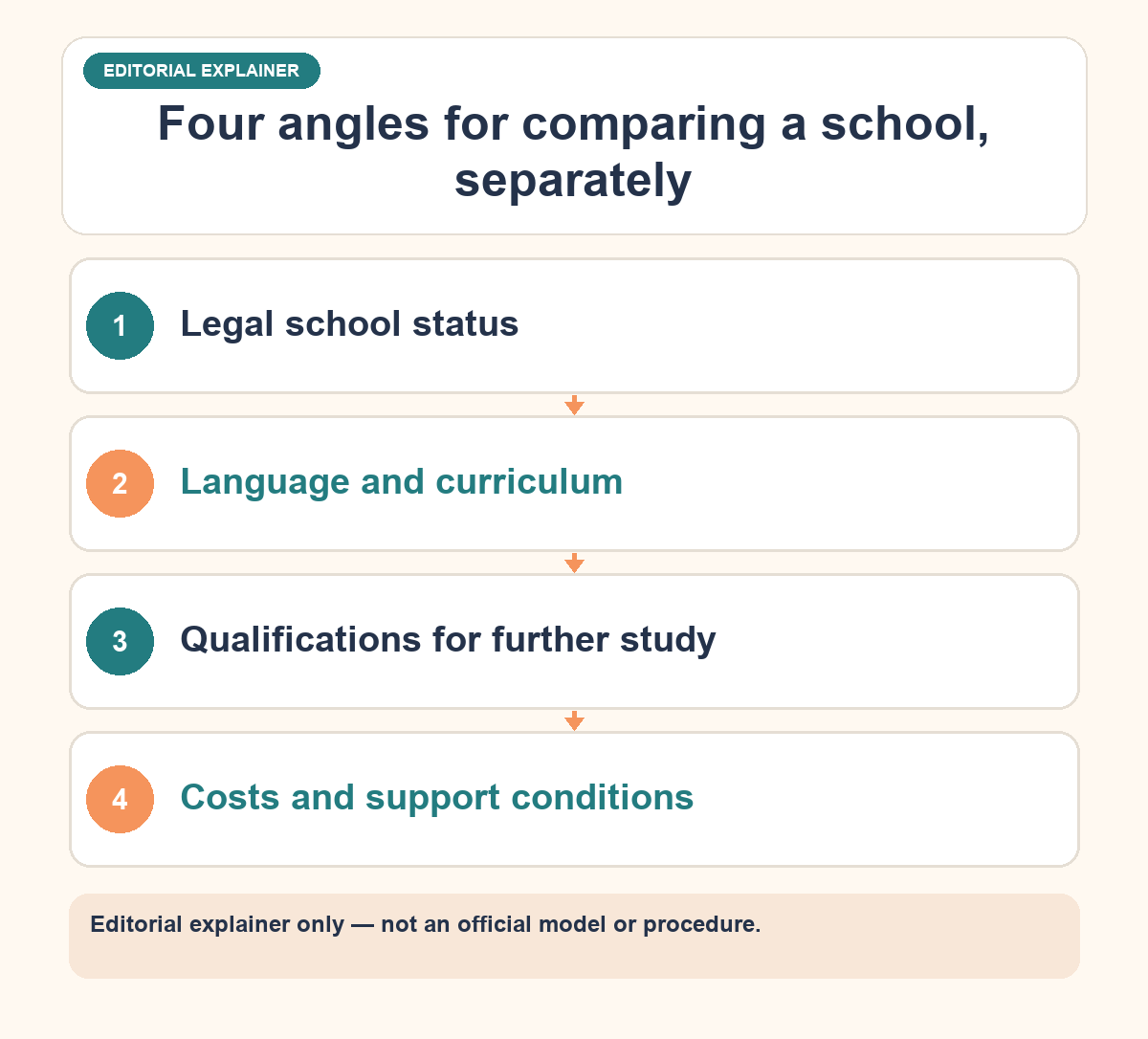
When comparing, separate five things: the school’s legal status, the language of instruction and curriculum, the qualifications gained afterwards, costs and support, and how well the school suits your child’s life. Being strong on one does not mean the others are covered. Being able to learn science in English is a different question from being eligible to apply to a Japanese high school. A school that uses an overseas curriculum may still not offer the way of getting to school your family needs.
Also note the school’s name separately from the official name of the division your child would attend. Under the same brand, the early years, primary and high school divisions may not share the same curriculum or the same office for procedures. If you add “which campus, which grade, which course” to what you hear at an information session, rereading your materials later will be less confusing. Do not judge whether the course you want is authorised from the name of the school corporation alone.
Parents’ reasons for wanting their child to learn in English also vary. You may want to prepare for a move abroad, want a different environment from your child’s current school, want to value the family’s language, or want your child to explore a favourite subject in another language. Different goals lead to different questions for the school. Go one step beyond “I want them to be good at English”, and talk with your child about the kind of day you hope they will have.
It also helps not to rely on the school as your only source of information about the system. For school-age children, enrolment procedures are handled by the board of education where you live; a school’s authorisation by the local government that oversees it; and admission requirements by the school you are applying to. You do not need to know the technical terms at the start. You can begin by giving the school’s name and the course you want, and asking, “Who should I ask about this point?”
| Angle | What you want to know |
|---|---|
| School status | Which category the course you want belongs to, such as Article 1 school or miscellaneous school |
| Language and curriculum | Which language is used, what is taught and how it is assessed |
| Qualifications and pathways | What your child will obtain, and which requirements of the receiving school it meets |
| Costs and support | The year covered, fee items and payment months, and the conditions for any support |
| Daily life and your child’s wishes | Whether the ways of getting to school, resting and asking for help seem to suit your child |
Angle 1: Article 1 schools, miscellaneous schools and compulsory schooling
Check the school’s authorisation and your child’s enrolment procedures separately.
An Article 1 school is a school defined in Article 1 of the School Education Act, such as an elementary school, a junior high school or a high school. A miscellaneous school is a separate category. MEXT explains that miscellaneous schools are set up with authorisation from the prefectural governor when they meet certain standards for teaching hours, number of teachers, facilities and equipment. If you see a short label such as “authorised”, check what category the authorisation is for.
An “unauthorised” label does not on its own tell you about the quality of lessons or how well a school suits your child. Nor can you assume it is treated in the same way under the system as a facility authorised as a miscellaneous school. When asking a candidate school about its category, you will get nearer to the information you need by asking a concrete question rather than for an evaluation, for example: “Which school category is this primary division? Is there a local government document I can check?”
Sources: MEXT, “What are miscellaneous schools?” (Japanese); MEXT, Q&A on school enrolment procedures, Question 11 (Japanese) (checked by the original editors on 10 November 2026).
According to MEXT’s Q&A, if parents send a school-age child with Japanese nationality to an international school that is not recognised as an Article 1 school, they have not fulfilled the compulsory-schooling duty set by law. This is not a judgement on the value of the child’s learning. It is how the Japanese system treats it. Do not assume that a school’s lessons or its overseas accreditation change this.
Translator’s note: MEXT’s Q&A on high school entrance eligibility states that this statutory duty is not imposed on guardians who do not hold Japanese nationality (checked for this translation on 20 November 2026). Ask your board of education how the rules apply to your child’s nationality, including dual nationality.
When you consult your board of education, explain your child’s age, any circumstances relating to nationality, where your child is currently enrolled and the course you are considering. Then ask about any notifications required, how your child’s enrolment record will be handled and what to check if your child later moves to a Japanese school. If your family has particular circumstances, such as multiple nationalities, ask for an answer that takes them into account. Avoid applying explanations given to other families, or a school’s general guidance, directly to your own procedures.
In particular, if you are simply told “you can keep your child registered at a public school too”, ask who decides how this is handled and under what conditions. Being enrolled, how attendance is recorded, completing a course and graduating are not the same thing. The fact that learning outside school is recorded does not mean a graduation certificate will be issued automatically. To support your child’s life, you need to compare what the school and the board of education tell you.
If you may move, check the answer you received from your current local government with your new one too. You do not need to decide everything about the future before enrolment, but noting “who we give what to if we move” makes preparation easier. You can also ask candidate schools in which languages they can issue enrolment certificates and academic records. Avoid cutting contact with your current school before the formal procedures are complete.
Angle 2: Separate the language of instruction from the curriculum
Schools that teach in English can still follow different countries’ curricula.
The word “English-medium” mainly gives a rough idea of the language used. It does not tell you which subjects are taught in which language, which curriculum is followed or how students are assessed. Time spent learning English as a subject is also different from time spent learning maths or history in English. If a school’s brochure lists several languages, asking to see the timetable for the grade you want makes things easier to understand.
For example, India International School in Japan (IISJ) states in its official admissions information that it follows the Indian CBSE curriculum and that English is the language of instruction. It mainly serves the Indian community living in Japan, while also referring to the admission of non-Indian nationals subject to conditions. This example shows that a curriculum linked to a particular country and teaching in English can coexist in the same school.
Sources: India International School in Japan, “Admission”; Lycée Français International de Tokyo, official website (checked by the original editors on 10 November 2026).
Lycée Français International de Tokyo (LFI Tokyo) explains on its official website that, as a member of the AEFE network, it offers a multilingual, multicultural environment based on the French curriculum. It also explains that children who do not yet speak French well can be considered, with support depending on their age, level and the places available. This is that school’s own information. It does not mean any child of any age can join without language conditions.
These two examples show how hard it is to split schools into “foreign schools teach only in the home language” and “international schools are not tied to any country’s education”. In your comparison table, rather than writing a single country name, put the language of instruction, the name of the curriculum, assessment in each grade and the qualifications aimed for on separate rows. Ask separately from the number of English lessons whether your child can keep up the language your family values.
When thinking about your child’s language skills, do not judge only from how they chat. Talking with friends, reading textbooks and putting their own ideas in writing are different situations in school life. At information sessions, ask “What do you check at entry?” and also “Who can my child talk to after enrolment if they don’t understand a lesson?” Whether extra support exists, what it costs and how long it is available need checking school by school.
The language used for communication with parents is also easy to overlook. IISJ requires at least one parent to speak fluent English, but you cannot extend this condition to other schools. Ask each school you are considering which languages can be used for meetings, absence notices, emergency contact and explanations of fees. If necessary, check in advance whether translation is available or whether you can bring an interpreter.
Even if your child was quiet during a visit, do not rush to a conclusion on the basis of language alone. In a new place or in front of many people, some children take time before they speak. After the visit, ask about specific moments, such as “What did you understand from the teacher’s explanation?” or “Who do you think you could ask if you got stuck?” Telling the school what you see at home, and thinking about it together with what the school wants to check, is more concrete than simply asking whether your child is good at English.
| School | What the official information says | What families might ask next |
|---|---|---|
| IISJ | Follows India’s CBSE curriculum; lessons are in English. Admission conditions are published | Assessment for the grade and course you want, and how far support goes |
| LFI Tokyo | Based on the French curriculum; describes a multilingual, multicultural environment | Admission and language support depending on age, level and available places |
Sources: India International School in Japan, “Admission”; Lycée Français International de Tokyo, official website (checked by the original editors on 10 November 2026).
Angle 3: Check diplomas and eligibility for further study
Treat completing a school course and meeting a target school’s application requirements as separate questions.
The first thing to ask about pathways is: “When my child completes this course, what certificate or qualification, under what name, will they receive?” Graduating from a Japanese high school, completing a course at a foreign school and gaining an international qualification cannot be lumped together. Then, depending on whether you are considering Japanese high schools, Japanese universities or schools abroad, look up what the receiving institutions require.
MEXT’s information on university entrance eligibility lists several routes. They include completing a 12-year course of regular school education in another country, completing a designated educational facility in Japan, holding certain international qualifications, and completing the 12-year course at an educational facility accredited by an international evaluation body. A school in Japan cannot be treated as “a 12-year course completed abroad” just because it uses a foreign curriculum. Check which route matches your child’s course.
MEXT’s linked accreditation page names WASC, ACSI, CIS, NEASC, Cognia and COBIS and tells readers to confirm a particular school’s accreditation with the relevant body. It also states that completing the 12-year course at a school accredited by Cognia’s subsidiaries NCA CASI, NWAC or SACS CASI is recognised. A school name, membership or general accreditation label alone does not settle eligibility. Check the campus and course covered, then compare them with the full conditions on MEXT’s main university-eligibility page (this paragraph was added in translation and checked on 20 November 2026).
Sources: MEXT, “University entrance eligibility” (Japanese); MEXT, “Foreign schools accredited by international evaluation bodies” (Japanese); MEXT, Q&A on high school entrance eligibility (Japanese) (checked by the original editors on 10 November 2026; rechecked for this translation on 20 November 2026).
When a school talks about accreditation, check not only the name of the body but also which campus or course is accredited and its current status. Membership, applying, candidate status and accreditation are not the same label. The fact that one grade has an accredited programme does not mean every grade leads to the same qualification. If the explanation is unclear, ask the school to show you the official registration details or the scope of the accreditation.
Being eligible for university entrance is separate from passing a university’s admissions selection. Even if your child meets the application requirements, they will need to prepare the subjects the faculty requires, language tests, grades and documents. If you are choosing at the high school stage, looking up which subjects are required in fields your child is interested in lets you ask more concrete questions, even before you have settled on a single target.
For Japanese high schools, too, completing the secondary division of a foreign school in Japan does not necessarily mean your child can apply automatically. MEXT’s Q&A on high school entrance eligibility describes routes such as the Lower Secondary School Graduation Equivalency Examination, and also mentions separate treatment related to guardians’ nationality and other factors. Rather than deciding your child is eligible because you think they have equivalent ability, check with the target school or the board of education which route applies to your situation and what documents are needed.
Ask your child’s current school whether it can provide documents describing their current grade, the subjects taken, how they are assessed and when they are expected to complete the course. Ask the receiving school whether those documents are enough to confirm eligibility, or whether additional certificates or an individual review are needed. Separating “what the current school certifies” from “what the receiving school accepts” reduces mismatched answers, compared with sending the same question to both.
Graduates’ destinations are useful as a reference, but they do not guarantee the same conditions for a child joining now. Graduates may have been on a different course, may have gained a required qualification separately, or university requirements may have changed. After asking “Did last year’s graduates go on to university?”, ask “Which qualification route do you expect for the course we are considering?” Also check how much room there is to change pathways.
Angle 4: Compare fees for the same year, period and item
List the payments needed at the start and the ongoing costs, not just tuition.
There is no standard fee for foreign schools or for English-medium international schools. Do not guess from the label whether a school is cheap or expensive; collect the fee information for the specific school, grade and course you want. Comparing tables for different years, or tables mixing annual and termly amounts, can make differences look larger or make you miss necessary costs. In your estimate, start by writing down the year covered and how many months each amount is for.
For household budgeting, it helps to split costs into three groups: one-off payments before entry, regular payments while enrolled, and payments when you use a service. Application fees and tuition may differ in both payment timing and refund conditions. Keep each school’s own names for fee items, and ask whether each is compulsory or optional, when it is billed and what happens if your child joins partway through the year. Items with similar names may not cover the same things at different schools.
Transport, separate from fees, also affects daily life. If you are considering a school bus, check which stops are available, how the timetable fits the end of the school day and how your child would get home on days with after-school activities. Do not assume your child can keep commuting just because a bus is available; imagine the whole day with your child, from leaving home to getting back. You can also note, next to your budget table, who could drive or accompany your child on days a parent needs to.
When you get answers about costs, look at the months of payment as well as the total. Is there a large one-off bill partway through the year? Can payments be split? Is the first payment due before any support is decided? Being able to afford the annual cost is different from being able to have the money ready in the specified month. If the information does not mention extra charges for instalment plans, ask the school rather than planning on assumptions.
If you have more than one child, rather than expecting a discount, ask which fee items it applies to, for which child and for how long. If an employer pays school fees, check separately what the school bills and what the employer covers. If outside support covers only some items, you cannot subtract the same percentage from the total bill. Keep support that has not been confirmed in a separate column from confirmed amounts.
With possible moves or changes of plan in mind, check before applying how to give notice when ending the contract and how fees are handled. Do not assume “the remaining months’ tuition will be refunded”; ask the school to show you the rules for the relevant year. A detailed comparison of refunds is left to a related article; here, keep in your first estimate the items you know are non-refundable and the ones still awaiting an answer. This is preparation for thinking as a family about both room for change and the budget, not a reason to blame your child for being unsure.
| Cost type | Conditions to align | What to record |
|---|---|---|
| Costs before entry | Items the school lists, such as at application or enrolment | Payment deadline, cancellation conditions |
| Regular costs | Annual, termly or monthly amount, and the year covered | Tuition, other compulsory items, payment months |
| Usage-based costs | Conditions for buses, lunches, activities and so on | Optional or compulsory, separate contract or not |
| If there is support | Name of the scheme, items covered, when it is decided | Confirmed amount, awaiting answer, amount paid first |
High school fee support: the new system, transitional measures and the budget programme
You cannot tell whether support is available just because a school is called a foreign school.
Tuition support at the high school stage needs checking separately from what a school is called. Under the amendment that took effect in April 2026, miscellaneous schools that exclusively serve foreign nationals, commonly called foreign schools, were removed from the types of school covered by the new High School Tuition Support Fund system, and the previous designation notice was abolished. However, it is not accurate to read this change as “all foreign school students have lost support”. There is the new system under the law, transitional measures for students already enrolled, and a separate budget programme.
First, under the new system, check both that your child attends an eligible school and that they meet personal requirements such as nationality and residence status. Whether a school teaches in English does not decide this. Even with Japanese nationality, the school’s conditions need checking separately, and having foreign nationality does not on its own make a student ineligible. This article does not make detailed judgements on nationality or residence; please check with the school and the responsible prefectural office.
Sources: MEXT, notice on the enforcement of the amendment to the Act on the High School Tuition Support Fund (Japanese); MEXT, Q&A on the High School Tuition Support Fund system (Japanese); MEXT, FY2026 budget: New Study Support for High School Students (PDF page 6, Japanese); MEXT, leaflet on support for students outside the new Tuition Support Fund system (PDF, Japanese) (checked by the original editors on 10 November 2026; the notice and Q&A were rechecked for this translation on 20 November 2026).
Next, current students. MEXT’s Q&A explains that students enrolled since on or before 31 March 2026, including those at foreign schools that were designated at the time, receive support at a level equivalent to the previous system through transitional measures. Eligibility and continued enrolment still need to be confirmed, so do not take this to mean “anyone who enrolled earlier gets the same amount”. If you are considering a transfer or a leave of absence, check the effect on support before starting the procedure.
There is also a budget programme called New Study Support for High School Students. MEXT’s FY2026 budget document lists it as a new programme of ¥1.3 billion. For public and private high schools and similar institutions, it is a mechanism in which the national government subsidises prefectures that support students’ tuition. A programme appearing in national documents is not the same as a payment being automatically decided for your family. Check the implementation guidance and application method of the prefecture where the school is located.
This programme is also described differently for new entrants and current students. For students entering from April 2026, there are conditions such as belonging to a household that could have been eligible under the former system, and people with the “Student” (ryugaku) residence status are excluded. For current students, on the other hand, the description includes international students, and support is shown for households affected by the former system’s income limit. Do not decide whether you are eligible, or how much you will receive, from an income guideline alone.
When you ask the school, go one step beyond “Can we use the subsidy?” It is easier to sort out if you ask, “Which applies to us: the new system, the transitional measures or the budget programme?” Give your child’s course, when they enrolled and whether they are continuing, and ask for the responsible office and the current guidance documents. Even if residence status or income needs confirming, you do not need to put detailed personal information into public forms or the school comparison notes from the start.
The application period for support is separate from the date you pay fees to the school. Some schools collect tuition first and settle the difference later, so ask when any support will be reflected in your bills. Do not count an estimated amount as a confirmed discount before it is decided. Separating what you pay first from your final cost if support is approved makes it easier to seek advice. Support for costs other than tuition should also be checked individually, rather than assumed to be part of the same application.
| Route | What to check | Where to ask |
|---|---|---|
| New Tuition Support Fund system | School category and the student’s nationality, residence status and other requirements | Your child’s school; the prefecture where the school is located |
| Transitional measures | Eligibility before the amendment, enrolment date, continued enrolment and so on | Your child’s school; the responsible prefecture |
| New Study Support for High School Students | Relationship to the previous system, conditions for new entrants and current students, implementation guidance | Your child’s school; the prefecture where the school is located |
Sources: MEXT, FY2026 budget: New Study Support for High School Students (PDF page 6, Japanese); MEXT, leaflet on support for students outside the new Tuition Support Fund system (PDF, Japanese) (checked by the original editors on 10 November 2026; these two PDFs could not be machine-read when reopened for this translation).
Admissions enquiries: ask separately about nationality, language and places
Check both the conditions for admission and the support available after enrolment.
The label “foreign school” does not mean Japanese nationals cannot attend, and the label “English-medium international school” does not mean anyone who speaks English can get in. In the admissions information of the school you want, read separately the age range, grades, any nationality conditions, how language is assessed, required documents and how available places are handled. Being able to apply is also separate from having a place secured.
As an official example, IISJ explains that admission of non-Indian nationals is based on a policy of maintaining a balance of nationality, gender and ability in each class. This is that school’s own policy, and you cannot assume other schools have the same condition. When contacting an admissions office, briefly explain your family’s situation, then ask first whether you can apply for your child’s current grade, and then which assessment comes next.
Source: India International School in Japan, “Admission” (checked by the original editors on 10 November 2026).
If the school invites your child to an assessment or interview, ask what it is for. Is it to decide the grade, to see how your child learns in the language of instruction, or to consider what support the school can offer? Rather than guessing the content and simply doing more practice questions, it is more useful to ask about the preparation needed, how the day will run and how your child can say if they are struggling. Also note when results will be given and how you will be contacted afterwards.
For documents from previous schools, check exactly what is required, such as grades, proof of enrolment or details of what was studied. Preparation differs depending on whether Japanese documents are acceptable, whether translation is needed, and whether the school sends them directly or the family submits them. Get the target school’s official list first rather than collecting lots of documents that were not requested. Talking to your current school early only about documents that take time to issue reduces last-minute requests.
If you mention your child’s difficulties when consulting a school, be specific about the situations you are worried about. These are descriptions of daily life, such as finding long instructions in English hard to follow, needing a quiet place when tired or finding it very stressful to speak in front of many people. Ask what the school can accommodate, whether there are extra charges and how to contact the person in charge. If you are only told that you can discuss things after enrolment, ask whether anything can be confirmed before you apply.
If communicating in English or another language is difficult, break what you do not understand into short questions. Instead of asking about admission conditions, fees and support in one long message, you might first confirm the conditions for applying, then gather the documents needed. When sharing the school’s answer with family members, keep the wording about grades and conditions, not just a translated conclusion. It is important not to rush into paying an application fee or withdrawing from your current school while parents understand things differently.
Angle 5: Your child’s own words and the load of each day
Alongside the system’s conditions, think about a daily life your child can keep up.
As your comparison progresses and the tables on authorisation, further-study eligibility and costs fill up, it can feel as if you could choose on that basis alone. But whether a school that meets the conditions is a place where your child can feel safe is something to check separately. Look at what interests your child, who they can turn to when they are struggling and when they can rest, in as much detail as the tables about the system.
Before a visit, it is enough to decide one thing the parent wants to know and one thing the child wants to see. Parents may want to know the language of instruction or who to ask questions; children may want to see the library or the feel of a classroom. Do not make touring every area or giving an opinion on the spot a condition of taking part. If needed, you can ask the school whether a visit can be cut short, or whether a parent can hear the explanation alone.
Asking “Do you want to go here?” straight after a visit can make it harder for a child to talk about what they did not understand. Try asking about what they saw: “Where did you feel settled?”, “Is there anything you’d like to see again?”, “Were there any words you didn’t understand?” It is fine if there were both good points and tiring ones. There is no need to turn your child’s impressions into scores for rating the school.
The journey to school will be closer to real life if you do not judge it from the map’s travel time alone. Lay out the morning crowds, changes of train, bags, the time your child gets home after school, and how much time is left at home to eat and rest. Trying the route on a day off is useful, but weekday crowds may be different. If you find situations where your child tires easily, ask the school about transport options and how to let them know when arriving late.
Also think about time to keep up the family’s language. There is no need to choose between using a new language at school and continuing conversations with family or favourite reading. Ask about the amount of homework and how much daily involvement parents are expected to have, and discuss how much your family can take on. You can also check that the plan does not rely on the family making up for everything without limit to raise school grades.
For a child who is very tired at their current school, there may be a period when rest should come before more visits. Changing schools will not necessarily solve every problem. You can also ask your current school and public advice services what support is available. Do not take this as your child giving up on learning; try to separate time for listening, time for gathering information and time for taking action.
In Japan, children can call MEXT’s 24-hour Children’s SOS Dial free of charge on 0120-0-78310 about worries such as bullying, problems at home or hurtful posts online. MEXT’s page does not say whether languages other than Japanese are available or whether the line can be reached from outside Japan. If your child is in immediate danger, call your local emergency number.
Source: MEXT, “SOS helplines for children” (Japanese) (added in translation and checked on 20 November 2026).
Leave room from the start to reconsider your choice. Ask in advance who you can talk to if the load becomes clear after your child starts, how you can receive records of their learning, and how much the family will support at home. Rather than making your child carry the idea that “you chose it, so you must stick with it”, adults can take on checking the system and the contract. That makes it easier for your child to share how each day feels.
10 Frequently Asked Questions
For an answer that fits your family, combine the explanations from the school and from public offices.
Can a school be classified as either a foreign school or an English-medium international school, but not both?
Not necessarily. Some schools follow a foreign curriculum and use English as the language of instruction. Rather than deciding a category from the name, check separately the school’s status under the School Education Act, its language and curriculum, the qualifications gained on completion, and its fees. Even within one school, it is important to use the documents for the grade or course you want.
Can children with Japanese nationality enrol at a foreign school?
Nationality alone does not decide this in the same way for every school. Who is eligible, language conditions, selection and available places depend on each school’s policy. Contact the admissions team of the school you are considering and give your child’s age and the course you want. Being accepted by a school is also separate from the enrolment procedures for a school-age child with Japanese nationality, so check with your board of education at the same time.
If a school is authorised as a miscellaneous school, is it treated the same as a Japanese elementary or junior high school?
Authorisation as a miscellaneous school is different from recognition as an Article 1 school. MEXT explains that sending a school-age child with Japanese nationality to an international school that is not an Article 1 school does not fulfil the compulsory-schooling duty. Do not assume that the miscellaneous school label means enrolment records, graduation and entry to the next school will all be treated the same; ask your board of education which procedures you need.
If my child is good at English, will they be able to keep up with lessons at an English-medium international school?
Being good at conversation is not enough to judge. Check the situations school requires, such as reading textbooks, putting ideas in writing and understanding lesson instructions. Ask not only about the assessment at entry but also who your child can turn to after enrolment and how far learning support goes. What you noticed during a visit, such as whether your child seemed comfortable asking questions, is also worth considering.
If my child graduates from a foreign school in Japan, can they apply to a Japanese university?
This needs checking, because it depends on the course completed and the qualification route. MEXT sets out several routes, including designated facilities in Japan, certain international qualifications and the 12-year course at educational facilities accredited by evaluation bodies. Ask the school which route it expects and what certificates it provides, and compare this with the application requirements in the target university’s admissions guidelines. Being eligible for university entrance is separate from passing the selection.
Is a school that is applying for international accreditation the same as an accredited school?
A school described as applying or as a candidate cannot be treated as already accredited. Check which body accredits which campus or course, and to what extent. If the school is describing future plans, ask separately about those plans and about the qualifications available now. You can also include, among your questions before applying, what pathways would remain if things do not go as planned.
Did tuition support for foreign school students end for everyone from 2026?
It cannot be said that support ended for everyone. Apart from the new Tuition Support Fund system, there are transitional measures for current students who meet the conditions and a budget programme called New Study Support for High School Students. What needs checking differs for new entrants and current students, and by school conditions, residence status and other factors. Ask the school and the prefecture where the school is located which scheme applies and how to apply, and do not assume payment is automatic.
If my child is eligible for New Study Support, will everything other than tuition be free too?
Even if your child is eligible, not every cost paid to the school will necessarily disappear. Check support for tuition separately from costs such as entry fees, materials, transport and activities. Also ask when support will be reflected in the school’s bills. Estimating separately the amount you must pay first and your cost after support is decided makes household planning easier.
Can we choose this kind of school if we might return to a Japanese school in future?
You can consider it, but what you need to check depends on when you would return and to which stage. Ask separately what learning records your current school can issue and what qualifications and documents the receiving school needs. For elementary and junior high school, consult the board of education; for high school, consult the target school or the board of education, explaining your child’s situation. Avoid rushing to leave your current school before acceptance has been confirmed.
What should we do if our child cannot decide after a visit?
Do not ask for an enrolment decision on the spot; instead, ask one at a time where they felt settled, which explanations they did not understand and when they felt tired. If there is something they want to see again, ask the school; if they need rest, separate the adults’ information-gathering from your child’s visits. Rather than rushing to rule schools out, you can start by recording your child’s wishes and the conditions your family must check in separate columns.
What you can do today: gather one set of documents
Today, you can start by gathering one school’s documents and sending one question.
You do not need to compare many schools at once. For one school you are interested in, gather the information on the course you want, the curriculum description and the fee table for the relevant year, and transfer them into the four basic items in the notes below. Leave any empty boxes as questions rather than filling them with another school’s information.
For points about compulsory schooling and pathways, check with the board of education or the receiving school, giving the course name and documents you received from the school. Ask your child just one thing: “What are you looking forward to, and what are you worried about?” Rather than hurrying to decide, the first step is for parent and child to share what to check next.
School comparison notes: four basic items and optional extras
Start by filling in only the four basic items, and pick one point that needs an answer.
These are notes the editorial team made for families to organise their thinking. They are not an official application form of any school or local government, nor a tool for judging eligibility. Do not write detailed nationality or residence information, income, health information, account numbers or passwords here, and check the procedures you need with official offices. Nothing you type is sent or saved automatically. You can copy your edited text to keep it.
Four basic items
Open the extra fields only if you need them
Extra fields (optional)
References
The facts in this English translation come from the Japanese original on Nijiiro, whose editors dated their source checks 10 November 2026. The Japanese page was last modified on 14 November 2026; that modification date is not a fact-check date. This translation was finalised on 20 November 2026. On that date, selected official sources were reopened for points added or changed in translation and for admissions, fee, legal and qualification rules: MEXT guidance on compulsory schooling, high school and university entrance eligibility, international accreditation and high school tuition support; the IISJ and LFI Tokyo admissions information; MEXT’s Children’s SOS Dial page; and NIJIN GLOBAL ACADEMY’s pages. The research team read MEXT’s FY2026 budget PDF, including printed page 6 (PDF page index P5), and the one-page tuition-support leaflet on 20 November 2026 using a public-document reader that exposed page-labelled text. A separate Claude WebFetch attempt could not machine-read these two PDFs; that tool-specific limitation does not mean the research team had not read them. The budget figure is a prefecture-administered programme budget, not a per-household award or actual-spending figure; the leaflet describes support cohorts and conditions, not an individual eligibility decision. All other information is also carried over from the original as of its 10 November 2026 check. Admission conditions, fees and support rules depend on the school, course, prefecture and family’s circumstances, so confirm current requirements with the relevant organisation.
- MEXT, “To foreign schools” (Japanese)
- MEXT, “What are miscellaneous schools?” (Japanese)
- MEXT, Q&A on school enrolment procedures, Question 11 (Japanese)
- MEXT, Q&A on high school entrance eligibility (Japanese)
- MEXT, “University entrance eligibility” (Japanese)
- MEXT, “Foreign schools accredited by international evaluation bodies” (Japanese)
- MEXT, notice on the enforcement of the amendment to the Act on the High School Tuition Support Fund (Japanese)
- MEXT, Q&A on the High School Tuition Support Fund system (Japanese)
- MEXT, FY2026 budget: New Study Support for High School Students (PDF page 6, Japanese)
- MEXT, leaflet on support for students outside the new Tuition Support Fund system (PDF, Japanese)
- MEXT, “SOS helplines for children” (Japanese)
- India International School in Japan, “Admission”
- Lycée Français International de Tokyo, official website
- NIJIN GLOBAL ACADEMY, “Tuition and admissions”
- NIJIN GLOBAL ACADEMY, “FAQ”
The featured image is an AI-generated illustration of fictional people. The diagram in the article is a separate editorial diagram. Neither is a photograph of a real school, family or support setting.