An international school has asked for a health form or vaccination record. What should you check, and who should you ask? This guide splits the job into three parts: the school’s latest documents, Japan’s routine immunisation system, and the rules for absence and return after an infectious illness. That way parents can check things before submitting.
Go to the family notes · Go to the 10 FAQs
Key points
- An international school’s health paperwork is a separate matter from Japan’s routine immunisations and from legal attendance suspension.
- CAJ stands for Christian Academy in Japan. It is a different school from Canadian Academy, so check that a document’s school name and URL match.
- Don’t decide on vaccinations, medical visits or return dates within the family alone. Check with the relevant contact at the school, the medical provider and your municipality.
Separate school paperwork from Japan’s public systems
“Health documents” can mean three different things: information a school collects before admission, routine immunisations run by Japanese municipalities, and attendance rules around infectious disease. Each has its own purpose and its own decision-maker. When admissions materials mention a “Health Form”, “Immunization Record” or “Medical Examination”, it is easy to assume your child legally cannot enrol unless everything is complete, or that they will fall outside Japan’s vaccination system. In fact, a school’s submission requirements and the system under the Preventive Vaccination Act (予防接種法) follow separate guidance. Start by checking each document’s name, who issued it, who fills it in and where it goes.
To keep these apart, sort your questions into three groups. The first is the school your child attends or plans to attend. It explains its own health forms, deadlines, who to contact when your child is off sick, and how a return to school is confirmed. The second is your local municipality. It sends routine immunisation notices and pre-vaccination questionnaires, and handles questions about records and certificates. The third is medical providers. They deal with vaccination history, health status, how to read overseas records, and individual medical decisions about consultations or vaccinations. If a school form has a doctor’s section, keep the school’s required format separate from what you need to discuss with a medical provider.
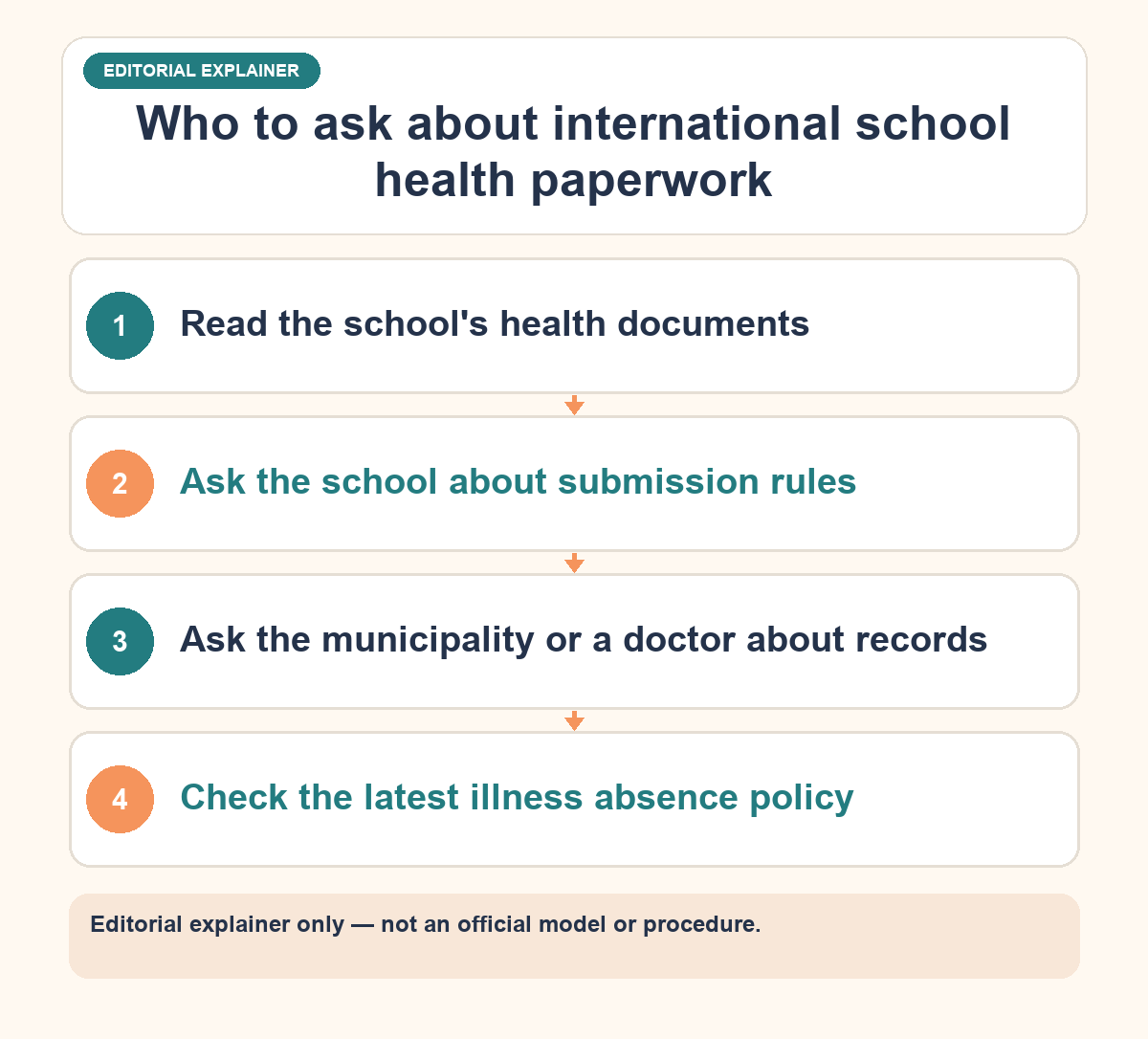
A parent’s first step is not to arrange extra vaccinations or count sick days. Confirm the enrolment year and grade, open the latest version of the school’s documents, and ask the school which information is mandatory. If you have lost vaccination records, contact your municipality. If you have questions about past vaccinations or symptoms, contact a medical provider. Asking each one separately cuts down on crossed answers.
Before submitting, work through five checks in order: (1) the latest version on the school’s official site and the year it applies to; (2) which vaccination records are required and in what formats they are accepted; (3) which sections a doctor completes, and who to consult; (4) where to submit, the deadline, and how receipt is confirmed; and (5) how to report an absence for infectious illness and how a return is confirmed. Not every family faces the same documents or vaccination conditions. Don’t assume an item is “not needed” because it doesn’t seem to apply. Check with the school, then note the answer.
Sometimes one document quotes both “school health rules” and “Japanese law”. Even then, a school voluntarily citing a law as part of its own rules is not the same as that law applying directly to the school. Check the school’s legal type, the year the document covers, when it was last updated and who makes the final decision. Mark anything unclear as unconfirmed, then ask the admissions office, the school health office and your municipality in turn.
| What to check | Main contact | Example questions |
|---|---|---|
| Health forms and school submissions | Admissions office, school health office | Which is the latest form? Who submits it, by when, and in what certificate formats? |
| Routine immunisations and municipal records | The immunisation section of your municipality | Who is eligible in my municipality and when? What are the conditions for record enquiries or certificates? |
| Individual decisions on vaccinations and consultations | Your family doctor or another medical provider | Given the records and my child’s health, what consultation is needed? |
Even after you submit the school’s documents, the records may be used when your child moves up a grade or receives care in the health office. Ask who can see them, how they are stored, and which form to use if the information changes. That can save you sending the same information again and again after enrolment. Don’t assume the process ends once the form is in. Also check how receipt is confirmed and how you will hear about any missing documents.
Match the school’s full name and the form version
If a document just says “CAJ”, match the URL domain, the school’s full name and its location, so you don’t confuse it with another school’s admission requirements. The caj.ac.jp site cited here is the official website of Christian Academy in Japan in Higashikurume, Tokyo. “CAJ” in its curriculum guides and health forms is short for this school’s name. Canadian Academy (canacad.ac.jp) is a different school. The names are similar, but you cannot apply one school’s health submissions or infectious disease policy to the other.
When looking for health forms, don’t rely on search-result headings. Check the page logo, footer, address, who the admissions information is for, and the file title. When saving a PDF, look at the school name printed on the cover, not just the file name. Confusing schools can mean passing on the wrong submission address, and even the wrong health checks or absence rules. If a document only gives an abbreviation, find the full name on the school’s official website and note it down.
Christian Academy in Japan’s Health Information page could not be read at its current official URL when the Japanese article was prepared, and a check on this translation’s date (21 November 2026) also returned an error page. Ask the school’s admissions office when health histories and doctor-completed forms are due, and which year that applies to. Because Canadian Academy is a different school, don’t carry health conditions found at one school over to the other.
According to the Japanese article’s reading of the form, Christian Academy in Japan’s official English Tuberculosis Screening form is a questionnaire for new students or students entering Grade 6. The form says parents complete it and present it to the doctor at the physical examination, and the doctor decides whether a tuberculosis test is needed. This is what CAJ’s published form says. It is not an instruction that every child must be tested. Check with the school which version of the PDF applies to the current admission year, and ask a medical provider whether your child needs a test and how.
If you use this questionnaire, check the school name, target grade, PDF version and whether it is used in the current admissions process. Ask the Health Office or admissions office, “Which is the latest version required for new students this year?” Writing records on a form and getting a new vaccination or test are separate actions.
| School and document | What the document showed | What prospective families should check |
|---|---|---|
| Christian Academy in Japan: TB questionnaire | For new students or Grade 6. A form on which a doctor decides whether testing is needed | Which version applies this year, where to submit, deadline |
| Nishimachi: Immunization Form | Instructions to submit proof of vaccination as a PDF/JPEG in English or Japanese | The latest form and any other required documents |
| The British School in Tokyo: Health & Safety | Health office contact details and a link to the Health History Form | Which form applies to the desired grade, and the absence contact |
Sources (as cited in the Japanese article, checked 10 November 2026): Christian Academy in Japan, “About”; the same school’s “Health Information” (current text could not be read at the direct URL; it also returned an error on 21 November 2026); the same school’s “Tuberculosis Screening (English)” (not re-verified for this translation); Canadian Academy, “Application Forms 6–12” (year of issue unconfirmed, so not used as a current requirement).
Health forms, vaccination records and doctor sections have different roles
Don’t lump everything together as “proof of vaccination” because of a document’s title. Check one by one who fills it in, what it proves and who it goes to. A school’s Health History may be a questionnaire in which parents describe allergies, health needs and medical history. An Immunization Record shows which vaccines were given and when. A Physical Examination form is completed by a doctor with the content the school specifies. Even when they are about the same child, documents with different purposes or authors cannot necessarily stand in for each other.
Parent sections, vaccination-record uploads and doctor examination sections may sit side by side in one PDF or portal, but check separately who writes what. The tuberculosis questionnaire from Christian Academy in Japan, which the Japanese article was able to read directly, tells families that a doctor decides on any testing needed. Nishimachi’s current immunisation form is for reporting records, and The British School in Tokyo’s current Health & Safety page links to a health history form and the Health Office. Check each form’s content and deadline in that school’s latest version, and never fill in a doctor’s findings section yourself.
Nishimachi International School’s currently published Immunization Form asks you to enter your child’s vaccination information and upload documents confirming the vaccinations. Files must be PDF or JPEG, in English or Japanese, and families with more than one child at the school are asked to submit a separate form for each child. Separately, the school’s Health and Wellness page says it has no required immunisation schedule of its own and expects students to follow either the Japanese schedule or that of their home country. This shows that asking for records is different from setting a school-specific vaccination standard.
As these two schools show, health history forms, doctor-completed physicals, vaccination records, and the scope and method of tuberculosis screening are not uniform. Schools that all call themselves “international schools” may differ in their status under the School Education Act, target grades, management, medical staff and submission routes. Don’t copy another school’s sample answers, and don’t apply one school’s health requirements to a new school. Use each school’s latest official pages and its admissions staff’s answers.
When you contact the school, put the form title in the subject line and ask about each document: “Is this mandatory?”, “Which school year does it cover?”, “Do you accept a copy of the record alone?” and “Which sections need a doctor’s signature?” Also ask whether a missing item would put admission on hold, whether it can be submitted after enrolment, and how gaps in the record are handled. This helps you plan the steps before rushing to book a medical appointment you may not need.
| Type of document | Typical role (example) | What to ask before submitting |
|---|---|---|
| Health History | Parents tell the school about health information and support needs | Mandatory fields, who it is shared with, when it must be updated |
| Vaccination record | Shows past vaccinations and their dates | Original or copy, translation, whether electronic file formats are accepted |
| Physical Examination | A doctor checks and completes the specified form | Target grade, appointment deadline, doctor’s signature, form version |
| Infectious disease screening | School questionnaire or checking procedure | Who assesses it, and who decides whether testing is needed |
Nishimachi’s form has separate fields for entering vaccination dates into the school’s format and for attaching supporting documents. Read each school’s submission guidance to see whether completing the form is enough, or whether you should also attach municipal records or a copy of the Maternal and Child Health Handbook. Even if the form offers options such as “Not Yet” or “N/A”, don’t decide their medical meaning within the family. Ask the school health office how to complete them.
“Not vaccinated”, “record unknown” and “record exists but does not match the school’s fields” are different situations. Don’t assume a missing record means no vaccination, and don’t guess the number of doses to fill a blank. Ask the municipality or the clinic that gave the vaccination about past records, the school about how to submit, and a doctor about future health questions. Putting each question to the right contact, rather than sending everything to everyone at once, makes the answers easier to keep track of.
Sources: Nishimachi International School, “Immunization Form”; the same school’s “Health and Wellness” (checked by the Japanese article on 11 November 2026; key points re-checked for this translation on 21 November 2026). The current text of Christian Academy in Japan’s “Health Information” could not be read and is not used as evidence for current requirements in this section.
Check the school’s latest infectious disease rules
When reading a school’s conditions for absence and return, look beyond the illness name: check the grades covered, the date, who decides within the school and how to make contact. On its Health and Wellness page, Nishimachi International School says unwell students must stay home until fully recovered, and that detailed illness-specific guidelines are available separately. The British School in Tokyo’s current Health & Safety page gives the school nurses’ contact details and a link to the Health History Form. The pages serve different purposes, but both are examples of how to find a school’s own contacts and guidance.
If you find a saved PDF or email, check the school name on the cover or footer, the issue or revision date, the grades covered and where the form links go. Old versions still showing in search results may not match current school policy, so check whether the document is linked from the current official page and matches what the health office tells you. Use each school’s latest version for illness-specific conditions, and never lift a number of days from one school and apply it to another. If you can’t tell which is the latest version, ask the health office which year it applies to.
Return conditions may involve more than counting days or checking temperature. Confirm in writing the symptoms the school specifies, how diagnoses and test results are treated, any doctor’s certificate, decisions by the school nurse or principal, and how class closures are communicated. When schools use different wording, such as “until fully recovered”, “follow the doctor’s instructions” or “in accordance with the School Health and Safety Act”, don’t leave it vague. Ask exactly which guideline or version of the rules is meant.
The contact for reporting an illness may not be the same as the general absence form. Check whether the school wants you to tell the nurse, the health office, the homeroom teacher or the office. Also check whether infections in parents or other household members must be reported, the emergency contact for weekends and closure days, and what information is needed. Make sure the email address on the school website is current. When forms or contact methods change, don’t rely only on PDFs you saved earlier.
“It’s in the school rules, so it’s the same as the law” is not necessarily true. A school may adopt Japanese standards as its own rules, or it may refer to other hygiene guidelines. To find out what a decision is based on, ask: “Is this absence under the school’s handbook or a legal attendance suspension?”, “Who checks whether my child can return?” and “Could you share the latest version of the document this is based on?” Families cannot work out an actual return date or a diagnosis from the table below.
| Field to check | What to look for | Question if information is missing |
|---|---|---|
| Document version | Issue or revision date, year covered, grades covered | Is this document still in force? |
| Reporting an absence | Contact point, reporting time, information needed | Is it the same after a positive test or when a family member is infected? |
| Confirming a return | Who decides at the school, whether a doctor’s document is needed, order of checks | Which staff member checks what? |
| Basis referred to | School policy, laws, information from municipalities and others | Is this the school’s own rule or a law that applies directly? |
| Effect on lessons and activities | Absence records, online provision, events and exams | Where do we check learning and assessment separately? |
If the school pushes for an early return, or if you can’t judge how long your child should stay home, you don’t need to apply legal day counts yourself. Ask the school to show you its latest policy, and take questions about your child’s condition or diagnosis to a medical provider. These checks protect your child’s health and the safety of others. They are not about blaming parents or making children responsible for explaining every absence.
Sources: Nishimachi International School, “Health and Wellness”; The British School in Tokyo, “Health & Safety” (checked by the Japanese article on 11 November 2026; key points re-checked for this translation on 21 November 2026).
Japan’s routine immunisations are a separate public system
A school asking for vaccination history is one question. Who is eligible for Japan’s routine immunisations under the Preventive Vaccination Act, when and at what cost is another. Check them separately. The Ministry of Health, Labour and Welfare (MHLW) publishes the routine immunisation implementation guidelines and vaccine-by-vaccine information on its official site. The page lists the guidelines as revised on 1 October 2026. Eligibility details and procedures can change, so don’t use an old vaccination calendar or another country’s form to decide eligibility in Japan. Check it against your municipality’s current guidance.
Routine immunisations in Japan are carried out by municipalities under the Preventive Vaccination Act. Within the national framework, municipalities use residence records and local administration to notify eligible people and tell them about questionnaires and vaccination sites. Chiba City’s guidance, for example, explains how it handles routine immunisations for people registered as residents of the city who receive an eligible vaccination within the set period. That is Chiba City’s own explanation. Don’t assume another municipality has the same clinics, cost information or eligibility checks.
When you submit vaccination history to a school, the school is not deciding whether your child is eligible for routine immunisations. School forms are sometimes designed simply to record “which vaccinations were received, and when”. A school asking for vaccination dates does not change your municipality’s routine immunisation periods. Nor should you read a field for a particular vaccine on a school form as meaning that the vaccine is a routine immunisation in Japan, or that your child must receive it.
The Ordinance for Enforcement of the Preventive Vaccination Act provides for the issue of vaccination certificates (予防接種済証). For infants, young children and pregnant women covered by the Maternal and Child Health Handbook, it provides for the details to be recorded in the handbook instead. Check the school’s form or admissions office to find out what it accepts as proof. Entries in the handbook are useful as an official vaccination record, but they do not automatically replace every school’s specified format, doctor’s signature or English medical certificate.
If you don’t know which year your materials are from, first check whether your municipality’s immunisation page shows an update date, then check the version on the national guidelines page. Old pages in search results may give eligible ages or costs for a different year or municipality. If you moved during the year or moved to Japan from abroad, the handling of vaccination vouchers and records may differ. Tell the relevant section where you have lived and since when, and ask what procedures currently apply.
This explanation is not a vaccination schedule telling you which vaccines your child should receive. How to read vaccination history, how past vaccinations are treated, and whether a consultation or vaccination is needed given your child’s health all call for individual medical advice. If a doctor or the municipality suggests checking something, discuss it separately from the school’s submission requirements, and ask the school only about the proof it needs and how to submit it.
Sources: MHLW, “Vaccination and vaccine information” (予防接種・ワクチン情報) (lists the routine immunisation implementation guidelines revised on 1 October 2026; re-checked for this translation on 21 November 2026); MHLW, “Ordinance for Enforcement of the Preventive Vaccination Act” (予防接種法施行規則), Articles 3 and 4 (checked by the Japanese article on 10 November 2026); Chiba City, “Vaccinations for overseas travellers” (checked by the Japanese article on 10 November 2026; re-checked on 21 November 2026).
Lost the Maternal and Child Health Handbook? Check municipal records
Which vaccination certificates a municipality can issue, and how to apply, vary between municipalities. Don’t assume there is one nationwide reissue procedure. Check the conditions with your current municipality. If you can’t find the Maternal and Child Health Handbook (母子健康手帳), search again where it might be kept, then ask the clinics that gave the vaccinations and any municipality you used to live in whether they hold records. Your current municipality won’t necessarily hold all vaccination records. Records from before a move, voluntary vaccinations and vaccinations received abroad may fall outside its usual certificates.
For cases where records can’t be found, Chiba City says it issues a vaccination history certificate (予防接種履歴証明書) covering routine immunisations it carried out from April 2017 onwards. It says it cannot certify routine immunisations before April 2017, voluntary vaccinations, or routine immunisations carried out by other cities. This shows that such a certificate does not recreate a child’s complete vaccination history wherever you ask. It certifies only the records that municipality holds. Families in other municipalities should check their own area’s scope, fees and application method.
Chuo City’s explanation of its vaccination certificate (予防接種済証) covers vaccinations given using pre-vaccination questionnaires and similar forms issued by Chuo City. It also says it cannot certify vaccinations given with another municipality’s questionnaire or voluntary vaccinations, and that issue may take around 10 business days from application. If you only start looking into certificates when the school deadline is close, the certificate may not arrive in time. Before applying, ask the municipality which vaccinations are covered, what documents are needed, how to collect the certificate and roughly how long it takes. Ask the school how it handles a certificate that arrives late.
Itabashi City’s official page explains how to obtain a Japanese or English certificate for routine immunisations and other vaccinations it carried out. As examples, it asks for the Maternal and Child Health Handbook to check the records, the applicant’s identification, and a passport or similar if English spelling is required. It also explains that its certificates are issued in the name of the director of its Health and Welfare Center, not in a doctor’s name. If the school specifies “completed by a doctor” or “doctor’s certificate”, ask the school first whether a municipal English certificate can be used instead.
Municipal certificates differ by area in fees, processing time, which records are covered and how much appears in English. An English version may simply translate the certificate, or you may need a document confirming how your name should be spelt. If the information isn’t on the website, explain the purpose, such as “We need it in English for an overseas school” or “The form says a doctor’s signature is required”, and ask what formats the municipality can issue. For anything it cannot issue, ask whether you can consult the clinic that gave the vaccination or your family doctor.
| Municipality (example) | What is published | What families elsewhere should not assume |
|---|---|---|
| Chiba City | Example of certifying the city’s routine immunisation records from April 2017 onwards | Other cities, voluntary vaccinations and periods outside the scope are handled separately |
| Chuo City (Tokyo) | Certificate based on questionnaires issued by the city. Guidance says issue takes around 10 business days | Records from other municipalities and voluntary vaccinations are outside this guidance |
| Itabashi City (Tokyo) | Japanese and English certificates for records that meet its conditions | A municipal certificate is not the same as a certificate in a doctor’s name |
If the records can’t be found and no certificate can be issued, start by telling the school that the record is unknown, and ask what to submit instead. Schools differ on whether you can submit with blanks, whether a record enquiry to a medical provider is needed, and whether late submission is allowed. Don’t fill in dates or doses from memory, and don’t assume a missing record means no vaccination. Keep confirmed information and unknown information separate.
Sources: official guidance from Chiba City, Chuo City and Itabashi City (checked by the Japanese article on 10 November 2026; the points above were re-checked for this translation on 21 November 2026).
Overseas vaccination records: keep originals and check accepted formats
Don’t convert the number or names of vaccinations received overseas into Japanese routine immunisation records yourself. Keep the documents first, then ask the school, the municipality and a medical provider, in that order, where they go and how they are read. Vaccine brand names, abbreviations, language, date order and whether there is a doctor’s signature can vary by country and provider. If a document is not in English, don’t assume it is invalid just because you can’t read it straight away. Keep it in a form that shows the original and the issuer, and ask the school which formats it accepts.
Some schools specify the language, file format and fields for vaccination records. Nishimachi’s published form asks for records in English or Japanese, as a PDF or JPEG. This should not be read as a rule that every school accepts only Japanese or English. Ask any other school whether it requires a translation, whether the translator needs particular qualifications, whether a doctor-completed section is needed, and what conditions apply for your child’s planned year of entry.
Even if a translation is required, don’t replace unclear abbreviations with Japanese vaccine names yourself or decide on your own whether enough doses were given. Keep the original product names and dates legible, and ask the school which parts need translating and whether to submit a copy of the original as well. If a medical assessment of the vaccination history is needed, take the documents to a medical provider.
Japanese municipalities may exclude vaccinations received abroad from the certificates they issue. Itabashi City’s guidance says it cannot certify vaccinations received overseas. That describes what Itabashi City issues. It does not mean overseas records are refused by every school. Ask separately whether a municipal certificate is needed, whether the school checks overseas medical records directly, or whether it wants a supplementary document from a doctor.
If time differences or school holidays mean you are waiting for a reply, confirm the submission deadline first, and raise any risk of missing it early. Agree with the school before going ahead with provisional documents, a formal certificate later, or a translation that follows later. Rather than worrying about what happens after the deadline, it is more practical to note who approves exceptions, plus the contact details and the date of their reply.
For families with different nationalities or residence situations, eligibility for municipal routine immunisations may also depend on individual conditions. Don’t use this article to judge eligibility from nationality alone. Give your municipality the necessary details of your address and residence status. Don’t combine completing the school form and using the system under the Preventive Vaccination Act into one question. Ask each contact separately.
Check attendance suspension rules against the school’s legal status
Before applying the attendance suspension standards in Japan’s School Health and Safety Act to every school that teaches in English, check the school’s legal category and its actual rules. Article 2 of the Act defines a “school” for its purposes as a school provided for in Article 1 of the School Education Act, and Article 19 provides for the principal to suspend attendance in connection with infectious diseases. However, the name “international school” alone does not tell you which category a particular institution falls into, or whether it has adopted other rules.
The Ministry of Education, Culture, Sports, Science and Technology (MEXT) explains in its school enrolment Q&A that there is no special category in law for “international schools” as a whole. It says some have been recognised as Article 1 schools, many have been recognised as miscellaneous schools (各種学校), and a not insignificant number appear to be unauthorised. So “International”, “Academy” or “School” in a name does not tell you its legal category. Ask the school directly for its full name and its authorisation or establishment type.
Ask two questions separately: whether the legal procedure under this Act applies directly, and whether the school has adopted Japanese standards as internal rules. Schools may set infection control measures separate from the statutory procedure, and public health guidance from the municipality or public health centre may also apply. If you don’t know the school’s category, ask who runs it and which authority oversees it. For individual infection situations or medical judgements, check who is responsible at the school, the public health centre or the medical provider.
What families should keep is not their own list of days per illness, but the school’s answer about which basis and version it uses. You can ask: “Is this an attendance suspension under the School Health and Safety Act, or the school’s own infectious disease policy?”, “Who confirms the return?” and “Which is the latest version of the document referred to?” Legal default periods, doctors’ findings and exceptions, and school-specific reporting and return procedures are different things. Don’t decide on a return to school from the numbers in a table alone.
Even when a school’s operator says “We follow Japanese standards”, distinguish between direct application of the law and adoption as internal rules. A school may use similar guidelines to the law on its own initiative. That does not make it an Article 1 school, and it does not mean other international schools have the same legal treatment. Check which article of which document is being referred to, and if it’s unclear, also ask your municipality or a specialist contact.
If a child with Japanese or dual nationality is of compulsory school age in Japan, the international school’s legal category and compulsory education requirements are an important matter, separate from absence procedures for infectious disease. MEXT explains compulsory education for children attending international schools not recognised as Article 1 schools. It states that sending a Japanese-national child to such a school does not fulfil the statutory duty to ensure schooling. Families with foreign or multiple nationalities should not judge their own situation from the school name either. Ask the board of education where you live which procedures apply and who to consult.
This is an area where the gap between legal language and everyday school language is especially hard to see. Keep together the issuer of any notice that says “attendance suspension”, its legal basis, start date and how a return will be confirmed. You don’t have to make a legal assessment as a family from a school email alone. If you don’t understand what a notice means, point to the relevant part of the document and ask the school to explain, then check with a public contact if needed.
Sources: e-Gov Laws and Regulations, School Health and Safety Act (学校保健安全法), Articles 2 and 19 (official XML) (re-checked on 21 November 2026); e-Gov, Ordinance for Enforcement of the School Health and Safety Act (学校保健安全法施行規則), Articles 18 and 19 (official XML) (checked by the Japanese article on 10 November 2026); MEXT, “Compulsory education when school-age children attend so-called international schools” (checked by the Japanese article on 10 November 2026; re-checked on 21 November 2026).
Confirm absence reporting and return decisions with the right school contact
When reporting an infectious illness, don’t decide on medical visits or school attendance alone as a family. Check what the school needs reported and who decides, and take medical questions to a doctor. When your child’s health changes, first check the school’s absence rules to see who to contact. Schools differ on whether you should wait for a confirmed diagnosis, what to write on the contact form, whether to report results later, and whether illness in parents or other family members must be reported. If you’re unsure how to describe symptoms or a diagnosis, tell the right contacts only what you have confirmed with a doctor.
Absence decisions can blur everyday absence reports, attendance suspensions decided by the school, and school or class closures during outbreaks. If the school tells you “Please keep your child at home today”, note the date, who sent the message, the reason given and when it will next be reviewed. This record isn’t only for challenging the school’s decision. It helps you pass the same facts accurately to other staff and ask for the support you need.
It also helps to check in advance what must be submitted before a return. If the school requires a doctor’s certificate, ask which form, whose signature is needed, whether it is valid only for a set period after the consultation, and whether online submission is accepted. If the school hasn’t said whether a medical certificate is needed, ask “After this illness, do you need a document from a doctor before my child returns?” and keep the answer. Don’t create your own certificate as a substitute, and don’t fill in the school’s specified fields by guesswork.
Check separately from the infection safety policy what happens with assignments, tests, school lunches, after-school activities and field trips during an absence. So that recovering and catching up on lessons don’t become one problem, talk to the grade-level staff about learning materials and deadlines if needed. While the return date is unknown, don’t promise a return date first. Share the confirmed conditions and the next planned contact with the school.
If the school gives return guidance verbally, briefly repeat back what you heard to check that you both understand it the same way. Where there are several conditions, such as “days since symptoms began”, “time since symptoms settled”, “the doctor’s judgement”, “submitting documents” or “a check by the nurse or principal”, it is up to the school to explain which conditions must be met before your child can attend. This article does not give waiting days for each illness or decide when your child should return.
If you receive a group email about an infectious disease, check which grades or classes it covers, when it was sent, who should get in touch individually and how updates will be given. School messages may be general cautions to a group, which is different from a notice about a particular child’s diagnosis or family situation. If a school message includes other students’ names or detailed health information, don’t share it further, and reply to the school only about what you need to discuss.
| Item | Information to keep | Next contact |
|---|---|---|
| Date, time and person | Date, department or role, contact method used | School health office or admissions office |
| Action requested | Absence report, documents, follow-up contact, waiting for confirmation | The school’s handbook and the staff member in charge |
| Medical questions | What to ask the doctor and the explanation received | Your family doctor or another medical provider |
| Public procedures | School enrolment system, municipal records, certificate applications | The relevant municipal section |
If your child finds it a burden to explain things to the school, you can ask whether a parent may contact the school first. Explain in words your child can understand what you have shared and who the school will talk to. You can also ask that details of an illness your child doesn’t want to discuss are not shared with classmates. Discuss with the staff member what the school needs for safety checks, and keep information given to the class to the minimum under the school’s rules.
Check who receives health information, and how, before sending it
Vaccination records and medical history help your child get the right support, but don’t send the full set through a channel where you don’t know who will read it. Confirm the recipient and how it will be stored before sharing. Check the scope and purpose of what the school asks for on its forms. When safety information is needed, such as allergies or emergency needs, don’t avoid filling it in. Use the secure contact point the school provides. If you have concerns, ask whether the health office, the admissions office or the person handling personal information is the right person to ask.
Avoid attaching detailed medical information or other students’ names to an ordinary email to the school without first confirming the recipient and method. This does not mean holding back information that is urgent or important for safety. If there is an urgent situation, first contact the emergency contact the school specifies, then confirm who should receive the details and how. Getting necessary information to the right person and not sending unnecessary information to a wide audience can go hand in hand.
When entering personal information into an online form, check that the URL is on the school’s genuine official domain, and before pressing submit, check that it covers only one child. Just as Nishimachi’s published form asks for one form per child, some schools ask you not to combine siblings on one form. Save the confirmation email or on-screen message to avoid sending the same data twice or attaching the wrong file.
If you can’t find out from official pages how long documents are kept or who can see them, ask the school about “staff who can view health information”, “staff it is shared with in an emergency” and “who to contact about updating or deleting records”. If needed, you can also ask whether information carries over as your child moves up the school, and how it is handled if you decline a place or your child leaves. If guidance arrives in a language you find hard to follow, use a translation tool, then confirm the meaning with the school before sending important personal information.
The notes parents keep don’t need to include illness names or vaccination details. Keeping administrative information, such as the submission address, the URL of the latest form, the date you asked, the answer and the next check date, makes it easier to follow resubmission steps. Don’t record My Number (individual number), passwords or other children’s contact details on your own sheet. Don’t alter official school forms, and don’t submit a homemade document in place of a municipal certificate.
10 Frequently Asked Questions
Taking the submission form and decisions about vaccination or attendance to separate contacts means your family doesn’t have to reach every conclusion alone.
1. Can I submit just a copy of the vaccination record?
Required documents differ by school. Nishimachi International School’s currently published form asks for vaccination details plus an upload of supporting documents, and specifies PDF or JPEG files in English or Japanese. The school also says it does not have its own required immunisation schedule. Ask the school you are submitting to about the type of copy, the language, any doctor’s signature and whether a separate health form is needed.
2. How do I tell Christian Academy in Japan and Canadian Academy apart?
Check the official domain and the full school name. caj.ac.jp is Christian Academy in Japan (CAJ) in Tokyo, and canacad.ac.jp is Canadian Academy in Kobe. The names are similar but they are different schools, so look at both the PDF cover and the link destination to avoid applying one school’s health forms or questionnaires to the other.
3. If the school asks for a form, must my child also receive Japan’s routine immunisations?
You cannot tell whether a particular vaccination is needed from the form requirement alone. A school may ask for a record of vaccination history, while Japan’s routine immunisations are a separate system under the Preventive Vaccination Act. Ask your municipality or a medical provider about eligibility and individual vaccination questions, and ask the school how to submit.
4. If we receive a tuberculosis screening form, does everyone get tested?
Submitting the form and needing a test are not the same thing. According to the Japanese article, Christian Academy in Japan’s published questionnaire sets out the target grades and the submission steps, and explains that a doctor decides, based on risk information, whether further testing is needed. Another school’s documents may have different conditions, so check individually with the school and a doctor.
5. If we lose the Maternal and Child Health Handbook, can the municipality reissue all vaccination records?
Municipalities differ in which records they can certify, the period covered, and how vaccinations from other municipalities or voluntary vaccinations are treated. Chiba City and Chuo City each publish guidance that limits the scope to vaccinations they carried out, among other conditions. Also check your previous places of residence and the clinics where vaccinations were given, and ask your current municipality about its conditions for issuing certificates.
6. Can a municipal English certificate replace the school’s doctor’s certificate?
Not automatically. A municipal certificate confirms vaccination records held by the municipality, while a school’s doctor form is completed by a doctor, so the issuer and purpose differ. Check the content, signature and format the school requires, and ask before submitting whether a municipal certificate can be used.
7. Can I convert doses received overseas into Japanese records myself?
Avoid guessing doses or vaccine details and writing them in yourself. Keep the original or the medical provider’s record, and check which languages, translations and formats the school accepts. Consult a medical provider about matching records medically and about future vaccinations, and check with the municipality too, because some records fall outside what it can certify.
8. Are attendance suspension periods under the School Health and Safety Act the same at every international school?
Article 2 of the Act defines a school for its purposes as a school under Article 1 of the School Education Act, and Article 19 provides for the principal to suspend attendance in connection with infectious diseases. However, the label international school alone does not tell you a school’s legal category. Ask the school about its type of establishment and the rules it applies, and confirm how your case is handled.
9. How many days must my child stay off school with an infectious disease?
This article does not set waiting periods or return dates for individual illnesses. Check the school’s latest infectious disease policy for the illnesses covered, contacts, return checks and whether a doctor’s document is needed, and consult a medical provider about your child’s symptoms or diagnosis. Do not treat the number of days in an old PDF as the current policy.
10. Can I attach vaccination records or medical history to an ordinary email?
First confirm the submission route and secure method the school specifies. This does not mean holding back information needed in an emergency; get the necessary information to the right person. Avoid sending a full set of detailed health information when the recipient or method is unclear, and do not include other students’ personal information.
What you can do today: preparing before you submit
What you can do today is not decide about vaccinations or attendance, but line up the right documents with the right people to ask. When health paperwork arrives before or after enrolment, first confirm the school’s full name and where to submit, then look at the document’s revision date and the grades covered. Check the school’s emails and parent portal, and if a PDF from a previous year turns up, ask whether it is the version currently in use.
Next, sort health forms, vaccination records, physical examinations and tuberculosis screening into separate groups. Follow the instructions on each form to see which parts parents complete, which parts a doctor completes, which records to attach and which items the school fills in later. Leave any section blank if you don’t know who should complete it, and check rather than guess. If you can’t meet the deadline, talk to the school before it passes and ask whether late submission is possible.
If you don’t have vaccination records to hand, ask your municipality which records it can certify and how to apply. If records span municipalities, for example because you moved or had voluntary or overseas vaccinations, check which office holds them. If the school asks for a document that a municipal certificate can’t cover, tell the school what the municipality can issue and ask whether another document would do.
For infectious illness absence rules, check the school’s latest policy, the contact point, return conditions and whether a certificate is needed. If you are told about a legal attendance suspension, ask about the school’s legal category, the legal provision relied on and who made the decision. Take questions about symptoms, possible infection or the need for vaccination to a medical provider, and don’t work out waiting days or treatment plans within the family alone.
Finally, send information only to the contacts who need it. Before attaching a full medical history to an ordinary email, check the secure submission method. In an emergency, don’t hold back necessary information. Contact the school’s emergency contact or a medical provider and ask where to send the details. Noting the document version, the date of each answer and the next contact date in your family notes will also help when you go through the same procedures after enrolment.
This order is not a checklist to finish before you are allowed to contact the school. If a deadline is close, records are lost or a form has a question you don’t understand, you can contact the school or municipality about just the one thing you know now. Put getting the right support to the right people first, without making your child’s health information more public than necessary.
Public places to ask
- School enrolment and compulsory education in Japan: the board of education in your municipality.
- Routine immunisations and vaccination certificates: your municipality’s immunisation section.
- Infectious disease and public health questions: your local public health centre (保健所) or a medical provider.
- If your child is worried or distressed, about school or anything else: the 24-hour Children’s SOS Dial (24時間こどもSOSダイヤル), listed by MEXT, is a free call within Japan on 0120-078-310. We did not confirm whether it offers support in languages other than Japanese.
- Families outside Japan: your local school, health and child-support services, which follow your own country’s rules.
Family notes: four basic items, extras optional
Keeping documents and answers on one sheet helps you avoid asking the school, municipality and medical provider the same question twice, and shows who to ask next. Below is a family note sheet prepared by the editorial team. It is not an official school or municipal form, and it does not replace a health form, vaccination certificate or doctor’s medical certificate. Use only the four basic items, and open the extra fields only if you need them. You don’t need to fill in every field, and you shouldn’t copy your child’s health information or My Number onto this sheet.
The four basic items are: the school name, desired year and grade; the names and version dates of documents received; the questions to ask each contact; and who answered and when you will next be in touch. With this administrative information written down, you can keep your questions short and specific when calling the school or looking for the latest form. Keep vaccination history and symptom details in the school’s specified form or through a medical provider’s secure channel.
Extra items, only if needed
Before sending anything to the school, check that the address and the staff member receiving it are official school contacts. Update the steps in the extra fields after reading the school’s latest version. When you get an answer, separate “what has been decided” from “what still needs asking”, so you don’t mistake a school answer for a decision on municipal vaccination records or medical matters. Don’t record your child’s medical condition here. If needed, parents can keep that separately in the place the school specifies.
References and related articles
This English translation was prepared on 21 November 2026 from a Japanese Nijiiro article last modified on 14 November 2026; that modification date is not a fact-check date. Statements marked as re-checked on 21 November 2026 were checked against the official source for this translation. All other school, municipal and legal details are inherited from the Japanese article and reflect its stated check dates (mainly 10 and 11 November 2026); they have not been newly verified. Forms, rules and procedures can change, so confirm them with the current school, municipality or medical provider.
Official public sources
- MEXT, “Compulsory education when school-age children attend so-called international schools” (Japanese) (legal category of schools; checked 10 November 2026, re-checked 21 November 2026)
- e-Gov Laws and Regulations, School Health and Safety Act (Japanese) (Articles 2 and 19, official XML; re-checked 21 November 2026)
- e-Gov Laws and Regulations, Ordinance for Enforcement of the School Health and Safety Act (Japanese) (types of infectious disease and period standards; whether they apply depends on the school’s legal category and the individual situation; checked 10 November 2026)
- MHLW, “Vaccination and vaccine information” (Japanese) (lists the routine immunisation implementation guidelines revised on 1 October 2026; re-checked 21 November 2026)
- MHLW, “Ordinance for Enforcement of the Preventive Vaccination Act” (Japanese) (vaccination certificates and records; checked 10 November 2026)
- MEXT, “Consultation contacts for children’s SOS” (Japanese) (added for this translation; checked 21 November 2026)
Official school information
- Christian Academy in Japan, “About” (checked 10 November 2026)
- Christian Academy in Japan, “Health Information” (current text could not be read at the direct URL; former content not used as current evidence; the URL also returned an error on 21 November 2026)
- Christian Academy in Japan, “Tuberculosis Screening (English)” (checked 10 November 2026; not re-verified for this translation)
- Nishimachi International School, “Immunization Form” (checked 11 November 2026, re-checked 21 November 2026)
- Nishimachi International School, “Health and Wellness” (checked 11 November 2026, re-checked 21 November 2026)
- The British School in Tokyo, “Health & Safety” (health office and Health History Form; checked 11 November 2026, re-checked 21 November 2026)
Official municipal information
- Chiba City, “Vaccinations for overseas travellers” (Japanese) (checked 10 November 2026, re-checked 21 November 2026)
- Chuo City, “Issuing vaccination certificates” (Japanese) (checked 10 November 2026, re-checked 21 November 2026)
- Itabashi City, “Vaccination certificates” (Japanese) (checked 10 November 2026, re-checked 21 November 2026)
Related articles
- Seven reasons families regret choosing an international school: what to check before enrolling (Japanese)
- Changing International Schools Mid-Year: A Practical Guide for Parents
- Do international schools need a lot of parent involvement? A guide to events, meetings and sharing roles at home (Japanese)
The featured image is an AI-generated illustration of an imagined scene. The diagram in the article body is a separate editorial diagram made by the Nijiiro team to show the checking steps. Neither is a photograph of a real school, student, parent or medical provider, and the diagram does not determine vaccination needs, diagnoses or whether a child can attend school.