
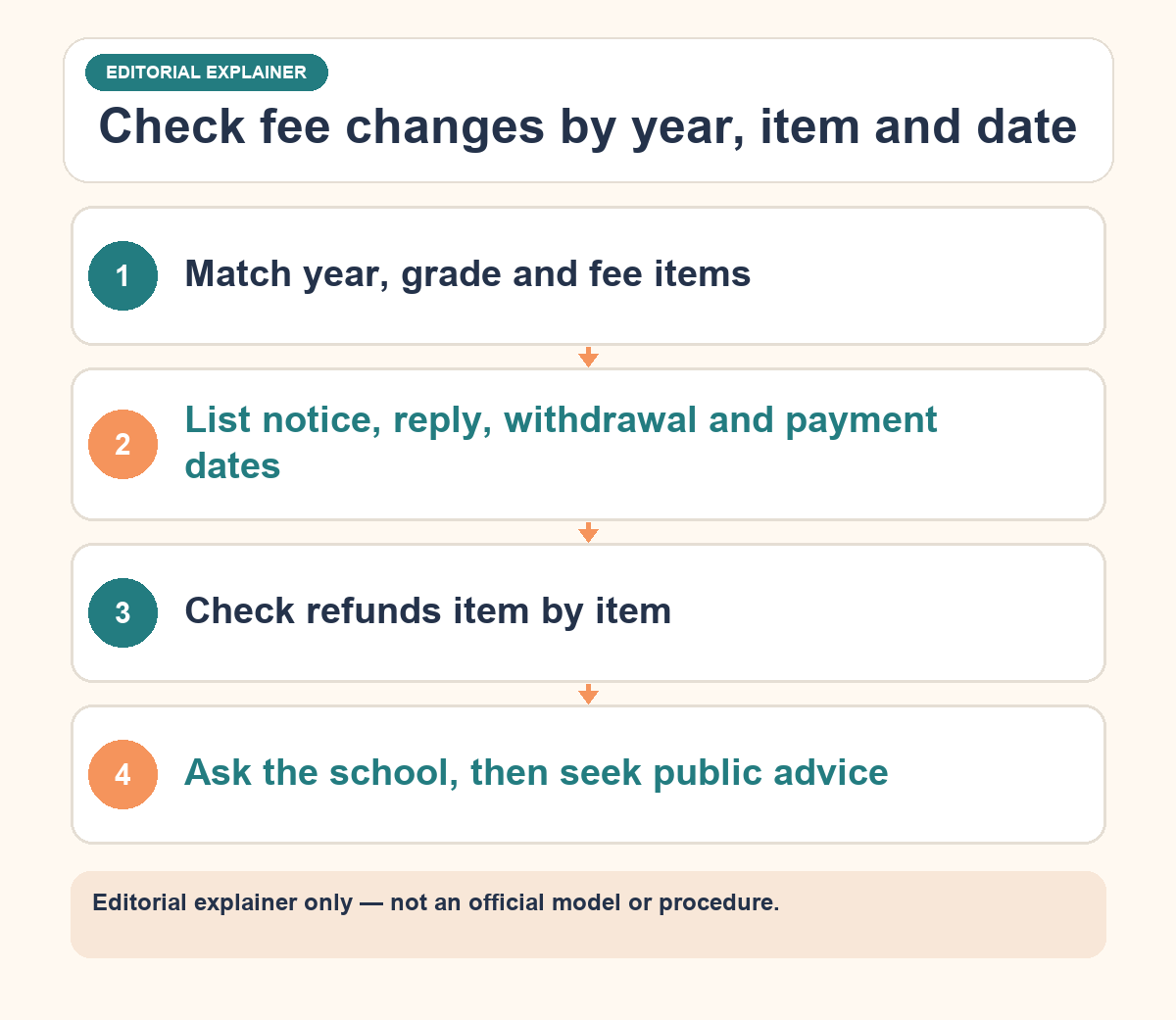
If your child’s international school tells you that next year’s fees are going up, where should you start? First, pin down which academic year, which grade and which fee items are changing, and from when. Then set this against the deadlines for replying about re-enrolment and for payment. Before focusing on the size of the increase, work out what your family needs to decide, and by when.
This article explains how to read a school’s official fee schedule and suggests questions to ask when you are deciding whether to stay. It does not offer a general ruling on whether a contract is valid or whether a refund is due. Check with the school, seek public advice where needed, and keep your child’s learning at the centre of the decision.
Go to the 10 FAQs · Go to the family checklist
Key points
- Compare old and new fees only after matching the academic year, your child’s grade, the fee items and what is being paid for.
- A policy of reviewing fees every year is not the same as a notice of what your family will be charged.
- Notice of fees, the re-enrolment reply, withdrawal notice and payment are four separate dates.
- Refund terms can differ by fee item and timing; do not assume a full refund or no possibility of discussion.
- If contract questions remain in Japan, the Consumer Hotline 188 can direct you to a local consumer advice desk (see the public advice section).
Read a fee notice by academic year, grade and fee item
Compare old and new amounts only after matching the academic year, grade, fee item and what is being paid for.
“School fees” can cover more than tuition. They may bundle annual facility fees, one-off registration fees charged only at entry, boarding fees, buses, lunches and more. Even if the total in the notice has gone up, what you need to check depends on whether tuition has changed or a newly chosen service has been added. Start by separating the items down to the line names on the invoice.
Next, check which period the amounts apply to. The Japanese calendar year and the school’s academic year are not necessarily the same. Do not rely on a phrase like “2027 fees” alone; match the start and end of the academic year with the period you want your child enrolled. If the notice says new fees apply partway through the year, ask specifically which periods and items change.
Who the change applies to also matters. Do not add a change in registration fees, which only new students pay, to the increase for a continuing family. On the other hand, at schools where the tuition band changes as children move up, the increase within the same grade band will not give you your child’s bill for next year. You need a fresh estimate for the grade your child will enter next year.
The basis for comparison also changes depending on boarding or day attendance, one-way or return bus, and paying annually or in instalments. Do not compare last year with whichever figure looks cheaper; calculate using the options you will actually use. Families who earn or transfer money in foreign currency should keep the fees set by the school separate from costs arising from exchange rates or banks.
Gather the fee schedule currently in force, the notice of new fees, the contract documents covering enrolment and fees, and any notices about the next steps. If you do not have time to read everything, first flag the academic year, what the total covers and the reply deadline. This is preparation for organising questions to the school, so you do not need to decide there and then whether to stay or move.
When looking at the figures as a family, distinguish between the monthly equivalent and the amounts you will actually pay. Dividing the annual fee into months makes it easier to relate to the household budget, but it does not mean the school offers monthly payments. Checking both the months when large payments fall due and the amount to set aside each month makes it harder to overlook when money will be needed.
If the notice comes as a shock, it is fine for the adults to take time to sort out the amounts and deadlines before raising a change of school with your child. There is no need to dismiss the worry, but presenting an unknown bill as a confirmed burden can make it harder for your child to picture what lies ahead. Start by sharing what you have been able to confirm.
| Condition | What to match | Differences that are easy to miss |
|---|---|---|
| Academic year and grade | The academic year the fees apply to and your child’s grade next year | A change of fee band when moving up a grade |
| Fee items | Tuition, annual charges and entry fees | Whether a figure is tuition only or the annual total |
| Services used | Day or boarding, bus and similar | Extra charges for services you choose |
| Payment method | Annual or instalments, handling fees and similar | A monthly estimate is not the same as actual payments |
Sources for this section
Rugby School Japan: Fees (2026–27 and 2027–28) (checked for the original article: 14 November 2026; figures rechecked for this translation: 21 November 2026)
Tokyo International School: School Fees (2026–27 and 2025–26) (checked for the original article: 14 November 2026; figures rechecked for this translation: 21 November 2026)
Separate an annual review policy from a specific increase notice
Check a policy of “reviewing fees every year” separately from a notice that “your family will be charged this amount”.
On its official fees page, Canadian Academy explains that its Board of Trustees reviews all tuition and fees annually, and refers to factors such as operating costs. A statement like this is a reason not to plan on the assumption that the same amounts will continue. However, it does not show next year’s specific amounts, or that every item will rise by the same percentage.
Rugby School Japan’s Finance and Fees Policy for 2025–26 states that fees are reviewed annually and that an updated schedule of fees will be published and circulated before 31 May each year. This is one example of a document that names the academic year it covers. That date cannot be used as a common deadline for other schools or for contracts in other years. Check with the school which version currently applies to your child’s enrolment. (This description is carried over from the original article; we could not re-read the text of version 1.3 of the policy for this translation.)
When reading a policy, record the date you downloaded the file separately from the academic year and version it covers. A document you can access now is not necessarily the one that applies to your current contract. If the website lists several years, asking the school which one to use for your family’s procedures helps avoid misreading.
It is also worth asking how notices are sent. The address or channel your family normally checks, such as email, a parent portal or paper letters, may differ from where fee notices are sent. Confirm where changes will be announced and which notice is the official one. Avoiding a situation where only one parent receives it gives you time to talk before the re-enrolment process.
If the school explains why fees are rising, read that explanation separately from the breakdown of the new fees. If facilities or educational content are changing, you can ask what will actually change. Do not assume that higher fees automatically mean more support or teaching time; checking the scope of the services described gives your family something concrete to decide on.
Even if you are not satisfied with the explanation, start by breaking your questions down. “Please cancel the whole increase” and “What is this fee item used for, and from which year is it compulsory?” call for different answers. Do not sign as if everything has been explained while questions about the rules or contract remain.
Sources for this section
Canadian Academy: Tuition and Fees (checked for the original article: 14 November 2026; annual review statement rechecked for this translation: 21 November 2026)
Rugby School Japan: Finance and Fees Policy 2025–2026 v1.3 (p. 2) (checked for the original article: 14 November 2026; not re-read for this translation)
Compare official fee schedules like for like
Separating a comparison of fee schedules from an estimate for your child’s next grade shows why the bill is going up.
Rugby School Japan’s official fees page lists annual fees for 2026–27 and 2027–28. For the same Year 7, day pupil tuition is listed as ¥4,500,000 rising to ¥4,600,000, and the full (7-day) boarding fee as ¥3,200,000 rising to ¥3,800,000. This example shows that tuition and boarding can change by different amounts. Read the boarding fee as a separate item from tuition.
If a Year 7 pupil moves up to Year 8 the following year, the difference between the two Year 7 figures will not tell you that pupil’s cost. You need to look at the Year 8 fee for the new year. Separating the change caused by the school’s fee revision from the change caused by your child moving into a different fee band makes the total in the notice easier to understand.
Tokyo International School’s official page shows the annual total for Kindergarten to Grade 2 as ¥3,000,000 for 2025–26 and ¥3,300,000 for 2026–27. Both are annual totals that include the Building Fee, not tuition-only figures. When describing them, it is important not to rephrase this as “tuition rose from ¥3,000,000 to ¥3,300,000”.
The same page also lists items not covered by school fees, such as some activities, uniforms, lunches and devices for certain grades. Unless you read what needs to be added to the annual figure, you will not know how much money you actually need for next year. If you plan to choose new activities, note the increase and the additional services separately.
These are school-specific examples for checking how to read a fee schedule. Location, grades covered, educational content and boarding differ, so this is not a table for ranking schools by price. When asking schools you are considering, “Please list the fee items needed for our family’s situation” will get you a more concrete estimate than “Is it about the same as other schools?”
If you calculate a percentage increase, state which fee item and which previous-year amount you used. The increase in a total that includes facility fees will not necessarily match the increase in tuition alone. Also, do not extend one year’s change over several years and treat it as the school’s planned rate of increase. If your family makes its own projection, keep it separate from the amounts the school has published.
When you ask the school for an itemised estimate, check that it shows which items are mandatory, which are optional and which apply only if you use a service. Some items on the schedule may not be charged to you, so multiplying last year’s bill by a flat percentage will not give an estimate. A practical order is to mark the items that change and then check the total.
| School, fee item and category | Earlier year as published | Later year as published |
|---|---|---|
| Rugby School Japan: Year 7 day pupil tuition | 2026–27: ¥4,500,000 | 2027–28: ¥4,600,000 |
| Rugby School Japan: full (7-day) boarding fee (separate from tuition) | 2026–27: ¥3,200,000 | 2027–28: ¥3,800,000 |
| Tokyo International School: K–G2 annual total (including Building Fee) | 2025–26: ¥3,000,000 | 2026–27: ¥3,300,000 |
Sources for this section
Rugby School Japan: Fees (2026–27 and 2027–28) (checked for the original article: 14 November 2026; figures rechecked for this translation: 21 November 2026)
Tokyo International School: School Fees (2026–27 and 2025–26) (checked for the original article: 14 November 2026; figures rechecked for this translation: 21 November 2026)
Four key dates: notice, re-enrolment reply, withdrawal notice and payment
Treat the date fees are announced and the dates your family must reply, give notice or pay as separate entries in your calendar.
When you receive re-enrolment information, first check whether next year’s fees have been finalised. If amounts have not yet been given, ask when they will be known, what replying about re-enrolment commits you to, and what can be changed later. Do not assume you can always withdraw freely just because fees are not final; compare the school’s answer with the documents that apply.
In your calendar, enter separately the date the school announced new fees, the re-enrolment reply deadline, the withdrawal or cancellation notice deadline and the payment deadline. Even if some fall on the same day, keep their meaning separate. Setting a target date for a family discussion before these helps you avoid talking about fees for the first time just before a reply is due.
If you only watch the payment deadline, you may miss an earlier deadline for confirming re-enrolment or giving notice of withdrawal. Conversely, simply sending a question about conditions may not count as a formal withdrawal notice or re-enrolment step. Ask which form to send to which office to complete each step, and how receipt is confirmed.
If a deadline is close and you are waiting for an answer, tell the person in charge what you are still checking and when you would like a reply. If necessary, you can also ask whether the school can discuss the deadline. However, do not assume that sending a question extends the deadline automatically; if a change is agreed, confirm the new date in writing in the reply.
Try adding a few of your child’s dates to the same calendar. Exams, events, long holidays and preparation for the next grade show the periods that matter for continuing their learning. This is not about leaving the fee decision to your child, but about making sure the adults do not lose sight of the child’s life and wishes while dealing with the procedures.
Even if a change of school is an option, think carefully about whether you need to decide on leaving your current school first. If you do not yet know a new school’s start dates, required documents, commute or costs, pursue those enquiries separately. Do not send a notice that is hard to reverse on the assumption that a place will be available elsewhere.
For payment, check the annual amount and the total if paying in instalments, any handling fees, the first payment and the deadline for changing method. Even where instalments are available, the treatment of the remaining balance on mid-year withdrawal may not work like a monthly payment. It is easier to understand if the school explains the choice of payment method separately from which period’s fees the contract commits you to.
| Date | What to check | Family preparation |
|---|---|---|
| Notice or publication of fees | Which version you received, and when | Compare who and which items it covers with last year’s documents |
| Re-enrolment reply | What replying commits you to | Set a family discussion date first |
| Withdrawal or cancellation notice | The official office, form and deadline | Distinguish enquiries from formal notice |
| Payment | Amount, due date and method | Check whether you must pay before support is decided |
Sources for this section
Tokyo International School: School Fees (2026–27 and 2025–26) (checked for the original article: 14 November 2026)
Check for mismatches between the contract, fee schedule and invoice
If amounts or terms look inconsistent, give the document name, academic year and relevant passage, and ask the school to reconcile them.
Suppose you have the contract you received at entry, the fee schedule for the new year, an explanatory email and an invoice. First, sort out which document applies to which period. Do not decide on your own that “the later one always takes priority” or that “the old amount I signed for continues forever”; ask the school which clause or notice it is basing the charge on.
When you ask, pointing out each difference specifically makes it easier to understand. For example: “This item appears on the fee schedule but under a different name on the invoice. Are they the same?” or “Is this amount annual or per term?” Before concluding the school has made a mistake, you are matching up wording, who is covered and the payment unit.
When reading policies in English, read the paragraphs around anything relating to changes, renewal, refunds and withdrawal notice. Machine translation can help you get started, but do not draw contractual conclusions from translating a single sentence. Ask the school to explain unclear terms in plain language, and keep important terms in the original wording too; this helps if you seek advice later.
If there are several parents or guardians, or an employer pays the fees, confirm who handles the contract and communications with the school. If the person who agrees to the school’s estimate, the person who applies to the employer and the person who pays are different, the school’s deadline may pass while approval is pending. Do not treat the school’s and the employer’s procedures as the same thing.
After receiving an explanation, you can summarise your understanding briefly and check it with the school. For example: “Is it correct that next year covers this grade, that this total does not include the bus, and that the re-enrolment reply is due by this date?” This is not drafting a new contract yourselves, but making sure the answer has not been misread.
If questions about the amount remain, you cannot conclude from this article that it is fine not to pay. Whether to withhold payment, and how to treat deadlines, needs advice based on your contract and situation. Gather your questions to the school, its replies and your documents in a form you can take promptly to a public consumer advice service or similar.
Treat refunds and deposits by fee item, timing and conditions
Do not jump to conclusions such as “the fees went up, so we get everything back” or “it says non-refundable, so there is nothing to discuss”.
When a fee change makes you consider moving schools, how much of what you have paid will come back is an important question. However, application fees, registration fees, tuition, facility fees, deposits and bus fees are not necessarily subject to the same conditions. Do not extend a “non-refundable” statement for one item to every payment.
Tokyo International School’s official 2026–27 information lists the application fee, registration fee and Development Fee for new students as non-refundable one-time fees. This describes the specified items for that year. It cannot be applied directly to another school, or to tuition after enrolment has begun. Match the names of the items you paid against the rules.
If something is called a deposit, check whether it is a payment to secure a place or money held to settle unpaid amounts and similar. It is important not to decide from the name alone that it will always be returned in full at the end. Knowing when it is returned, what may be deducted and how to claim it makes it easier to estimate the money you need for a move.
Even at the same school, conditions may differ between declining a place before entry and withdrawing after classes have started. Also ask how the official entry date, last day of attendance and the date withdrawal takes effect are treated. Do not calculate on a daily basis that “we only pay up to the last day attended”; ask the units and conditions the school uses to settle accounts.
When estimating a refund, get an itemised answer from the school. Separating the amount already paid, the amount the school says will be refunded and any amounts still to be charged prevents double deductions and stops you counting a refund as money available in time for the next school’s payments. If you do not know the transfer date or charges, ask about those too.
For activities or services you will no longer need, check whether the provider is the school or a separate company, and whether a separate cancellation is required. Notifying the school of withdrawal and stopping bus or extracurricular services are not necessarily completed at the same time. Keep a record of where you sent notices and confirmations of receipt, rather than sending one email to the school and assuming that is the end of it.
Sources for this section
Tokyo International School: School Fees (2026–27 and 2025–26) (checked for the original article: 14 November 2026; non-refundable one-time fee listing rechecked for this translation: 21 November 2026)
Map your family budget and peak payment months
Think about the total for the year and the cash needed in months when payments cluster as two separate questions.
Once you know the fees, first add up next year’s mandatory costs, then add the services you choose. Lunch and transport cost your family money even if they are not on the school’s invoice. Working out the amount paid to the school separately from your total spending on continued attendance makes it clearer what could be changed.
Next, place the planned payments month by month. Even if the annual amount seems manageable, months when the annual payment coincides with housing costs or a sibling’s school costs may need separate preparation. Compare the school’s payment deadlines with when your family receives income, and if you see a shortfall, check before paying whether instalments or similar arrangements exist.
If your employer provides support, ask the person responsible which items are covered, the cap, when to apply and whether you must pay first. The total the school presents and the items your employer accepts are not necessarily the same. Including how long the support lasts and what happens on transfer, do not assume from the school’s explanation alone that “next year will also be fully covered”.
If scholarships or discounts are offered, check the eligibility conditions, the assessment, the conditions for renewal and when decisions are made. Read reductions to the school’s basic fees separately from support offered to some families. If payment is due before support is decided, think about how to cover the period until the decision, and do not count support that has not been awarded as confirmed income.
When your family projects future costs, record the next-year amounts the school has published separately from the assumptions you make. You can vary assumptions to test the burden, but do not tell your child or others that an increase rate you chose yourselves is the school’s plan. Sharing as a family when you will review and what your upper limit is will be more useful than trying to predict several years ahead exactly.
When looking for savings, do not simply swap your child’s necessary learning support or safe transport for the cheaper option. If you cut extracurricular activities, ask your child what matters to them; if you plan more driving by family members, consider the load on work and rest. Time and support, not just money, are part of judging whether you can keep going.
Start your questions to the school with the facts
Ask the school about “the fees that apply, the document they are based on and your family’s deadlines” as questions that are easy to answer.
For your first contact, choosing about three unanswered points you need for your decision is easier to manage than sending a long list of requests at once. Include the academic year and grade, the fee items you want to know about and when you need to reply. If admissions and finance are handled by different staff, also ask which one to contact.
For example, if you need an estimate of next year’s annual fees, you could ask: “Please show tuition, annual charges and mandatory additional costs separately.” If you are being asked to reply about re-enrolment, ask: “How are fee changes after we reply handled, and which policy applies?” This is not a claim that the school must allow changes, but a question to understand the conditions.
If you get answers at an information session or by phone, briefly note the date, the office and what was confirmed. It is reassuring to have important amounts and deadlines shown in a notice or reply you can refer to later. Do not treat the tone of a conversation as agreement; ask for the documents you need to reread as a family.
If you are worried about language, splitting questions into short ones also helps. If you use translation tools, avoid giving external services more than necessary, such as your child’s name, invoice numbers or family circumstances. You can also ask first whether the school can explain in Japanese or another language, or whether an interpreter can attend.
When you receive a reply, check whether your original questions have been answered and what still needs deciding. Understanding the school’s explanation is different from deciding that your family will take on the cost. With fees, deadlines and your child’s learning side by side, narrow down what to look into next, such as continuing, changing the services you use or comparing other options.
If family members disagree, talk about the learning you want and the conditions you can afford without turning it into a judgement of each other. Avoid shutting down one view with statements such as “We should be able to pay for our child’s sake” or “Worrying about cost is wrong”. Sharing what is difficult about these fees, and what you want to check by when, also makes it easier to talk to the school.
Public advice and organising your documents when contract questions remain
Contract questions that are hard to resolve with the school’s answers alone can be taken to public consumer advice services.
In Japan, the Consumer Hotline 188 is a nationwide number that directs callers to a nearby consumer affairs centre or other consultation desk. Advice is free, but call charges apply once you are connected. Rather than assuming a fee increase is unlawful in itself, you can organise where your questions about the contract or notice lie and ask for advice.
Before seeking advice, gather the contract documents, the fee schedule for the relevant year, the notice, a breakdown of what you have paid and your correspondence with the school. A timeline only needs to show what you were told when and how your family replied. Rather than adding more paperwork, summarising what you want to ask in one sentence makes it easier to explain your situation.
The label “international school” alone does not mean the same cancellation rules apply to every contract. The Consumer Affairs Agency’s guidance on specified continuous services covers designated services, such as language classes and cram schools, and the conditions that apply to them. Do not assume that a school teaching in English automatically qualifies for the same cooling-off as a language school.
Likewise, do not use court cases about declining university places, or refund rules published by other schools, as the answer for your own school. Even if their reasoning is useful, the contract, the school’s status, the items paid and the timing differ. For questions about how rules apply, consult a service or professional who can look at your contract.
While seeking advice, keep a note of how to contact the school and of the deadlines. Do not assume that seeking advice alone pauses an obligation to pay or a withdrawal notice deadline; check what action to take. Handling questions to the school, contract advice and formal changes or withdrawal as separate steps lets you see what is still outstanding.
It is enough to tell your child, as far as needed, that the adults are checking the conditions with the school. It is important not to make your child responsible for the cost, or to make light of their attachment to their current learning and friendships. Use the advice to clarify the choices available, and make time to hear what your child wants.
If the uncertainty is weighing on your child, the Ministry of Education (MEXT) page of consultation services for children lists the 24-Hour Children’s SOS Dial (0120-0-78310), a free-to-call line available 24 hours a day in Japan. The 188 hotline and this dial are Japanese services; families living outside Japan, or whose contract is governed elsewhere, should check which consumer or legal advice services apply to them, as this article does not identify equivalents in other countries.
Sources for this section
Consumer Affairs Agency: Consumer Hotline (in Japanese) (checked for the original article: 14 November 2026; rechecked for this translation: 21 November 2026)
Consumer Affairs Agency: Specified Commercial Transactions Act guide, “Specified continuous services” (in Japanese) (checked for the original article: 14 November 2026; rechecked for this translation: 21 November 2026)
MEXT: Consultation services for children’s SOS (in Japanese) (added and checked for this translation: 21 November 2026)
10 Frequently Asked Questions
Separate general ways of reading fees from the conditions that apply to your own contract.
If a school reviews fees every year, will fees rise by the same percentage each year?
An annual review policy alone does not tell you future increase rates or whether every fee item will change in the same way. Check the fee schedule the school has published for the relevant academic year. If your family builds a projection for several years ahead, keep the school’s confirmed amounts separate from your own assumptions. Multiplying last year’s total by a single percentage may not reflect a change of grade or of the services you use.
Can moving up a grade raise our costs by more than the announced increase?
If fee bands change by grade, the change within one band will not tell you your child’s cost for next year. Check the fee for the grade your child will enter and the services they will use. Separating tuition changes, annual charges such as facility fees, and additions such as boarding or buses shows what is actually increasing. You can also ask the school for an itemised individual estimate.
Can we rely on the latest fee policy we find online?
Even if you downloaded it recently, the document itself may be for a past academic year. Check the policy’s academic year and version, and how it relates to the contract and notices your family received. The notice date in Rugby School Japan’s 2025–26 policy cannot be used as a common deadline for another year or another school. Ask the school which document applies to your child’s enrolment and procedures.
What if the school asks us to confirm re-enrolment before new fees are announced?
Ask when the fees will be known, what your reply commits you to, and which terms apply if you change plans later. Check the reply and payment deadlines separately. Sending an email asking about conditions does not necessarily extend a deadline. You can tell the school you are waiting for answers you need to decide, and ask whether the deadline can be discussed.
If we give notice of withdrawal before the payment deadline, will we avoid next year’s fees?
The payment deadline and the formal withdrawal or cancellation notice deadline are not necessarily the same. Check which period’s fees arise, the required form, the office to contact and how receipt is confirmed. An enquiry may not count as formal notice. Do not decide for yourself the date after which nothing is owed; check the contract and your situation with the school, and if it is hard to judge, consult a public consumer advice service or similar.
If we leave because fees went up, will we get a full refund?
A fee increase alone does not mean you will receive a full refund. You need to check which items you paid, whether this is before entry or after enrolment began, when notice was given, and which contract applies. Read any non-refundable statement for the specific items and situations it covers. If questions remain, take the school’s itemised reply and your contract documents to a consultation service.
Will a deposit always be returned in full at the end?
You cannot tell from the name alone. Check the school’s rules, for example whether the payment relates to securing a place or is held during enrolment for settling accounts. Ask about conditions for return, offsetting against unpaid fees, timing and the procedure required. If you plan to use it for the next school’s payments, it is easier to plan if you do not count it as confirmed money until the refund amount and payment date are known.
Can we plan to pay one-twelfth of the annual fee each month?
Dividing by 12 is a budgeting guide, but it does not mean the school accepts monthly payments. Check the actual number of instalments, due dates, fees and the total cost if paying in instalments. Think separately about what you can prepare over a year and what you need in months with large payments. If employer support or financial aid is decided later, check whether you will need to pay first.
If a school teaches in English, can we use cooling-off?
You cannot conclude that the same rules as a language school apply automatically just because a school teaches in English. The Consumer Affairs Agency guidance sets out designated services and the conditions for them. What matters is the contract and the actual nature of the service, not what the school is called. If you have questions about cancellation or refunds, do not reach a conclusion on your own; take your documents to a consumer advice service or similar.
Where can we get advice if the school’s explanation is not enough?
In Japan, the Consumer Hotline 188 directs callers to a nearby consumer affairs centre or other consultation desk. Advice is free, but call charges apply once you are connected. Organise your contract documents, old and new fee schedules, notices, payment breakdown and correspondence with the school, and explain what was decided when and where your questions lie. Do not decide the validity of an individual contract or a refund from this article alone; seek advice suited to your situation.
Sources for this section
Rugby School Japan: Finance and Fees Policy 2025–2026 v1.3 (p. 2) (checked for the original article: 14 November 2026; not re-read for this translation)
Consumer Affairs Agency: Consumer Hotline (in Japanese) (checked for the original article: 14 November 2026; rechecked for this translation: 21 November 2026)
Consumer Affairs Agency: “Specified continuous services” guide (in Japanese) (checked for the original article: 14 November 2026; rechecked for this translation: 21 November 2026)
What you can do today
Today you can start by gathering the old and new fee schedules and the school’s deadline notices in one place.
First, confirm the academic year and your child’s grade next year, and mark only the fee items that are increasing. If some amounts are unknown, do not fill them in yourselves; keep them as questions for the school. Once you know the annual total and when payments cluster, you will have what you need to think it through as a family.
Next, check the nearest reply deadline and set a date for a family discussion before it. Ask your child what they want to keep learning and what worries them, while the adults take on checking the contract and fees. Even if you cannot decide straight away, you can move forward by separating what to ask the school, what to take to public advice and what to consider at home.
Family checklist and sample enquiry email for fee changes
Use the four basic items to gather the facts you need, and add extra circumstances only when necessary.
This checklist is an editorial example for family use. It does not replace the school’s re-enrolment form, withdrawal form or any formal document for contract changes or payment. You can edit, copy and print the basic section, the optional section and the sample email separately. Do not enter account numbers, card numbers, or sensitive information about income or health.
Optional items to add only when needed
The sample email is for asking about the breakdown of new fees and the conditions for each procedure. Replace the academic year and year group before sending it to the school. Sending this email alone does not confirm re-enrolment or give notice of withdrawal. Check the method the school specifies for formal procedures.
References
Information dates: the original Japanese article states that its sources were checked on 14 November 2026, and the information in this English version dates from that check unless marked otherwise. This English translation was prepared on 21 November 2026. On that date we rechecked only the Rugby School Japan and Tokyo International School fee figures, Canadian Academy’s annual review statement, the two Consumer Affairs Agency pages, the MEXT children’s consultation listing and NIJIN GLOBAL ACADEMY’s pages. We could not re-read the text of the Rugby School Japan policy, so that description is carried over from the original. Other statements are carried over from the original article and have not been newly verified. For admissions information and fee schedules, check the version for the academic year specified by the school you are applying to or attending.
- Rugby School Japan: Fees (2026–27 and 2027–28)
- Rugby School Japan: Finance and Fees Policy 2025–2026 v1.3 (p. 2)
- Canadian Academy: Tuition and Fees
- Tokyo International School: School Fees (2026–27 and 2025–26)
- Consumer Affairs Agency: Consumer Hotline (in Japanese)
- Consumer Affairs Agency: Specified Commercial Transactions Act guide, “Specified continuous services” (in Japanese)
- MEXT: Consultation services for children’s SOS (in Japanese)
- NIJIN GLOBAL ACADEMY: Tuition and Admissions
Related articles (in Japanese)
The featured image is an AI-generated illustration of fictional people. The diagram in the body is a separate editorial diagram summarising the article. Neither is a photograph of a real school, family or activity.