
Some families combine a free school with the school where their child is enrolled, but there is no common rule that says how many days a week to attend. In Japan, a “free school” is a private learning and support space outside the regular school system; the name does not mean it costs nothing. This article sets out seven checks to help you work out, with your child, an arrangement that fits their health and wishes, the school’s contact procedures and the facility’s conditions of use.
Nijiiro is an education information site operated by NIJIN, Inc. This English edition is a translation of a Japanese article. It includes two clearly labelled PR cards for NIJIN GLOBAL ACADEMY, a school planned by the same company.
Go to the planning sheets · Go to the FAQ
If your child or your family needs someone to talk to, public consultation contacts in Japan, including MEXT’s 24-hour Children’s SOS Dial (0120-0-78310, toll-free), are listed under Next steps.
“Combining” is not one fixed way of attending
Combining school and a free school can mean keeping your child enrolled at their school while also using a learning or support space outside it, but there are no nationwide set days, number of days or order of steps. Some families gradually increase the days their child goes to school; others try an outside space first. The combination changes with the child’s health and wishes.
When a facility says children can attend “from one day a week”, that is the facility’s own way of operating and its own admission conditions. It does not mean every facility has a one-day-a-week option, that one day a week is right for everyone, or that a child can always start from one day a week. On a visit, check each point in turn: the eligible school years, the days available, the minimum number of visits, how to report absences, fees, and the steps for pausing or changing.
Whether your child wants to keep a connection with their school, or whether thinking about school is a burden right now, also matters when planning. Do not set the schedule on the parent’s wishes alone. Offer several small choices so your child can say things like “I’d like to try”, “Just a visit is OK” or “I don’t want to decide yet”. If there is no answer, do not immediately take that as agreement; you can wait a while.
Facilities vary: some centre on subject study, some on free activities, some on consultation or simply being a place to be. Even under the same name, “free school”, hours, staffing, individual support, group activities, online participation and contact with parents differ. Do not judge how easily a facility can be combined with school from its name or photos. Use a visit to see how your child would actually spend time there and how the adults interact with children.
Putting school days, facility days and rest days at home on the same weekly chart also shows travel and recovery time. Filling Monday to Friday with activities can leave a child worn out before they have settled into a new place. If the first schedule is provisional and can be adjusted after your child reflects on it, starting at a facility is less likely to feel like a promise that has to be kept.
| Question | Who to check with | What to decide together |
|---|---|---|
| What kind of place to use | Child, facility | Activities, eligible ages, conditions of use |
| How to stay connected with the enrolled school | Child, parents, school | Contact person, how often to consult, what to share |
| How to spend the week | Child, family, facility | Days, travel, rest, how to make changes |
| How records are handled | Enrolled school, facility | Whether reports are made, format, where they go |
Contact with the school and attendance recognition are separate questions
Signing up with a free school and whether the enrolled school counts that activity as attendance are separate decisions, so check with the school’s consultation contact before your child starts at a facility. A notice from Japan’s Ministry of Education (MEXT) sets out a system under which the principal can decide, after confirming certain requirements, to record such days as attendance in the official student record (shido yoroku). Facility days do not automatically become attendance days at the enrolled school.
Note for readers: this section describes Japanese procedures for compulsory education (elementary and lower secondary school). Other countries have their own attendance rules, and there is no direct overseas equivalent to this system.
For facilities outside school, the notice lists points such as cooperation between parents and the school, the child’s situation, the content of consultation and guidance at the facility, and confirmation with the school and the board of education. Local guidelines, required documents and reporting frequency may also differ. Even if a facility you visit says it “supports attendance recognition”, it is the principal of the enrolled school who decides for each individual child. Do not treat the facility’s description and the school’s decision as the same thing.
In your first contact with the school, rather than asking for a conclusion such as “My child will attend a facility, so please count it as attendance”, you could say: “My child is thinking about using a facility. Could you tell us what documents the school would want to see and what the consultation steps are?” Check which of the following are needed, and when and to whom to give them: the activity schedule, the support offered, an outline of the facility, and the range of information your child is willing to share. Also ask whether you need to send detailed family circumstances or your child’s records before the school asks for them.
Keep the attendance question and the learning-evaluation question apart too. Whether facility days count as attendance and whether learning at the facility can be reflected in subject evaluation are different issues. For evaluation at the compulsory education stage, MEXT points to the learning plan and content being appropriate in light of the enrolled school’s curriculum, cooperation between the school and parents, and ongoing contact with the child. Ask the school which records are needed.
If the school contact cannot answer straight away, ask who makes the decision, who in the school will check, whether the board of education needs to be consulted, and roughly when to expect a reply. Contacts within a school can change, so note whether to get in touch with the class teacher, the head of year, the education counselling staff member or the principal. Do not assume the current treatment from last year’s explanation or a friend’s experience; go by your child’s own school’s guidance.
Even if the days are not counted as attendance, that does not make using the facility pointless. Using it as a safe place or a source of support is a different purpose from how the school records attendance. When you receive the school’s answer, ask about the reasons and any additional conditions, and talk separately about how activities at the facility can help your child’s daily life.
MEXT: “Treatment of attendance in the student record when children in compulsory education who are not attending school receive consultation and guidance at public institutions or private facilities outside school” (Japanese) MEXT: “On attendance recognition and grade evaluation for children not attending school” (material for schools and boards of education, Japanese; publication date not stated; checked 6 November 2026 for the original article)Build the week around how your child is doing
Rather than fixing the number of days first, draft a provisional weekly plan that includes tiredness after travel, breaks during activities and recovery the next day, and review it with your child. One day a week can sometimes serve as a starting point, but how many days a child can manage and how demanding it feels differ from child to child.
When planning, separate the facility’s opening hours from the hours your child can take part. Even if a facility is open from morning to afternoon, your child may not need to stay all day from the first visit. Ask whether a visit, a trial or short-time use is possible, how to let staff know if your child leaves early, what times a parent needs to drop off or pick up, and how lateness and absence are handled.
If there are days in the week when your child goes to school, sort things out so that school events, subject lessons and meetings do not clash with facility use. Rather than deciding that one always takes priority when they overlap, talk it through looking at what matters to your child, deadlines for reporting absence, how easily they tire and the facility’s booking conditions. Check your child’s goals in both places so that attending school more often does not become the condition for ending facility use.
Write down not only facility days and travel but also wake-up times, meals, rest after coming home and household tasks. At home, instead of asking every day “What did you do at the facility?”, you can choose questions that are easier to answer, such as “How tired were you before you went and after you came back?” or “Would you like a shorter time next time?” So that getting an answer does not become the goal, accept leaving it on days your child does not want to talk.
Having “undecided”, “rest” and “decide on the day” columns on the chart makes it less likely that missing a day feels like failure. At the start, you could decide only the next visit and reflect afterwards, instead of fixing a month’s schedule. If the facility has a deadline for changing bookings or a cancellation fee, check the conditions in the contract, and agree in advance how to get in touch when your child is unsure on the day.
Before the first visit, ask the facility whether it offers a building tour only, a short visit, or a way to watch from outside without joining activities. The options for a first visit depend on each facility’s admission arrangements, so tell your child only about options you have confirmed are actually available. You can also ask whether the goal for the first day can simply be to see the flow from arrival to going home, rather than assuming a long stay.
When going over the plan as a family, think about when to show it to your child before the parent decides the “going days”. Some children find it hard to prepare if told only the day before; for others, seeing a long schedule ahead keeps the worry going. Ask when your child feels settled seeing the plan, and use a clear format such as paper, a calendar or simply talking it through.
The enrolled school may contact you, or a school assignment or meeting may come up, on a facility day. Rather than always prioritising one, check how urgent the contact is, which activity your child is looking forward to, the facility’s deadline for reporting absence and what the school event involves. When a parent has to decide, briefly tell your child what they can choose between and explain the reasons in words they can understand; this helps them accept a change of plan.
If your child wants to work on school assignments or handouts at the facility, ask whether the facility can support this and how to check with the school’s teachers. A facility cannot necessarily replace school lessons, and the handling of textbooks and devices may follow school rules. Check in advance which materials your child will bring, what support the facility provides and how work should be submitted to the school.
Include in the weekly plan the days when the person doing drop-off changes and the days your child uses public transport. If your child travels alone, agree with the child, the facility and the family on messages for arrival and for getting home, and what to do about delays. Having a back-up way to check, in case your child forgets to message or cannot use a phone, also helps parents organise contact while at work.
| Point | Examples to write on the chart | Who to check with |
|---|---|---|
| Activities | Learning and rest at school, the facility and home | Child, school, facility |
| Travel | Departure, return, transfers, who does drop-off | Child, family, facility |
| Load | Meals, breaks, free time after coming home | Child, family |
| Changes | Absence reporting, booking changes, alternatives | School, facility |
Seven checks before you apply
Check each facility not only for “which days are available” but also for how staff respond when your child is struggling, how information is shared with the school, and fees and conditions for changes. The seven items below are example questions for parents, not admission criteria common to all facilities.
| Item | Example question | Facts to confirm |
|---|---|---|
| 1 Eligibility | Which school years, ages and areas are eligible? | Eligibility conditions, capacity, waiting list |
| 2 Days and hours | Which days and hours are available? Is short-time participation possible? | Opening hours, minimum visits, booking |
| 3 Activities | How can children choose free time, subject study and events? | Example activities, choice between joining and watching |
| 4 Adult involvement | Who can my child talk to when struggling? | Staff in charge, staffing, how to consult |
| 5 Contact and records | What is shared with parents and the school, and how often? | Whether records exist, child’s consent, who receives them |
| 6 Fees and changes | What costs are there besides monthly fees? How do pausing and changes work? | Enrolment fee, materials, refunds, cancellation terms |
| 7 Safety and travel | What are the procedures for arrival, going home and emergencies? | Handover, contact details, response to accidents |
On a visit, observe not only the activities you are shown but also where children rest, what happens when a child stops an activity part-way, and how staff check a child’s own views. So that your child does not get bored or tense while you ask questions, also arrange how long your child will join the visit and where they can step out.
If you want the school and the facility to work together, ask whether the parent relays every message, whether the facility can talk to the school directly, and how your child’s consent will be checked. If you are told the facility reports to the enrolled school, also check whether parents and the child can read the report before use begins and how the child’s own words will be recorded.
Before a trial, ask about what to bring, clothing, lunch, travel costs and how to check in on arrival. Whether a parent must accompany the child, who confirms entry to and exit from the building, and whether children are expected to go home alone all vary by facility. Confirming specific safety arrangements and emergency contact procedures in writing or in the user guide, not only verbally, means you can check them later.
Do not judge costs on the monthly fee alone. Ask about anything the family may have to pay, such as enrolment fees, materials, lunch, travel, event costs and fees while paused. Where subsidies exist, eligibility, application periods and required documents differ by municipality, so do not rely on the facility’s explanation alone; check the municipality’s official website.
If you are asked to decide on joining straight after a visit, say that your family needs time to review the contract terms, and read the rules on application deadlines, refunds, withdrawal and pausing. Rather than judging whether your child wants to continue from their mood on the trial day, you can ask after they have rested at home. Not going ahead, looking for another facility, or booking just one more visit are also options.
If you are visiting several places, ask every facility the same questions and keep records you can compare. For example, ask in the same order about hours, the main flow of a day, what happens if a child declines an activity, who a child talks to when struggling, how parents are contacted, fees, and pausing or withdrawal. Mixing different facilities’ explanations in one note makes it easy to confuse conditions, so write the facility name, the date you asked and the type of material next to each answer.
When watching your child during a visit, do not judge the fit only by how much they smile. Reflect on each moment: whether they could ask questions, whether they could say when they wanted a break, whether there was room to choose activities, and what they said after coming home. Even if your child was too tense to say much, you do not have to decide from the first visit that it is not a good fit; you can check whether they want to see it again and how staff followed up.
When visiting before signing a contract, ask whether there are written documents on terms of use, how often parents are contacted, handling of photos and activity records, and emergency procedures. If photos showing your child might be used for publicity, see whether consent for that can be confirmed separately. If applying for a place and consenting to publicity seem to be bundled together, ask the operator whether you can decline the latter.
Sharing information between school, facility and home
Be clear about whom any information shared among the three parties is for and what decision it will be used for, and check how much your child wants shared. More contact does not necessarily mean better support; consider your child’s privacy and the burden on the family as well.
When the school and the facility have different contact people, agree on roles so that a parent does not end up carrying every message alone. For example, changes to facility plans could go directly to the facility, and dates of school meetings or lesson plans directly to the school. If you ask the facility to contact the school, check in advance which staff member will get in touch, when, and what will be shared.
Even when the school and facility need to share what your child has talked about, do not assume every conversation will be shared. Ask whether only the information needed for support can be passed on while keeping a place where your child feels safe to talk. Where your child’s safety is involved, parents, the facility and the school discuss the necessary response, but that does not necessarily mean everyday activity records or conversations with friends must all be shared.
If you use several methods, such as a contact notebook, email and meeting notes, agree which one is the official channel and who checks it. When an important change of plan is given verbally, a parent can send a short confirmation message to make sure everyone understands the same thing. When sharing records about your child, limit where they are stored and forwarded, and check that they contain no information about other children.
When the school’s contact person changes, a parent can summarise the key points so that your child does not have to explain everything from the beginning. Before doing so, ask your child whether what they told the previous person can be passed on to the new one. Separate the parts of the record where earlier explanations are enough from those you want to update for the current situation, respecting your child’s wishes.
If an agreed contact method proves hard to use, ask to change it. For example, if weekly reports are a burden on the family, ask whether a monthly check is possible; if your child dislikes phone calls, ask whether email or written contact can be used; and ask whether contact times with the school can be fitted around a parent’s working hours. If the facility or school cannot offer the method you want, discuss alternatives or a different contact person.
Before information is shared, also ask who can correct mistakes in records. If you feel an activity date is wrong, your child’s words differ from what they meant, or support is missing from the record, knowing where the child or parent can ask for a check helps reduce mistrust of the records. If the facility sends records directly to the school, check whether your child and you can see the content before it is sent and ask for corrections where needed.
If a liaison meeting or three-way meeting is arranged, sort out the topics with your child in advance. Let the school and facility know whether your child will attend, whether parents will talk first on their own, and, if your child attends, which topics they want to be present for. Also check the purpose of the meeting, who will attend, who writes the record and what will be shared with whom afterwards, so your child is less likely to feel things were decided without them.
If parents work during the day, contact times for the school and facility may clash with working hours. Separate emergencies from routine contact, and ask about times you can call back, typical email reply times, and whether someone else can be registered to take calls. Also check how staff will explain things to your child, and how far they will listen to your child’s wishes, before contacting a parent while your child is at the facility; this makes it easier for both the family and the facility to respond.
When giving family records to the school, check whether they duplicate information in the facility’s official reports. Where entries differ, do not delete one; be ready to explain the differences in who wrote them and when they were observed. For example, the hours recorded by the facility and the tiredness after coming home recorded by a parent describe different things. Ask the school contact which is needed for the purpose of the discussion.
If one person reports absences to the school and another tells the facility about changes, keep a record of the contact in one place. Briefly noting whether a contact notebook, email or phone call was used, the date and time, who you spoke to and the next step needed lets a parent at work hand the situation over to another family member. This is a family memo to reduce missed messages, not a replacement for the official records of the school or facility.
How fees are paid and how absences are handled also affect the family schedule. Before signing, check whether there are registration fees, materials or activity costs in addition to monthly fees, when to give notice for pausing or withdrawal, and what happens to fees in months when your child cannot use the planned number of visits. If the costs feel heavy, ask the facility whether the frequency of use can change and ask your municipality whether support schemes exist.
If the school and facility give conflicting explanations, do not decide on the spot which is right; write down the specific differences. Separate topics such as attendance recognition on facility days, how often activity reports are submitted and when school meetings take place, and check each with the relevant documents or contact person. Noting the date, time and who explained what you were told verbally, and sending a short query later, makes misunderstandings easier to sort out.
Signs it is time to review the plan
After your child starts, do not decide whether to continue only by how many times they managed to attend; review together their tiredness, sense of safety, ease of choosing activities and the family’s coordination load. Sticking to the days and hours set at the start is not the goal.
Signs that a review may be needed include strong tension before going that does not ease, needing a long rest after coming home, changes in eating or sleeping patterns, your child being unable to choose activities, and the family being swamped by contact with the facility. There may be more than one reason for such changes, and medical diagnoses are not something a family should decide on its own. Listen to your child and, where needed, tell the school or a consultation service so the schedule and support can be adjusted.
If your child is settling in and wants to do more, there is no need to increase the number of days all at once. Try one change at a time, such as slightly longer hours, joining only activities they are interested in, changing drop-off arrangements, or choosing weeks that do not clash with school events. Help your child reflect on which change made things easier.
Conversely, if your child wants to pause or stop using the facility, check the conditions for withdrawal and fees, how records are kept or deleted, and contact with the school. A period of not using a facility does not mean the family’s choice was a failure. Leave room for your child to try another approach, and explain things so they do not feel pressured to continue.
If your child starts going to school more often, whether to continue at the facility is also something to discuss in light of your child’s wishes and the conditions of use. It need not be an either-or choice, such as having to “graduate” from the facility once school days increase, or being unable to return to school if they keep going to the facility. Review the school, facility and child’s schedules regularly and consider whether the learning and support spaces suit your child now.
After a few weeks, briefly reflect with your child on “how I felt before going”, “what I could choose during activities”, “how tired I was afterwards” and “what I’d like to change next time”. The aim is not to score attendance days or amount of activity, but for your child to find which parts of the plan felt easy and which felt hard. If your child does not want to talk, choose between recording what the parent observed or skipping the reflection for now.
If the facility suggests “your child could come more days”, decide whether to accept after talking with your child. If places or plan-change deadlines are involved, check when a reply is needed and tell your child how much time they have to think. Including the option of not increasing days, review whether the current routine fits your child’s wishes and the family’s schedule.
If the school suggests more school days, do not decide on the spot which to reduce; ask about the purpose of the suggestion, the trial period, whom your child can contact when struggling, and when it will be reviewed. Schools may suggest shorter school days, using a separate room such as the school nurse’s office or a counselling room, or joining only events, but the places and conditions available differ by school. Check the specific procedures at the school and choose the steps with your child.
Changes are easier to track if you do not propose many at once. If you change the days and also the activities and the person doing drop-off, it becomes hard to tell what affected how your child felt. Discuss one condition first, such as shortening the hours or changing the routine after arrival, before planning the next step. Of course, if your child feels a heavy burden, discuss pausing before continuing the trial.
Changes in a parent’s work or siblings’ schedules also call for reviewing how your child attends. If drop-off is to be handled by relatives or an outside service, check what confirmation the facility requires for handover, how it will be explained to your child, and how to register emergency contacts. Rather than hiding family constraints and pushing on, discuss possible options with the facility, such as fewer days, different hours or a break for a set period.
10 Frequently Asked Questions
When you are unsure about the number of days or attendance recognition, check your child’s wishes, the facility’s conditions and the enrolled school’s procedures separately, then put them together.
Can my child use a free school and their enrolled school at the same time?
Some families use an outside facility without changing their child’s enrolled school, but there is no nationwide rule on how many days to attend or how to keep in contact. Check your child’s wishes, the facility’s admission conditions and the school’s consultation procedure separately.
Do many facilities accept children from one day a week?
Facilities differ in the days they are open, the minimum number of visits and whether short visits are possible. Treat “from one day a week” as that facility’s own condition, not a standard that applies to every facility.
Will days at a free school count as attendance at my child’s school?
Not automatically. At the compulsory education stage in Japan, certain requirements and the child’s situation are checked and the principal makes the decision. Before your child starts, ask the enrolled school what consultation and documents it needs.
Is it all right for my child to miss school on facility days?
Check with the school how facility days should be reported and how they will be treated. Whether they count as attendance is a separate decision, so tell the school the planned facility days and ask about absence reporting and any procedures needed.
Should we talk to the school or the facility first?
You can ask the facility about visits and conditions of use, and the school about contact with the enrolled school and attendance records. If personal information will be shared, explain this to your child first and agree who will pass on what.
What if we do not want to tell the school our child uses a facility?
What to share and when can be discussed with your child’s and your own wishes in mind. However, if you want attendance recognition or cooperation between school and facility, check whether the school needs certain information. Ask specifically about the purpose and scope of sharing.
Should we choose a facility that offers academic study?
Facilities vary in what they do. Visit to see whether subject study, free activities, consultation or a place to be matches what your child needs now. You do not need to judge the fit on whether study is offered alone.
If my child gets tired after starting, can we reduce the days?
Conditions for changing or pausing depend on the facility’s contract and user guide. Listen to the reasons for the tiredness and your child’s wishes, and ask the facility whether days, hours and rest can be adjusted. It also matters not to treat continuing as a given.
Do we need to submit records of out-of-school activities to the school?
Required documents and frequency differ by enrolled school and local practice. Ask what information the school needs, whether the facility reports, whether your child and you can check the content, and how to submit it.
Can my child use a facility without plans to return to school?
Check the facility’s conditions of use and your child’s wishes. Systems such as attendance recognition have requirements, but using a facility as a place to be or a source of support can be considered separately. Ask the facility directly whether your child can use it.
Next steps and public consultation
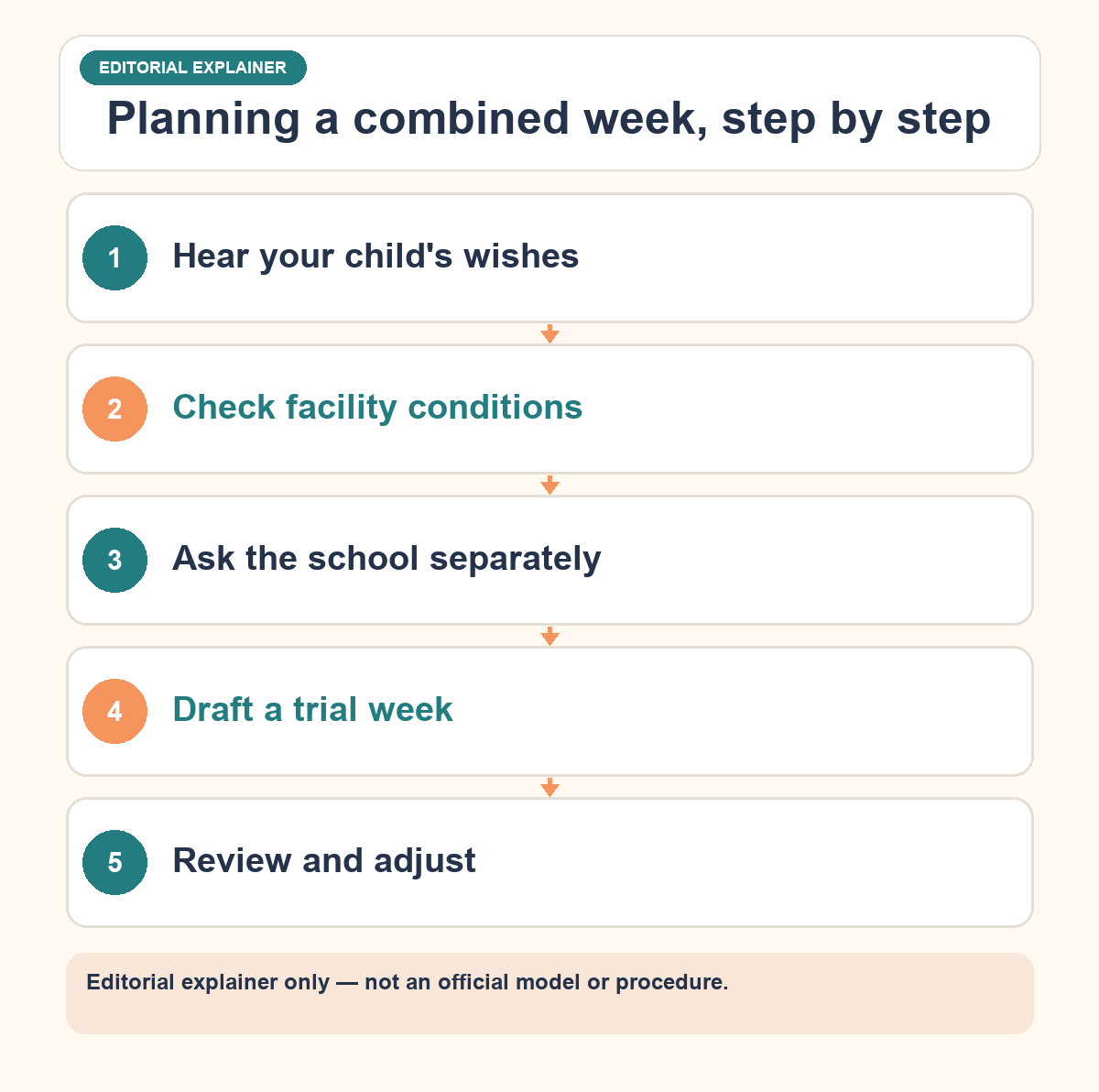
Start small: hear your child’s wishes, ask facilities and the enrolled school their separate questions, and treat the first week as a trial you will review together.
- Ask your child what they would be willing to try, including “just a visit” or “not yet”.
- Use the seven checks to ask each facility the same questions, and keep a dated note of each answer.
- Contact the enrolled school’s consultation contact to ask what steps and documents apply before deciding anything about attendance.
- Draft a provisional week in the basic sheet below, then review it with your child after the first visits.
Public consultation in Japan: MEXT lists the 24-hour Children’s SOS Dial (0120-0-78310), a toll-free line that takes calls 24 hours a day. The same MEXT consultation page (Japanese, checked 24 November 2026) also lists social-media, telephone, holiday and local consultation services, with a separate page for local contacts about school attendance difficulties. The page is in Japanese, and we have not confirmed whether English support is available. Your municipality’s board of education and your child’s school are also places to ask. Families living outside Japan should use the education and support services where they live.
Editable planning sheets
Put the school, facility and home schedule and any unconfirmed points on one page, and check your child’s load and contact methods before fixing the number of days. These are editorial examples, not official forms of any school, municipality or facility.
Basic sheet: weekly plan
Combined weekly plan and consultation notes
My child’s wishes: ________ Review date: ________
| Day and time | School / facility / home | Travel and rest | Who to contact about changes |
|---|---|---|---|
| Mon ________ | ________ | ________ | ________ |
| Tue ________ | ________ | ________ | ________ |
| Wed ________ | ________ | ________ | ________ |
| Thu ________ | ________ | ________ | ________ |
| Fri ________ | ________ | ________ | ________ |
What to do when my child is tired: ________ Date to discuss the next plan: ________
Optional sheet: extra checks, only if needed
Facility eligibility, days, fees and conditions for changes: ________
School consultation contact, documents needed, next check date: ________
What my child wants shared / does not want shared: ________
You do not need to fill in every day. You can leave things undecided, for example a visit only at first, deciding on the day, or putting rest days first. Before sharing a sheet with family or the school, tell your child who will see it, and leave out any personal information that is not needed.
References
Sources cited in the original Japanese article (dates as given there; not rechecked for this translation unless also listed below):
- MEXT: Treatment of attendance when children receive consultation and guidance at public institutions or private facilities outside school (Japanese) (2019 notice according to the original article; checked 6 November 2026)
- MEXT: On attendance recognition and grade evaluation for children not attending school (material for schools and boards of education, Japanese) (publication date not stated; checked 6 November 2026)
- NIJIN ACADEMY official website (Japanese) (checked 6 November 2026; cited for the original article’s promotional cards, which this edition replaces)
- NIJIN ACADEMY: About NIJIN ACADEMY (Japanese) (operator and facility information; checked 6 November 2026)
Targeted checks for this English edition (24 November 2026):
- MEXT attendance treatment page (Japanese): reopened to confirm that the principal decides attendance recognition under stated requirements.
- MEXT: Consultation contacts for children’s SOS (Japanese)
- NIJIN GLOBAL ACADEMY: FAQs (English)
- Nijiiro: Editorial structure (Japanese)
The seven-item table, the planning sheets and the example questions were created by the editorial team. Check individual conditions of use with each facility, and attendance recognition and evaluation with the enrolled school and municipality.
The school-system and facility information in this English edition is inherited from the Japanese source article, whose cited sources were checked on 6 November 2026 (one MEXT notice is described there as a 2019 notice, and one MEXT document has no stated publication date). This translation was prepared on 24 November 2026. On that date we rechecked only the MEXT attendance page, MEXT’s public consultation page, Nijiiro’s editorial-structure page and NIJIN GLOBAL ACADEMY’s English pages; other inherited statements have not been newly verified.
The featured image is an AI-generated illustration, and the body diagram is an editorial diagram summarising the article. Neither is a photograph of real school or facility activities.