
“Which is best for university: IB, AP or A Level?” It is tempting to start by comparing programme names. But applications rarely hinge on the name alone. What matters is which subjects your target university and course require, at what level and grade, and whether your child’s school actually lets them take those subjects.
If your child has not yet settled on a destination, there is no need to rush into one major. This guide shows how to shortlist provisional options, then check, in order, the conditions that narrow choices and the school’s deadlines. It is a step-by-step guide to choosing high school subjects, not a full comparison of the programmes. You do not need to become an expert in the systems. Put your child’s interests, the official university requirements you have found and the school’s answers side by side, and the next question usually becomes clear.
You can edit, copy and print the subject-checking worksheet and a sample email to a counselor on this page.
Key points
- Subject requirements differ by university, course and entry year. Read each official course page rather than relying on a national rule of thumb.
- Earning a qualification does not mean admission, and meeting subject requirements does not guarantee an offer.
- IB, AP and Cambridge A Level are structured differently. Check levels (such as IB HL/SL), course and exam arrangements, and progression rules at your school.
- A subject listed in a catalog may not run in your year. Ask about running decisions, class caps, timetable clashes and prerequisites.
- Before relying on “you can change later,” check both the school’s change deadlines and the university’s requirements.
Start with the university, course and entry year, not the programme name
Before choosing subjects, sketch a provisional destination in this order: country, university, faculty or course, and entry year. If nothing is decided yet, listing two or three fields of interest is enough. For example, you might put down engineering, life sciences and economics, then pull the subject conditions for each from the official admissions information.
Do not assume there is one rule for a whole country. Even within the same country, requirements differ by university, faculty and entry year.
Read the conditions in at least three parts:
- Does the qualification make the student eligible to apply?
- Does the course require specific subjects, subject levels or grades?
- Are there other selection elements, such as tests, English proficiency or interviews?
Earning a qualification does not mean admission, and meeting the subject requirements does not guarantee an offer. Check the year and the applicant groups that apply on the faculty’s own page, and contact the admissions office if anything is unclear.
The IB’s subject selection guidance also tells students to consider their interests, their plans after graduation and the subjects their school offers, and to research the subject requirements of the universities, programmes and countries they are interested in. In other words, the starting point is to look at your child’s possible paths and the school timetable together, rather than at a programme’s general reputation. IB: Subject selection guidance (checked 29 October 2026 in the original article).
If Japanese universities are on the list, do not assume an overseas qualification automatically does or does not allow a student to apply. Check the Ministry of Education’s (MEXT) eligibility rules and each university’s application guidelines separately. A MEXT document posted in May 2026 describes the International Baccalaureate qualification as the DP qualification, and treats international A Level and similar qualifications separately from AS Level alone. This concerns eligibility to apply. It does not set subject requirements or admission standards for any particular faculty. MEXT: About university entrance eligibility (PDF, Japanese) (checked 29 October 2026 in the original article).
Translator’s note (24 November 2026): we could not extract readable text from this PDF on the translation date, so the wording above has not been rechecked. MEXT’s web page on university entrance eligibility still lists the International Baccalaureate and international A Level among recognised foreign university entrance qualifications: MEXT: University entrance eligibility (Japanese).
Record “required”, “recommended” and “considered in selection” separately
Course pages use different categories: required subjects, desirable subjects, subjects the university recommends taking, and subjects recommended as preparation for the course. Similar wording does not always mean the same thing. Keep the original words, such as “must,” “required,” “recommended” or “preferred,” and ask the university if you are unsure what they mean.
If you copy subject conditions onto social media posts or into old progression charts, the entry year or course can get mixed up. Record the URL, the date you viewed it and the admissions year together.
Neutral help comes first: your child’s school counselor, each university’s admissions office and, for families abroad or returning to Japan, the public consultation services listed under Next steps.
How IB, AP and A Level differ in choosing and combining subjects
The three programmes cannot be ranked by name; they differ in how subjects are chosen and combined. They differ in the number of subjects, how levels are structured, how students are assessed and how schools deliver them, so families need to check different things. The table below is an outline only. For actual options, follow your school’s information for the relevant grade and year.
| Programme | What to look at when choosing subjects | What to ask the school |
|---|---|---|
| IB Diploma Programme | Usually six subjects; check the mix of SL/HL levels and the subject groups | Subjects offered, permitted combinations, HL/SL availability, course conditions |
| AP | Several subjects chosen individually; check the preparation needed for each and the exam arrangements | Courses running that year, course and exam registration, timetable |
| Cambridge International AS & A Level | Decide between a combination that goes deep in a strength and one that keeps several fields open | Subjects offered, progression from AS to A Level, assessment timing |
In the IB Diploma Programme (DP), students usually choose one subject from each of six subject groups, six subjects in total, and take each at Standard Level (SL) or Higher Level (HL). The usual pattern is three of each. If a university course requires a particular subject at HL, simply taking that subject may not be enough. Whether a student can take individual DP courses without the full diploma depends on the school, so ask. IB guidance.
Check AP course enrolment and AP exam registration separately. College Board recommends taking the course but says it is possible to take an exam without it. In that case, ask the AP coordinator whether the school can arrange the exam, or whether the student can test at another school or a test center. Some exams have their own requirements, such as subjects that use a digital portfolio. Meanwhile, which courses run, which prerequisites apply and any extra enrolment conditions vary by school. There is no single right number of AP courses for everyone. College Board: Can I take the AP Exam if I haven’t taken an AP course? and How to Choose an AP Course.
AP exam scores may count toward university credit or advanced placement, but each university decides whether it grants credit, for which subjects and at what score. College Board points students to each university’s credit and placement policy. Credit is a separate matter from subjects required for admission, so keep the two apart. College Board: Setting AP Credit and Placement Policies.
Cambridge International AS Level is usually a one-year course and A Level usually a two-year course. Some subjects can be extended from AS to A Level, and schools can offer many subjects in a variety of combinations. So do not infer from the programme name that “A Level means this subject is available.” Check your school’s subject list, exam series and conditions for continuing from AS. Cambridge International: Curriculum and Qualification (both checked 29 October 2026 in the original article).
When comparing, ask more than “Which programme lets my child apply to this university?” Put these questions in the same table too: Can the student take the right subjects at the right level? Can they prepare for them realistically from where they are now? When is the last date to change? Taking more subjects is not automatically an advantage, and no programme is an advantage in every country.
Break course requirements down into subject, level and grade
When you read a university’s entry requirements, note the subject, level, grade, combination, any separate test and the entry year, one item per line. Even if a page says “mathematics is required,” which maths course, whether HL is needed and whether there is a minimum grade vary by course. Do not rely on a summary table alone. Open the notes and qualification-specific requirements on the course’s official page.
- Eligibility: Does the student’s diploma or course record qualify them to apply to that university?
- Required subjects: Subject names, permitted combinations and any exclusions.
- Level and grade: In what form the conditions are stated, such as IB HL/SL, the number of A Level subjects and grades, or AP exam scores.
- Other elements: Entrance exams, aptitude tests, portfolios, English proficiency or interviews.
- Year: Are the requirements valid for the intended entry year? Are updates or transitional arrangements planned?
As a concrete example, the University of Oxford’s Medicine page (for 2027 entry) states that A Level applicants need Chemistry plus at least one of Biology, Physics, Mathematics or Further Mathematics. The separately listed IB condition is Chemistry and at least one of Biology, Physics or Mathematics at HL. Check each qualification’s conditions without mixing them up. The page also gives information about the UCAT. This example covers one course, Medicine, for one entry year. It is not a rule for a whole country or the whole university. Oxford Medicine: official requirements (checked 30 October 2026 in the original article).
Translator’s note (24 November 2026): the Oxford Medicine page refused automated access on the translation date, so this example has not been rechecked. It applies to 2027 entry only. Check the current page for later entry years.
For Engineering Science at the same university, the A Level conditions include Mathematics and Physics, and the IB conditions include Mathematics and Physics at HL. Set beside the Medicine example, this shows that subject conditions change by course even at the same university. Oxford Engineering Science: entry requirements (checked 29 October 2026 in the original article; on 24 November 2026 the page still listed Mathematics and Physics in both its A Level and IB HL requirements, without naming an entry year). Do not apply these two examples directly to other universities or years. Reread the original wording for each course you are considering.
When a subject is described as “preferred” rather than “required,” you can ask the university what that means before applying. Ask whether students can apply without it, whether it is recommended as preparation for the course, or whether it counts in selection. Do not draw conclusions just by translating the English terms. It is safest to ask with the course name and entry year included.
When your child’s plans are not yet narrowed down
Choose two or three possible fields, pick one university for each and compare the required conditions. Treat subjects and levels the options share as “choices to keep for now.” For subjects that differ, note when a decision is needed. For example, option A might require advanced maths, option B a laboratory science and option C a portfolio. In that case, do not assume the shared subjects alone will satisfy every option. Ask the school whether the extra subjects run and how heavy the workload would be.
When comparing options, do not treat subjects as equivalent just because their names are similar. The subject named by a university may differ from the name and syllabus used at the school. Ask the school counselor for course descriptions or syllabuses, and ask the university whether that coursework meets its requirements. Maths courses can differ in type and scope. Science requirements may specify practical components or a level. If you cannot settle the match yourself, attach the course description to your question and record who answered and when.
“You can change direction later” does not necessarily mean you can change subjects. Timetable clashes, prerequisites, material not yet covered after moving up a year, class caps and university subject requirements can all limit change. While keeping options broad, ask the counselor when changes stop being possible and what minimum is needed to keep options open, and keep their answer in writing.
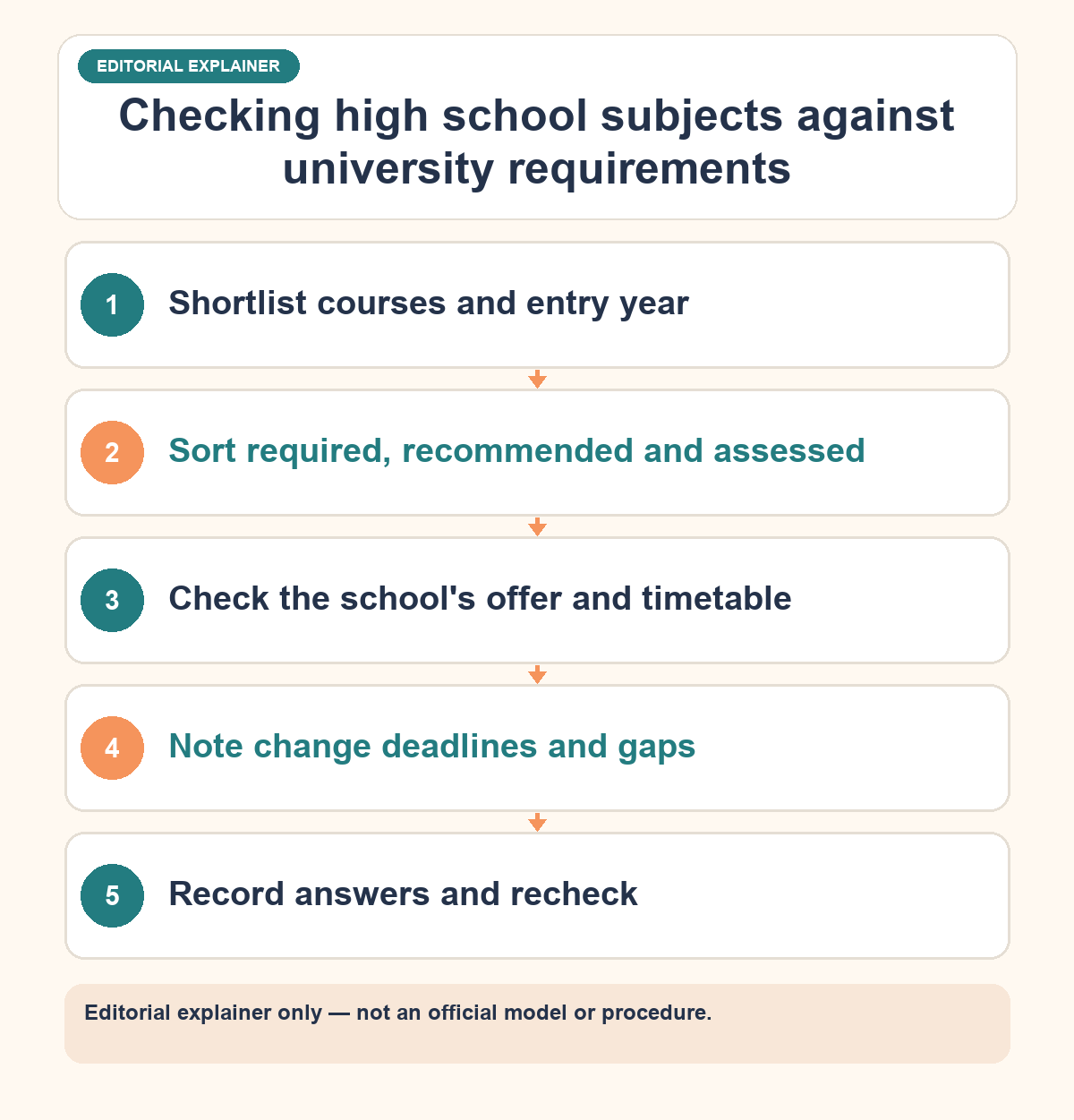
This is an illustrated editorial diagram, not a photograph. It does not show any real school, student or NGA activity.
Check what “available” really means at your school
A subject listed in the catalog does not guarantee your child can take it in the year they need. Before filling in the option form, check the following with the school. Is this the final version for that year? Could a course be cancelled if too few students choose it? Are there class caps, priority rules or class allocations? Are any subjects scheduled in the same block? If minimum numbers or caps are not published, do not assume they exist. Ask the school whether such rules apply.
- Planned offerings: Is the course expected to run next year, and when will this be final? Does the list differ from last year’s?
- Class size: Minimum numbers to run, class caps, any selection or first-come-first-served rules, and how places are allocated when demand is high.
- Timetable: Are some subjects impossible to combine, or do any clash with compulsory courses?
- Prerequisites: Courses required in the previous year, grades, placement tests or teacher approval.
- Transfer students: Who reviews the previous school’s syllabus, grades and course content, and how gaps in prior study are covered.
- Changing and continuing: The deadline for changing choices, how long changes are allowed after classes begin, conditions for continuing from AS to A Level, and the approval needed.
- Graduation: Do the chosen subjects meet the requirements for the school’s diploma or the programme diploma?
If the school’s published information and an individual meeting give different answers, confirm in writing which year’s rules apply. If a change mid-course is possible, ask more than “Can we change?” Ask how the student would learn the units needed after the change, and whether it affects assessment or graduation requirements. Whether places are allocated first come, first served, by grades or by order of preference is also specific to each school.
For AP in particular, College Board’s course selection guidance advises checking each school’s offerings and prerequisites. Cambridge International also offers a wide range of subjects, but which ones a school delivers is part of that school’s curriculum. Do not treat a programme provider’s subject list as a guarantee that your school offers those subjects.
How programme structures differ: examples from school websites
Here we use the official information from ASIJ, The British School in Tokyo (BST) and Yokohama International School (YIS) as school-specific examples. Do not treat these three schools as the standard for all international schools. Use them as prompts to check the latest subject options guide and admissions information of the school you are considering. All three were checked on 29 October 2026 in the original article.
| School | What its official pages describe | Still to confirm with the school |
|---|---|---|
| ASIJ | A US-style high school diploma, AP courses and AP Capstone; the Admissions FAQ compares IBDP and AP and describes AP Seminar leading to AP Research within AP Capstone | AP courses running in your year, course conditions, when exams can be taken, placement on transfer |
| BST | Two main pathways in Years 12–13: IBDP and the BST Diploma; BTEC Level 3 in Enterprise or Sport can be built into BST Diploma choices | Specific subjects, prerequisites, number conditions, change deadlines (the linked options booklet was not reviewed) |
| YIS | Students work toward the YIS Diploma, choosing externally assessed IB DP courses, school-assessed courses, or a combination | Courses actually available, assessment methods, fit with graduation requirements, credentials for university applications |
ASIJ: AP courses and AP Capstone
ASIJ’s high school pages introduce its US-style high school diploma, AP courses and AP Capstone. Its Admissions FAQ compares IBDP and AP. It explains that AP is taken as individual courses and that, within the school’s AP Capstone, AP Seminar is the prerequisite for moving on to AP Research. This is the programme structure as described by ASIJ. Check with the school separately which AP courses run in your year, the course conditions, when exams can be taken and how transfer students are placed. The public pages alone do not show that every AP course will run or that every student who wants a course can take it. ASIJ: High School and ASIJ: Admissions FAQ.
BST: a choice between IBDP and the BST Diploma
BST’s official Senior School page sets out two main pathways for Years 12–13, the IBDP and the BST Diploma. It says BTEC Level 3 courses in Enterprise or Sport can be included in BST Diploma subject choices. So when comparing qualification routes within a school, check two things together: whether your child can take subjects that meet university requirements, and how those subjects count toward that route’s graduation requirements. The original article could not open the linked options booklet, so specific subject names, prerequisites, number conditions and change deadlines were not confirmed. BST: Senior School.
YIS: combining course types within the YIS Diploma
YIS’s official high school page describes a flexible framework. Students work toward the YIS Diploma and, depending on their interests and goals, choose externally assessed IB DP courses, school-assessed courses, or a combination. This cannot be read as meaning every student takes the full IB Diploma. Check the subjects actually available, how each course is assessed, how it maps to graduation requirements and what credentials can be shown in university applications against that year’s school materials and the university’s requirements. YIS: High School.
What these three examples show is that schools structure courses differently, not which school is better. At visits or individual meetings, show the requirements of the courses your child is considering. Then ask, one by one, whether the necessary subjects are likely to be available, whether there are timetable clashes, when changes are possible and how the subjects count toward the diploma.
Keeping room to change: deadlines and the gaps a change leaves
Whether a subject can be changed depends on both the school’s procedures and the university’s requirements. At school, check the option submission date, the final change date, how long changes are allowed after classes begin, class caps and the conditions for teacher approval. On the university side, find out whether it is enough to be taking a required subject at the time of application, whether final grades are needed and whether subject changes must be reported. Do not conclude “we can change later” by looking at only one side.
If a change comes up, check four points with the school counselor:
- Does the student meet the new subject’s prerequisites?
- Is there a way to catch up on units already covered?
- Will the student still meet the credit and compulsory requirements for the school diploma or programme diploma?
- Does the change break any required conditions of the target universities?
Even if the change is allowed, the study time needed and how to catch up on assessment are separate questions.
In a discussion about changes, it helps to describe your child’s wishes in four groups: “good at,” “interested in,” “needed for my path” and “worried about the workload.” That makes it easier to discuss alternatives rather than just swapping subject names. Rather than pressing the school for a decision, parents can present both the child’s interests and the university requirements, then confirm what is settled and what is not. After the meeting, confirm the change deadline, procedure and required documents by email so the whole family can see the same information.
As a working plan until applications are narrowed down, build a timetable that fits both the student’s current grades and workload and the minimum conditions of the fields being considered. Taking as many of the hardest subjects as possible should not be the goal in itself. Discuss whether your child can explain why they chose each subject, whether they can use the school’s support, and whether the plan fits realistically alongside other compulsory courses and activities. College Board’s guidance that there is no single right number of AP courses supports focusing on preparation and balance rather than quantity.
If a university’s official page shows only an older year’s information, if the conditions for a qualification are unclear, or if it is unclear how subject names match, do not fill the gap by guessing. Ask the admissions office. If the reply stays general, include the faculty name, entry year, qualification and planned subjects, and ask specifically which subjects and levels are required.
10 Frequently Asked Questions
Most answers come back to the same check: match each course’s official requirements with what your school can actually offer.
Which is best for university admission: IB, AP or A Level?
There is no single ranking based on the programme name alone. Match the qualifications your target universities and courses accept, their required subjects and levels, what your school offers, and your child’s own learning situation.
Can my child choose subjects before deciding on a university or major?
Yes. List several possible fields, look up what their official requirements have in common and where they differ, check the subject-change deadlines, and build a draft plan. Tell the counselor that plans are still open and discuss what is needed to keep options available.
Is taking more IB Higher Level subjects always better?
Not necessarily. Check the subjects and levels the university and course require, and discuss them together with the school’s course conditions and your child’s workload. The IB’s own guidance also encourages students to check subject and level requirements for the university programmes they are interested in.
How many AP courses should a student take?
College Board says there is no right number of AP courses for everyone. Check your target universities’ requirements and the school’s preparation conditions, and plan a manageable load with the counselor.
Can a student with three A Levels apply to any university?
The number of subjects alone does not decide this. Check eligibility, required subjects, grades and additional selection steps for each university, course and entry year. If Japanese universities are on the list, check MEXT’s eligibility rules and each university’s application guidelines separately.
Will every subject in the course catalog definitely run?
Not necessarily. Ask the school whether the catalog is for the year you need, when offerings are confirmed, and about minimum numbers, class caps, timetable clashes and course conditions.
Can a student change subjects after classes begin?
Deadlines and conditions differ by school. Also ask what material would need to be covered after the change, and how it would affect grades, graduation requirements and university subject requirements.
Does AP credit at a university mean it is easier to get in?
No. Credit and advanced placement are separate from admission decisions and subject requirements. Each university sets its own credit policy.
Which IB or A Level subjects do Japanese universities require?
Check each university and faculty’s application guidelines. The MEXT document sets out university entrance eligibility; it does not set subject requirements for every faculty.
What if a required subject is not offered at my child’s school?
Ask the school counselor whether an alternative subject, external study or another route is permitted, and ask the university whether that alternative meets its requirements. Do not guess whether an individual case will be accepted.
Next steps you can take today
Choose one university course your child is interested in and open its official requirements page for the relevant entry year. Note the required subjects, subject levels, grades and any additional selection steps separately, along with the URL and the date you checked. Then ask the school counselor for the subject list and the change deadlines, and compare the university’s conditions with the combinations the school can offer. If your child’s plans are still open, it is fine to discuss several options at once.
Leave gaps as questions, for example when you cannot find the admissions year or cannot tell whether two subjects are equivalent. Record the date you receive each answer from the school and the university, and recheck before applying that the requirements have not been updated.
Public and neutral consultation
- Families living abroad or returning to Japan: the Japan Overseas Educational Services (JOES) offers education consultations for parents and guardians, including school choice and high school and university entrance after returning to Japan. Check its current booking methods and fees on the JOES consultation page (Japanese) (checked 24 November 2026).
- University entrance eligibility in Japan: MEXT’s page on university entrance eligibility lists the recognised categories and the responsible office. Questions about a specific faculty’s subject conditions go to that university’s admissions office. MEXT: University entrance eligibility (Japanese) (checked 24 November 2026).
- If your child is distressed (in Japan): MEXT’s 24-Hour Children’s SOS Dial, 0120-0-78310, takes calls from troubled children and their parents at any time, including nights and holidays, and connects to the education board’s service in the caller’s area. It is a Japanese domestic number. The MEXT page does not say whether it can be reached from outside Japan. MEXT: 24-Hour Children’s SOS Dial (Japanese) (checked 24 November 2026).
Related Nijiiro articles (in Japanese)
- IGCSE vs IB: how they relate to A Level and university entrance eligibility (Japanese)
- How to choose an international school: 7 criteria including accreditation, fees and commuting (2026, Japanese)
- Paths after international school: Japanese university eligibility and diploma differences (2026, Japanese)
Worksheet and counselor email
The worksheet below helps families organise information at home. Fill in the basic fields first, then copy the optional fields for each university course you are considering. Always go back to the original university and school wording for official requirements, and leave fields blank rather than filling them in by guessing.
Edit, copy and print | Unofficial family notes
High school subjects and university requirements: checking sheet
You can use this even if your child’s destination is undecided, noting possible fields and points still being checked. Fill in the basic fields once, then copy the optional fields for each university and course.
Basic fields (4)
Open the optional fields only when needed
This is not an official document to submit to a school. Use the school’s own forms and official certificates first. Your entries are not sent or saved anywhere, so copy or print them before closing the page. This unofficial aid is for organising information at home. It does not replace official university or school admissions guides, designated forms or counseling. Always confirm requirements and course availability with the official contact for the relevant year.
Editable sample email | Unofficial
Sample email to a school counselor
Replace the parts in square brackets with your family’s details and delete any questions you do not need. In a first enquiry, do not attach detailed health information or certificates. Ask what documents are needed and how to submit them officially.
This is not an official document to submit to a school. Use the school’s own forms and official certificates first. Your text is not sent or saved anywhere, so copy or print it before closing the page.
References and sources
Information dates: the facts in this article are inherited from the Japanese original, whose sources were checked on 29–30 October 2026 (dates are given for each source below). This English translation was prepared on 24 November 2026. Translation is not a new fact-check, and inherited statements have not been newly verified unless they are listed under “Targeted checks on the translation date (24 November 2026).”
Sources cited in the original article (dates as stated in the original; not rechecked unless noted)
- IB: Subject selection guidance: page updated 13 October 2026. It covers IB programmes; university conditions vary by university and year (checked 29 October 2026).
- IB: Example subject choices: page updated 19 February 2026 (checked 29 October 2026).
- College Board: How to Choose an AP Course: current guidance; check registration timing and courses offered with each school for each year (checked 29 October 2026).
- College Board: Can I take the AP Exam if I haven’t taken an AP course?: current FAQ; check exam arrangements and subject-specific conditions with the AP coordinator for the exam year (checked 30 October 2026).
- College Board: Setting AP Credit and Placement Policies: current guidance; credit policies are set by each university (checked 29 October 2026).
- Cambridge International: Curriculum: current curriculum information; subjects delivered vary by school (checked 29 October 2026).
- Cambridge International: Qualification: current information; also check subject rules for assessment routes (checked 29 October 2026).
- MEXT: About university entrance eligibility (PDF, Japanese): document posted May 2026 (checked 29 October 2026; text could not be extracted on 24 November 2026).
- University of Oxford: Medicine: 2027 entry requirements (checked 30 October 2026; could not be reopened on 24 November 2026).
- University of Oxford, Engineering Science: Entry requirements: current requirements on the page (checked 29 October 2026).
- ASIJ: High School: the school’s public information at the time; check the subject list for your year (checked 29 October 2026).
- ASIJ: Admissions FAQ: the school’s public FAQ at the time (checked 29 October 2026).
- The British School in Tokyo: Senior School: the school’s public information at the time; check the options booklet for your year separately (checked 29 October 2026).
- Yokohama International School: High School: the school’s public information at the time, checked from saved HTML (checked 29 October 2026).
- NIJIN GLOBAL ACADEMY: Admissions (Japanese page): official information on the planned September 2027 opening (checked 29 October 2026). It is replaced here by the English pages listed below.
Targeted checks on the translation date (24 November 2026)
- NIJIN GLOBAL ACADEMY: FAQs (English): operator, pre-opening status, September 2027 opening, ages 6–18, bilingual environment, Article 1 school status and Japanese high-school diploma.
- NIJIN GLOBAL ACADEMY: Opening updates (English): an information signup; applications are not yet open.
- NIJIN GLOBAL ACADEMY: Contact us (English): the contact route for questions.
- University of Oxford, Engineering Science: Entry requirements: Mathematics and Physics in the A Level and IB HL requirements; no entry year stated on the page.
- MEXT: University entrance eligibility (Japanese): the International Baccalaureate and international A Level are listed among foreign university entrance qualifications.
- MEXT: 24-Hour Children’s SOS Dial (Japanese): number and hours.
- JOES: Education consultation (Japanese): consultation for families abroad and returning to Japan.
The article’s featured image is an AI-generated illustration. The diagram in the body is a separate editorial diagram summarising the steps in this article. Neither is a photograph of a real school, student or NGA activity.