If you want your child to enter an international school at primary age, start by giving the school your child’s date of birth and the start date you hope for, then confirm which year group applies and whether you are eligible to apply. There is no blanket rule such as “first grade in Japan means Grade 1” or “young children can get in without English”. This guide walks through the school’s language requirements, what your family can support and first-year costs, in that order.
Key points
- Year groups are decided by each school from the date of birth, intended year and schooling history. Japanese grades do not convert automatically.
- Check the child’s English and the parents’ English separately. Both example schools set requirements for parents.
- “No general entrance exam” can still mean document reviews, interviews or assessments.
- The fee totals in this guide use a limited set of 2026–27 fee items. They are not 2027–28 estimates.
- For a school-age child with Japanese nationality, attending only an international school that is not an Article 1 school does not fulfil the schooling obligation. Consult your local board of education.
This guide is for families whose child is about to start, or has just started, primary school in Japan, and for families considering a transfer during primary school. It uses two Tokyo schools, the American School in Japan (ASIJ) and The British School in Tokyo (BST), as concrete examples of how to read admission conditions. It does not rank the two schools or treat them as representative of international schools across Japan. A checklist and an English enquiry email are included for contacting schools.
The official information in the original Japanese article was checked on 29 October 2026. It distinguishes application guidance for 2027–28 from general guidance with no stated year, and mainly uses fee amounts published for 2026–27. A few time-sensitive items were rechecked for this English translation on 24 November 2026, and those updates are labelled as translation notes. Before applying, get the latest answers on places, deadlines and fees for your intended year.
You can edit, copy and print the admissions checklist and the English enquiry email on this page.
Start with the school day you want, not the start date
Once you start thinking “I want my child to learn in English”, write down the kind of day you want your child to have before you search for school names. Think about time to play with friends in person, how they would ask teachers questions, the language they speak with family and how much time the commute can take. This gives you a framework for reading what schools tell you. Choosing a primary school only with university in mind is less useful than picturing the daily life that starts the next morning, which makes it easier to explain what your family needs.
Ask your child too. Don’t just ask whether they like English: ask how they feel about spending time somewhere unfamiliar and what they would want to see on a visit. There is no need to rush their answer. Parents can hear the school’s explanation first and discuss later when the child might take part. “Finding a school that will admit your child” and “whether they can learn with confidence once there” are two questions to work through one after the other.
If your child is about to start primary school in Japan, sort out early where they will be enrolled and when the school year starts. If they are transferring during primary school, sort out the records from their current school and how their learning will carry over. Do not withdraw from a school or decide to move before you have an offer. Keep making enquiries to schools and consulting about enrolment procedures at the same time.
Give your child’s birth date, intended year and current grade together
Japanese primary grade names do not translate directly into the Grades or Years of overseas curricula. Schools differ in their cut-off dates, academic years and how they treat previous schooling. In your enquiry, don’t stop at your child’s current age. Give their date of birth, the month and year you hope they will start, and their current nursery, kindergarten or school and grade. Present any year group you have chosen as a preference, and get the school’s formal decision.
For example, ASIJ’s Admissions Guidelines require Kindergarten applicants to be five years old before 1 September of the year of enrolment. That is a Kindergarten rule. Do not read it as a rule for first grade at a Japanese school or for ASIJ’s Grade 1. If you are hoping for Grade 1, give the school the birth date and schooling history and confirm the year group with them.
BST’s official year-group chart groups children by their age on 31 August, with five-year-olds in Year 1 and six-year-olds in Year 2. The school’s FAQ explains that year groups are based on age and that out-of-year placement is not considered. The linked chart was presented as a 2026–27 document, so families applying for 2027–28 should also check the chart for that year.
Translation note (24 November 2026): the linked file is still titled “UK Year Group Chart 2026-2027”. We could not display its contents, so the age details above come from the original article’s 29 October 2026 check. BST’s FAQ still says out-of-year placement is not considered.
If the birthday is close to a cut-off date, one clear question works well: “With this date of birth, can we apply for this year group in this academic year?” Do not decide on your own to move your child up a year because their English is strong, or down a year because English is new to them. If siblings are joining at the same time, get an answer on year group and available places for each child.
Once you know the year group, confirm which campus your child would attend before booking a visit.
Line up Japan’s April school start with each school’s application calendar
When the original article was written, BST’s applications page said that applications for 2027–28 would open in mid-November 2026. It also set out a sequence: application review from early February, interviews or assessments where needed from late February, and decisions from early March into the summer. For year groups that are full, the outlook may not be clear until later. Applying early does not mean places are guaranteed in the order applications arrive.
Translation note (24 November 2026): BST’s applications page now states that applications for the 2027–28 academic year are open. It also says application review and interviews or assessments continue into late June, and that for full year groups, openings may not be clear until May or later.
ASIJ’s general timeline, meanwhile, describes accepting applications from mid-November for entry in August of the following school year. For the original article, we could not confirm specific 2027–28 deadlines. Don’t assume “any time in November is fine”. Ask when applications open for your intended year, when documents must be ready and when assessments take place.
Translation note (24 November 2026): ASIJ’s guidelines page still gives only the general timeline, with no specific 2027–28 deadlines.
| School | What the official guidance says | What to confirm |
|---|---|---|
| ASIJ | Applications received from mid-November for August entry the next school year. No mid-year transfers for families currently living in Tokyo. | Opening date, document deadlines and assessment timing for your intended year |
| BST | 2027–28 applications open. Review from early February, assessments where needed from late February, decisions from early March into summer. | Places in your year group, and when you can expect clarity if it is full |
In your family calendar, note the date you contact each school, the dates you ask the nursery or current school for documents, possible interview dates and how long you can wait for results. If your child is due to start a Japanese school in April, ask the board of education where you live which enrolment procedures are needed before the international school’s results arrive. Do not handle the gap between school years by deciding on your own that your child “doesn’t need to attend school for a few months”.
If you are thinking about joining part-way through a year, start by confirming available places and when the school accepts new students. ASIJ’s general guidance says it does not allow mid-year transfers for families living in Tokyo. If your situation is different, for example if you are moving from overseas, the starting point for the conversation changes too. Even where you see “rolling admissions”, it does not follow that every family and every year group can join at any time.
Keep a record of your communications, and note what you are waiting to hear from each school next.
Check your child’s English and the parents’ English separately
It is tempting to ask whether everyday conversational English is enough. But primary lessons involve many situations: following the teacher’s explanations, saying when something is wrong, and reading and writing at an age-appropriate level. When you summarise your child’s English history, describe who they used English with and what they did, not just the number of years. Do not treat time spent at English conversation classes as proof that your child can take part in lessons.
ASIJ’s official FAQ says English does not have to be a child’s first language, but that a high level of English proficiency is needed, and that language support is available in Grades 1–8. Having support is not the same as guaranteeing a place for a child who has only just started learning English. Ask the school how much support is possible in the year group you want.
BST’s FAQ requires age-appropriate English and says at least one parent must also be able to communicate effectively in English. Its applications page also has a requirement about parents’ passports, so do not judge eligibility on English alone. These are BST’s own conditions and do not apply to every school.
Translation note (24 November 2026): the passport condition on BST’s applications page is that at least one parent holds a valid non-Japanese passport.
In its admissions home page, ASIJ also requires that one parent speaks, reads and writes English. At home, talk about more than who will attend interviews. Decide who will report absences, take emergency calls and check documents. If you first make sure your family can handle essential communications, before polishing the application, it is easier to picture life after entry.
Translation note (24 November 2026): ASIJ’s admissions home page words this as one parent who “speaks, reads, and writes fluent English”. It also states that all applicants must live in Tokyo with their parents while attending ASIJ. This residency condition was not in the original article.
On a visit, ask how staff respond when a child does not understand instructions, how children can ask questions, and whether language support happens inside lessons or separately. Translation tools or interpreters may help in some situations, but they do not necessarily satisfy the school’s requirements. Describe your family’s situation as it is, and confirm what support is possible and what is difficult.
“No entrance exam” does not mean no assessment
ASIJ’s admissions guidance says there is no general entrance examination. It also says the school reviews school records, recommendations and similar materials, and may ask applicants to take part in academic, English or other screening. BST’s FAQ says it is not an academically selective school, yet its application steps include interviews and assessments after the documents are reviewed. Do not take this to mean “no written test, so no preparation is needed” or “a visit is enough to get in”.
Instead of asking for tips on getting in, ask the school what is checked, by whom and how. Is there time with the child alone? Do parents attend? What language is used? How long does it take, and what should you bring? If you are concerned about a young child’s health or worry about new settings, tell the school in advance. Whether the timing or format can be adjusted is something to discuss with the school.
At home, you can give your child experience of listening to unfamiliar adults, words for asking for help and chances to talk about activities they enjoy. This is not a guess at assessment questions. Rather than having your child memorise answers, note when they usually show what they can do and what they need help with. In interviews, too, do not list only what your child can do while hiding the help they need.
Outcomes also depend on the support available and on places. If your child is not offered a place, do not explain it only in terms of their ability. Ask whether you can reapply, and look at other options. Leave time to hear how your child feels.
Request nursery and school records in the way the school specifies
ASIJ’s document guidance lists the application materials for Elementary School. Separately, it asks Grade 1 applicants to submit report cards or teacher comments from previous and current Kindergarten years, if available. If your child has no formal reports from early childhood, do not make a report at home or force yourself to fill a generic “two years of records” field. Tell the school about your child’s nursery or kindergarten history and ask what is needed.
When you start preparing, put each document’s name, issuer, the person to ask, its language, how it is submitted and the deadline on one list. Before asking nursery or kindergarten teachers for help, don’t just say “please write an English reference”. First check whether the school uses its own form or a system that goes directly to the teacher. Move early enough that teachers can be asked outside their busiest periods, with more margin than your own schedule needs.
Parents should not write references on their child’s behalf. ASIJ’s application portal sends a dedicated form to teachers. The checklist and English email in this article are for a first enquiry to a school. They are not for writing confidential references on a teacher’s behalf, and they do not replace official application documents.
If you have documents in Japanese, ask which ones need translating and whether the school specifies who translates or certifies them. Practice varies by school, so confirm what is needed before paying for translation to avoid doing it twice. Also check that names and dates of birth match across documents.
Prepare a factual explanation of any absences, school changes or support your child has received. Follow the school’s guidance and submit the necessary information in the way it specifies.
First-year budget: separate tuition from one-time fees
When comparing costs, don’t just line up annual tuition. Split costs into those due when you apply, those due when a place is confirmed and those due every year, and you can see when each payment falls. Fee names and what they cover differ by school, so a missing line with the same name does not mean there is no such cost.
ASIJ’s 2026–27 fee schedule lists annual tuition for Kindergarten to Grade 5 at ¥3,498,000. Adding the ¥50,000 application fee, ¥300,000 registration fee, ¥1,525,000 one-time building maintenance fee and ¥250,000 annual capital assessment fee gives a total of ¥5,623,000 for these five listed items. This is not a total that includes buses, lunches and everything else.
BST’s 2026–27 fee schedule lists Primary tuition at ¥2,960,000 a year. Adding the ¥40,000 application fee, ¥500,000 one-time enrolment fee, ¥680,000 one-time educational resources fee and ¥100,000 annual capital development fee gives ¥4,280,000 for these five items. Lunches, some activities and additional support are handled separately and need checking. Again, this is not the total your family will pay. It is an example calculated from items published for the same year.
| Item | ASIJ (Kindergarten–Grade 5) | BST (Primary) |
|---|---|---|
| Application fee | 50,000 | 40,000 (BST lists 50,000 for 2027–28) |
| One-time fee on entry | Registration fee 300,000 | Enrolment fee 500,000 |
| One-time facilities or resources fee | Building maintenance fee 1,525,000 | Educational resources fee 680,000 |
| Annual facilities fee | Capital assessment fee 250,000 | Capital development fee 100,000 |
| Annual tuition | 3,498,000 | 2,960,000 |
| Total of these five items | 5,623,000 | 4,280,000 |
Both are 2026–27 examples and cannot be used as 2027–28 estimates. BST gives its 2027–28 application fee as ¥50,000, so match the general figure on its applications page to the right year. Get the fee schedule and billing terms for your intended year, and mark any fees not yet set as “TBC”.
Translation note (24 November 2026): ASIJ’s and BST’s fee pages still show 2026–27 schedules, and we did not find full 2027–28 schedules on them. BST’s fees page lists ¥50,000 for 2027–28 applications, while its applications page still says a ¥40,000 application fee is paid on the form. Confirm the fee that applies with BST.
A family budget sheet is easier to manage if you split it into these three parts. The key is to keep “TBC” items as questions for the school, not to enter them as zero.
| Column | What to enter | What to check |
|---|---|---|
| Before entry | Application fee, fees on entry, preparing documents | Payment dates, what happens if you decline |
| While enrolled | Tuition, annual fees, lunches, transport | What is included, how fee increases are notified |
| Family-side costs | School run, device, uniform and similar, any learning support needed | Required or optional, when to buy |
Even if the annual amount fits your budget, large payments may all fall due soon after a place is confirmed. As a family, check when and how much you can have ready. Ask in writing which fees are refunded if you decline the place, withdraw part-way or move, including deadlines and deductions. Do not assume instalment plans or financial help will be available. Add them to your budget only once you know the conditions.
Plan a trial week, including the school run and after school
Once you know the school timetable, write out a week of family life, from leaving home to after you get back. Think about getting to the bus stop, early-dismissal days, and who can help on days when the person doing the school run cannot manage alone.
Even if a school runs buses, they will not necessarily come near your home. For your intended campus and year group, check routes, availability, stops, costs and how to report absences. On visit days, try the journey at the time your child would normally travel if you can, so you can allow for morning crowds and waiting times. If you plan to move, check the commute before rushing into a lease.
Plan the time at home too. Ask whether there is homework and how much, what help parents are expected to give and who to contact when you don’t understand something. Instead of only asking “Do parents need to teach English?”, try “On days when my child cannot understand the task instructions, how much should we help at home?” This makes roles concrete.
Look at the school-year calendar and discuss how your child will spend the holidays. Before adding more after-school activities, check that time for sleep and play remains.
Japanese and maths: build on your child’s learning history
Choosing a school that teaches in English is not the same as giving up Japanese. Work out, as your family’s own wishes, which language you use at home and how you want to keep up Japanese reading and writing. If the school has Japanese lessons, ask more than whether they exist: ask which children they are for, how many hours a week, what they cover and what is expected at home.
For a child not yet at primary school, start from the picture books and word games they enjoy now. For a primary-age child, start from the books they read, their writing and the maths they have covered so far. Rather than deciding from the outset to add the same content as Japanese peers every day, find out what the school teaches and choose what is needed while watching your child’s tiredness and interests. Do not conclude from this article that you need to switch the language you speak at home to English.
If your child might move to a Japanese school in future, keep documents showing their enrolment periods, their reports and teacher comments, and what they studied. Keeping records does not guarantee admission to another school, but it helps you describe your child’s learning history when you ask. Year group and admission at that point must be confirmed with the school and board of education at the time.
Watch which language your child finds easier for explaining their thinking and what is troubling them now, and share this with the school as you go.
Compulsory schooling in Japan depends on a school’s legal status, not its name
MEXT’s question-and-answer page on enrolment procedures (Question 11) explains that international schools in Japan fall into three groups. Some are “Article 1 schools” (ichijō-kō) under the School Education Act, the category that includes standard Japanese primary schools. Some are “miscellaneous schools” (kakushu gakkō), and the rest are other facilities. The same page explains that if a school-age child with Japanese nationality attends only an international school that is not an Article 1 school, the parents have not fulfilled their legal schooling obligation. Teaching in English, or holding accreditation from an overseas body, is a separate question from how the school is treated under Japan’s compulsory schooling rules.
First, ask the school you are interested in about the legal status of the school and the programme. Then contact the board of education where you live. Give them your child’s nationality, date of birth, planned start date and the school’s name, and ask which enrolment procedures are needed and how your child’s current enrolment will be handled. Do not decide on procedures from a school’s advertising alone. Do not stop contact with a Japanese school just because you have an international school offer.
MEXT’s page on school enrolment procedures states that children who hold both Japanese and another nationality are also covered by the schooling obligation. The legal explanation is different for families of foreign nationality. Do not apply one sentence of this article to every family. Explain your own circumstances when you ask.
Translation note (24 November 2026): the same MEXT page says that parents of foreign-national children are not subject to the schooling obligation under the School Education Act. It adds that boards of education are encouraged to admit these children to public schools if the family wishes. These rules concern Japan. Families living outside Japan should check the rules where they live.
When you consult anyone, record who you asked, when and what. Instead of asking “Is an international school OK?”, be specific: “Our child has this nationality and age, and we plan for them to attend this school from this date. Which procedures do we need?” Nobody can promise that an exemption or postponement of the schooling obligation will be granted automatically, or that attending an international school will count as attendance at a Japanese school.
On school visits, ask specifically about “when things go wrong”
On a visit you will naturally notice whether the buildings are attractive and whether the children look happy. What is worth checking next is how the school responds on days when a child struggles to join in. The questions below are examples the editorial team put together. They do not describe a system every school shares. You do not need to ask them all at once, so choose the ones that matter to your family.
For example, you could ask: “When a child does not understand the teacher’s explanation, how do they ask for help?”, “If a new child is on their own at break time, who keeps an eye on them?” and “When a child is tired or upset during lessons, where can they go for support?” These questions are meant to find out what your child could actually do, rather than settling for the word “support”.
For communication with parents, check: “How is day-to-day news shared?”, “Should concerns go to the class teacher or to an office?” and “How often are parent meetings held, and in what language?” If extra support costs money, also ask what is provided, who provides it and when it is reviewed. If an answer is not available on the spot, ask who you can follow up with later.
After the visit, rather than asking your child “You want to go there, don’t you?”, ask “Was there anywhere you noticed?” or “Was there anything you didn’t understand?” It is fine to ask about both the fun parts and the tiring parts. If one visit is not enough to decide, ask the school whether you can get further information. Even after receiving an offer, time for the family to think matters.
Separate changing schools from adding English-medium learning
Your research may show that attending a school is difficult given your child’s current age, their English or the school run. If so, consider separately the idea of revisiting the start date and the idea of trying another way of learning while keeping your current routine. Online options are also possible, but do not compare them on the same terms as attending school every day. Write down, for each option, the places where your child spends time in person, the support needed at home and the time involved.
As one example, the English FAQ of NIJIN GLOBAL ACADEMY (NGA), which is run by NIJIN, Inc., the company that also runs Nijiiro, describes online learning for ages 6–18, covering primary to high-school age, with opening planned for September 2027. This is a pre-opening plan, which is different from information about places at schools your child could attend now. Check the latest information on how to take part and on fees. Do not give up a school place on the strength of a plan alone.
Translation note (24 November 2026): NGA’s English FAQ states that NGA is not a Japanese “ichijō” (Article 1) school. See the compulsory schooling section above.
A school your child attends will not necessarily allow combining it with another school. BST’s Admissions Policy requires full participation in school attendance and does not allow dual registration. Whether a planned online activity affects enrolment or coursework needs to be confirmed with each school. Do not treat taking part online as equivalent to enrolment or attendance at a Japanese school, or to earning a graduation qualification.
Translation note (24 November 2026): the BST Admissions Policy link now redirects to a PDF file on Google Drive that we could not display. The description above comes from the original article’s 29 October 2026 check, which recorded the policy as updated in February 2025. It has not been rechecked.
For each option, write down the eligibility conditions and anything still unconfirmed. When you finish comparing, come back to the question of which week your child can keep up.
10 Frequently Asked Questions
These answers are general, so always confirm with the school and, for procedures in Japan, with your local board of education.
If my child starts primary school in Japan this year, can they apply for Grade 1?
Japanese school years cannot be matched mechanically to Grades or Years. Give the school your child’s date of birth, intended academic year and current schooling history, and ask the school to decide the year group. BST’s year-group chart, for example, uses its own cut-off date. Check which academic year a chart covers, and do not assume it applies unchanged to the next year.
Can a young child who has only just started learning English still get in?
Being young does not guarantee a place. ASIJ’s FAQ says a high level of English proficiency is needed, while also describing language support for certain grades. Ask each school separately about its admission requirements and the support available after entry. Do not overstate your child’s English history. Describe the situations where they use English and where they struggle.
What if the parents only use Japanese?
Check the parents’ language requirements separately from the child’s. Both schools featured here have requirements about parents’ English, and translation tools or outside interpreters may not count as meeting them. Work out who can handle essential communication, and talk to the school before applying. Do not assume other schools have the same rule. Check each one.
My child’s kindergarten does not issue report cards. Do I need to make one myself?
You do not need to create an official report at home. ASIJ’s Grade 1 guidance asks for Kindergarten report cards or teacher comments if available. Tell the school what records your kindergarten issues, and ask what alternatives are acceptable and how teachers should be asked. Parents should not write references on a teacher’s behalf.
Can my child transfer in the middle of a school year during primary school?
It depends on available places, school policy and whether your family is relocating. ASIJ’s guidelines say it does not allow mid-year transfers for families living in Tokyo. Do not assume every school accepts mid-year entry. Tell the school the month you hope to start and your current residence and schooling, and confirm whether entry is possible before making plans.
If we apply for two siblings at the same time, will both get in?
Applying together does not guarantee places for both children. Year group, language requirements and support needs are checked for each child. Think through the school run and differing school years in case only one child is offered a place. Ask the school how long you can wait for results and what to do if joint entry is not possible.
Does annual tuition tell me the first-year cost?
Besides tuition, check application fees, one-time registration and facility fees, transport, lunches and similar costs. The totals in this article are examples using a limited set of 2026–27 fee items, not 2027–28 totals. Get the fee schedule for your intended year in writing, and build a budget that separates required and optional costs, payment dates and what happens if you decline.
If my child could not speak in the interview, is that the end?
Do not reach a conclusion at home from one occasion. Assessment methods and any chance of a second look vary by school. Tell the school about relevant circumstances, such as worry about new settings or feeling unwell on the day. A reassessment or an offer cannot be promised, but do not blame your child. Ask the school for its explanation and your next options.
Once we have an offer, can we stop the procedures for a Japanese primary school?
Do not decide based on the offer alone. According to MEXT’s question-and-answer page on enrolment procedures, if a school-age child with Japanese nationality attends only an international school that is not an Article 1 school, the schooling obligation is not fulfilled. Confirm the school’s legal status, and ask the board of education where you live which procedures are needed and how enrolment will be handled.
Do we have to cover all Japanese reading and writing at home?
It depends on the school’s lessons and your family’s wishes. Ask the school what its Japanese classes cover, who they are for and what is expected at home, and plan around your child’s current reading and writing and their workload. Rather than adding all the work of Japanese peers across the board, find out what your child is actually struggling with. If a future move to a Japanese school is possible, keep records of what they studied and where they were enrolled.
What you can do today
What you do today does not have to be adding more schools to your list. Start by writing down your child’s date of birth, intended start month and year and current school, then choose two or three questions to ask the school. Next, check the application guidance for your intended year. While you wait for answers, sort out the records to request from the nursery or school and your family budget.
Don’t ask your child to decide about school in one go. Ask what they enjoy in their current routine and what they would like to see on a visit. Put the schools’ answers together with how your child is doing, and decide the next step from there.
Public contacts in Japan: for enrolment procedures, contact the board of education where you live. If worries about school, friends or changes are weighing on your child or on you, the 24-hour Children’s SOS Dial introduced by MEXT is available on 0120-0-78310. MEXT says children and parents can call at any time, including nights and holidays, and calls are generally connected to the consultation service of the board of education in the area you call from. MEXT’s page does not say which languages are supported. Families outside Japan should contact the education authorities where they live.
Related Nijiiro articles (in Japanese):
Admissions checklist for primary-age entry
Edit, copy and print | Unofficial family notes
You can start with the basic fields only. Write your wishes as “family preference” and the school’s conditions as “school answer, with the date received”. These notes help you narrow down what to ask next.
Basic: four items
Open optional items only when you need them
This is not an official document to submit to a school. Use the school’s own forms and official certificates first. This is an unofficial preparation aid from the editorial team. It does not replace the school’s designated forms, official records or references that teachers submit directly. It does not guarantee a reply or a place. Nothing you type is sent or stored externally, so copy or print it before closing the page.
First enquiry email to a school
Editable English email | Unofficial
Replace the parts in square brackets with your family’s details and delete any questions you don’t need. Do not attach detailed health information or certificates to a first enquiry; ask instead about required documents and the official way to submit them. Use the school’s own enquiry form if it has one, and check the submission route rather than sending passport images or detailed medical records by ordinary email.
This is not an official document to submit to a school. Use the school’s own forms and official certificates first. Nothing you type is sent or stored externally, so copy or print it before closing the page.
References and sources
The school, fee, legal and NGA information in this article comes from the original Japanese article, whose sources were checked by the Nijiiro editorial team on 29 October 2026. This English translation was prepared on 24 November 2026. On that date, only the items marked “targeted check, 24 Nov 2026” below were reopened, and the results appear as translation notes in the text. All other statements are inherited from the original and have not been newly verified. Ask each school about future places and entry conditions.
Sources cited in the original article (original check date in brackets). Where the item was also reopened for this translation, both dates are shown.
- ASIJ | Admissions Guidelines: general guidance, no specific 2027–28 deadlines (original check: 2026-10-29; targeted check, 24 Nov 2026)
- ASIJ | Admissions Home: guidance at time of publication (original check: 2026-10-29; targeted check, 24 Nov 2026)
- ASIJ | Admissions FAQ: guidance at time of publication (original check: 2026-10-29; targeted check, 24 Nov 2026)
- ASIJ | Tuition & Fees: 2026–27 (original check: 2026-10-29; targeted check, 24 Nov 2026)
- BST | Applications: 2027–28 application opening and general guidance (original check: 2026-10-29; targeted check, 24 Nov 2026)
- BST | Admissions FAQ: guidance at time of publication (original check: 2026-10-29; targeted check, 24 Nov 2026)
- BST | UK Year Group System (linked from the official admissions pages): linked as a 2026–27 document (original check: 2026-10-29; on 24 Nov 2026 only the file title could be seen)
- BST | Fees: 2026–27, and 2027–28 application fee (original check: 2026-10-29; targeted check, 24 Nov 2026)
- BST | Admissions Policy (linked from the official admissions pages): updated February 2025 (original check: 2026-10-29; not rechecked, as the link now redirects to a file we could not display)
- MEXT | Enrolment procedures Q&A, Question 11 (Japanese) (original check: 2026-10-29; targeted check, 24 Nov 2026)
- MEXT | School enrolment procedures (admission, transfer, etc.) (Japanese) (original check: 2026-10-29; targeted check, 24 Nov 2026)
- NIJIN GLOBAL ACADEMY | Official site (Japanese): planned opening September 2027 (original check: 2026-10-29; replaced in this translation by the English FAQ below)
- NIJIN GLOBAL ACADEMY | FAQ (Japanese): pre-opening information (original check: 2026-10-29; replaced in this translation by the English FAQ below)
Sources added for this translation (targeted check, 24 Nov 2026):
- NIJIN GLOBAL ACADEMY | FAQs (English): pre-opening, planned opening September 2027, ages 6–18, not a Japanese Article 1 school
- MEXT | 24-hour Children’s SOS Dial (Japanese)
- NIJIN GLOBAL ACADEMY | Opening updates (English): information email signup, not an application form
- NIJIN GLOBAL ACADEMY | Contact us (English): contact form for questions; planned opening September 2027
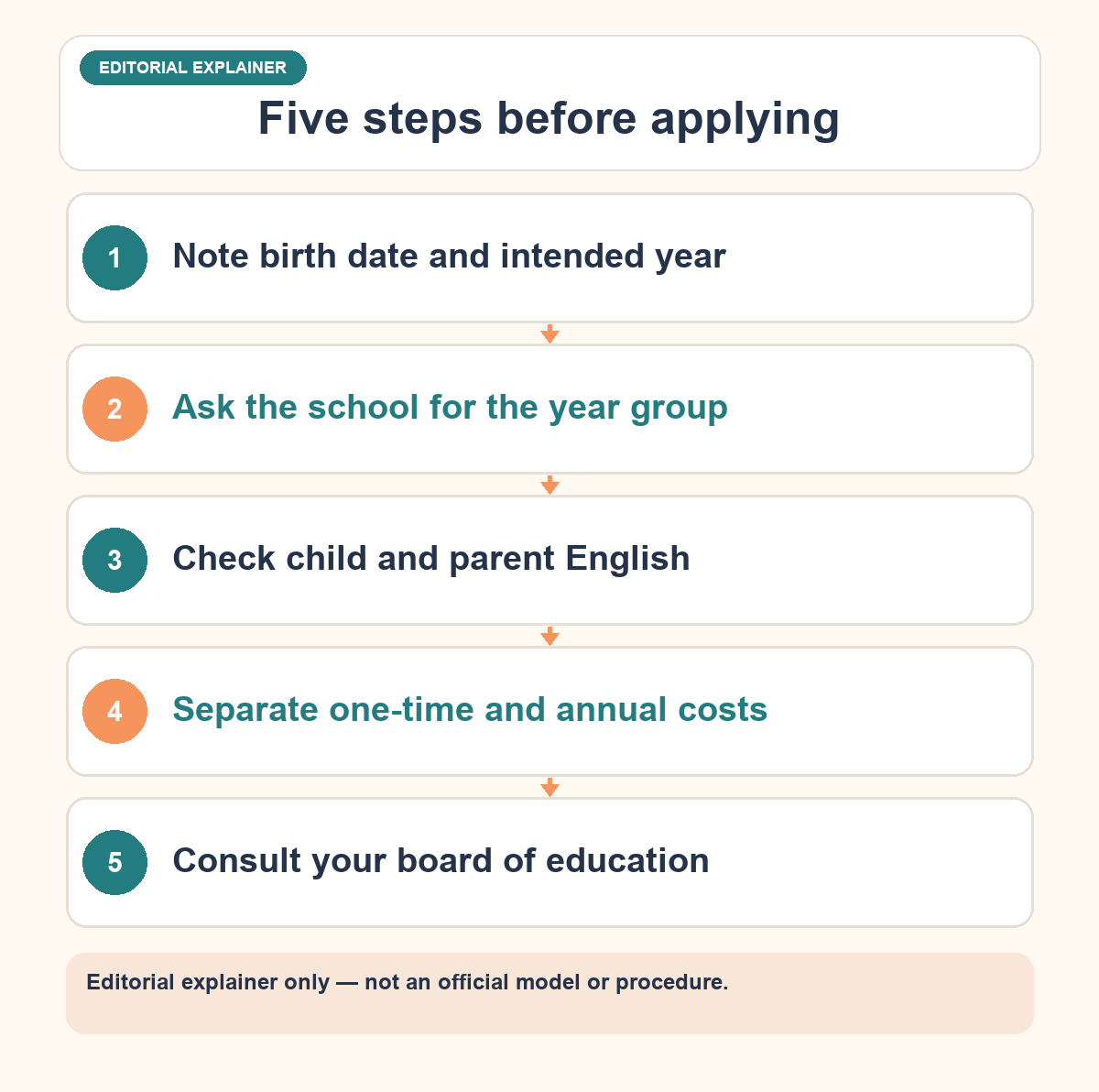
About the images: the featured illustration for this article is AI-generated. The diagram in the body is an editorial diagram summarising the article. Neither is a photograph of a real school, real pupils or NGA activities.