Missing a lot of school in the third year of junior high school does not automatically rule out preparing for high school entrance in Japan. How the chōsasho (the admission record, often called the naishinsho) is formatted and how it is used in selection differ by prefecture, school and admission route. Start by separating two questions: which document records what, and what your target school asks for. Then work through five steps.
PR: Nijiiro is an education information site operated by NIJIN, Inc. This article includes information about NIJIN GLOBAL ACADEMY (NGA), which is run by the same company. NGA’s official English FAQ says it plans to open in September 2027.
Go to the checklist sheets Go to the FAQ
The chōsasho and the report card are different documents
The report card is not necessarily what goes to the high school; check the chōsasho format, who fills it in and how it is submitted in the guidance for your prefecture and admission category. The report card (tsūchihyō) is how the school your child attends tells the student and family about their learning. The chōsasho is a document that the school applied to receives as selection material. Even when the junior high school prepares it, what goes into the admissions version and when it is due follow separate rules.
If your child has been absent a lot, you may worry that the number of days attended will directly decide the result. But which items the chōsasho contains, and which other materials it is considered alongside, are not uniform. Systems differ: some areas have a field for days absent, some provide a field for reasons for absence or special notes, and some let the student submit a self-report form (jiko shinkokusho). Do not infer how much weight something carries in selection just because a field for it exists.
“What goes into the chōsasho” and “how the target school uses that information in selection” are also separate questions. The prefecture’s admission guidelines may explain how the chōsasho is prepared, while an individual school’s admissions information may set out the weighting of interviews, essays and academic tests, and which documents to submit. Do not decide based on only one of these. Check them together, matching the admission year, the course type (full-time, part-time or correspondence) and the category, such as general or special selection.
When you speak to your child’s homeroom teacher, go beyond “How will you write the chōsasho?” Ask specifically: “For this year and this admission route, what documents will the target school receive?”, “Is there anything the family needs to submit?” and “Will my child have a chance to check the contents?” If the school has not yet prepared the chōsasho, ask them to separate what is fixed by the system from what is still being discussed within the school.
| Document | Mainly handled by | Questions to check |
|---|---|---|
| Report card (tsūchihyō) | Given by the junior high school the child attends to the student and family | Grades, written comments, how learning during absence is described |
| Chōsasho (admission record) | Prepared by the junior high school and submitted according to the admission guidelines | Fields, school years covered, attendance record, deadline |
| Self-report form and similar | Submitted by the student or others where the system or target school allows it | Who can submit, form, length limit, where to submit |
| Transcripts and learning materials | Submitted where the admission guidelines specify them | Required or optional, who issues them, what they include |
There is no single nationwide standard
National notices show the direction of consideration, but always confirm the chōsasho format, whether a self-report form exists and individual selection methods in your region’s and school’s materials for the relevant year. On high school entrance selection, MEXT has issued notices saying it is desirable not to disadvantage students with experience of school non-attendance (futōkō) who have the will and ability to learn solely because of their attendance at the school they are enrolled in. It has also pointed to consideration such as appropriately taking into account the student’s self-report form and materials on learning outside school.
These notices are not a nationwide rule that days absent will never be looked at, nor are they a school’s admission guidelines granting a right to submit a self-report form. Who evaluates which materials, and how, has to be checked against each area’s system and selection category. Once you understand the national position, compare the prefectural guidelines with your target school’s explanation.
MEXT’s published survey on improvements in public high school admissions lists prefecture-by-prefecture examples covering self-report forms, interviews, chōsasho fields and more. At the time of the survey, for example, some prefectures guided students with long-term absence to submit a self-report form, and some allowed learning outside school to be recorded in the chōsasho. These are not systems shared by every prefecture, and they describe the year surveyed. Do not assume the same arrangements continue in the year you apply; go back to the latest admission guidelines.
Public and private schools may also have different contacts. For public schools, the basic materials are the prefectural board of education’s guidelines and each school’s admission guidelines. For private schools, they are the admission guidelines of each school corporation or school. Correspondence, part-time and credit-based (tan’isei) courses and special selections have their own eligibility requirements and selection methods. Rather than lumping everything together as “high school entrance exams”, note the school name, course and selection name as you research.
Eligibility to apply and selection methods are separate checks. The first covers requirements such as age or expected graduation from junior high school. The second covers how academic tests, interviews, the chōsasho and other materials are handled. Asking “Can my child apply?” and “How are the chōsasho and the self-report form handled?” as separate questions makes it harder to confuse eligibility decisions with explanations of selection materials.
When checking materials, look beyond the year on the cover to the selection category, course and department, and any annexes and sets of forms. Documents may differ between general and special selections, and a school’s own forms may be in a separate file. When you save a document, record the date checked, the URL, the admission year, the course and the selection name, so you do not later confuse it with guidance for another year.
If this year’s admission guidelines have not been published yet, you can refer to last year’s, but do not mix them with this year’s rules. Mark previous-year materials “Reference: previous year” and ask whether changes are planned. Even if you find a summary in a web article or school information site, check deadlines, forms and eligibility against the official admission guidance.
A MEXT notice dated 30 June 2026 (reference 8文科初第882号, item 7(6)) indicates that, in addition to avoiding unfavourable treatment based only on attendance, it is desirable to appropriately take into account the student’s self-report form and materials on learning outside school. This does not mean that a particular school must accept self-report forms, that days absent are never considered in selection, or that admission is guaranteed. Read the direction set by the national notice separately from the current-year selection guidelines that each school publishes.
In this year’s guidelines, first check that the year on the cover, the school name, the course and the admission category match your candidate school. Then go through eligibility, the list of required documents, the chōsasho format, who may submit a self-report form and how, the selection materials, and deadlines and where to submit, in that order. Submission conditions may appear not only in the main text but also in annexed forms, sample entries and notes. If there are both common prefectural guidelines and school-specific guidance, save both.
For example, even if the guidelines say a self-report form “may be submitted”, who is eligible, whether advance application is needed, which parts the student fills in, length limits and how to submit may be set out separately. Ask three separate questions: “Can it be submitted?”, “Is it required?” and “How is it used in selection?” Before writing, also ask whether the junior high school checks the content and whether you can consult the target school in advance. This reduces last-minute rewrites.
If there are fields for days absent or reasons for absence, check which period is recorded, who fills it in and how special notes are handled. Not finding a field does not mean absence information is unused in selection, and the presence of a field tells you nothing about its weighting. Ask the junior high school about its criteria for preparing the chōsasho and how much the student and family can see. Ask the target school to explain its selection materials in line with its published guidelines.
If you want to submit materials about learning outside school, check whether the admission guidelines list them as acceptable, and do not assume a portfolio you have put together will automatically be accepted. If such materials are accepted, ask about the format, number of pages, any space for the student’s own explanation, whether certification from a facility is needed, the deadline and whether materials are returned. The MEXT notice points to appropriately taking out-of-school materials into account, but it does not set a uniform scoring method or point value for individual materials.
The MEXT status survey covers public high school admissions for school year 2025 (Reiwa 7), and the PDF is a version updated on 17 February 2026. Read the year covered and the update date separately, and do not treat the prefectural practices it lists as the same as the following year’s current guidelines. Use the survey examples only as clues to regional differences, and go back to primary materials from the board of education and target school for the year you apply.
If your checks are still in progress, sort items on your family sheet into “Confirmed”, “Need to ask” and “Waiting for update”, and note the date of each answer and who gave it. Because systems and admission schedules can change, reopen the official pages shortly before applying and check whether any saved PDFs have been updated or replaced.
| Source of the material | What it tells you | Questions to check it is current and relevant |
|---|---|---|
| MEXT notices | The direction of consideration set at national level | What does it cover? Does it go as far as individual admission decisions? |
| Prefectural board of education | The public admissions system and common guidelines | Do the year, department and selection category match? |
| Target school’s admission guidelines | Documents, tests, weighting, schedule | Are there school-specific attachments or ways to consult? |
| The junior high school your child attends | Preparing the chōsasho and application procedures | What are the in-school deadlines, and what must the student and family prepare? |
Five steps to prepare for high school admission
Instead of trying to resolve every worry about the chōsasho at once, check candidate schools, the admission year, required documents, contacts and deadlines in turn, so your child’s preparation and the system checks can move forward side by side. The five stages below are an example of how a family might proceed. They are not an official procedure set by MEXT or any local government.
- Listen to your child’s wishes: Write down, in your child’s own words, the commuting range they can manage, how they want to learn, the kind of environment where they feel safe, and any conditions they want to avoid for now.
- Make a provisional list of schools: Keep several candidates across public and private schools and full-time, part-time and correspondence courses, without deciding yet how likely admission is.
- Collect primary materials on the system: Save this year’s guidelines from the board of education and the target schools, the eligibility requirements and explanations of the chōsasho.
- Agree roles with the junior high school: Check when the chōsasho will be prepared, what the family submits, what your child wants to explain and the in-school deadlines.
- Work back from deadlines and review: List application deadlines, consultation bookings, information sessions and document issue dates, and recheck for changes.
You can start career consultations with the junior high school before narrowing down to one school. Rather than jumping ahead to “Is it impossible because of the absences?”, first check which system category is closest to your child’s wishes and whether anything is missing for eligibility. When you contact a high school’s admissions staff, give the school name, course, admission year and selection method. This makes it more likely you will receive the relevant guidance rather than general answers.
If your child’s feelings are unsettled, there is no need to rush into choosing candidate schools. You can break things into small next steps such as “just visit”, “just read the materials” or “time the commute”. Another approach is for the parent to organise the information and share the options with the child a little at a time. If your child does not want to attend an information session, ask the school whether a parent can attend alone and ask questions.
| Rough timing | Organise at home | Check with schools and others |
|---|---|---|
| Starting to think about candidates | Your child’s wishes, commuting conditions, questions | Consultation contacts, information sources for candidate schools |
| After admission guidelines are published | Record the year, course and selection name | Eligibility, chōsasho, self-report form |
| While preparing the application | Whether your child’s own documents are needed; drafts | In-school deadlines, submission steps, how to check |
| After submission | Confirmation of receipt and the exam schedule | Contact for changes or missing documents |
Comparing schools and selection methods
When comparing schools, look separately at the admission method, attendance and learning support after enrolment, and where to request accommodations, not only at hensachi (deviation-score rankings) or commuting time. Check each school’s admission guidelines to see whether any selection route lets your child explain their circumstances during absence, and which of academic tests, interviews, essays and self-report forms are used.
At information sessions, go beyond a vague “Can a student who hasn’t been attending school get in?” Ask one at a time about “eligibility for the [selection name] for 2027 admission”, “whether documents explaining absence can be submitted” and “where to ask about learning support needed after enrolment”. For anything the school cannot answer, ask whether they can refer you to the board of education or the admissions department.
Even when a selection method includes a self-report form, not every applicant is necessarily required to submit one. Check who it is for, who may submit it, what can be written, whether the student writes it and how information that overlaps with the chōsasho is handled. If a sample form is published, talk with your child about what they are comfortable sharing before they start writing.
In an admissions consultation, you do not necessarily have to explain the reasons for absence or family circumstances in detail. Check how much is needed to answer your questions, and you can say at the outset what your child does not want to disclose. If a school asks for medical or support information, ask why it is needed, where it goes, how it will be used and how it will be returned or stored before you decide.
In selections that include an interview, your child may worry about being asked about the period of absence. What is asked varies by school and method, so do not assume a fixed set of questions; check whether past question examples or interview guidance have been published. If you practise at home, do not push your child to answer things they do not want to talk about. Instead, help them put into their own words “what I am learning now”, “what I would like to discuss at high school” and “what I want to do if a difficult question comes up”.
If you want to understand how information in the chōsasho relates to what is scored in selection, ask, “Which items in the chōsasho do you use as selection material?” Some schools do not publish specific weightings; in that case, ask for an explanation within the scope of the published materials. Not knowing the weighting is no reason to assume the result will be decided by days absent alone, or, conversely, to assume absence is not considered at all. Separate the facts you can confirm from what has not been published.
If parent and child want different things, do not decide that either one is right. Set out the conditions each of you values and the ones that worry you. You can sort items such as commuting distance, fees, how often attendance is required, support contacts within the school and paths after graduation into “non-negotiable”, “decide after visiting” and “don’t know yet”. Cost and the practicality of the commute affect whether your child can keep going after enrolment, so check them at the same time as eligibility.
Private schools each run consultation events and individual consultations differently. Do not apply a prefecture’s common public school system to private schools, or assume that one school’s approach applies to every school run by the same corporation. Keep the guidance you receive in writing from the target school. If an important deadline comes up in a verbal explanation, it helps to show your notes and confirm that your understanding is correct.
A table comparing schools can include not only ease of commuting but also “start time in the morning”, “how to report lateness or absence”, “contacts after enrolment”, “extra lessons or help with assignments” and “study spaces your child can use”. This information is different from explanations of selection materials; it helps you think about life after enrolment. Do not put systems the school publishes and the conditions confirmed for your child in an individual consultation in the same column. Record each with its source.
Writing “essential conditions” and “daily-life conditions to check for fit” in separate columns for each candidate school makes the order of decisions clearer. Essential conditions include eligibility, required certificates, deadlines and test subjects. Daily-life conditions include start time, commuting route, support contacts and how to report absence. Check essential conditions in the admission guidelines and daily-life conditions through visits and individual consultations. Avoid choosing a path on the basis of only one of these.
For academic test preparation, you can talk with junior high school teachers or supporters about “what my child is currently studying”, “test subjects”, “where past papers or sample questions are published” and “a plan that matches my child’s capacity”. Do not estimate your child’s academic level from the length of absence; break what they can work on into small pieces. If a school offers test accommodations or taking the test in a separate room, check the application period, required documents and contact in this year’s guidelines.
If visits or information sessions tire your child, ask whether a short visit, an online session or a parent-only visit is possible. How not attending a session is treated in selection, for example whether the school describes attendance as optional, should be checked in the admission guidelines. Rather than visiting several schools in one day regardless of your child’s energy, you can prioritise the questions you most want answered and keep the materials so your child can read them later.
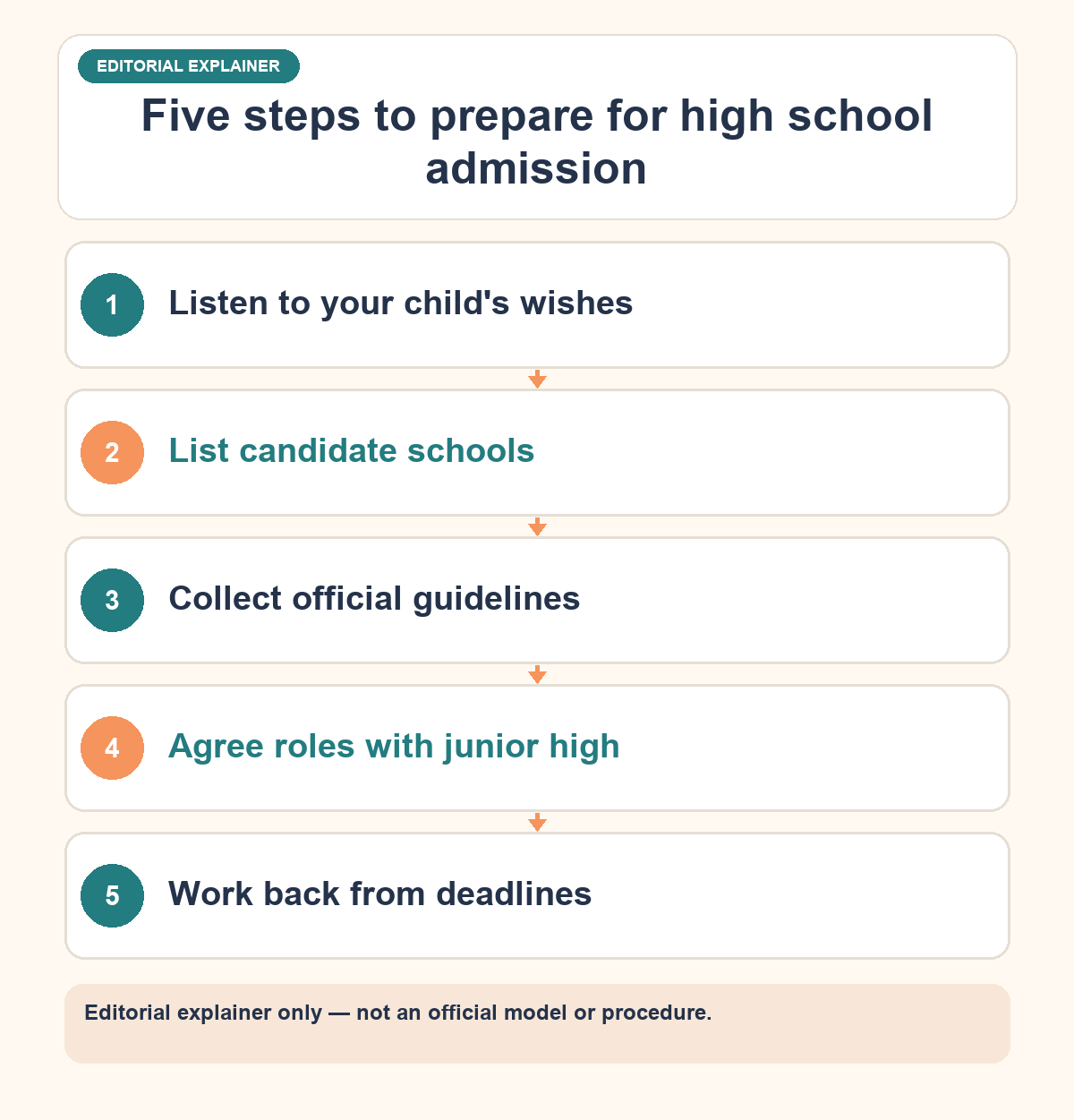
The diagram is an organising aid made by the editors, not a uniform official procedure or a standard route to admission. Adjust the order to the guidance for your admission year.
Handling reasons for absence and learning records
Whether to explain reasons for absence or learning outside school should be decided with your child, after checking whether there is a way to submit such information and how far it will be shared. The existence of a field in the chōsasho or self-report form does not necessarily mean you must write down medical information or every detail of your family’s situation.
If you plan to submit learning records to a target school, first check whether the admission guidelines accept them. A school will not necessarily accept a free school’s activity records, home study notebooks or a portfolio of work. Distinguish what can be recorded in the junior high school’s chōsasho from what your child can submit separately, and check where and by when each document goes.
If your child writes a self-report form, think about how much to say not only about the reasons for absence but also about what they are learning now, what they are good at and what they would like to discuss after enrolment. If the admission guidelines set specific questions or a length limit, work within those. If writing tires your child, or there are things they do not want to write, talk to the homeroom teacher or admissions staff and check whether any designated form of support is available.
Families can listen to their child and help organise the timeline and facts, but should not replace the child’s feelings and wishes with the parent’s words. If your child cannot yet put into words what they thought about during the period of absence, there is no need to force a positive conclusion. Another option is to briefly state what they want to discuss now and what they hope for after enrolment.
Out-of-school support or learning records affecting attendance recognition or grading is a separate procedure from their use as material in entrance selection. MEXT’s materials on support for school non-attendance include examples of out-of-school learning being treated as attendance, but they do not indicate extra points or admission at a target school. Check how such records are treated in admissions separately, in the guidelines for the relevant year.
| Point to check | Decide with your child | Ask the school |
|---|---|---|
| Scope of information | Facts they want to explain; information they do not want shared | What is needed for selection |
| Who writes it | How much your child writes; how you help | Designated form; signature fields |
| Who sees it | Whether your child agrees to submit it | Who reads it, and in which selection it is used |
| Storage | Whether to keep a copy | Return, storage and contact for questions |
Sample questions for the junior high school and target schools
Rather than asking in the abstract whether a school “accepts students who haven’t been attending”, specify the admission year and selection method and ask about documents, deadlines and contacts. Also check whether each answer is a confirmed rule or general guidance, and which official document it appears in.
With the junior high school, confirm what the chōsasho records and when it is prepared, how learning during absence is recorded, when your child can check the contents and what documents the family submits. The chōsasho is a document the school prepares, so parents do not rewrite its contents directly. If you believe something in it is wrong, organise the facts and supporting evidence and ask which procedure the school uses to check it.
With the target school’s admissions staff, give the school name, course, year and selection name, and ask about “how days absent are handled”, “whether a self-report form or similar can be submitted”, “whether learning materials are accepted” and “opportunities to consult if my child wants to explain their situation”. Some schools cannot comment on an individual’s chances of admission. Focus your questions on things that can be officially confirmed, such as eligibility and required documents.
Subject: Documents required for the 2027 entrance selection
I am the parent of a third-year student at [name] Junior High School. We are considering the [name] course, [name] selection at your school. Regarding the admission guidelines for 2027, could you please tell me: (1) the documents required at application; (2) whether a self-report form or similar explaining attendance can be submitted, and its format; (3) whether records of learning outside school can be submitted; and (4) the contact office and deadlines? I would like to share individual information about my child’s situation after confirming why it is needed and who it will be shared with.
This email is a sample question written by the editors, not a formal application document. Before contacting the school, read the admission guidelines and FAQ so you are not repeatedly asking about things already published. For important points answered verbally, record the date, the office and the document name, and if necessary confirm briefly: “Am I right in understanding that …?”
Not everything may be settled in one consultation. Separating items that need an answer before the chōsasho is prepared, items that only need to be settled at application, and items your child will keep thinking about can help manage the load on the family. When the school’s guidance is revised, check the latest version, not just the PDF you saved earlier.
What to do before and after the documents are prepared
Plan document preparation to include not only writing the content but also getting the latest versions, meeting in-school deadlines and confirming receipt after submission. When the exam schedule is tight, gather the required materials on one list and separate out the items your child does not need to decide right now.
When the admission guidelines are published, save them with the date obtained and the year in the file name so they do not get mixed up with older versions. Set dates to check the official pages of the board of education and the target school for revision histories or additional notices. If the opening date for an online application system and the issue date for certificates from the junior high school are different, start preparing for the earliest deadline.
Before preparing application documents, agree with your child how much will be shared. When entering your home address or health information, decide who operates the account and where documents are stored. Even for documents going to the school your child wants to attend, do not write detailed circumstances without telling your child.
After submission, keep the admission ticket, confirmation emails, reference numbers and so on, and check how you will be contacted if documents are missing. If you send documents by post, check tracking and the arrival deadline; if you apply online, keep the completion screen or a copy. Keeping a record of questions you have asked the school or application system saves you from explaining the same thing repeatedly.
Whether the student or parents can receive a copy of the chōsasho, and when and in what form they can see it, depends on the school’s procedures. Ask whether there is a way to see it, and where and by when to report an error, before it is prepared rather than just before applying; this leaves more time to check. This does not mean the chōsasho can be changed to match your child’s wishes. Raise factual corrections and opinions about evaluations as separate matters.
If preparation is falling behind schedule, be specific about what is delayed when you get in touch. Different help is needed when your child is finding it hard to decide, when the school has not yet set a date for preparing documents, or when the family is still obtaining required papers. Ask the junior high school’s career guidance staff which documents are needed by when and what can be done now, and ask the target school when it can accept documents and who to contact.
You do not have to finish checking documents perfectly in one go. First list each document and who submits it, dividing them into those issued by the junior high school, those your child writes and those the family prepares. Next, check which documents need drafts, what must be prepared separately such as ID photos or the exam fee, and which documents the junior high school sends directly to the target school. Follow the guidelines on whether to use post, in-person submission or online submission, and decide where to keep copies.
Also check in the school’s or local authority’s guidelines the contact for problems with documents, office hours, what to do if the admission ticket does not arrive, and how to get in touch if your child feels unwell on the exam day. Do not assume uniform hours or exception procedures; record the guidance each school gives.
Your preparation schedule can also include days off and periods when your child does not look at admissions information. A string of information sessions and document checks can be tiring, so decide as a family what you will not do this week as well. After confirming the deadlines, split the work to suit your child’s condition, and if needed, ask the junior high school about adjusting the schedule.
After the exams, try not to focus only on the result and where your child will go. Check pre-enrolment information sessions and support contacts. How learning will proceed after enrolment, how to report absence, where to get support and how to request accommodations are matters to discuss separately from the entrance selection documents. If, through the preparation process, your child has been able to put into words how they want to explain things and what help they would like, you can carry that into conversations with the next school.
10 Frequently Asked Questions
Admission conditions do not necessarily apply in the same way to every third-year junior high student, so give the year and selection category when you ask.
Can my child still apply to high school if they have missed a lot of school?
Whether a student can apply cannot be decided uniformly from the number of days absent alone. Eligibility and selection methods differ by school, course and year, so check the admission guidelines and the board of education’s guidance. Ask the junior high school and the target school specific questions about anything that is unclear.
Is the number of days absent always recorded in the chōsasho?
The chōsasho format and fields differ by region and other factors. Check in the materials for the relevant year which school years and periods of attendance are recorded and whether there is a special notes field. The contents of the report card and the chōsasho are not necessarily the same.
Can parents rewrite the chōsasho?
The chōsasho is prepared by the junior high school in line with the admission guidelines and related rules. If you think there is a factual error, show the relevant records and dates and ask the school about its procedure for checking. It is not a document the family edits directly.
Can a self-report form be submitted to any high school?
No, not uniformly. Who may submit, the form, length limits and deadlines differ by system, school and selection method, so check whether this year’s admission guidelines mention it.
Can my child submit free school records to a high school?
Records may be accepted where the admission guidelines allow learning materials from outside school, or the junior high school may receive them as reference for preparing the chōsasho, but submission is not always possible. Ask the junior high school and the target school separately about where to submit, the format and the deadline.
Does the MEXT notice mean days absent will not be looked at?
MEXT asks for consideration so that students are not disadvantaged by their attendance alone, but the notice does not uniformly decide individual selection methods or results. Check the specific handling in the latest guidelines for your region and school.
Is the chōsasho unnecessary for correspondence high schools?
Eligibility and required documents differ between correspondence high schools too. Check each school’s official admission guidance for required documents, the selection process, whether there is an interview or essay, and the application period.
Do we need to explain the reasons for absence in detail?
How much explanation is needed depends on the form and the selection. Talk with your child, and confirm what information is requested, who will see it and how it will be used before writing anything. If you are not sure why some information is needed, ask the school.
Can we contact the target high school directly?
If the admission guidelines or official website give a contact, you can ask procedural questions by stating the year, course and selection name. Asking about eligibility, forms and deadlines, rather than your child’s individual chances of admission, makes it easier to get clear answers.
Can we ask about support after enrolment before the exams?
What can be discussed, and who to contact, differ by school. Separately from your questions about selection, ask the admissions staff or the school’s consultation contact about contacts after enrolment, learning support and whether there is a procedure for requesting accommodations.
Next steps
Start with the official guidance and your child’s junior high school, and treat every answer as applying to one year, one school and one selection route.
- Ask the homeroom teacher or career guidance staff which admission guidelines apply to your child’s year, and when the chōsasho will be prepared.
- Save the board of education’s and each target school’s guidelines for the same admission year, with the date you checked them.
- Fill in the basic sheet below for each candidate school, and use the optional log to record every answer and its source.
- If worry is building up for your child or for you, use public consultation services such as the school counselor, your local board of education or the 24-hour Children’s SOS Dial (0120-0-78310, Japanese-language).
Nijiiro also has a Japanese-language article on self-report forms and prefecture-specific arrangements: 高校入試の自己申告書とは? (What is the self-report form in high school admissions?, in Japanese).
Editable checklist sheets
Recording the year, school, selection method and contacts on one sheet, together with the date you checked the official materials, makes it harder to mix up different systems. These sheets are organising examples made by the editors. They are not application documents or official board of education forms.
Basic sheet: chōsasho and high school admission checklist
My child’s wishes: ________ Date checked: ________
| School, course, selection | Official document and year | What we found out / next question |
|---|---|---|
| 1st choice: ________ | ________ | ________ |
| 2nd choice: ________ | ________ | ________ |
| 3rd choice: ________ | ________ | ________ |
- Chōsasho: prepared by ________ In-school deadline ________
- Self-report form or similar: required / optional / not applicable / not yet checked
- Materials on learning outside school: can be submitted? ________ Format ________
- Eligibility and deadlines: ________
- Who we asked, staff member, date of answer: ________
- Information my child does not want shared, and things to be careful about: ________
- Next check date: ________
Date we checked for updated guidelines: ________ Saved in: ________
Optional sheet: contact and update log
| Date | School or office, contact | Question | Answer and document it is based on | Status |
|---|---|---|---|---|
| ________ | ________ | ________ | ________ | Confirmed / Need to ask / Waiting for update |
| ________ | ________ | ________ | ________ | Confirmed / Need to ask / Waiting for update |
| ________ | ________ | ________ | ________ | Confirmed / Need to ask / Waiting for update |
Official pages to reopen just before applying: ________ Saved PDF update date: ________
After meetings, arrange the notes so the family can review them easily, for example by colour-coding “decided”, “being checked” and “check next time”. Before showing them to your child, also confirm who the notes containing personal information will be shared with.
References
- MEXT, “Kōtō Gakkō Nyūgakusha Senbatsu-tō ni okeru Hairyo Jikō-tō ni tsuite (Tsūchi)” (30 June 2026, reference 8文科初第882号, item 7(6); in Japanese) (checked 6 November 2026 for the original article)
- MEXT, “Realising flexible, high-quality learning that responds to diverse learning needs in high schools and similar institutions” (in Japanese) (13 February 2024; checked 6 November 2026 for the original article)
- MEXT, “Survey on the status of improvements in high school entrance selection for school year 2025 (Reiwa 7) (public high schools)” (in Japanese) (covers school year 2025; published December 2025; version updated 17 February 2026; checked 6 November 2026 for the original article)
- MEXT, “Tashika na Gakuryoku Q&A” (in Japanese) (checked 6 November 2026 for the original article)
- MEXT, “Attendance treatment and grading for students in school non-attendance (for parents and guardians)” (in Japanese) (publication date could not be confirmed from the document text; checked 6 November 2026 for the original article)
- MEXT, “24-hour Children’s SOS Dial” (in Japanese) (checked 24 November 2026 for this translation)
- NIJIN GLOBAL ACADEMY, FAQ (English) (checked 24 November 2026 for this translation)
Information dates: the factual statements in this English page are translated from the Japanese original, whose sources were checked by the original editors on 6 November 2026 (with the publication dates shown for each item). This translation was prepared on 24 November 2026. On that date, only the NGA information, the public consultation details and the existence and date of the June 2026 MEXT notice were rechecked; the other inherited statements were not newly re-verified and may have changed. Always check the official guidance for your admission year.
This article is general information about the path to high school. It does not decide any individual school’s eligibility, admission results or what is written in a chōsasho. Check the official materials for your admission year.
The featured illustration at the top of this page is an AI-generated illustration. The diagram in the body is a separate editorial diagram of the steps in this article. Neither is a photograph of real school activities, students or families.