Menu
BASICS
How Japanese schools work Japanese phrases for school Glossary of school termsWAYS TO LEARN
Free schools Education support centers Online schools Homeschooling in Japan International schools Correspondence high schoolsMORE
Neurodivergent children Where to get help Attendance and costs Learning Place Finder 日本語サイトへJapanese Public Elementary School for Foreign Children: A Parent Guide
- How foreign children enroll in a Japanese public elementary school, and what is free and what is not
- What a school day looks like, including school lunch (kyūshoku) and cleaning time (sōji)
- The parent side: the contact notebook, handouts, PTA, homework and summer assignments
- Where children from abroad commonly find things hard, and what Japanese language support exists
- Signs that a rough patch may be turning into something bigger
- Who to talk to at school and in your city, with a polite Japanese message you can copy
This article is general information, not legal or medical advice. Rules, fees and support differ between municipalities and even between schools in the same city, so treat the details below as a starting point and check with your local board of education. If your child talks about hurting themselves or you are worried about their safety, contact a doctor or emergency services straight away.
Enrolling a foreign child in a Japanese public elementary school
The first thing many foreign parents are surprised to learn is that the rules are different for them. In a 2019 notice to local authorities, Japan’s Ministry of Education (MEXT) states that parents of foreign children are not subject to the school-attendance obligation set out in Article 16 of the School Education Act. In other words, you are not legally required to send your child to a Japanese school. But you may, and the same notice asks local authorities to actively promote enrollment and explain the support available.
The Tokyo Metropolitan Government puts it simply: Japanese public elementary and junior high schools “accept foreign nationals if they wish to enroll.” MEXT’s multilingual Guidebook for Starting School, available in English and several other languages, walks through the process.
| Step | What happens |
|---|---|
| 1. Contact your municipality | Go to the board of education at your city, ward, town or village office and say you want your child to attend a Japanese school. Tokyo notes this can be done at any time of year. |
| 2. Fill in the application | MEXT’s guidebook describes an application form for non-Japanese students, submitted to the municipal board of education. |
| 3. Receive the permit | An enrollment permit is issued, on the day or by post, naming the school your child will attend. |
| 4. Meet the school | The school explains daily life, what to buy and how to contact them. MEXT’s guidebook says an interpreter will be arranged when necessary. |
Which grade? Japanese schools place children by age. According to MEXT’s guidebook, children born between 2 April and 1 April of the following year are in the same grade, and elementary school starts in the April after a child turns six. The guidebook also says that if a child’s Japanese is not yet strong enough for the age-level curriculum, they may temporarily be placed in a lower grade. This is worth discussing openly with the board of education rather than assuming either way.
| Usually free | Usually paid by parents |
|---|---|
| Tuition at public elementary and junior high schools (MEXT) | Supplementary learning materials, workbooks and some supplies (MEXT) |
| Textbooks, given to each child (MEXT) | School lunch, in many areas (MEXT); some municipalities now waive it, e.g. Nerima City’s 2025 guide says there is no lunch fee |
| Interpreting for some school meetings, in some cities (e.g. Nerima’s volunteer interpreters) | Things you buy yourself: school bag, indoor shoes, gym clothes, events and trips |
If costs are a problem, both MEXT and the Tokyo Metropolitan Government note that municipalities offer financial assistance for school supplies and school lunches (often called shūgaku enjo, 就学援助) for families who would otherwise struggle. Ask your board of education how to apply.
What a school day looks like
A Japanese elementary school is not only a place for lessons. Children are expected to take part in running the school day: serving lunch, cleaning, and moving around as a group. For many children from abroad, this is the biggest change, bigger even than the language.
Three parts of the day children share
These are often new to children who went to school elsewhere. City guides describe all three.
01
School lunch
Kyūshoku (給食) is eaten together in the classroom. MEXT’s guidebook notes that children usually serve and clear up themselves; Sendai’s guide describes one-week serving shifts with a white coat taken home to wash.
02
Cleaning time
In sōji (掃除), children and teachers clean classrooms and other areas together. Sendai’s guide calls it a traditional part of Japanese education.
03
Group routines
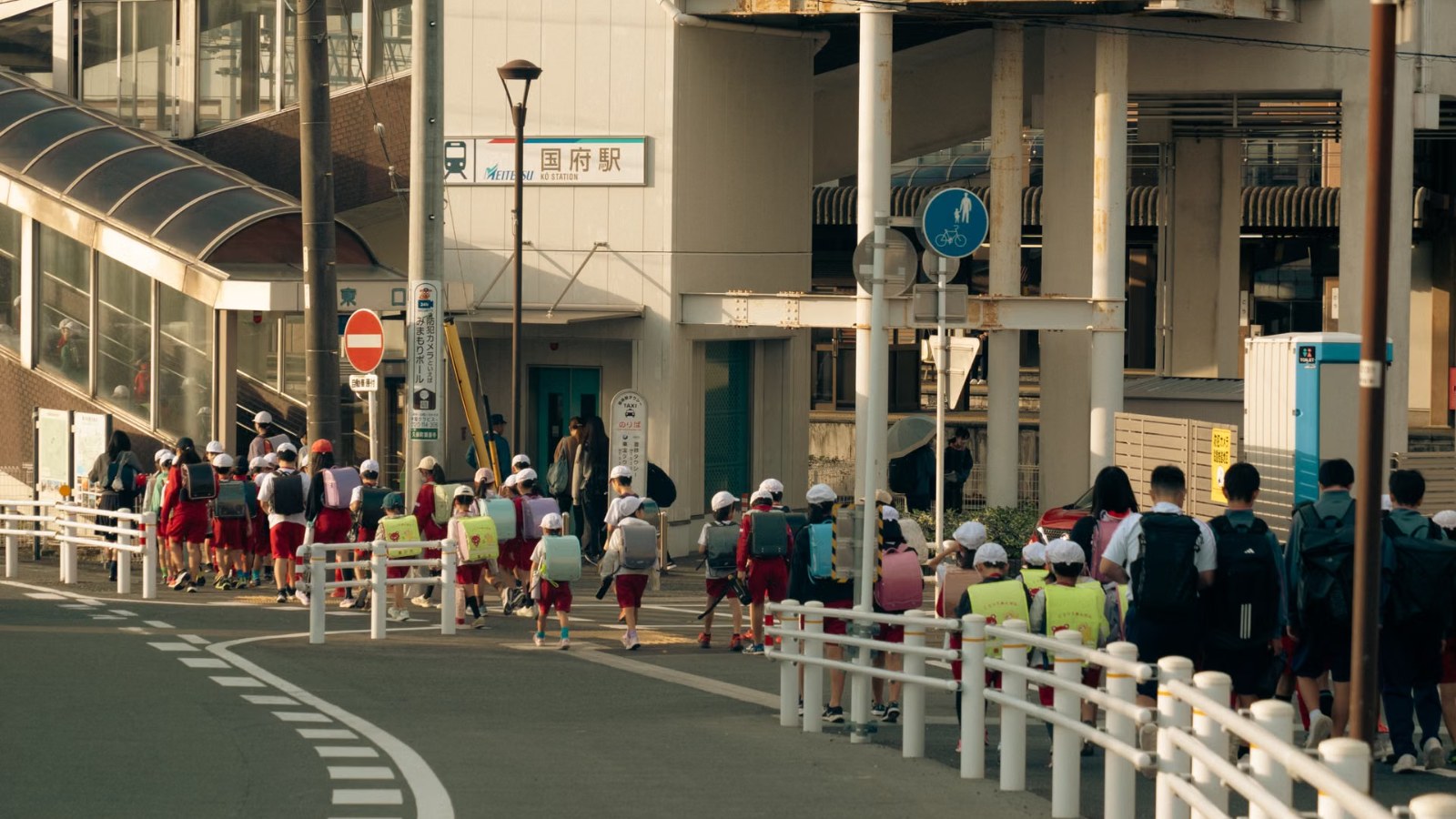
Children walk to school on set routes, change into indoor shoes, and move, line up and greet as a class. Nerima’s guide mentions designated routes to school.
None of these are meant to be hard. But a child who doesn’t yet know the unwritten steps can feel watched and out of place.
A few practical details from city guides that help children settle faster:
| Part of the day | What to know | Where children can struggle |
|---|---|---|
| Arriving | Walk to school; change into indoor shoes, uwabaki (上履き). Sendai asks children not to come by bike. | Forgetting the shoe change; not knowing where to put things |
| Lunch | Everyone usually eats the same meal. Nerima asks parents to tell the homeroom teacher about food allergies before lunch starts. | Unfamiliar food, eating within the time, serving duty |
| Cleaning | Short daily session, usually with set roles | Not knowing the routine; feeling it is unfair |
| Belongings | Nishitokyo’s guide asks parents to write the child’s full name on everything used at school; money, phones, snacks and toys are not allowed | Bringing something from home that turns out to be banned |
If your child has dietary needs for health or religious reasons, raise them before the first day rather than after the first difficult lunch. Schools differ in what they can offer, so ask what is possible.
The parent side: renrakuchō, handouts, homework and PTA
Japanese schools expect a lot of paper-based contact with families, and much of it arrives in Japanese. Knowing what each item is for makes it far less overwhelming.
| Item | What it is | Tip for foreign parents |
|---|---|---|
| Randoseru (ランドセル) | The hard school backpack. Nerima lists it among the things guardians prepare. | Ask the school whether a different bag is acceptable if cost or weight is an issue |
| Renrakuchō (連絡帳) | The contact notebook. Nishitokyo’s guide says children write the teacher’s announcements in it, and parents and teachers use it to communicate. | Check it every evening; a short note in simple Japanese or English is fine |
| Handouts and newsletters | Sendai’s guide says they cover next month’s events, class topics, money needed and things to bring | A translation app on your phone helps; ask a neighbor parent when unsure |
| Homework | Nishitokyo notes first graders usually practice hiragana, kanji and counting | Short daily routines work better than long sessions |
| Absence notice | Nerima and Sendai both ask you to contact the school in the morning if your child will be absent, late or leaving early | Ask how your school prefers to be contacted: app, phone or notebook |
PTA. MEXT’s guidebook describes the PTA as a group of parents, guardians and teachers who work together to support the school. Nishitokyo’s guide mentions activities such as local events and safety patrols on the way to and from school. How membership and duties work varies a lot between schools, so ask the school or another parent how it works there, and say honestly if your Japanese or working hours limit what you can do.
Many foreign parents find the paperwork harder than their child finds the classroom. That is normal. It is also a good reason to find one friendly parent in your child’s class early: they can often explain a handout in two minutes.
The school year: undōkai, summer and events
The Japanese school year probably runs on a different calendar from the one your child knows. MEXT’s guidebook says schools start in April and end in March, with the year divided into two or three terms.
| Event | What it involves | Why it can feel big |
|---|---|---|
| Undōkai (運動会), sports day | MEXT describes short races, relays, ball games and dancing; Nerima says guardians are encouraged to watch | Weeks of group practice and dance routines, often with instructions shouted in Japanese |
| Summer vacation | About 30–40 days, depending on the region (MEXT) | A long break, then a return to routines |
| Summer assignments | Nishitokyo’s guide says children hand them in on the first day of the second term | Parents may need to help with instructions in Japanese |
| Class observation, individual meetings | Sendai’s guide mentions lesson observations once or twice a term; Nerima describes one-to-one meetings with the homeroom teacher | A good chance to ask how your child is really doing |
| Home visits | Sendai notes some schools have the homeroom teacher visit the family at home | Can feel unfamiliar; it is a routine conversation, not an inspection |
Summer assignments are a common stress point for foreign families. Look at them with your child early in the break, list anything you don’t understand, and ask the teacher or another parent before the holiday is half over.
Where foreign children commonly struggle
Every child is different, and many children from abroad settle in well. But when things get hard, the difficulties tend to cluster in a few areas. None of them mean your child has failed at anything.
Three things that make the first year tiring
Children often manage lessons well enough but come home exhausted. These are usually the reasons.
01
Language all day
Listening in a new language for six hours is hard work. Children may understand playground Japanese long before they can follow a lesson or read instructions.
02
Unwritten group rules
How to line up, when to speak, what to do at lunch or cleaning. Classmates learned these over years; your child has to pick them up by watching.
03
Standing out
A different name, face, lunch preference or way of talking can draw attention. Most of it is curiosity, but repeated teasing needs to be raised with the school.
Fatigue, not refusal, is the most common early sign. Plenty of rest and a quiet after-school routine help more than extra study.
Some children push hard to fit in and then fall apart at home in the evening. Others go quiet at school for weeks. Both can be ordinary parts of adapting to a new language and culture. What matters is the direction of travel over time, which the next sections help you judge.
If your family also speaks another language at home, keep using it. Children’s home language is part of who they are, and dropping it rarely speeds up learning Japanese. Our article on when your child doesn’t speak the local school’s language covers this in more depth.
Japanese language support at school
Your child is not the only one learning Japanese at school. MEXT’s most recent survey found that, as of 1 May 2025, 73,313 foreign-national students in Japanese public schools needed Japanese language instruction, up from 57,718 in the previous survey two years earlier (84,759 when Japanese-national students are included). Most of these children were receiving some form of specially arranged support, though the amount and type vary by school.
What that support looks like depends heavily on where you live. Examples from local guides:
| Type of support | Example from a local guide |
|---|---|
| Extra Japanese lessons at school | Nerima (2025): students from international families study Japanese at school for an additional 80 hours |
| Japanese teacher for a period | Nishitokyo: your child can take Japanese lessons from a teacher of Japanese in the school for a certain period |
| In-class helpers | Sendai: a volunteer may be available to help with Japanese and classes |
| Interpreters for parents | Nerima: volunteer interpreters for parent-teacher meetings, free of charge; Tokyo’s board of education runs an interpreted consultation service |
| Learning materials | Tokyo’s board of education offers a Japanese teaching textbook, Tanoshii Gakkō, in 22 languages |
MEXT’s guidebook also notes that in some cases a child may be able to attend a different school from the designated one to receive sufficient Japanese language instruction. If your school has little support, ask the board of education what options exist in your area.
How many hours of Japanese instruction will my child receive, and for how long? Will it be in a separate room or in class? Who is the Japanese language instructor, and can I meet them? Can an interpreter join our individual meeting? Is there a local Japanese class or homework support for children outside school hours?

Adjustment, or something bigger?
Some difficulty in the first months is expected. The question is whether things are slowly improving or getting stuck. The table below is a rough guide, not a diagnosis.
| Usually adjustment | Worth acting on |
|---|---|
| Tired and grumpy after school, better at weekends | Tired all the time, including weekends and holidays |
| Complains about lunch or cleaning, but goes | Stomach aches or headaches most school mornings |
| Few friends yet, but mentions one or two names | Talks about being laughed at, left out or hurt, repeatedly |
| Slowly understands more Japanese over months | No progress after many months despite support, or trouble in their home language too |
| Reluctant on Mondays, fine by midweek | Missing school more and more often, or refusing to go at all |
School avoidance is not unusual in Japan. MEXT’s figures for the 2024 school year counted 137,704 elementary school students as futōkō (不登校), meaning absent for 30 or more days in the year for reasons other than illness or finances, or about 23 in every 1,000 elementary students. If your child is heading in that direction, read our guide to school refusal in Japan.
Language can also hide other needs. A child who struggles with attention, reading or social situations may be seen as “still learning Japanese” for a long time, or the other way round. If you notice difficulties that also show up in your home language, it may be worth an assessment. Our guide to special needs support in Japanese schools explains the options.
Who to talk to, and how to start
You don’t need perfect Japanese to raise a concern. What helps is knowing who does what.
| Who | What they can help with |
|---|---|
| Homeroom teacher, tannin (担任) | Your first contact for almost everything: friendships, lunch, homework, how your child seems in class |
| Japanese language instructor | How your child’s Japanese is progressing and what support they get |
| School counselor | Worries about feelings, friendships or bullying; Nishitokyo’s guide says parents can consult the school counselor |
| Municipal board of education | Enrollment, grade placement, Japanese support, financial assistance, changing school |
| Local international association | CLAIR says these offer consultation for foreign residents, Japanese classes and translation; services vary |
For help beyond school, including consultation lines in English, see our guide to where to get help in Japan.
You can write this in the renrakuchō or send it through the school’s app. Replace ○○ with your child’s name.
担任の先生へ
いつもお世話になっております。○○の母(父)です。最近、○○が朝になると「学校に行きたくない」と言うことが増えています。学校での様子について、一度お話を伺えますでしょうか。日本語に不安があるため、可能であれば通訳の方にご同席いただけますと助かります。お忙しいところ恐縮ですが、どうぞよろしくお願いいたします。
(In English: Thank you for all your help. I’m ○○’s mother/father. Recently ○○ has often said in the morning that they don’t want to go to school. Could we talk about how things are going at school? As I am not confident in Japanese, it would help if an interpreter could join, if possible.)
Public school, international school, or online? An honest comparison
Most families find that, with time and support, the local school works. For some children it doesn’t, at least for now. If you are thinking about options, here is how the three most common choices compare in general. For in-person options, see our overview of international schools in Japan.
Local school, international school, or online
| Japanese public school | International school in Japan | Online international | |
|---|---|---|---|
| Free tuition | ○ | × fees | × fees |
| In-person friends and campus | ○ | ○ | × |
| Taught in English | × | ○ | ○ |
| Japanese language and neighbors | ○ | △ varies | △ bilingual staff |
| Official Japanese schooling | ○ | △ check each | × |
○ = generally yes △ = depends × = generally no / General tendencies, not a judgment on any particular school. As of September 2026.
There is no single right answer. Some families move between options as a child’s needs change, and others combine a local school with outside activities or tutoring. If you are also considering online schools or other alternatives, compare what each one says about attendance, qualifications and cost before deciding.
An online option in English and Japanese: NIJIN GLOBAL ACADEMY
NIJIN GLOBAL ACADEMY (NGA) is an online international school for ages 6–18, run by NIJIN, the company behind this site. Its FAQ says families living in Japan, as well as abroad, can join. We include it because some of its design choices respond to the pressure points above. Please read the limitations as carefully as the features.
| What NGA says it offers | Why it may matter for a child struggling at a local school |
|---|---|
| Classes of eight, the same small group every day, and a daily morning circle | A predictable routine and a small group to get to know |
| Bilingual (English and Japanese) mentors who stay with each group | An adult who can support your child in both languages |
| No rankings; a place where children “cheer each other on rather than compete” | Less comparison for a child who has been feeling behind |
| No entrance exam and no English requirement; children who have struggled with attendance are welcome | No need to prove readiness after a hard year |
| Timetables for Asia and Oceania time zones; learning continues if the family moves; optional Cambridge IGCSE and A-Level | Continuity for families who may leave Japan later |
NGA opens in September 2027; free trial classes are planned monthly from September 2026. Tuition has not been published; NGA says it will be well below in-person international schools and will be shared first with its mailing list. There is no physical campus, so in-person friends and Japanese immersion would need to come from outside activities. NGA is not a Japanese “ichijo” school (一条校), so it does not give a Japanese school diploma, and we could not find a statement on its website about attendance recognition (shusseki atsukai) at a child’s Japanese school. Its FAQ says enrollment and withdrawal policies (including mid-year joining), mentor hiring criteria and absence policies are still being prepared. Figures such as “1,000+ students” or a 97% attendance-recognition rate belong to its sister school, NIJIN Academy, not NGA.
NIJIN GLOBAL ACADEMY is an online international school for ages 6–18, with classes of eight and bilingual mentors, open to families in Japan and abroad. It opens in September 2027, with free trial classes planned from September 2026.
Frequently asked questions
Sources used for this article
- MEXT (Ministry of Education, Culture, Sports, Science and Technology), Guidebook for Starting School (English and Japanese edition, dated April 2015, posted 2022): mext.go.jp (PDF)
- MEXT, “外国人児童生徒のための就学ガイドブック” (multilingual guidebook page): mext.go.jp / English page “Guide for foreign students to start school”: mext.go.jp
- MEXT, “外国人の子供の就学の促進及び就学状況の把握等について(通知)” (15 March 2019): mext.go.jp
- Tokyo Metropolitan Government, “Enrollment in Public Elementary and Junior High Schools” (2 December 2024): metro.tokyo.lg.jp
- Nerima City Board of Education, Enrollment Guidebook for International Families (September 2025): city.nerima.tokyo.jp (PDF)
- Board of Education of Nishitokyo City and Nishitokyo Multicultural and International Center, Guidebook for Parents/Guardians of Foreign Children who will Enter Elementary Schools (revised January 2016): city.nishitokyo.lg.jp (PDF)
- Sendai Tourism, Convention and International Association (SenTIA), Japanese Elementary Schools (revised FY2019): sentia-sendai.jp (PDF)
- MEXT, “日本語指導が必要な児童生徒の受入状況等に関する調査(令和7年度)” results summary (May 2026): mext.go.jp (PDF)
- MEXT, “令和6年度 児童生徒の問題行動・不登校等生徒指導上の諸課題に関する調査結果の概要(不登校抜粋版)” (November 2025): mext.go.jp (PDF)
- Council of Local Authorities for International Relations (CLAIR), “International Associations – Consultation Services”: clair.or.jp
- NIJIN GLOBAL ACADEMY, FAQ and “Why NGA” pages (checked September 2026): FAQ / Why NGA / Tuition & Admissions
If the local school isn’t working for your child right now, NIJIN GLOBAL ACADEMY offers live online classes of eight with mentors who speak English and Japanese, and no entrance exam. It is not a Japanese ichijo school and tuition is yet to be announced; it opens in September 2027.
Published: 22 September 2026 / Last updated: 22 September 2026