Menu
BASICS
How Japanese schools work Japanese phrases for school Glossary of school termsWAYS TO LEARN
Free schools Education support centers Online schools Homeschooling in Japan International schools Correspondence high schoolsMORE
Neurodivergent children Where to get help Attendance and costs Learning Place Finder 日本語サイトへHow to Tell a Japanese School Your Child Is Absent (Templates)
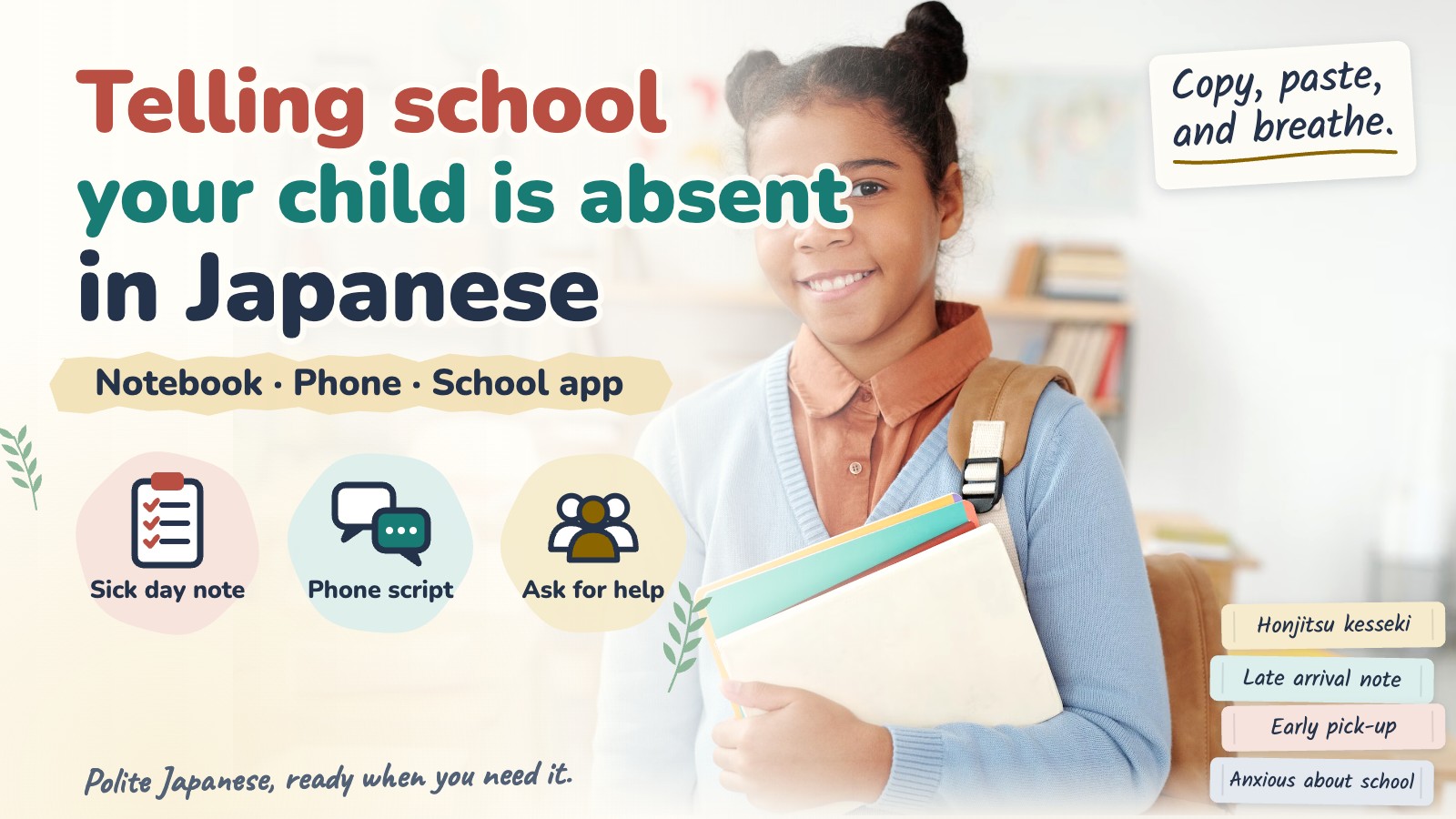
- The three common ways Japanese schools take absence notices: the renrakuchō (連絡帳), a morning phone call, and school apps or online forms
- Polite, natural Japanese templates for a sick day, a late arrival and an early pick-up, with romaji and English
- A short phone script, and the questions a teacher or office staff member may ask you
- What to write when your child is refusing or dreading school, and how to ask for a meeting or for handouts
- Where to get interpreters and multilingual help, from the school, the city and national bodies
- What to know when absences start to add up, including how “attendance recognition” works
This article is general information for parents, not medical or legal advice. Every school sets its own procedure, so always follow the instructions in your school’s letters or app. If your child is very unwell, or you are worried about their safety or mental health, contact a doctor or emergency services first. The school can wait.
How Japanese schools usually receive absence notices
Japanese public elementary and junior high schools expect parents to tell them every time a child will be absent, late or leaving early. Nerima City’s enrollment guidebook for international families (September 2025) puts it plainly: “Always contact the school when your child is going to be absent (will not be going to school), tardy (be late for school), or will be leaving school early.” Sendai’s guide for foreign parents asks families to inform the school in the morning, either by phone or through the renrakuchō.
The method itself depends on your school. Traditionally it was a phone call or a note in the communication notebook, and many schools still accept both. But a growing number now use apps or online forms. Gifu City, for example, introduced a “Smart Renrakuchō” app in June 2022 so parents in its public elementary and junior high schools can send absence notices by smartphone. The Ministry of Education (MEXT) has also published an example of a school using online forms for absence notices and health reports, noting that it reduced the interruptions caused by morning phone calls.
Notebook, phone call, or school app
Your school will tell you which one it prefers. Many schools accept more than one.
01
Renrakuchō notebook
A small notebook that travels between home and the homeroom teacher. For absences, a sibling or a neighbor’s child who goes to the same school may carry it in for you.
02
Morning phone call
A short call to the school office before classes begin. Useful for urgent or same-day changes, and the fallback when the notebook can’t reach school.
03
App or web form
A school app or online form where you pick “absent,” “late” or “leaving early” and type a reason. Often possible the night before, and easy to translate.
If your school uses an app, the templates below still work: paste them into the free-text “reason” or “message” box.
| Method | Good for | Watch out for |
|---|---|---|
| Renrakuchō (連絡帳) | Planned absences, longer notes, replies from the teacher | Someone has to carry it to school; handwriting can be hard to read |
| Phone call | Urgent, same-day changes | Fast Japanese, no written record; timing matters |
| School app / web form | Routine sick days, late arrivals | One school we checked says email-only registration can’t send absence notices; ask how to register |
That last point comes from a public elementary school in Funabashi that takes absence notices through its app. Setup details like this are worth checking in your first week, not on the first sick morning.
The key words, and three things every notice needs
You only need a handful of Japanese words to handle most absence notices. Kawasaki International Association’s guide for non-native-speaking parents lists the same three core phrases shown here.
| Japanese | Romaji | Meaning |
|---|---|---|
| 欠席 | kesseki | Absent (the whole day) |
| 遅刻 | chikoku | Arriving late |
| 早退 | sōtai | Leaving early |
| 発熱 / 熱 | hatsunetsu / netsu | Fever |
| 体調不良 | taichō furyō | Feeling unwell (general) |
| 通院 / 受診 | tsūin / jushin | Going to the doctor / seeing a doctor |
| 家庭の都合 | katei no tsugō | Family reasons |
| 担任の先生 | tannin no sensei | Homeroom teacher |
Whatever the channel, a clear notice has three parts: who you are (grade, class and child’s name), what is happening (absent, late or leaving early, and when), and why (a short reason). Japanese messages also open and close with fixed polite phrases. They work like “Dear” and “Kind regards.”
| Part | Japanese | What it does |
|---|---|---|
| Opening | いつもお世話になっております。 (Itsumo osewa ni natte orimasu.) | “Thank you for all you do.” Standard greeting |
| Who you are | 〇年〇組〇〇の母です。 (○-nen ○-kumi ○○ no haha desu.) | “I’m the mother of [name], grade ○, class ○.” Use 父 (chichi) for father, 保護者 (hogosha) for guardian |
| Closing | よろしくお願いいたします。 (Yoroshiku onegai itashimasu.) | “Thank you for your understanding.” |
Templates for a sick day, a late arrival and an early pick-up
Copy these into the renrakuchō, an app or an email and replace the ○ marks. Grade and class are written as numbers, for example 3年2組 (3-nen 2-kumi) for grade 3, class 2.
いつもお世話になっております。〇年〇組〇〇の母です。本日、発熱のため欠席させていただきます。よろしくお願いいたします。
Itsumo osewa ni natte orimasu. ○-nen ○-kumi ○○ no haha desu. Honjitsu, hatsunetsu no tame kesseki sasete itadakimasu. Yoroshiku onegai itashimasu.
“Thank you as always. I’m the mother of ○○ in grade ○, class ○. ○○ will be absent today because of a fever. Thank you.”
Other reasons you can swap in for 発熱 (fever): 腹痛 (fukutsū, stomachache), 頭痛 (zutsū, headache), 体調不良 (taichō furyō, feeling unwell), 通院 (tsūin, a doctor’s appointment), 家庭の都合 (katei no tsugō, family reasons).
いつもお世話になっております。〇年〇組〇〇の父です。本日、通院のため遅刻いたします。10時ごろに登校する予定です。よろしくお願いいたします。
Itsumo osewa ni natte orimasu. ○-nen ○-kumi ○○ no chichi desu. Honjitsu, tsūin no tame chikoku itashimasu. Jū-ji goro ni tōkō suru yotei desu. Yoroshiku onegai itashimasu.
“Thank you as always. I’m the father of ○○ in grade ○, class ○. ○○ will be late today because of a doctor’s appointment, and plans to arrive around 10:00. Thank you.”
いつもお世話になっております。〇年〇組〇〇の母です。本日、歯科受診のため、13時に早退させていただきたく存じます。13時に私が学校まで迎えに参ります。よろしくお願いいたします。
Itsumo osewa ni natte orimasu. ○-nen ○-kumi ○○ no haha desu. Honjitsu, shika jushin no tame, jūsan-ji ni sōtai sasete itadakitaku zonjimasu. Jūsan-ji ni watashi ga gakkō made mukae ni mairimasu. Yoroshiku onegai itashimasu.
“Thank you as always. I’m the mother of ○○ in grade ○, class ○. I would like ○○ to leave early at 1 p.m. today for a dental appointment. I will come to the school to pick them up at 1 p.m. Thank you.”
Pick-up rules differ. Nerima City’s guidebook, for example, says guardians must come to the classroom to drop off or collect a child who is arriving late or leaving early. If someone other than you will collect your child, say so in the note: 本日は祖母が迎えに参ります (Honjitsu wa sobo ga mukae ni mairimasu, “Today their grandmother will pick them up”).

A phone script, and what the school may ask you
Phone calls feel harder than writing, but absence calls are short and predictable. Keep this script next to the phone.
| Who | Japanese (romaji) | English |
|---|---|---|
| School | はい、〇〇小学校です。 (Hai, ○○ shōgakkō desu.) | “Hello, ○○ Elementary School.” |
| You | おはようございます。〇年〇組〇〇の母です。いつもお世話になっております。 (Ohayō gozaimasu. ○-nen ○-kumi ○○ no haha desu. Itsumo osewa ni natte orimasu.) | “Good morning. I’m the mother of ○○ in grade ○, class ○.” |
| You | 本日、熱があるため欠席いたします。担任の〇〇先生にお伝えいただけますか。 (Honjitsu, netsu ga aru tame kesseki itashimasu. Tannin no ○○ sensei ni otsutae itadakemasu ka.) | “○○ has a fever and will be absent today. Could you please pass this on to their homeroom teacher, ○○ sensei?” |
| School | わかりました。お大事になさってください。 (Wakarimashita. Odaiji ni nasatte kudasai.) | “Understood. We hope they feel better soon.” |
| You | ありがとうございます。よろしくお願いいたします。失礼いたします。 (Arigatō gozaimasu. Yoroshiku onegai itashimasu. Shitsurei itashimasu.) | “Thank you. Goodbye.” |
Office staff or the teacher may ask a follow-up question or two. These are ones you may hear. It helps to have the answers ready before you dial.
| You may hear | Meaning | Example answer |
|---|---|---|
| 熱は何度ですか。 (Netsu wa nando desu ka.) | “What is the temperature?” | 38度5分です。(Sanjūhachi-do go-bu desu, 38.5°C) |
| 病院には行かれましたか。 (Byōin ni wa ikaremashita ka.) | “Have you seen a doctor?” | これから行きます。(Kore kara ikimasu, “We’re going now.”) |
| ほかに症状はありますか。 (Hoka ni shōjō wa arimasu ka.) | “Any other symptoms?” | せきが出ています。(Seki ga dete imasu, “a cough”) |
| 明日はどうされますか。 (Ashita wa dō saremasu ka.) | “What about tomorrow?” | また明日の朝ご連絡します。(Mata ashita no asa gorenraku shimasu.) |
These two sentences are always acceptable: すみません、もう一度ゆっくり言っていただけますか。(Sumimasen, mō ichido yukkuri itte itadakemasu ka, “Sorry, could you say that again slowly?”) and 日本語があまり得意ではないので、連絡帳に書いていただけますか。(Nihongo ga amari tokui dewa nai node, renrakuchō ni kaite itadakemasu ka, “My Japanese isn’t strong, so could you write it in the notebook?”). Asking is normal, and it helps the school too.
Flu, COVID-19 and “suspension of attendance”
For certain infectious illnesses, Japan’s rules work differently from an ordinary sick day. Under the School Health and Safety Act’s enforcement regulations, a child with an illness such as influenza or COVID-19 is kept home under “suspension of attendance,” shusseki teishi (出席停止). MEXT’s April 2023 notice explains that these days are recorded in a separate column of the school register, not counted as ordinary absences.
| Illness | Standard period in the regulations |
|---|---|
| Influenza (seasonal) | Until 5 days have passed since onset and 2 days since the fever went down (3 days for preschool children) |
| COVID-19 | Until 5 days have passed since onset and 1 day since symptoms improved |
Schools and municipalities differ on paperwork. Some ask for a form or a doctor’s note when the child returns, and some don’t. Ask your school, and use this sentence when you report it: 病院でインフルエンザと診断されました。出席停止の期間について教えていただけますか。(Byōin de infuruenza to shindan saremashita. Shusseki teishi no kikan ni tsuite oshiete itadakemasu ka, “A doctor diagnosed influenza. Could you tell me about the suspension period?”)
When your child says “I don’t want to go to school”
Some mornings the reason isn’t a fever. Your child has a stomachache that appears only on school days, cries at the door, or simply says they can’t go. This is common in Japan, and it has a name: futōkō (不登校), usually translated as school refusal or school non-attendance. Our guide to school refusal in Japan explains it in more depth.
You don’t need to have the full picture before you tell the school. It is fine to be honest and brief, and to ask for a conversation. Many parents find the first message the hardest one to write, so here is one you can adapt.
いつもお世話になっております。〇年〇組〇〇の母です。本日も欠席させていただきます。数日前から、朝になると体調がすぐれず、学校へ行くことに不安を感じているようです。家では落ち着いて過ごしております。今後のことについて、一度ご相談させていただけますでしょうか。よろしくお願いいたします。
Itsumo osewa ni natte orimasu. ○-nen ○-kumi ○○ no haha desu. Honjitsu mo kesseki sasete itadakimasu. Sūjitsu mae kara, asa ni naru to taichō ga sugurezu, gakkō e iku koto ni fuan o kanjite iru yō desu. Ie de wa ochitsuite sugoshite orimasu. Kongo no koto ni tsuite, ichido gosōdan sasete itadakemasu deshō ka. Yoroshiku onegai itashimasu.
“Thank you as always. I’m the mother of ○○ in grade ○, class ○. ○○ will be absent again today. For the past few days, ○○ has felt unwell in the mornings and seems anxious about going to school. At home, they are calm. Could we talk about how to move forward? Thank you.”
If you expect several days away, you can add: しばらくの間、欠席が続くかもしれません。(Shibaraku no aida, kesseki ga tsuzuku kamo shiremasen, “The absences may continue for a while.”) Some schools let you report several days at once through the app. Others prefer a short daily notice, and some teachers will offer a phone check-in instead. Ask which your school prefers so the morning routine doesn’t become a daily source of stress.
Three things to say when your child is anxious
You don’t need a diagnosis or a reason your child can explain. These three points are enough to start.
01
What you see
Describe behavior, not labels: stomachaches on school mornings, trouble sleeping, crying at the door. Teachers can compare it with what they see in class.
02
How home is
A line such as “calm at home” or “tired and quiet” helps the school understand whether the difficulty is tied to school itself.
03
A request to talk
Ask for a meeting or a phone call. It turns a string of absence notices into a shared plan, and it tells the school you want to work together.
Avoid promising a return date in the first message. It puts pressure on your child and may be hard to keep.

Asking for a meeting, handouts and homework
Japanese schools send home a lot of paper: letters, worksheets, schedules for events. When your child is absent, these can pile up at school. It is perfectly reasonable to ask how to collect them, and to request a meeting (mendan, 面談) with the homeroom teacher.
いつもお世話になっております。〇年〇組〇〇の母です。〇〇の学校生活について、ご相談したいことがございます。お忙しいところ恐縮ですが、面談のお時間をいただけますでしょうか。〇日の午後、または〇日の16時以降でしたら伺うことができます。日本語での会話に不安があるため、可能であれば通訳の方にご同席いただけますと幸いです。よろしくお願いいたします。
Itsumo osewa ni natte orimasu. ○-nen ○-kumi ○○ no haha desu. ○○ no gakkō seikatsu ni tsuite, gosōdan shitai koto ga gozaimasu. Oisogashii tokoro kyōshuku desu ga, mendan no ojikan o itadakemasu deshō ka. ○-nichi no gogo, mata wa ○-nichi no jūroku-ji ikō deshitara ukagau koto ga dekimasu. Nihongo de no kaiwa ni fuan ga aru tame, kanō deareba tsūyaku no kata ni godōseki itadakemasu to saiwai desu. Yoroshiku onegai itashimasu.
“I’d like to talk with you about ○○’s school life. I know you’re busy, but could we arrange a meeting? I’m available on the afternoon of the ○th, or after 4 p.m. on the ○th. As I’m not confident speaking Japanese, I would be grateful if an interpreter could join, if possible.”
欠席している間の配布物や宿題がございましたら、受け取りに伺いたいと思います。ご都合のよい日時を教えていただけますでしょうか。
Kesseki shite iru aida no haifubutsu ya shukudai ga gozaimashitara, uketori ni ukagaitai to omoimasu. Gotsugō no yoi nichiji o oshiete itadakemasu deshō ka.
“If there are handouts or homework from the days ○○ has been absent, I’d like to come and collect them. Could you let me know a convenient time?”
A related request many international parents find useful: 大切なお知らせは、短い文で書いていただけると助かります。(Taisetsu na oshirase wa, mijikai bun de kaite itadakeru to tasukarimasu, “For important notices, it would help me if you could write in short sentences.”) Short, plain sentences are much easier to run through a translation app than long formal letters.
Interpreters and multilingual help
You are not expected to manage everything in Japanese on your own. MEXT’s Guidebook for Starting School for foreign families, available in English and seven other languages, notes that some schools will, at a parent’s request, arrange meetings at a convenient time or provide an interpreter. What is available depends heavily on where you live, so ask early.
| Where | What you can ask for | Example we checked |
|---|---|---|
| Your child’s school | An interpreter for meetings; notices in simpler Japanese | Kawasaki’s guide: “please contact the school in advance. It may be possible to arrange interpretation.” |
| Board of education | Interpreter volunteers, Japanese-language support for your child | Nerima’s guidebook: volunteer interpreters support parent–teacher conferences and consultations |
| City international association | Multilingual guides and consultation | Sendai and Kawasaki both publish school guides for foreign parents |
| Prefectural consultation center | Multilingual advice on daily life, including school | CLAIR lists consultation centers for foreign residents by region |
| MEXT “Casta-net” | Multilingual template notices schools can use for parents | Worth mentioning to a teacher who wants to send you translated letters |
If your child is struggling at school and you are looking for someone to talk to outside the school, our guide to where to get help in Japan gathers counseling and support options in one place.
When absences start to add up
A few sick days are part of every school year. But if absences stretch into weeks, it helps to know how Japanese schools count them. In MEXT’s national survey, a student counts as a “long-term absentee” after 30 or more days of absence in a school year, and as futōkō when the reasons are psychological, emotional, physical or social rather than illness or financial hardship.
You would be far from alone. MEXT’s survey for the 2024 school year counted 353,970 elementary and junior high school students in Japan as futōkō, 137,704 in elementary and 216,266 in junior high. The same survey found that 38.3% of them were not receiving specialist support from agencies inside or outside school, which is one more reason to raise concerns early.
Japan also has a system for recognizing learning outside school. Under MEXT’s October 2019 notice on supporting students who are not attending, a principal may, when certain conditions are met, count days spent at public or private facilities, or ICT-based learning at home, as attendance. This is called shusseki atsukai (出席扱い). The principal decides, and close cooperation between the family and the school is one of the conditions. Our guide to attendance recognition and costs explains how to ask about it.
Keep going, part-time, or learn online
| Attend with support | Partial school + free school | Online school (NGA) | |
|---|---|---|---|
| Attendance recognized at school | ○ | △ principal decides | × not confirmed |
| Lower daily pressure | △ depends | ○ | ○ |
| Support in English | × mostly Japanese | △ varies | ○ bilingual |
| In-person friends and activities | ○ | ○ | × add outside |
| Available right now | ○ | △ by area | × opens 2027 |
○ = generally yes △ = depends × = generally no / General tendencies, not a judgment on any particular school or facility. As of September 2026.
These paths are not either-or, and the best starting point is usually a calm conversation with the homeroom teacher, using the meeting template above.

An English-and-Japanese online option: NIJIN GLOBAL ACADEMY
NIJIN GLOBAL ACADEMY (NGA) is an online international school for ages 6–18, run by NIJIN, the company behind this site. Its FAQ says families both abroad and in Japan can join. We mention it here because some international families in Japan are looking for a small, bilingual setting when the local school stops working for their child. Please read the limitations as carefully as the features.
| What NGA says it offers | Why it may matter to your family |
|---|---|
| Bilingual (English and Japanese) mentors who stay with each small group | Adults your child and you can talk to in either language |
| Classes of eight, the same small group every day, and a daily morning circle | A predictable routine with few people, which some anxious children find easier |
| No entrance exam and no English requirement; children who have struggled with attendance are welcome | No need to “prove” readiness after a hard stretch |
| No rankings; it describes itself as a place where children “cheer each other on rather than compete” | Less comparison and pressure |
| Timetables for Asia and Oceania time zones; optional Cambridge IGCSE and A-Level | Learning continues if the family later moves within the region |
NGA opens in September 2027, so it is not an option for a child who is absent now; free trial classes are planned monthly from September 2026. Tuition has not been published; NGA says fees will be well below in-person international schools and will be shared first with its mailing list. NGA is not a Japanese “ichijō” school (一条校), so it does not issue a Japanese school diploma, and we could not find any statement on its website about whether time spent at NGA would count as attendance (shusseki atsukai) at your child’s Japanese school. Ask your school and board of education before relying on it. There is no physical campus, and its FAQ says enrollment and withdrawal policies (including mid-year joining), mentor hiring criteria and absence policies are still being prepared. Figures such as “1,000+ students” or a 97% attendance-recognition rate belong to its sister school, NIJIN Academy, not to NGA.
NIJIN GLOBAL ACADEMY is an online international school for ages 6–18, with classes of eight and mentors who speak English and Japanese. It opens in September 2027, with free trial classes planned from September 2026.
Frequently asked questions
Sources used for this article
- Nerima City Board of Education, “Enrollment Guidebook for International Families” (September 2025): city.nerima.tokyo.jp (PDF)
- Sendai Tourism, Convention and International Association (SenTIA), guide for parents whose child enrolled in a Japanese elementary school (revised FY2019): sentia-sendai.jp (PDF)
- Kawasaki International Association, “Elementary School Admission Guidance for Non-native Speakers of Japanese” (30 January 2021): kian.or.jp (PDF)
- Gifu City, announcement of the “Smart Renrakuchō” app for city schools (2022): city.gifu.lg.jp (PDF)
- Funabashi City, Miyamoto Elementary School, “欠席連絡” (absence notices): city.funabashi.lg.jp
- MEXT, “欠席連絡をデジタル化” (digitizing absence notices), StuDX Style: mext.go.jp
- MEXT, Guidebook for Starting School (April 2015), English edition, and language list: English (PDF) / all languages
- MEXT, Casta-net (multilingual information for children with foreign roots and their schools): casta-net.mext.go.jp
- Council of Local Authorities for International Relations (CLAIR), “Consultation Centers”: clair.or.jp
- School Health and Safety Act Enforcement Regulations (Ministry of Education ordinance), Article 19: mhlw.go.jp (PDF)
- MEXT, “学校保健安全法施行規則の一部を改正する省令の施行について(通知)” (28 April 2023): mext.go.jp (PDF)
- MEXT, “令和6年度 児童生徒の問題行動・不登校等生徒指導上の諸課題に関する調査結果の概要(不登校抜粋版)” (2025): mext.go.jp (PDF)
- MEXT, survey glossary (definitions of long-term absence and futōkō): mext.go.jp
- MEXT, “不登校児童生徒への支援の在り方について(通知)” (25 October 2019) and attendance-treatment guidance: notice / outside facilities
- NIJIN GLOBAL ACADEMY, FAQ and “Why NGA” pages (checked September 2026): FAQ / Why NGA / Tuition & Admissions
If your child needs a smaller, bilingual place to learn, NIJIN GLOBAL ACADEMY offers live online classes of eight with English- and Japanese-speaking mentors and no rankings. Tuition is yet to be announced, and the school opens in September 2027.
Published: 22 September 2026 / Last updated: 22 September 2026