Menu
BASICS
How Japanese schools work Japanese phrases for school Glossary of school termsWAYS TO LEARN
Free schools Education support centers Online schools Homeschooling in Japan International schools Correspondence high schoolsMORE
Neurodivergent children Where to get help Attendance and costs Learning Place Finder 日本語サイトへChild Fluent in English but Struggling at School? BICS vs CALP
- Why a child fluent in English can still be struggling at school, and what BICS and CALP mean
- What the research says about how many years academic English actually takes
- Why teachers miss it, and why children are sometimes exited from EAL support too early
- What academic language really demands: subject words, dense noun phrases, passive voice, essay shapes, exam command words
- How to tell a language lag from dyslexia or ADHD, and when to ask for an assessment
- What good EAL support looks like, the questions to ask, and what helps at home
This is general information for parents, not medical, psychological or legal advice. If you are worried about your child’s learning or wellbeing, speak to the school and to a qualified professional where you live. Nothing here replaces a proper assessment.
Fluent in conversation, struggling in class: the two languages of school
School runs on two kinds of language, and children pick them up at very different speeds. The first is the language of the corridor and the football pitch: face to face, supported by gesture, tone and a shared situation. The second is the language of the textbook, the exam paper and the essay: abstract, written down, stripped of those clues.
The distinction was set out by the Canadian researcher Jim Cummins, who called the first BICS (basic interpersonal communicative skills) and the second CALP (cognitive academic language proficiency). NALDIC, the UK subject association for English as an additional language, describes BICS as “the social language skills which is often highly contextualised whether in the classroom, playground or street,” and CALP as “the more de-contextualised, abstract language use increasingly required for the school curriculum.”
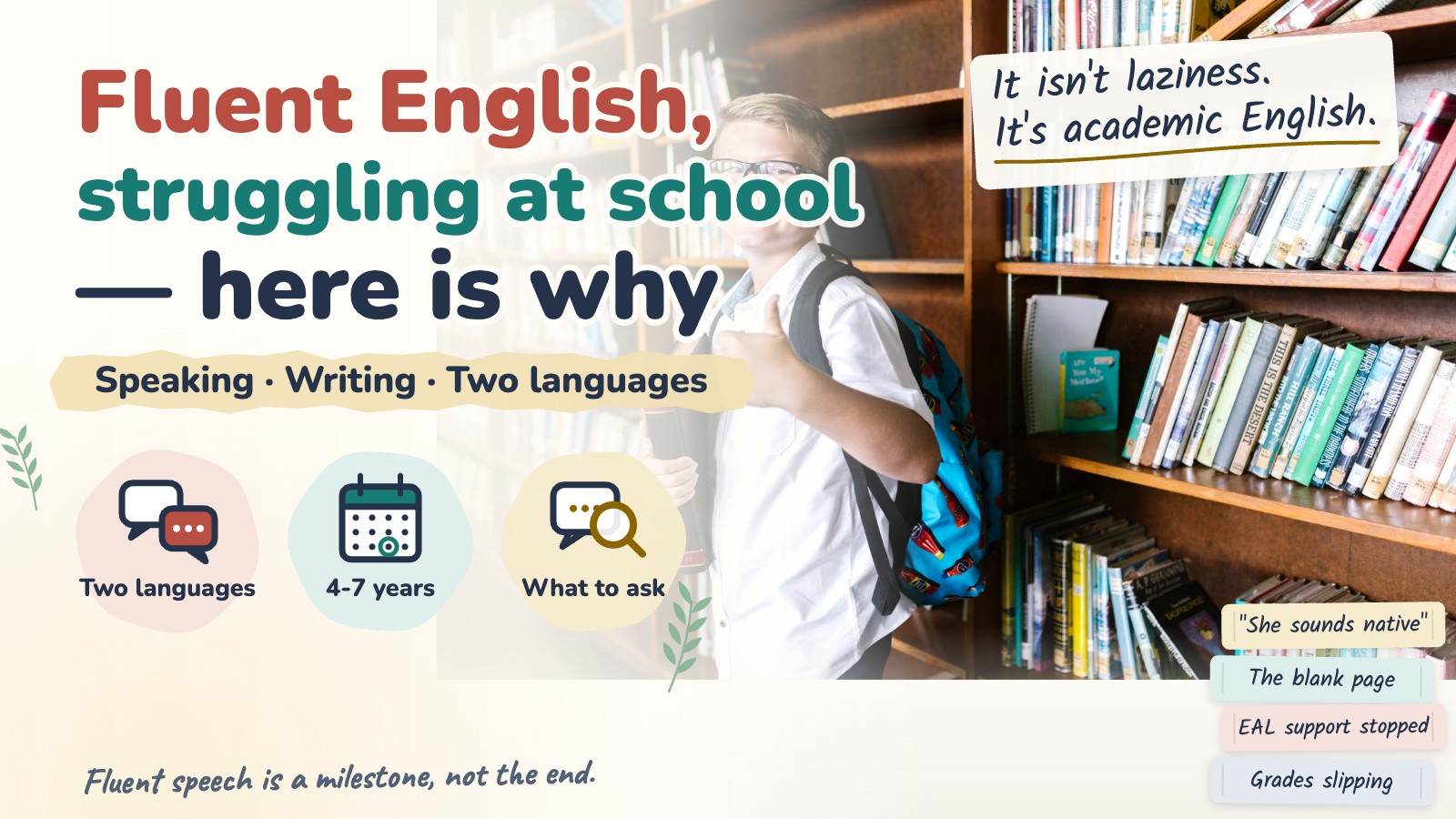
A child can be at the top of the first scale and near the bottom of the second at the same time. That is not a contradiction and it is not laziness. It is the normal shape of second-language development, and it catches out families who reasonably assumed that “she speaks English now” meant the problem was solved.
If your child cannot yet follow lessons at all, that is a different situation with different answers — see our guide to starting a local school without the language. This article is about the child who sounds fine and still cannot write the essay.
How long academic English takes, and what progress looks like
The most quoted study is by Kenji Hakuta, Yuko Goto Butler and Daria Witt, published in 2000 by the University of California Linguistic Minority Research Institute. Across four school districts, two in California and two in Canada, they concluded that oral proficiency takes three to five years to develop, and academic English proficiency can take four to seven years. Policies assuming one year of support is enough, they added, are “wildly unrealistic.”
A more recent study gives a sense of the spread. Steve Strand and Ariel Lindorff of the University of Oxford, in a 2020 report for the Bell Foundation, tracked 5,453 pupils in Wales who started school as English learners. By the end of their sixth year of primary school, 96% had reached the “Early Acquisition” band and 78% “Developing Competence” — but only 31% were rated Competent or Fluent. Among those who did get there, it took 4.6 years on average.
| Finding | Source | What it means for you |
|---|---|---|
| 3–5 years for oral English; 4–7 for academic English | Hakuta, Butler & Witt (2000) | Year three is often when the gap becomes visible |
| ~2 years conversational; 7+ years academic | NALDIC Working Paper 5 | Fluent speech is an early milestone, not the finish line |
| Only 31% rated Competent/Fluent after six years | Strand & Lindorff (2020), 5,453 pupils | Slower than average is still within normal range |
| Once Competent/Fluent, attainment matches peers | Strand & Lindorff (2020) | Bilingualism itself is not the barrier |
That last row matters. In the Oxford study, EAL pupils rated Competent or Fluent outperformed native English and Welsh speakers at every stage measured. The gap is real, but it closes.
Term by term, progress looks like subject words used correctly, longer and better-controlled written sentences, and less scaffolding needed to start a piece of writing. The NSW Department of Education’s EAL/D progression describes four phases — Beginning, Emerging, Developing, Consolidating — and notes that even at Consolidating, when a student has “a sound knowledge of Standard Australian English”, they “still require focused language teaching.”
Why it gets missed, and why support often stops too soon
The Australian Curriculum’s EAL/D Teacher Resource names the problem exactly: “Some EAL/D students will appear to have good interpersonal communication skills; however, as academic language demands increase in the curriculum, gaps in their English language skills will appear.” NALDIC makes the same point from the teacher’s side: “Once pupils learning EAL have acquired a very basic communicative competence, it is easy to assume that their understanding of English and engagement in learning is much greater than it actually is.”
Why a fluent-sounding child is overlooked
None of these involve anyone doing their job badly. They are structural, which is why asking direct questions helps.
01
Speech is public
Everyone hears your child talking. Almost nobody sees the blank page at the start of a written task. Fluency becomes the evidence, and writing the exception.
02
Support ends early
Language support is often tied to an early proficiency check. California’s school dashboard defines a “long-term English learner” as a student who has not reached proficiency within seven years of being classified — evidence that the tail is long.
03
Subject teachers aren’t language teachers
A geography teacher may not see “the vocabulary is the obstacle.” The EEF’s answer is disciplinary literacy: every subject teacher teaching the language of that subject.
If your child has been exited from EAL support and results then dipped, that sequence is worth raising with the school directly.
ACARA adds a useful line for your child’s record: EAL/D students who do not meet age-related benchmarks “are not necessarily ‘underperforming’, but rather they are achieving at levels commensurate with their phase of English language learning.” Worth quoting in a meeting.

What academic language actually demands
It helps to be concrete here, because “she needs to improve her English” is too vague to act on.
Subject vocabulary. Averil Coxhead’s Academic Word List, developed at Te Herenga Waka — Victoria University of Wellington, contains 570 word families and deliberately excludes the 2,000 most frequent words of English: a whole layer of words a child almost never meets in conversation. The Education Endowment Foundation’s 2019 guidance separates general academic words (“examine”) from subject-specific ones (“photosynthesis”) and recommends explicit teaching of both in every subject.
Dense noun phrases. Fang, Schleppegrell and Cox, in the Journal of Literacy Research (2006), found that “the language through which academic subjects are presented is markedly different from the social language that students use in everyday ordinary life,” largely because academic texts pack information into nouns. “The rapid cooling of the surface layer” is one noun phrase carrying a whole process.
Passive voice and instruction grammar. ACARA gives a sharp example from maths: “if 8 is subtracted from 10” means 10 − 8, not 8 − 10. Get the grammar wrong and you get the sum wrong, no matter how well you understand subtraction.
Text shapes. WIDA, the US language-development consortium, describes four “Key Uses” of academic language: recount, explain, argue and discuss. A child who argues brilliantly out loud may never have been taught what an argument looks like on paper.
Command words. Exam boards define these precisely. In Cambridge International’s AS & A Level Geography syllabus, describe means “state in words the key characteristics and give factual details,” explain means “set out reasons, causes or purposes,” and evaluate means “make a judgement from available evidence” (Cambridge’s own spelling). A student who describes when asked to evaluate loses marks for a language reason, not a knowledge one.
| Demand | What it looks like | Why a fluent speaker trips |
|---|---|---|
| Academic vocabulary | establish, constitute, derive | Rarely appears in conversation |
| Dense noun phrases | “the gradual erosion of the coastline” | Speech unpacks; writing compresses |
| Passive voice | “8 is subtracted from 10” | Reverses the order of operations |
| Text structures | recount, explain, argue, discuss | Each needs a taught shape |
| Command words | describe vs. explain vs. evaluate | Marks depend on the distinction |
The same gap exists in your home language
Parents often notice the mirror image: a child chatty in English but vague in the home language — able to talk about dinner, unable to discuss a news article. A child who left first-language schooling at seven has roughly a seven-year-old’s academic vocabulary in it, however fluent their speech sounds.
This matters practically. The International Dyslexia Association points out that the key to an accurate diagnosis for an English learner is checking whether the difficulty “exists in both the native and second language.” You cannot make that comparison if the home language has quietly faded.
Keeping the home language strong also appears to help English rather than hinder it. Australia’s Raising Children Network, a government-funded parenting service, states that children exposed to a heritage language “do better at learning English at school if they keep using their heritage languages at home,” because “a solid base in their first language makes it easier for them to learn a second one.”
Switching the family to English at home is one of the most common responses to a struggling child, and the evidence does not support it. Children usually end up with weaker academic language in both. Keep reading, discussing and, where you can, writing in the home language alongside the English work.
Language lag, dyslexia, or ADHD?
This is the question most parents arrive at, and it cannot be answered from a report card. The patterns overlap, and only a proper assessment can separate them — but there are signposts worth noticing.
The clearest is whether the difficulty shows up in both languages. The International Dyslexia Association warns about errors in both directions: schools may miss dyslexia by “attributing any English reading and writing difficulties to their status as English learners,” while children with limited English exposure may be wrongly labeled dyslexic when they simply need more instruction. It recommends looking at core indicators — phonological awareness, decoding, fluency and spelling — alongside years of schooling in each language and any family history.
The NHS lists signs of dyslexia in school-age children including reading below the expected level, being slow and hesitant when reading aloud, messy written work with many spelling mistakes, and difficulty planning and organising schoolwork. The CDC’s list for ADHD is different in character: daydreaming, losing things, fidgeting, talking too much, careless mistakes, difficulty taking turns — and, importantly, difficulties that show up “at school, at home, or with friends” rather than only in written English.
| What you see | More like a language lag | Worth an assessment |
|---|---|---|
| Home language | Reads and writes at age level in it | Same difficulties in both languages |
| Listening | Understands spoken lessons well | Struggles to follow spoken instructions too |
| Pattern over time | Slow but steady improvement each term | Little movement despite good support |
| Where it shows | Mainly in written and exam work | Across home, friendships and unstructured time |
| Decoding | Reads aloud accurately, misses meaning | Persistent difficulty sounding out words |
If the right-hand column keeps describing your child, ask the school about an assessment rather than waiting another year. We set out how that works for families living abroad in our guide to ADHD and autism assessment as an expat family and in our guide to dyslexia assessment and support abroad. Two things can also be true at once: a child can be an English learner and dyslexic, and needs support for both.

What good EAL support looks like, and what to ask
International schools vary enormously, from a specialist department with qualified staff to one part-time teacher shared across the school. The questions below reveal which kind you are dealing with. Ask them in writing, so you have the answers on record.
| Question to ask | Why it matters |
|---|---|
| Who teaches EAL, and what is their qualification? | A trained EAL specialist is different from a spare teacher |
| How many hours a week does my child get? | Turns “we support EAL learners” into a number |
| In-class support or withdrawal, and why? | Both can work; the reasoning tells you how considered it is |
| Do subject teachers teach subject language? | The EEF’s disciplinary literacy point, in practice |
| What are the exit criteria, and who decides? | Prevents support ending on a single test score |
| How is progress measured and reported to me? | You want a language scale, not just subject grades |
| Is my child monitored after exiting support? | Catches the dip that often follows |
Frameworks such as WIDA’s six proficiency levels, from Entering to Reaching, exist precisely so that language progress can be tracked separately from subject grades. If the school cannot tell you where your child sits on any language scale, that is useful information in itself.
On methods, a 2021 systematic review by Oxley and de Cat in the Language Learning Journal, covering 26 studies, found that explicit vocabulary instruction and targeted oral language practice produced gains, with the strongest effects for learners starting furthest behind. Shared reading helped when combined with pre-taught vocabulary, embedded definitions or follow-up activities — not on its own.
Both models have trade-offs: withdrawal gives focused time but misses curriculum content; in-class support keeps the child in the room but can be thinly spread. The question to ask is not which model, but what the child actually does in that time, and how it connects to the subjects they are failing.
What helps at home, and what does not
You are not expected to be a language teacher. The most useful things you can do at home are about exposure to written language and talking about it.
Three habits worth protecting
Small, regular and unhurried beats an hour of drilling on a Sunday.
01
Reading for pleasure
Any language, any format, chosen by your child. Wide reading is where academic vocabulary is met often enough to stick. Graphic novels and audiobooks count.
02
Talking about texts
Ask what happened, then why, then what they think. The EEF recommends structured talk in every subject; the home version is simply not stopping at “what.”
03
Glossaries and frames
A running list of subject words per topic, and sentence starters for each command word. The EEF’s advice is to break complex writing tasks down and gradually remove the support.
Ask the school for its own writing frames and word lists first — it is better if home and school use the same ones.
| Usually helps | Usually does not |
|---|---|
| Reading widely for pleasure, in any language | Timed vocabulary drills with no context |
| Discussing what was read, in the home language if easier | Switching the whole family to English |
| Subject glossaries built topic by topic | Copying out long word lists |
| Writing frames and model answers from the teacher | Rewriting your child’s essays for them |
| Asking the school for its language plan | Waiting a year to “see if it settles” |
One more thing worth saying out loud to your child: being told your English is excellent and then getting a low grade is confusing. Naming the two-languages idea often comes as a relief, because it explains the mismatch without making it a verdict on how clever they are.

Stay, change school, or try a small online class
Most children in this position do best where they are, with better-targeted support. But if the school has no real EAL provision, or refuses to look again after exiting your child, the setting itself is part of the question. Before moving, read what a mid-year school change actually involves. Here is how the three routes compare.
Stay, move, or a small online class
| Stay, push for support | Change school | Small online class | |
|---|---|---|---|
| Teachers already know the child | ○ | × starts again | × starts again |
| Talk time per child | △ class size | △ class size | ○ |
| Specialist EAL staff | △ ask first | ○ if chosen for it | △ ask |
| In-person labs and sport | ○ | ○ | × add outside |
| Continues if you relocate | × | × | ○ |
○ = generally yes △ = depends × = generally no / General tendencies, not a judgment on any particular school. As of September 2026.
Class size is the variable that matters most for language. A child who says three sentences a day in a class of 28 gets little practice at using academic language out loud, which is the step before writing it — online or in a building.
One option built around small groups: NIJIN GLOBAL ACADEMY
NIJIN GLOBAL ACADEMY (NGA) is an online international school for ages 6–18, run by NIJIN, the company behind this site. We mention it because two parts of its design relate directly to the problem in this article: very small classes, and no English requirement to join. It will not suit every family, and the limitations below matter as much as the features.
| What NGA says it offers | Why it may matter here |
|---|---|
| Classes of eight, the same small group every day, with a daily morning circle | Far more speaking turns per child than a full class |
| Bilingual (English and Japanese) mentors who stay with each small group | An adult who can check understanding in more than one language |
| No entrance exam and no English requirement | No language test to pass before joining |
| No rankings; children “cheer each other on rather than compete” | Less comparison while academic language catches up |
| Optional Cambridge IGCSE and A-Level; timetables for Asia and Oceania | A route to recognized qualifications |
NGA’s FAQ also says classes run in an environment outsiders cannot freely enter, that mentors watch over online interactions, and that families both abroad and in Japan can join.
NGA opens in September 2027, so it is not an immediate answer to a difficult term; free trial classes are planned monthly from September 2026. Tuition has not been published; NGA describes it as far more affordable than a typical international school and says exact fees will be shared first with its email community. There is no physical campus, so in-person labs, sport and friendships would need to come from elsewhere. We could not find a published statement about specialist EAL provision, so ask directly how academic language is taught and tracked. Its FAQ says mentor hiring criteria, absence policies and enrollment rules are still being prepared. NGA is not a Japanese “ichijo” school and does not issue a Japanese high-school diploma. Figures such as “1,000+ students” or a 97% attendance-recognition rate belong to its sister school, NIJIN Academy, not to NGA.
NIJIN GLOBAL ACADEMY is an online international school for ages 6–18 with classes of eight, a daily morning circle and bilingual mentors, and no English requirement to join. It opens in September 2027, and free trial classes are planned monthly from September 2026.
Frequently asked questions
Sources used for this article
- Hakuta, K., Butler, Y. G. & Witt, D., “How Long Does It Take English Learners to Attain Proficiency?”, University of California Linguistic Minority Research Institute Policy Report 2000-1 (January 2000): stanford.edu
- Strand, S. & Lindorff, A., “English as an Additional Language: Proficiency in English, educational achievement and rate of progression in English language learning”, University of Oxford for the Bell Foundation (February 2020): bell-foundation.org.uk
- NALDIC, “Working Paper 5: The Distinctiveness of EAL — a cross-curriculum discipline” (1999): naldic.org.uk
- ACARA, “English as an Additional Language or Dialect Teacher Resource: Overview and EAL/D Learning Progression” (revised February 2014): acara.edu.au
- NSW Department of Education, “Using the EAL/D Learning Progression”: education.nsw.gov.au
- California Department of Education, “Long-Term English Learner (LTEL) Students” (accessed September 2026): cde.ca.gov
- WIDA, “Can Do Descriptors, Key Uses Edition, Grades 6–8” (version 1.1, 2016), University of Wisconsin: wida.wisc.edu
- Coxhead, A., “Academic Word List information”, Te Herenga Waka — Victoria University of Wellington: wgtn.ac.nz
- Fang, Z., Schleppegrell, M. J. & Cox, B. E., “Understanding the Language Demands of Schooling: Nouns in Academic Registers”, Journal of Literacy Research 38(3) (September 2006): SAGE Journals
- Cambridge Assessment International Education, “Cambridge International AS & A Level Geography 9696 syllabus, 2025–2026” (command words glossary): cambridgeinternational.org
- Education Endowment Foundation, “Improving Literacy in Secondary Schools” guidance report (2019): educationendowmentfoundation.org.uk
- Oxley, E. & de Cat, C., “A systematic review of language and literacy interventions in children and adolescents with English as an additional language (EAL)”, Language Learning Journal 49(3) (2021): White Rose Research Online
- Raising Children Network (Australia), “Benefits of bilingualism or multilingualism for kids and families” (updated August 2025): raisingchildren.net.au
- International Dyslexia Association, “English Learners and Dyslexia” fact sheet: dyslexiaida.org
- NHS, “Dyslexia — Symptoms” (reviewed March 2026): nhs.uk
- U.S. Centers for Disease Control and Prevention, “ADHD — Signs and Symptoms” (July 2026): cdc.gov
- NIJIN GLOBAL ACADEMY, FAQ, “Why NGA” and Tuition & Admissions pages (checked September 2026): FAQ / Why NGA / Tuition & Admissions

If your child needs more chances to use academic language out loud, class size is the first thing to look at. NIJIN GLOBAL ACADEMY is an online international school with classes of eight and bilingual mentors, opening in September 2027. Tuition has not yet been announced.
Published: 23 September 2026 / Last updated: 23 September 2026