Menu
BASICS
How Japanese schools work Japanese phrases for school Glossary of school termsWAYS TO LEARN
Free schools Education support centers Online schools Homeschooling in Japan International schools Correspondence high schoolsMORE
Neurodivergent children Where to get help Attendance and costs Learning Place Finder 日本語サイトへAcademic Pressure in Asia: When Homework and Tutoring Take Over
- What official surveys in Singapore, Korea and Hong Kong show about homework, tutoring and study hours
- How to tell harmful stress from healthy challenge, using CDC, NHS and AAP guidance
- What sleep and activity guidelines leave available for study — the arithmetic most timetables ignore
- How to raise workload with the school without being written off as the difficult parent
- How to decide about tutoring: catching up, keeping up, or competing
- When pressure tips into anxiety, and what to do next
This is general information for parents, not medical advice. The figures below are averages, not targets. If your child’s mood, sleep, eating or behavior worries you, speak to your doctor or a mental health professional rather than working through this alone.
Academic pressure children in Asia face: what the figures show
The feeling is not imagined, and not unique to your family. Study hours in several Asian systems really are at the top of international comparisons. The Hong Kong Legislative Council’s Research Office gathered the numbers in a 2018 information note using OECD PISA 2015 data on 15-year-olds; the totals include class time plus all study outside it.
| Place | Total study hours per week (15-year-olds) |
|---|---|
| Singapore | 50.8 |
| Republic of Korea | 50.5 |
| Hong Kong | 46.4 (28.8 in school, 17.7 after school) |
| OECD average | 44.0 |
| Japan | 41.1 |
| Finland | 36.1 |
For younger children the same report found Hong Kong pupils in Primary 4 to 6 spending 2.4 hours a day on homework, secondary 1 to 3 students 1.9 hours, plus roughly 0.7 hours a day of tutoring (2012 data) — around ten hours of school-related activity a day. By comparison, the OECD found that across member countries in 2012, 15-year-olds reported just under five hours a week on homework; students in Shanghai reported about 14.
Private tutoring is measured too. South Korea’s national statistics office publishes an annual Private Education Expenditures Survey; its 2025 results, released in March 2026, found 75.7% of elementary, middle and high school students taking private education — 84.4% of elementary pupils — for an average of 7.1 hours a week. Those figures were down on 2024, but they still describe a large majority of children in paid lessons outside school hours.
In Singapore, the Ministry of Education told Parliament in February 2025 that a government survey put household spending on private tuition at $1.8 billion in 2023. The same reply drew a distinction worth borrowing: some students “genuinely need more dedicated help,” while others “take tuition even though they are coping well” — and excessive tuition “can diminish students’ joy of learning.”
Three different kinds of pressure (they need different answers)
“Too much school work” is usually three separate problems wearing one coat. Naming which one you are dealing with changes what you should do about it, and what you should ask the school for.
Volume, stakes and comparison
Most families are dealing with two of these three, and they rarely respond to the same remedy.
01
Volume
There is more work than hours. The child is capable but cannot finish. Fixes are practical: workload conversations, cutting one commitment, better routines.
02
Stakes
One exam appears to decide everything — streaming, a place, a future. The work may be manageable but the fear is not. This needs information about real pathways, not more revision.
03
Comparison
The child is measured against classmates constantly: class rank, group averages, who is in which tutoring tier. This needs a change in what the child hears, at home and sometimes at school.
A child drowning in volume needs fewer tasks. A child frightened by stakes needs a map. A child worn down by comparison needs a place where nobody is counting.
Hong Kong’s Education Bureau made a related point in a 2017 reply to the Legislative Council. It said “quality rather than the quantity of homework that counts,” asked schools to “refrain from unduly overburdening their students with homework, tests and examinations,” and reported that its own 2015–2017 surveys found daily homework time ranging from under 30 minutes to over three hours among students in the same grade and the same school. If that is the spread inside one classroom, “the normal amount” is not a fixed quantity — and your child’s experience of the workload is information the school does not automatically have.
Stress or healthy challenge? What to look for
Hard work is not harmful. The American Academy of Pediatrics puts it plainly: moderate stress can be useful, but stress that is “continuous or particularly intense” causes psychological and physical harm. The difference shows up in the child, not in the timetable.
The AAP lists signs including fatigue, loss of sleep, nightmares, teeth-grinding, poor appetite, tantrums or depression, plus physical effects such as stomach upset and headaches. The NHS describes much the same picture for anxiety: younger children may become “irritable, tearful or clingy” or have difficulty sleeping; older children may find it hard to concentrate, have angry outbursts, or “start avoiding everyday activities, such as seeing friends, going out in public or going to school.”
| What you see | Closer to healthy challenge | Closer to harmful stress |
|---|---|---|
| Before a test | Nervous, then settles once it starts | Dread for days; stomach aches; can’t sleep the night before |
| After a hard week | Tired, recovers over the weekend | Never recovers; weekends are for catching up |
| Interests outside school | Still has one or two they protect | All dropped “until exams are over” |
| Talking about school | Complains, but with detail and humor | Flat, avoids the topic, or says “I’m just stupid” |
| Body | Normal appetite and sleep | Headaches, stomach aches, teeth-grinding, changed appetite |
| Mornings | Reluctant but goes | Regular refusal, tears, or physical symptoms that clear by 10am |
Two cautions. The CDC notes that “some anxious children keep their worries to themselves and, thus, the symptoms can be missed” — a quiet, high-achieving child is not automatically a fine one. And its threshold for when worry becomes a disorder is useful for parents: when fears and worries “interfere with school, home, or play activities.” If schoolwork has eaten play and home life, that is not a matter of opinion.
Sleep, movement, and what is left for study
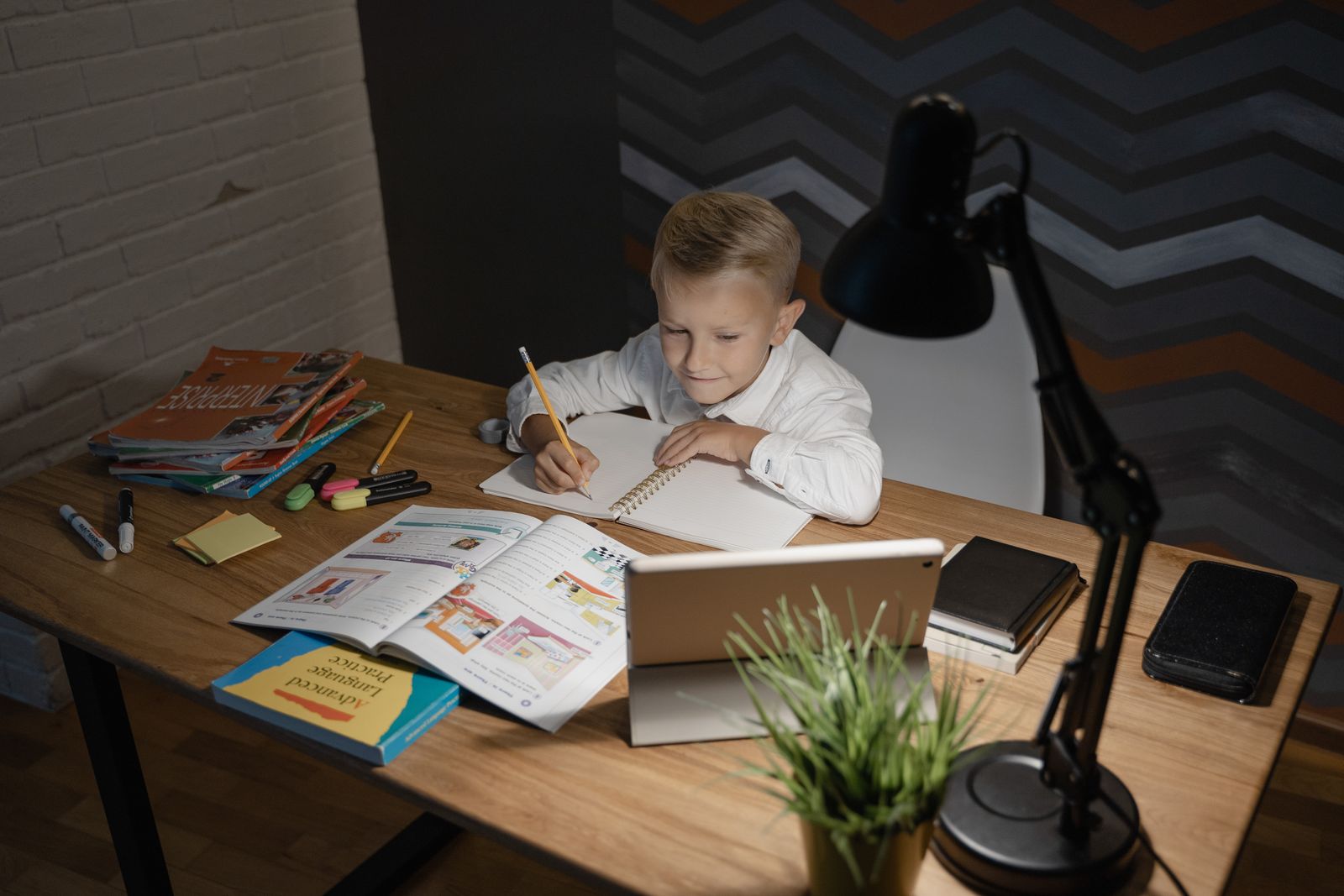
The most useful thing to bring to a workload conversation is arithmetic. Two official recommendations set the floor.
| Recommendation | Source | Amount |
|---|---|---|
| Sleep, ages 6–12 | CDC | 9–12 hours per 24 hours |
| Sleep, ages 13–18 | CDC | 8–10 hours per 24 hours |
| Physical activity, ages 6–17 | CDC | 60 minutes or more of moderate-to-vigorous activity daily |
Now count a school day for a ten-year-old. Ten hours of sleep, around seven hours at school, one hour of physical activity and roughly two hours for travel, meals and washing leaves about four hours for homework, tutoring, family and doing nothing in particular. Hong Kong’s figures — 2.4 hours of homework plus 0.7 of tutoring a day — use most of that before anything else happens.
This is why “it’s only twenty minutes per subject” can be true and still wrong: six subjects makes two hours. The “10-minute rule” endorsed by the National Education Association and National PTA suggests roughly ten minutes per night per grade level from first grade — about 40 minutes for a fourth-grader. It is a rule of thumb, not a standard, and plenty of good schools assign more; but if your child’s nightly total is three or four times it, that is worth a conversation.
The arithmetic also protects play. The AAP’s clinical report on play (2018, reaffirmed 2025) describes play as something that “regulate[s] the body’s stress response,” citing a study in which anxious preschoolers showed a twofold decrease in anxiety after fifteen minutes of play. Downtime is not the reward left over after the work. And globally, the WHO reports that 81% of adolescents aged 11–17 do not meet its physical activity guidelines — this is not a problem your family invented.
How to talk to the school about workload
Schools respond to specifics and to a clear request. “There is too much homework” is easy to file away; a two-week log with times is not. This sequence tends to work in local, international and bilingual schools alike.
Step 1: Count for two weeks. Note the start and finish time of homework each evening, the subject, and whether your child needed help.
Step 2: Email the homeroom or form teacher. Put it in writing, and ask for a short meeting rather than a decision by email.
Step 3: Ask what the school expects, in minutes. Many schools have a guideline that individual teachers have never compared notes on.
Step 4: Make one specific request. “Could we agree that he stops at 90 minutes and I sign the book?” is easier to say yes to than “please reduce the workload.”
Step 5: Agree a review date. Four to six weeks, with one named contact.
| Question to ask | A good answer sounds like |
|---|---|
| What is the school’s expected homework time for this year group? | A number in minutes, and where it is published |
| How do teachers coordinate so tests don’t land in the same week? | A shared assessment calendar you can see |
| What happens if my child stops after the agreed time? | A clear, non-punitive answer, in writing |
| Is my child struggling with the content, or with the volume? | Evidence from classwork, not just grades |
| Who do I speak to if this doesn’t change? | A named head of year or pastoral lead |
Dear [teacher’s name],
Over the past two weeks I have noted how long [child’s name] spends on homework: an average of [X] minutes on a school night, and [Y] on [day]. [He/She/They] is managing the content but regularly finishes after [time] and goes to bed late.
Could we meet briefly to agree a sensible stopping point? I am happy to sign the homework book to confirm the time spent.
Thank you, [your name]
If your family has recently moved, add that context: a child working in a second language is doing the same homework at a different cost. See also our guides on starting at a local school without the language and changing schools mid-year.
Tutoring: catching up, keeping up, or competing
Tutoring is not the villain here. In much of Asia it is simply how school works, and for some children a patient adult explaining fractions for an hour a week is the kindest thing that happens all month. The useful question is not “is tutoring bad?” but “which of these three am I buying?”
Catching up, keeping up, or competing
All three are legitimate. They have different end points, and only one of them ends by itself.
01
Catching up
There is a specific gap — a missed term, a new curriculum, a topic that never landed. This has a finish line. Agree at the start what “caught up” looks like.
02
Keeping up
The class moves faster than your child processes, which is not the same as ability. Useful — but check whether the real fix belongs at school: in-class support, or a workload conversation.
03
Competing
Everyone else has a tutor, so yours needs one to hold position. This never ends on its own, costs the most, and is the one most likely to eat the hours sleep and play need.
If you cannot say which column you are in, that is the first thing to work out — with your child, not only about them.
Before signing up, a few questions save money and hours.
| Ask the tutor or center | Why it matters |
|---|---|
| What exactly will improve, and how will we know? | Turns a vague subscription into a goal with an end |
| How much homework do you set on top of school? | Tutoring that adds two hours of work is not relief |
| Will you talk to the school? | Avoids two adults teaching two different methods |
| What happens in a session when my child is exhausted? | Tells you a lot about the place |
| Can we pause for a term without losing the place? | Lets you test whether it is still needed |
One honest note about results: the OECD found extra homework time associated with higher math scores, strongly so in Hong Kong, Japan, Macao and Singapore — around 17 score points or more per extra hour. It also found advantaged students doing more homework than disadvantaged ones (5.7 hours a week against 4.1). Extra hours are not nothing. They are also not free.
Protecting motivation and family time
One PISA finding is worth sitting with. The OECD reported that more motivated students tend to report more anxiety, and that in all but three education systems studied, students who said they wanted top grades were also more likely to feel very anxious before a test even when well prepared. Students in Singapore were among those especially likely to report both drive and anxiety. Ambition and dread travel together.
The UNESCO GEM Report’s analysis of PISA 2022 adds that more than six in ten students worldwide worry about their ability to succeed in math classes, that math anxiety rose significantly in 37 countries and economies between 2012 and 2022, and that Japan ranks in the top five for math performance while reporting high math anxiety. High scores do not indicate low pressure.
What helps at home is small and unglamorous.
| Instead of… | Try… |
|---|---|
| “How did the test go?” | “What was the best bit of today?” |
| “Your cousin got into that school.” | “What do you want to be better at this term?” |
| “You could have got an A if you’d tried.” | “I saw how long you worked on that.” |
| “We’ll do fun things after exams.” | One protected hour or evening a week, every week |
| “Just push through, it’s only a few months.” | “What would make this week survivable?” |
Protect at least one thing your child is good at that is not graded — a sport, an instrument, a friendship. For families who move often, that anchor matters more than any single school year (see helping a child make friends after moving abroad). If your child is bored rather than buried, the problem may be the opposite one: when a bright child is bored at school.
When pressure tips into anxiety or school refusal
Sometimes the adjustments are not enough, and the picture changes from a tired child to a child who cannot go in. The NHS threshold is a reasonable one for parents: seek help when anxiety “is severe, persists and interferes with their everyday life,” through your doctor or the school. The AAP says much the same — talk to your pediatrician about ways to help your child manage stress.
Regular refusal to go to school; physical symptoms every school morning that ease at home; withdrawal from friends; changes in eating or sleeping that last more than a couple of weeks; talk of being worthless or not wanting to be here. The last of these is an immediate reason to contact a doctor or local emergency services, not something to monitor.
For children living abroad, academic pressure usually arrives tangled up with everything else — a new curriculum, a new language, friendships that reset every year. Our article on school anxiety in third culture kids covers that combination and what tends to help.
Stay, switch, or learn online? An honest comparison
If the load is genuinely unsustainable and the school will not move, there are three broad directions. The least disruptive option is often the best one, but it helps to see the trade-offs laid out rather than deciding at 11pm after a bad evening.
It is also fair to note that systems do change. Singapore’s Ministry of Education removed mid-year examinations for all remaining levels in primary and secondary schools by 2023, saying the aim was to reduce “an overemphasis in academic grades” and free up time for teachers. That is slow, and it does not help a child struggling this term — but “this is just how school is” is not permanently true.
Stay, switch, or learn online
| Stay and adjust | Less exam- focused school | Online school | |
|---|---|---|---|
| Keeps friends and routine | ○ | × fresh start | △ outside school |
| Reduces workload quickly | △ negotiable | ○ by design | △ varies |
| Keeps local exam pathway | ○ | △ depends | × different route |
| Works if the family moves | × | × | ○ |
| Daily in-person sport and play | ○ | ○ | × arrange locally |
○ = generally yes △ = depends × = generally no / General tendencies, not a judgment on any particular school. As of September 2026.
An online school is not automatically calmer. Some are more demanding than the school you left, and a child anxious about grades can be anxious about them at home too. What changes is how much of the day school occupies, the commute, and — in small-group models — how much pressure comes from being ranked against thirty other children.
An online school built around small classes: NIJIN GLOBAL ACADEMY
NIJIN GLOBAL ACADEMY (NGA) is an online international school for ages 6–18, run by NIJIN, the company behind this site. We mention it because parts of its design speak to the comparison problem above. Please read the limitations as carefully as the features.
| What NGA says it offers | Why it might matter under pressure |
|---|---|
| Classes of eight, the same small group every day, with a daily morning circle | Fewer children to be ranked against; an adult who notices a bad week |
| No rankings; describes itself as a place where children “cheer each other on rather than compete” | Removes one of the three pressures — comparison — by design |
| Bilingual English and Japanese mentors who stay with each small group | A named adult who knows the child, in more than one language |
| No entrance exam and no English requirement | No test to pass at the point a child is already exhausted by tests |
| Timetables for Asia and Oceania time zones; no commute | Hours returned to sleep, activity and family |
| Optional Cambridge IGCSE and A-Level; “portable” if the family relocates | An exam pathway exists if you want one, on a different schedule |
NGA opens in September 2027, so it is not a solution for this term. Tuition has not been published; NGA describes it as far more affordable than a typical international school and says exact fees will be shared first with its email community. There is no physical campus, so sport, clubs and in-person friendships have to be arranged locally. NGA does not issue a Japanese high-school diploma and is not a Japanese “ichijo” school. Its FAQ says mentor hiring criteria and absence policies are still being prepared, and enrollment and withdrawal policies, including mid-year joining, are in preparation. Figures such as “1,000+ students” or a 97% attendance-recognition rate that appear in NIJIN materials belong to its sister school, NIJIN Academy, and are not NGA’s own results.
NIJIN GLOBAL ACADEMY is an online international school for ages 6–18 across Asia and Oceania, with classes of eight, bilingual mentors and no rankings. It opens in September 2027, and free trial classes are planned monthly from September 2026.
Frequently asked questions
Sources used for this article
- Legislative Council of the HKSAR, Research Office, Overall study hours and student well-being in Hong Kong (30 January 2018): legco.gov.hk (PDF)
- Government of the HKSAR, “LCQ19: Homework and tests for primary and secondary students” (6 December 2017): info.gov.hk
- OECD Education and Skills Today, “Trouble with homework” (based on PISA in Focus No. 46, December 2014): oecdedutoday.com
- OECD, “Does Homework Perpetuate Inequities in Education?” PISA in Focus (December 2014): oecd.org
- OECD Education and Skills Today, “How is students’ motivation related to performance and anxiety?”: oecdedutoday.com
- UNESCO GEM Report, SCOPE, “Mathematics anxiety negatively affects mathematics performance” (citing OECD PISA 2022): education-progress.org
- Ministry of Data and Statistics (Statistics Korea), Private Education Expenditures Survey of Elementary, Middle and High School Students in 2025 (12 March 2026): mods.go.kr
- Ministry of Education, Singapore, “Private Tuition” — parliamentary reply (5 February 2025): moe.gov.sg
- Ministry of Education, Singapore, “Removal of mid-year exams will help nurture joy for learning” (17 March 2022): moe.gov.sg
- Ministry of Education, Singapore, “Effect of removing mid-year examinations” — parliamentary reply (3 October 2023): moe.gov.sg
- US Centers for Disease Control and Prevention, “About Sleep” (recommended hours by age): cdc.gov
- US Centers for Disease Control and Prevention, “Physical Activity Guidelines for Children and Adolescents”: cdc.gov
- US Centers for Disease Control and Prevention, “About Anxiety and Depression in Children”: cdc.gov
- NHS, “Anxiety in children”: nhs.uk
- American Academy of Pediatrics, HealthyChildren.org, “Helping Children Handle Stress”: healthychildren.org
- Yogman M. et al., “The Power of Play: A Pediatric Role in Enhancing Development in Young Children,” Pediatrics 142(3), American Academy of Pediatrics (September 2018; reaffirmed January 2025): publications.aap.org
- World Health Organization, “Physical activity” fact sheet: who.int
- California State PTA, “Homework: How Much is Enough?” (on the 10-minute rule endorsed by the National Education Association and National PTA): capta.org
- NIJIN GLOBAL ACADEMY, FAQ and school pages (checked September 2026): FAQ / nijinglobal.academy

NIJIN GLOBAL ACADEMY offers live online classes of eight with bilingual mentors, no entrance exam and no rankings, for families across Asia and Oceania. Tuition is yet to be announced and the school opens in September 2027, with free trial classes planned monthly from September 2026.
Published: 23 September 2026 / Last updated: 23 September 2026